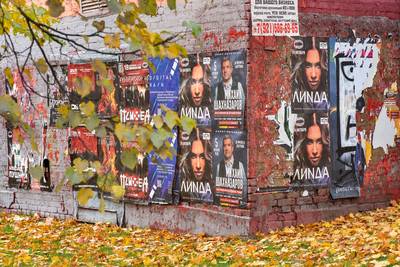
An old transformer substation in Lanskoy Garden on Sampsonievsky Prospekt near Lanskaya train Station. This view of its brick wall focuses entirely on the gritty, tactile reality of the city--where every surface is a battleground between human attempts to cover things up (paint, posters) and nature s tendency to strip them back down (peeling, tearing, weathering). Saint Petersburg, Russia, October 9, 2025  An old transformer substation in Lanskoy Garden on Sampsonievsky Prospekt near Lanskaya train Station. This corner can be described as a striking example of urban decay juxtaposed with natural harmony. The scene captures a raw, "wabi-sabi" beauty--an appreciation for things that are imperfect, impermanent, and incomplete. The Wall: The brickwork is rough, weathered, and tactile. The peeling paint and chipped bricks tell a story of age and neglect. The layers of torn posters add a "trash collage" effect (reminiscent of decollage art), creating a chaotic, man-made texture that feels gritty and transient. The Ground: In stark contrast, the ground is covered in a soft, organic carpet of fallen maple leaves. This natural texture is random but harmonious, softening the harsh lines of the brick building. Saint Petersburg, Russia, October 9, 2025  A distinctive Stalinist Neoclassical residential building located at Bolshoy Sampsonievsky Avenue, 108, from a platform of Lanskaya railway station. Saint Petersburg, Russia, September 26, 2025  A wooden gate in the wall of a building at Uus 16/1. The gate is covered in layers of graffiti. The most prominent feature is the word "TOY" spray-painted in red over a black-and-white heart symbol. In graffiti culture, the term "toy" is a derogatory slur used to describe an inexperienced or unskilled writer, or someone who disrespects the unwritten rules of the scene (e.g., painting over better work). The underlying black-and-white geometric heart appears to be a stencil or a specific artist s tag that has been "crossed out" (dissed) by another writer using the red paint. This layering tells a story of conflict or rivalry within the local street art community. The gate and the yellow stucco wall are covered in various other tags ("PACollege Station, Texas," "ATAS," "NGR"), typical of the tagging that plagues less-surveilled streets in the Old Town like Uus Street. This gate likely leads to a private courtyard or a utility area behind the residential buildings on Uus Street. Tallinn, Estonia, October 16, 2025  Old building of Lanskaya train stop from a passenger platform. Saint Petersburg, Russia, July 29, 2024  Neoclassical apartment building located at 108 Bolshoy Sampsonievsky Prospect (corner of Serdobolskaya Street), viewed across Serdobolsky Pond. The dominant structure is a residential complex known locally as the House of Specialists or sometimes nicknamed the "Bastille near Lanskaya". Designed by architects Viktor F. Belov, V.A. Potapov, and M.P. Savkevich. Built between 1953 and 1956, representing the late Stalinist "Empire" style. It was commissioned by the Klimov Plant (Zavod im. Klimova), a major manufacturer of aviation engines, to house its employees. Lesnoy Park (Lesotekhnicheskiy Universitet), Saint Petersburg, Russia, October 14, 2025  Fungus (basidiolichen) Multiclavula corynoides in a shallow depression covered by sand, s-w from Petyayarvi train stop, near train tracks. Petyayarvi, north from Saint Petersburg, Russia, October 5, 2025  Basidiolichen (a mushroom that is also a lichen) Multiclavula corynoides in a shallow depression covered by sand, s-w from Petyayarvi train stop, near train tracks. Petyayarvi, north from Saint Petersburg, Russia, October 5, 2025  Spores of mushrooms Multiclavula corynoides collected earlier 10/5/2025 in a shallow depression covered by sand, near Petyayarvi train stop, north from Saint Petersburg, Russia, October 19, 2025  Masses of pale creamy-white bodies of fungus Multiclavula corynoides in a shallow depression covered by sand, s-w from Petyayarvi train stop, near train tracks. Petyayarvi, north from Saint Petersburg, Russia, October 5, 2025  Small, club-shaped (clavarioid), pale creamy-white bodies of fungus (basidiolichen) Multiclavula corynoides in a shallow depression covered by sand, s-w from Petyayarvi train stop, near train tracks. Petyayarvi, north from Saint Petersburg, Russia, October 5, 2025  Top view of small, club-shaped (clavarioid), pale creamy-white bodies of fungus (basidiolichen) Multiclavula corynoides in a shallow depression covered by sand, s-w from Petyayarvi train stop, near train tracks. Petyayarvi, north from Saint Petersburg, Russia, October 5, 2025  This view of the installation near the Russian embassy on Pikk Street captures a broader perspective of the protest site, showing how it stretches along the sidewalk in front of the embassy building. The white banner in the foreground originally read "FOR THE VICTIMS OF WARS STARTED BY RUSSIA" (with the Russian translation on the right). However, someone has vandalized the sign by crossing out "RUSSIA" and scrawling "US" and a Star of David (hexagram) over it. This act of vandalism attempts to deflect blame from Russia by invoking anti-American and antisemitic tropes, a tactic often seen in pro-Kremlin disinformation campaigns. On the left side of the street, the building with the distinctive Art Nouveau facade (Pikk 18) houses the Ron Verlin salon, visible through the large arched window. This contrasts the elegant, peaceful commercial life of the street with the raw political conflict playing out just meters away. The fencing extends far down the street, covered in layers of posters, flags, and messages. This indicates the sustained nature of the demonstration, which has become a semi-permanent fixture in the Old Town since the start of the full-scale invasion. Tallinn, Estonia, October 16, 2025  View from an apartment window showing lived-in atmosphere of a residential block near Svetlanovsky Prospekt, characterized by 1970s brick architecture softened by mature greenery. Saint Petersburg, Russia, October 13, 2025  Kitchen Ruin (Kukhnya-Ruina) which is one of the most historically fascinating and visually authentic follies in Catherine Park. Built between 1785 and 1786, it was designed by the Italian architect Giacomo Quarenghi. It was constructed specifically to serve as a "service pavilion" (a kitchen) for the nearby Concert Hall. Quarenghi incorporated authentic ancient Roman fragments into its brick walls. These include broken columns, capitals, cornices, and friezes with carved garlands, which were brought to Russia from Italy. The headless statue in the niche is a prominent feature, emphasizing the theme of lost time and the decay of empires. Pushkin (former Tsarskoe Selo) near Saint Petersburg, Russia, October 10, 2025  Serdobolsky Pond of Lesnoy Park near Lanskaya train station. Saint Petersburg, Russia, June 26, 2003  A building at 5 lit. B Engelsa Prospect which is a surviving historical service corps of the Orlovo-Novosiltsevskaya Almshouse complex. This small brick structure was originally built as one of the auxiliary buildings (likely for staff or utility purposes) for the larger almshouse institution. The main complex, located at Engelsa 1-5, was a major philanthropic center established in the 1830s. The complex was designed by the renowned architect Iosif Charlemagne (Joseph-Maria Charlemagne-Baudet) in the late Classicist style. It was constructed between 1834 and 1841. Lesnoy Park (Lesotekhnicheskiy Universitet), Saint Petersburg, Russia, October 14, 2025  Large brick building of the Officer s Building (Officers Assembly) of the Fort Shanetz. Kronstadt, Russia, September 27, 2025  Pigeon on asphalt of a passenger platform of Lanskaya train stop. Saint Petersburg, Russia, July 29, 2024  A striking architectural contrast on Sauna Street (Sauna ta"nav), near the intersection with Va"ike-Karja Street. On the left, a modern glass-and-steel building features large display windows and industrial-style staircases, illuminated by neon lights. This building is part of the Helios Hall complex (formerly the Helios Cinema), which has been repurposed as an event venue and art space. The transparent facade allows a view into the contemporary interior, contrasting sharply with the solid, historic walls of the Old Town. On the right, the corner of an older, plastered building (Sauna 12) is covered in colorful, abstract graffiti. This gritty, urban element acts as a foil to the clean lines and slick surfaces of the modern building opposite it, highlighting the eclectic mix of styles in this part of the city. Tallinn, Estonia, October 16, 2025  Community announcements near Obukhovskoy Oborony Prospekt. Saint Petersburg, Russia, July 3, 2010  A view from a window near Svetlanovsky Prospekt that offers an intimate look into a typical residential courtyard (dvor) of the Vyborgsky District. The beige brick buildings framing the scene are classic examples of brick Khrushchev-era apartments (or early Brezhnev-era), likely built in the 1960s. The 5-story height was standard to avoid the mandatory installation of elevators, which was required for buildings of 6 stories or more. This layout reflects the Soviet microdistrict concept, where residential blocks were arranged around green, communal courtyards to provide light, air, and recreation space away from the main roads. Saint Petersburg, Russia, October 14, 2025  Monument to Alexander Lanskoy (often referred to as the Pamyatnik Lanskomu or simply the marble pedestal/urn), located on the Rose Field (Rozovoe Pole) in Catherine Park. It was erected by Catherine the Great in memory of her young favorite, Alexander Lanskoy, who died suddenly in 1784 at the age of 26. The monument is an example of Neoclassical funerary art, likely designed by Antonio Rinaldi or possibly Giacomo Quarenghi. It features a high pedestal made of grey and pink marble, adorned with bas-reliefs and inscriptions (though these are often weathered). Pushkin (former Tsarskoe Selo) near Saint Petersburg, Russia, October 10, 2025  Mont Blanc office building on Bolshoy Sampsonievsky Prospect. Saint Petersburg, Russia, August 16, 2016  Community billboard near Umm Wishad Street in Musheirib area. Doha, Qatar, May 2, 2014  Mont Blanc office building from a crossing of Bolshoy Sampsonievsky and Finliandsky Prospect. Saint Petersburg, Russia, August 16, 2016  Brick buildings at Liteyny Prospekt. Saint Petersburg, Russia, July 9, 2010  Stone flowers on walls of a mausoleum in Novodevichye Cemetery at Moskovskiy Prospekt. Saint Petersburg, Russia, September 22, 2015  Spores (spore print white) of Goblet mushrooms (Pseudoclitocybe cyathiformis) collected earlier 10/12/2025 up from 67 km train stop near Orekhovo, north from Saint Petersburg, Russia, October 19, 2025  Red Cascade or Turkish Cascade in Catherine Park. The Red Cascade is a dam that regulates the water level between the Upper Ponds and the Great Pond. The two "towers" flanking the crossing are designed in the Gothic style, featuring red brick walls with white limestone details, pointed arches, and niche windows. It was built in the 1780s by the engineer Ivan Gerard, likely based on designs by the architect Vasily Neelov. Pushkin (former Tsarskoe Selo) near Saint Petersburg, Russia, October 10, 2025  This evening view is likely a side street or courtyard just off the bustling Viru Street, possibly near the intersection with Vene Street or Sauna Street given the architectural style and proximity to nightlife areas. The most striking feature is the graffiti-covered wooden doors on the right. The words KID3:feff, PINTSEL:feff (meaning "paintbrush" in Estonian), and other tags cover the chevron-patterned double doors. This type of street art is common in the "alternative" or less-polished corners of the Old Town, often near bars and clubs. To the left, a brightly lit shop window with modern art prints or posters suggests this is a commercial area that remains active into the evening. The purple and blue lighting effects contribute to a club-like atmosphere, consistent with the nearby Viru Street and Sauna Street nightlife districts. The narrow cobblestone street slopes gently upward, flanked by tall, plastered buildings in pastel colors (pink, yellow, purple). The building on the right features a distinctive green downspout and a small blue diamond-shaped sign (likely a utility marker). Tallinn, Estonia, October 16, 2025  A building at Sredniy Prospekt of Vasilievsliy Island, opposite to a tram stop. Sankt Petersburg, Russia, October 9, 2000  Rebuilding of the Forest Building (Russian: Lesnoy Korpus) in a major reconstruction project at the historic Sestroretsk Resort (Sestroretsky Kurort). The original Sestroretsk Resort was a famous health spa complex founded in 1898 by engineer Peter Avenarius. It featured several grand wooden structures, including a massive Kursaal (concert hall), a mud bath facility, and the Forest Building. The resort was a hub for St. Petersburg s elite and intelligentsia in the early 20th century. The original Forest Building was a beautiful wooden hotel and sanatorium building constructed in the early 1900s. It was a key part of the ensemble but was destroyed during World War II. The new structure faithfully replicates the "Northern Art Nouveau" style of the original resort architecture, characterized by its complex roofline, spires, towers, and wooden detailing that harmonizes with the surrounding pine forest and dunes. The exterior appears nearly complete, showing the elaborate wooden facade, the large central dome, and the corner towers with their needle-like spires. The scaffolding indicates that finishing work is still in progress. Saint Petersburg, Russia, October 9, 2025  Residential courtyard near Svetlanovsky Prospekt transformed by the vibrant colors of "Golden Autumn". Saint Petersburg, Russia, October 13, 2025  Wooden building of Train Station Marienburg. South from Saint Petersburg, Russia, June 6, 2014  Brick tuft mushrooms (Hypholoma lateritium) in Dubki Park. Sestroretsk near Saint Petersburg, Russia, October 9, 2025  Brick-brown powdercap mushrooms (Cystodermella granulosa) in Petyayarvi, north from Saint Petersburg, Russia, October 5, 2025  A perspective of Rataskaevu Street, looking up the gentle slope towards the intersection with Niguliste Street. The building on the right with the striking yellow and grey modern facade and large arched window is home to Casa Alta, an Italian restaurant. The architecture of this building stands out for its postmodern interpretation of the gabled roofline, contrasting with the older structures nearby. The pinkish-red building on the left side of the street (Rataskaevu 6) is a historic property. It currently houses Restoran O~ (or a similar establishment depending on recent changes), known for its fine dining in a medieval setting. Further down on the left, you can see signs for other venues like De 6 and Vana Tallinn. Tallinn, Estonia, October 16, 2025  Istok Lake at "Golden Hour". The sunrise reveals distinct layers in the forest structure: birch curtain, pine canopy, spruce backdrop. Kannelyarvi, north from Saint Petersburg, Russia, October 1, 2025  Church of the Tikhvin Icon of the Mother of God near the train station in Sestroretsk. The huge icon of Jesus and the rocket models is part of a distinct chapel and memorial complex dedicated to the Royal Martyrs (Tsar Nicholas II and his family) and the spiritual protection of Russia. The "Face" Facade: The large face is a giant icon of the Savior Not Made by Hands (Spas Nerukotvorny). Below it, the red banner reads "Holy Royal Martyrs, Pray to God for Us", referring to the canonized Romanov family. Community: This church is known for its "Cossack" guard and a very distinct, staunchly monarchist and patriotic atmosphere that differs from typical Russian Orthodox parishes. Saint Petersburg. Russia, October 9, 2025  Debarcadere (train shed) of the Vitebsky Railway Station in St. Petersburg (industrial Art Nouveau architecture). Russia, October 6, 2025  A path covered by yellow maple leaves. Lesnoy Park (Lesotekhnicheskiy Universitet), Saint Petersburg, Russia, October 14, 2025  Rugged stone steps covered by yellow maple leaves. Sergievka Park, Old Peterhof, west from Saint Petersburg, Russia, October 13, 2025  Panoramic view from the Tarkhovka shoreline that looks north-west across the Sestroretsky Razliv (Lake Sestroretsk) toward the city of Sestroretsk. This view captures the dual nature of Sestroretsk: a historic resort town with natural beauty (the lake, reeds, and stones) juxtaposed with modern urban infrastructure (heating plant and high-rise housing). "Three Chimneys" (Center): The most prominent industrial feature is the cluster of three tall red-and-white striped chimneys. These belong to the Sestroretsk District Heating Plant (part of the city s thermal infrastructure). Residential Towers (Left of Chimneys): The tall, beige-and-orange brick apartment buildings are part of the modern residential developments in Sestroretsk, likely along Tokarevskaya Street or the Razliv microdistrict. Church of Peter and Paul (Far Right): On the far right horizon. This is a modern church (consecrated in 2009) built in memory of the Russian submariners. "Pyramid" Building (Far Left): On the far left, there is a distinctive white building with a stepped, pyramid-like shape. This is likely the "Eden" (Edem) residential complex or a similar luxury apartment block, which is known for its terraced architecture. Tarkhovka Park near Sestroretsk, west from Saint Petersburg. Russia, October 3, 2025  Northern end of Vene Street (Vene ta"nav) at the intersection with Olevima"gi and Bremeni ka"ik. The red brick building on the immediate left is located at Vene 28. It is a historic structure that was originally built in 1912 as a residential building and briefly housed the Estonian Provisional Government in 1918. It stands out with its industrial-style red brick facade contrasting with the medieval stone walls nearby. The large limestone wall with the archway on the far left is part of the city s defensive fortifications, specifically near the Bremen Tower (Bremeni torn). The archway leads into Bremen Passage (Bremeni ka"ik), a short, atmospheric walkway that connects Vene Street to Uus Street through the city wall. The tower itself, a 15th-century horseshoe-shaped defensive structure, is located just behind this wall. In the background, at the end of the street, you can see the yellow tower and facade of the Orthodox Church of St. Nicholas (Nikolai kirik) at Vene 24. Designed by architect Luigi Rusca and built between 1820-1827, this Neoclassical church serves a congregation under the Moscow Patriarchate and is known for its valuable iconostasis. It sits on the site of a much older church that served Novgorod merchants in the Middle Ages. Tallinn, Estonia, October 16, 2025  Italian Pergola located in the Private Garden (Sobstvenny Sadik) of Catherine Park. The pergola was built in 1865 (mid-19th century) during the reign of Alexander II. It was designed specifically to be covered in climbing plants, creating a shaded walkway or "veranda" that offered respite from the sun while allowing views of the obelisk and the surrounding landscape. Pushkin (former Tsarskoe Selo) near Saint Petersburg, Russia, October 10, 2025  Spores of Calocybe-like mushrooms collected earlier 10/8/2025 under silvery fir trees behind Lenin s monument in Botanical Garden, Saint Petersburg, Russia, October 19, 2025  Saint Petersburg courtyard near Svetlanovsky Prospekt during "Golden Autumn" (Zolotaya Osen). The foliage is in a transitional phase where the trees are displaying their most vibrant colors (bright yellows and oranges) before shedding completely. The area around Svetlanovsky Prospekt (Vyborgsky/Kalininsky districts) is characterized by residential blocks from the 1960s and 1970s. Unlike the dense city center, these blocks were designed with large, open courtyards (dvory) intended to act as "green lungs" for residents. Russia, October 10, 2025  108 Bolshoy Sampsonievsky Prospect from Serdobolsky Pond in Lesnoy Park. Saint Petersburg, Russia, October 8, 2016  Large area covered by corticioid fungus Plicatura nivea on a log in Aleksandrovsky (Alexander) Park in Pushkin (former Tsarskoe Selo) near Saint Petersburg, Russia, October 10, 2025  Christmas decoration on tall brick security walls of Huntsville prison "The Walls". Huntsville, Texas, December 20, 2009  Roothole rosette mushrooms (Stereopsis vitellina) mushrooms extracted from peat walls of a burrow near a road under pines in Petyayarvi, north from Saint Petersburg, Russia, October 5, 2025  Texture of large area covered by corticioid fungus Plicatura nivea on a log in Aleksandrovsky (Alexander) Park in Pushkin (former Tsarskoe Selo) near Saint Petersburg, Russia, October 10, 2025  Maple alley near a building of the Forestry Academy. Lesnoy Park (Lesotekhnicheskiy Universitet), Saint Petersburg, Russia, October 14, 2025  Azure blue walls and white columns of Grotto Pavilion sitting on the edge of Great Pond (Bolshoy Prud) in Catherine Park. Pushkin (former Tsarskoe Selo) near Saint Petersburg, Russia, October 10, 2025  Close-up view of the Karasta River cascade in Oranienbaum Park. The water tumbles over tiered, man-made steps (part of the Lower Bridge dam system), transforming into a silky, smooth sheet of water that suggests a long-exposure photograph. Moss-covered boulders at the base add a rugged, naturalistic touch, breaking the uniform flow into frothy white streams that contrast with the dark, wet stone walls. Oranienbaum palace-and-park ensemble in Lomonosov (a suburb of St. Petersburg), Russia, October 13, 2025  This winding dirt path ascends a steep slope covered in an old-growth maple forest, showcasing the serene and untamed beauty of Sergievka Park. Old Peterhof, west from Saint Petersburg, Russia, October 13, 2025  Apartment houses near Svetlanovsky Prospekt from a window of a house. This view presents the "other side" of the Golden Autumn coin: not the crisp, sunny glory, but the damp, reflective, and deeply saturated beauty that follows the city s frequent rains. Saint Petersburg, Russia, October 12, 2025  Garden work at alpine Hill (or Alpinarium). The people visible in blue jackets are likely garden staff or volunteers preparing the alpine beds for winter. Peter the Great Botanical Garden of Komarov Botanical Institute. Saint Petersburg, Russia in Peter the Great Botanical Garden of Komarov Botanical Institute. Saint Petersburg, Russia, October 8, 2025  A view of the Pavlovsk Palace seen from the Triple Lime Avenue. Planted by Charles Cameron in the 1780s using linden trees imported from Lu"beck, this avenue was designed as the grand formal approach to the palace. The building at the end is the garden facade of the Great Palace. The dark figure standing in front of the palace is the statue of Paul I. Pavlovsk, a suburb of Saint Petersburg, Russia, October 15, 2025  Entrance stairs in Vitebsky Vokzal train station, now reconstructed as a historic site of the first train station in Russia. Saint Petersburg, Russia, January 1, 2006  Debarcader (train shed) of the Vitebsky Railway Station, Russian Art Nouveau (Style Moderne). Massive riveted steel spans were designed by architect Stanislav Brzhozovsky and engineer Sima Minash. It is serving the historic route to Tsarskoye Selo (Pushkin) and Pavlovsk. Saint Petersburg, Russia, October 15, 2025  Perron (train arrival area) in Vitebsk Train Station. Saint Petersburg, Russia, May 12, 2021  Brick walls of Koporye Fortress. Leningrad Region, Russia, February 9, 2013  Steam train in a railroad museum on Varshavsky Train Station. Saint Petersburg, Russia, August 8, 2012  Marienburg Train Station, view from a window of a train. South from Saint Petersburg, Russia, July 25, 2012  Steam engine train in a railroad museum on Varshavsky Train Station. Saint Petersburg, Russia, August 8, 2012  Russian steam train in a railroad museum on Varshavsky Train Station. Saint Petersburg, Russia, August 8, 2012  View of a late-Soviet brick residential quarter (kirpichnaya khrushchevka) deeply integrated with the mature nature of the Vyborgsky district, captured at the beautiful but fleeting peak of autumn. View from this window providing a glimpse into Soviet-era urban planning, specifically the residential design of the 1960s. The beige brick buildings visible in the frame are classic examples of "Khrushchevka" (Series 1-528). Unlike the cheaper concrete panel blocks (panelki), these are constructed from silicate brick, which was considered a "premium" material for mass housing at the time. They are easily identified by their 5-story height, hipped roofs (often replaced with metal sheeting), and specific balcony arrangements. Saint Petersburg, Russia, October 11, 2025  Hypomyces species (possibly Hypomyces rosellus or similar) parasitizing common mazegill mushrooms (Cerioporus mollis) in a state nature reserve "North Shore of Neva Gulf" (Zakaznik Severnoe Poberezhye Nevskoy Guby) on the northern coast of the Gulf of Finland, near Lisiy Nos. Saint Petersburg, Russia, October 7, 2025  Missile launch train Molodets in a railroad museum on Varshavsky Train Station. Saint Petersburg, Russia, August 8, 2012  A Christmas tree and a monument of V. I. Lenin on an armored train in front of Finland Train Station. Saint Petersburg, Russia, January 10, 2017  Monument of V. I. Lenin on an armored train with light snow in front of Finland Train Station. Saint Petersburg, Russia, January 10, 2017  Alley near Dendrology Garden. Lesnoy Park (Lesotekhnicheskiy Universitet), Saint Petersburg, Russia, October 14, 2025  Small commercial brick building with galleries at 1601 Magazine Street on a triangular island between Richard and Felicity streets, in Lower Garden District. New Orleans, Louisiana, May 20, 2006  The grave of Mikhail Ilyich Svyatkin (1986-2025), a 39-year-old soldier whose death in May 2025 aligns with the surge in casualties during the spring and summer of that year. His wooden cross bears a framed photo of him in combat gear holding a rifle, surrounded by wreaths inscribed "From Mother," highlighting the personal grief embedded in the mass loss. The background is crowded with similar fresh graves, flags, and flowers, reinforcing the density and continuity of the burials at this active military cemetery. "Alley of Heroes" at Cemetery of the Victims of January 9, St. Petersburg, Russia, October 4, 2025  Garden fence near 2 Novorossiyskaya Street. Lesnoy Park (Lesotekhnicheskiy Universitet), Saint Petersburg, Russia, October 14, 2025  Garden fence near 5 lit. B Engelsa Street. Lesnoy Park (Lesotekhnicheskiy Universitet), Saint Petersburg, Russia, October 14, 2025  Crumbling brick walls of Fort Pike on Road 90, Saint Tammany Parish. Louisiana, July 4, 2006  Saint Petersburg State Forestry University (often referred to historically as the Forestry Academy or Lesotekhnicheskaya Akademiya). Established in 1803 by decree of Emperor Alexander I as the Practical Forestry School in Tsarskoye Selo. In 1811, it was moved to its current location in the Vyborgsky District of Saint Petersburg, occupying the site of an old English dairy farm. The classical white building shown in the photo is the Main Educational Building. Originally constructed as four separate corps between 1826 and 1833 by architects I.F. Lucchini and A. Nellinger, these were later united into a single complex with a central courtyard in the late 1830s. Lesnoy Park (Lesotekhnicheskiy Universitet), Saint Petersburg, Russia, October 14, 2025  Flattened, spoon-shaped or fan-like fruit bodies with a bright egg-yellow to creamy-yellow color of Roothole rosette mushrooms (Stereopsis vitellina) mushrooms extracted from peat walls of a burrow near a road under pines in Petyayarvi, north from Saint Petersburg, Russia, October 5, 2025  A politically charged scene on Pikk Street (specifically at Pikk 19) in front of the Russian Embassy in Tallinn. The metal barricades lining the street have become a permanent protest installation since Russia s full-scale invasion of Ukraine in February 2022. The barriers are covered in posters, slogans, and artwork condemning the war and Russian leadership. The large banner in the foreground reads "FOR THE VICTIMS OF WARS STARTED BY RUSSIA". Other signs visible on the fence typically document war crimes or satirize political figures. A police officer in a high-visibility yellow jacket is patrolling the area. A constant police presence has been standard here to maintain order given the high tensions surrounding the embassy. The Russian Embassy occupies a historic Art Nouveau building at Pikk 19. Ironically, this street is one of the most picturesque and tourist-heavy routes in the Old Town, creating a surreal juxtaposition between medieval charm and modern geopolitical conflict. Across the street (visible in the background) is the famous Maiasmokk Cafe, the oldest operating cafe in Tallinn, further highlighting the clash between leisure tourism and serious political activism in this specific location. Tallinn, Estonia, October 16, 2025  This view from the St. Nicholas Church tower focuses on the southwestern edge of the Old Town, dominated by medieval fortifications and the lush greenery of Toompea s slopes. The massive round tower on the right is Kiek in de Ko"k ("Peep into the Kitchen"), a 15th-century artillery tower. Its formidable stone walls, over 4 meters thick, were designed to withstand cannon fire, making it the most powerful defensive tower in the Baltic region during its time. Today, it houses a fortification museum. Below the tower, the cobblestone street running vertically is Ru"u"tli Street, historically home to the city s executioner and later a quiet residential area. To the left of Ru"u"tli Street, the large building with the expansive red-tiled roof is the Swedish St. Michael s Church (Rootsi-Mihkli kirik). Originally a medieval hospital and poorhouse, it was converted into a church for the Swedish garrison and community. Its simple, robust architecture contrasts with the more ornate merchant houses found elsewhere in the Old Town. Estonia, October 16, 2025  Monument of a Russian communist leader V. Ulyanov (Lenin) on an armored train in front of Finland Train Station. Saint Petersburg, Russia, January 10, 2017  A weathered stone portal and wooden door at Sauna Street 2 (Sauna 2), in the heart of Tallinn s nightlife district. The arched doorway features a rustic, heavy limestone surround with a prominent keystone. This style is typical of the less ornate, utilitarian medieval architecture found in the Old Town s side streets. The panelled wooden door is heavily distressed, covered in layers of graffiti tags in various colors (silver, red, black). The tags cover nearly every inch, including the panels and the frame, obscuring the original wood finish. The heavy graffiti on this specific door is a hallmark of the area around Sauna Street and Va"ike-Karja, which transforms into a bustling party zone at night. While the historic architecture remains, the street level often bears the marks of the active nightlife scene, creating a gritty contrast between the medieval heritage and modern urban culture. This door is likely a side entrance or utility access for one of the nearby venues like Frank or Sigmund Freud Bar. Tallinn, Estonia, October 16, 2025  Rocky riverbed of Karasta River, with moss-covered boulders visible in the shallow water. Oranienbaum palace-and-park ensemble in Lomonosov (a suburb of St. Petersburg), Russia, October 13, 2025  Close-up of flattened, spoon-shaped or fan-like fruit bodies with a bright egg-yellow to creamy-yellow color of Roothole rosette mushrooms (Stereopsis vitellina) mushrooms extracted from peat walls of a burrow near a road under pines in Petyayarvi, north from Saint Petersburg, Russia, October 5, 2025  A quiet, atmospheric section of Pikk Street (near Pikk 5 and 7), one of the oldest and most important commercial streets in medieval Tallinn. Veta Fashion (Pikk 6/8): On the left, the brightly lit shop window belongs to Veta, a well-known Estonian brand specializing in knitwear and linen clothing. The building itself features a classic stucco fac,ade with large display windows that invite passersby to look in. On the right, the building with the blue-and-red wooden door (Pikk 5) is home to the Noku Klubi, a somewhat "secret" bohemian cultural club and restaurant located on the upper floor. The heavy, colorful door is a distinctive landmark for locals knowing where to find this hidden gem. Further up on the right, the red brick building with Gothic-style pointed arches stands out against the plastered facades, adding texture and historical depth to the streetscape. Tallinn, Estonia, October 16, 2025  Utility building on Storozhevoy Bashni Street. Vyborg, Russia, August 12, 2012  Monument of a Russian communist leader V. Ulyanov (Lenin) on an armored train with Christmas decorations in front of Finland Train Station. Saint Petersburg, Russia, January 10, 2017  Kapella Concert Hall. Saint Petersburg, Russia, June 25, 2009  Morskoy Prospekt in Krestovsky Island. Saint Petersburg, Russia, October 7, 2017  The central alley leading to the Arsenal Pavilion, a red-brick neo-Gothic structure designed by Adam Menelaws. Completed in 1834, the Arsenal resembles a medieval castle with crenellated towers and massive arched windows. It was originally built to house Nicholas I s vast collection of medieval arms and armor. The straight alley is a remnant of the formal layout from the earlier "Monbijou" pavilion that stood here, now framed by the mature trees of the surrounding landscape park. After severe damage in WWII, the building was restored and reopened in 2016 as a museum displaying imperial weaponry. Aleksandrovsky (Alexander) Park in Pushkin (former Tsarskoe Selo) near Saint Petersburg, Russia, October 10, 2025  SNT "Rodnik" (Garden Non-Commercial Partnership "Rodnik") adjacent to the Kannelyarvi railway station in November, showcasing a quiet, frosty late-autumn scene typical of the Karelian Isthmus. North from Saint Petersburg, Russia, October 1, 2025  Evening view of Lai Street (looking towards St. Olaf s Church). The large grey building on the right (Lai 44/46) stands out with its curved bay windows and decorative facade elements. This is a fine example of Jugendstil (Art Nouveau) architecture, which appeared in Tallinn during the early 20th century. Its smoother lines and larger windows contrast sharply with the smaller medieval merchant houses nearby. On the left, the yellow building (Lai 33) retains a more traditional, modest scale typical of the street s residential past. At the end of the street, the illuminated white tower of St. Olaf s Church (Lai 50) acts as a dramatic focal point. The lighting accentuates the church s massive walls and the green copper spire against the twilight sky. Tallinn, Estonia, October 16, 2025  A graceful, arched footbridge with simple metal railings and a small, tree-covered island of Lower Pond (Nizhny Prud). Oranienbaum palace-and-park ensemble in Lomonosov (a suburb of St. Petersburg), Russia, October 13, 2025  Area between houses near Svetlanovsky Prospekt at "Golden Hour" shortly before sunset. SPb, October 12, 2025  Red Chrysanthemum in Peter the Great Botanical Garden of Komarov Botanical Institute. Saint Petersburg, Russia, October 8, 2025  Linden alley on Morskoy Prospekt in Krestovsky Island. Saint Petersburg, Russia, October 7, 2017 |