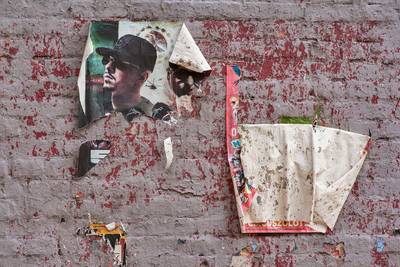
An old transformer substation in Lanskoy Garden on Sampsonievsky Prospekt near Lanskaya train Station. This corner can be described as a striking example of urban decay juxtaposed with natural harmony. The scene captures a raw, "wabi-sabi" beauty--an appreciation for things that are imperfect, impermanent, and incomplete. The Wall: The brickwork is rough, weathered, and tactile. The peeling paint and chipped bricks tell a story of age and neglect. The layers of torn posters add a "trash collage" effect (reminiscent of decollage art), creating a chaotic, man-made texture that feels gritty and transient. The Ground: In stark contrast, the ground is covered in a soft, organic carpet of fallen maple leaves. This natural texture is random but harmonious, softening the harsh lines of the brick building. Saint Petersburg, Russia, October 9, 2025  An old transformer substation (or similar utility building) in Lanskoy Garden on Sampsonievsky Prospekt near Lanskaya train Station. Its brick walls have effectively become an unofficial community billboard, covered in layers of concert posters (e.g., for the singer Linda). Saint Petersburg, Russia, October 9, 2025  A distinctive Stalinist Neoclassical residential building located at Bolshoy Sampsonievsky Avenue, 108, from a platform of Lanskaya railway station. Saint Petersburg, Russia, September 26, 2025  Brown house with peeling paint on Serpukhovskaya Street in Sementsy area near Vitebsky Train Station. Petersburg, Russia, September 2, 2013  View from an apartment window showing lived-in atmosphere of a residential block near Svetlanovsky Prospekt, characterized by 1970s brick architecture softened by mature greenery. Saint Petersburg, Russia, October 13, 2025  A weathered, wooden gate at Tolli Street 8 (Tolli tn 8) in the Old Town of Tallinn. This short, historic street runs north from Pikk Street towards the harbor area. Its name (meaning "Customs") reflects its historical connection to trade and taxation near the old port. The gate likely leads to a private courtyard or garden behind one of the historic residential properties. The wooden gate is visibly aged, with uneven planks and temporary reinforcements, suggesting it is awaiting restoration or is part of a less polished corner of the Old Town. This "shabby chic" aesthetic contrasts with the meticulously renovated facades on nearby Pikk Street. The flanking limestone walls are covered in peeling plaster and graffiti, revealing the raw stone construction typical of Tallinn s medieval infrastructure. The presence of graffiti and the unkempt nature of the gate offer a glimpse into the "lived-in" reality of the city, distinct from the purely tourist-focused attractions. The autumn leaves visible above the gate add a touch of seasonal color to the otherwise gritty scene. Tallinn, Estonia, October 16, 2025  Leuchtenberg Palace, designed by architect Andrei Stackenschneider and completed in 1842. The facade reflects the Late Classicism style (resembling a Roman villa), characterized by a grand portico with Corinthian columns, symmetrical window arrangements, and a pediment that gives the structure a noble, temple-like appearance. The palace s yellow stucco walls show signs of weathering and peeling paint, contributing to the estate s romantic, slightly melancholic atmosphere of a "forgotten" royal residence. The palace is situated on a terrace overlooking the Gulf of Finland, with its color palette harmonizing with the surrounding golden autumn foliage, reinforcing the seamless blend of architecture and nature intended by its designers. Sergievka Park, Old Peterhof, west from Saint Petersburg, Russia, October 13, 2025  Apartment houses near Svetlanovsky Prospekt from a window of a house. This view presents the "other side" of the Golden Autumn coin: not the crisp, sunny glory, but the damp, reflective, and deeply saturated beauty that follows the city s frequent rains. Saint Petersburg, Russia, October 12, 2025  A view from a window near Svetlanovsky Prospekt that offers an intimate look into a typical residential courtyard (dvor) of the Vyborgsky District. The beige brick buildings framing the scene are classic examples of brick Khrushchev-era apartments (or early Brezhnev-era), likely built in the 1960s. The 5-story height was standard to avoid the mandatory installation of elevators, which was required for buildings of 6 stories or more. This layout reflects the Soviet microdistrict concept, where residential blocks were arranged around green, communal courtyards to provide light, air, and recreation space away from the main roads. Saint Petersburg, Russia, October 14, 2025  Serdobolsky Pond of Lesnoy Park near Lanskaya train station. Saint Petersburg, Russia, June 26, 2003  View of a late-Soviet brick residential quarter (kirpichnaya khrushchevka) deeply integrated with the mature nature of the Vyborgsky district, captured at the beautiful but fleeting peak of autumn. View from this window providing a glimpse into Soviet-era urban planning, specifically the residential design of the 1960s. The beige brick buildings visible in the frame are classic examples of "Khrushchevka" (Series 1-528). Unlike the cheaper concrete panel blocks (panelki), these are constructed from silicate brick, which was considered a "premium" material for mass housing at the time. They are easily identified by their 5-story height, hipped roofs (often replaced with metal sheeting), and specific balcony arrangements. Saint Petersburg, Russia, October 11, 2025  Narrow, cobblestone street is Sauna Street (Sauna ta"nav), located in a lively section of the Old Town known for its nightlife and history. As the name implies, this street was historically the location of public bathhouses (saunas) dating back to the medieval period. The "Sauna Tower" of the city wall is also nearby, named for a women s sauna that once stood there. Today, Sauna Street and its immediate surroundings (connecting to Viru Street) are a popular destination for nightlife. The street is lined with well-known bars and clubs like Club Baila and Frank. The image shows the street in a relatively quiet moment, emphasizing the contrast between the historic architecture and the gritty urban texture. Tallinn, Estonia, October 16, 2025  Neoclassical apartment building located at 108 Bolshoy Sampsonievsky Prospect (corner of Serdobolskaya Street), viewed across Serdobolsky Pond. The dominant structure is a residential complex known locally as the House of Specialists or sometimes nicknamed the "Bastille near Lanskaya". Designed by architects Viktor F. Belov, V.A. Potapov, and M.P. Savkevich. Built between 1953 and 1956, representing the late Stalinist "Empire" style. It was commissioned by the Klimov Plant (Zavod im. Klimova), a major manufacturer of aviation engines, to house its employees. Lesnoy Park (Lesotekhnicheskiy Universitet), Saint Petersburg, Russia, October 14, 2025  Old building of Lanskaya train stop from a passenger platform. Saint Petersburg, Russia, July 29, 2024  Top view of small, club-shaped (clavarioid), pale creamy-white bodies of fungus (basidiolichen) Multiclavula corynoides in a shallow depression covered by sand, s-w from Petyayarvi train stop, near train tracks. Petyayarvi, north from Saint Petersburg, Russia, October 5, 2025  A wide, panoramic view of the "Three Graces" sculpture within its autumn context. The dark bronze sculpture of the three women acts as a vertical anchor in a landscape dominated by towering trees. The wider angle emphasizes the scale of the forest compared to the artwork, placing human creativity within the embrace of nature. Oranienbaum palace-and-park ensemble in Lomonosov (a suburb of St. Petersburg), Russia, October 13, 2025  Pigeon on asphalt of a passenger platform of Lanskaya train stop. Saint Petersburg, Russia, July 29, 2024  This view of the installation near the Russian embassy on Pikk Street captures a broader perspective of the protest site, showing how it stretches along the sidewalk in front of the embassy building. The white banner in the foreground originally read "FOR THE VICTIMS OF WARS STARTED BY RUSSIA" (with the Russian translation on the right). However, someone has vandalized the sign by crossing out "RUSSIA" and scrawling "US" and a Star of David (hexagram) over it. This act of vandalism attempts to deflect blame from Russia by invoking anti-American and antisemitic tropes, a tactic often seen in pro-Kremlin disinformation campaigns. On the left side of the street, the building with the distinctive Art Nouveau facade (Pikk 18) houses the Ron Verlin salon, visible through the large arched window. This contrasts the elegant, peaceful commercial life of the street with the raw political conflict playing out just meters away. The fencing extends far down the street, covered in layers of posters, flags, and messages. This indicates the sustained nature of the demonstration, which has become a semi-permanent fixture in the Old Town since the start of the full-scale invasion. Tallinn, Estonia, October 16, 2025  Saint Petersburg courtyard near Svetlanovsky Prospekt during "Golden Autumn" (Zolotaya Osen). The foliage is in a transitional phase where the trees are displaying their most vibrant colors (bright yellows and oranges) before shedding completely. The area around Svetlanovsky Prospekt (Vyborgsky/Kalininsky districts) is characterized by residential blocks from the 1960s and 1970s. Unlike the dense city center, these blocks were designed with large, open courtyards (dvory) intended to act as "green lungs" for residents. Russia, October 10, 2025  Monument to Alexander Lanskoy (often referred to as the Pamyatnik Lanskomu or simply the marble pedestal/urn), located on the Rose Field (Rozovoe Pole) in Catherine Park. It was erected by Catherine the Great in memory of her young favorite, Alexander Lanskoy, who died suddenly in 1784 at the age of 26. The monument is an example of Neoclassical funerary art, likely designed by Antonio Rinaldi or possibly Giacomo Quarenghi. It features a high pedestal made of grey and pink marble, adorned with bas-reliefs and inscriptions (though these are often weathered). Pushkin (former Tsarskoe Selo) near Saint Petersburg, Russia, October 10, 2025  Graffiti series, located on the concrete retaining wall separating the beach from the promenade along the Gulf of Finland (near the Sestroretsk Resort or "Kurort" area) which is a fanciful and nostalgic mural composition featuring whimsical animals and nature motifs. A distinct horizontal band runs across part of the mural, depicting a long, grey commuter train (possibly an elektrichka) traveling through a green landscape. This element likely references the vital railway connection between St. Petersburg and the resort towns of the Kurortny District, a familiar sight for locals and visitors. Saint Petersburg, Russia, October 9, 2025  Brick wall at 11 Krepostnaya Street in old city of Vyborg. Russia, May 24, 2019  Fungus (basidiolichen) Multiclavula corynoides in a shallow depression covered by sand, s-w from Petyayarvi train stop, near train tracks. Petyayarvi, north from Saint Petersburg, Russia, October 5, 2025  Back wall of Gatchina Palace from Own Garden of Emperor Paul I. Gatchina, a suburb of Saint Petersburg, Russia, September 4, 2013  Basidiolichen (a mushroom that is also a lichen) Multiclavula corynoides in a shallow depression covered by sand, s-w from Petyayarvi train stop, near train tracks. Petyayarvi, north from Saint Petersburg, Russia, October 5, 2025  Brick buildings at Liteyny Prospekt. Saint Petersburg, Russia, July 9, 2010  Marienburg Train Station, view from a window of a train. South from Saint Petersburg, Russia, July 25, 2012  Northern end of Vene Street (Vene ta"nav) at the intersection with Olevima"gi and Bremeni ka"ik. The red brick building on the immediate left is located at Vene 28. It is a historic structure that was originally built in 1912 as a residential building and briefly housed the Estonian Provisional Government in 1918. It stands out with its industrial-style red brick facade contrasting with the medieval stone walls nearby. The large limestone wall with the archway on the far left is part of the city s defensive fortifications, specifically near the Bremen Tower (Bremeni torn). The archway leads into Bremen Passage (Bremeni ka"ik), a short, atmospheric walkway that connects Vene Street to Uus Street through the city wall. The tower itself, a 15th-century horseshoe-shaped defensive structure, is located just behind this wall. In the background, at the end of the street, you can see the yellow tower and facade of the Orthodox Church of St. Nicholas (Nikolai kirik) at Vene 24. Designed by architect Luigi Rusca and built between 1820-1827, this Neoclassical church serves a congregation under the Moscow Patriarchate and is known for its valuable iconostasis. It sits on the site of a much older church that served Novgorod merchants in the Middle Ages. Tallinn, Estonia, October 16, 2025  Masses of pale creamy-white bodies of fungus Multiclavula corynoides in a shallow depression covered by sand, s-w from Petyayarvi train stop, near train tracks. Petyayarvi, north from Saint Petersburg, Russia, October 5, 2025  Spores of mushrooms Multiclavula corynoides collected earlier 10/5/2025 in a shallow depression covered by sand, near Petyayarvi train stop, north from Saint Petersburg, Russia, October 19, 2025  Spores (spore print white) of Goblet mushrooms (Pseudoclitocybe cyathiformis) collected earlier 10/12/2025 up from 67 km train stop near Orekhovo, north from Saint Petersburg, Russia, October 19, 2025  Sculptures of god Mercury on a wall of giant atrium in Vitebsk Train Station. Saint Petersburg, Russia, May 12, 2021  Wall of entrance hall in Vitebsky Vokzal (train station). Saint Petersburg. Russia, July 10, 2010  Residential courtyard near Svetlanovsky Prospekt transformed by the vibrant colors of "Golden Autumn". Saint Petersburg, Russia, October 13, 2025  Decorated wall of entrance hall in Vitebsky Vokzal (train station). Saint Petersburg. Russia, July 10, 2010  This picturesque courtyard is located at Ru"u"tli 28, tucked away near the medieval city wall and the fortifications of Toompea. The site features a charming, small white building with red doors and window frames, nestled directly against the limestone cliff and city wall fortifications. The lush ivy covering the stone walls turns a vibrant red in autumn, creating a "fairytale" aesthetic that contrasts with the defensive nature of the surrounding structures. The wooden walkway visible above the cliff is part of the Kiek in de Ko"k Fortifications Museum complex. This gallery connects the Maiden Tower (Neitsitorn), the Stable Tower (Marstall), and the Kiek in de Ko"k artillery tower, allowing visitors to walk along the old defensive perimeter. The courtyard below sits in the shadow of these massive fortifications, which once protected the city from invaders. Estonia, October 16, 2025  Small, club-shaped (clavarioid), pale creamy-white bodies of fungus (basidiolichen) Multiclavula corynoides in a shallow depression covered by sand, s-w from Petyayarvi train stop, near train tracks. Petyayarvi, north from Saint Petersburg, Russia, October 5, 2025  Brick-brown powdercap mushrooms (Cystodermella granulosa) in Petyayarvi, north from Saint Petersburg, Russia, October 5, 2025  Brick tuft mushrooms (Hypholoma lateritium) in Dubki Park. Sestroretsk near Saint Petersburg, Russia, October 9, 2025  Top view of Colchicum flowers in Peter the Great Botanical Garden of Komarov Botanical Institute. Saint Petersburg, Russia, October 8, 2025  Debarcadere (train shed) of the Vitebsky Railway Station in St. Petersburg (industrial Art Nouveau architecture). Russia, October 6, 2025  Garden fence near 5 lit. B Engelsa Street, view from Novorossiyskaya Street. Lesnoy Park (Lesotekhnicheskiy Universitet), Saint Petersburg, Russia, October 14, 2025  This view emphasizes the imposing nature of Hermann Castle while revealing the stark reality of the modern frontier. From this angle, the Tall Hermann Tower looms directly overhead, showcasing its 51-meter height and white-washed stone upper sections. The massive limestone walls of the fortress rise steeply from the riverbank, illustrating why this stronghold was the northernmost defensive point of Livonia. In the foreground, the Friendship Bridge is heavily fortified, contrasting sharply with the medieval architecture. Rows of concrete "dragon s teeth" (pyramidal anti-tank obstacles) and coils of razor wire block the roadway. These fortifications, installed by Estonia around 2024-2025, serve as a physical barrier against potential military threats and unauthorized vehicle crossings, marking the bridge s transformation from a trade route into a secure defensive line. A blue, black, and white flag flies from the castle wall, asserting Estonian sovereignty. Modern security cameras are mounted on the utility pole in the foreground, highlighting the intense monitoring of this border zone. Estonia, October 16, 2025  Showy Evening Primrose (Oenothera speciosa, invasive ground cover) on a lawn near back entrance of Texas A and M University on campus of Education City. Doha, Qatar, April 14, 2015  Panoramic view from the Tarkhovka shoreline that looks north-west across the Sestroretsky Razliv (Lake Sestroretsk) toward the city of Sestroretsk. This view captures the dual nature of Sestroretsk: a historic resort town with natural beauty (the lake, reeds, and stones) juxtaposed with modern urban infrastructure (heating plant and high-rise housing). "Three Chimneys" (Center): The most prominent industrial feature is the cluster of three tall red-and-white striped chimneys. These belong to the Sestroretsk District Heating Plant (part of the city s thermal infrastructure). Residential Towers (Left of Chimneys): The tall, beige-and-orange brick apartment buildings are part of the modern residential developments in Sestroretsk, likely along Tokarevskaya Street or the Razliv microdistrict. Church of Peter and Paul (Far Right): On the far right horizon. This is a modern church (consecrated in 2009) built in memory of the Russian submariners. "Pyramid" Building (Far Left): On the far left, there is a distinctive white building with a stepped, pyramid-like shape. This is likely the "Eden" (Edem) residential complex or a similar luxury apartment block, which is known for its terraced architecture. Tarkhovka Park near Sestroretsk, west from Saint Petersburg. Russia, October 3, 2025  Showy Evening Primrose (Oenothera speciosa, invasive ground cover) on a lawn among Carissa bushes near back entrance of Texas A and M University on campus of Education City. Doha, Qatar, May 7, 2014  Mu"u"rivahe Street (Mu"u"rivahe ta"nav), specifically the section near the famous "Knit Market" wall. The name Mu"u"rivahe translates to "Between the Walls," referring to its historical location between the city s main defensive wall and a lower, secondary wall. This area is famous for the open-air market where local craftswomen sell traditional Estonian hand-knitted items like wool sweaters, mittens, and socks directly off the medieval stone wall. This specific spot (near Mu"u"rivahe 21) is close to the Viru Gate entrance to the Old Town and connects towards St. Catherine s Passage, another famous medieval walkway. Tallinn, Estonia, October 16, 2025  Spores of Calocybe-like mushrooms collected earlier 10/8/2025 under silvery fir trees behind Lenin s monument in Botanical Garden, Saint Petersburg, Russia, October 19, 2025  Looking down Mu"u"rivahe Street (Mu"u"rivahe ta"nav), running alongside the medieval city wall of Tallinn. The dominant feature is the massive, 14th-century limestone defensive wall on the right. What stands out in this specific section (near Mu"u"rivahe 52) are the large concrete buttresses supporting the wall. Unlike the original medieval masonry, these are modern reinforcements added during the Soviet era (specifically in the late 1960s or 70s) to stabilize this section of the wall, which was in danger of collapsing. While effective, they are often noted for their distinct, brutalist contrast with the historic stonework. Further down the wall, you can see the red-tiled roof of the defensive walkway (chemin de ronde) and the towers (Hellemann Tower is nearby) that made Tallinn one of the best-fortified cities in Northern Europe. At the base of the wall, the original pointed arches (niches) are illuminated, highlighting the texture of the rough-hewn limestone. These niches historically housed workshops or stalls. The street name "Mu"u"rivahe" literally means "the gap between the walls," referring to the space between the main city wall and the lower defensive earthworks that once existed here. Tallinn, Estonia, October 16, 2025  108 Bolshoy Sampsonievsky Prospect from Serdobolsky Pond in Lesnoy Park. Saint Petersburg, Russia, October 8, 2016  The truck in this close-up is a Soviet-era GAZ-51 (or possibly its four-wheel-drive variant, the GAZ-63), which has been repurposed into a striking, semi-ruined art installation in Tallinn s Old Town. The distinct rounded hood, vertical grille slats, and cab shape identify it as a GAZ-51, one of the most widely produced trucks in the Soviet Union from 1946 to 1975. It was a workhorse of Estonian agriculture and industry during the Soviet occupation. The truck is in a state of deliberate decay, with peeling blue paint revealing rust, missing headlights, and a weather-beaten interior. This "ruined" aesthetic allows it to blend into the surrounding greenery, symbolizing the passage of time. The door features a stylized graffiti tag of a dragonfly, adding a layer of modern urban art to the vintage industrial canvas. A large, green, pipe-like structure (resembling a telescopic boom, grain auger, or water cannon) is mounted on the back. This industrial attachment gives the truck a fantastical, almost "Mad Max" or steampunk appearance, repurposing a utility vehicle into a whimsical sculpture. There is a local story that the owner of this specific plot of land (which is private, unlike the surrounding city-owned park) placed the truck and other objects (like manure heaps or potato patches in previous years) as a form of protest or disruption because the city would not grant permission to construct a new building on the site. Estonia, October 16, 2025  Peeling paint and tilted headstones in Holt Cemetery in fog. New Orleans, Louisiana, December 18, 2006  Glacial erratic (a large granite boulder) left behind by the retreating Scandinavian Ice Sheet over 11,000 years ago. The inscription ":041d:0415:0422 :0412:041e:0419:041d:0415" (pronounced Net Voyne), meaning "NO TO THE WAR," is a direct political protest against the ongoing Russian invasion of Ukraine. Activists often paint this slogan in forests, on snow, on frozen rivers, or in elevators to avoid CCTV cameras and police patrols found in city centers. This stone serves as a quiet but firm artifact of internal resistance, standing in the silent forest just kilometers from the station and the dacha community. Kannelyarvi, north from Saint Petersburg, Russia, October 1, 2025  Side view of mushrooms Conocybe rugosa (Pholiotina rugosa)(?) on a lawn in Peter the Great Botanical Garden of Komarov Botanical Institute. Saint Petersburg, Russia, October 8, 2025  This panoramic view from the newly opened viewing platform of St. Nicholas Church (Niguliste kirik) offers a perspective over Tallinn s Old Town. The prominent spire on the right is St. Olaf s Church (Oleviste kirik), once the tallest building in the world (1549-1625). Its commanding height makes it a key reference point in the city skyline. The sea of red-tiled roofs is a signature feature of Tallinn, interspersed with historic merchant houses and courtyards. In the middle distance, you can spot sections of the medieval city wall and defensive towers (like the ones near the Nunne gate area) that still encircle much of the lower town. In the background, the view stretches out to the Gulf of Finland, highlighting Tallinn s historic role as a major Hanseatic port city connecting trade between East and West. Estonia, October 16, 2025  The dense concentration of recent casualties, with fresh earthen mounds tightly packed together and adorned with the ubiquitous Russian tricolor. In the foreground, the grave of Aleksandr Vladimirovich Dementyev (1962-2025) is marked by a wooden cross and a color portrait, identifying a 63-year-old soldier whose age highlights the heavy toll on older reservists and volunteers. The background reveals the integration of the cemetery into the urban fabric, with modern commercial buildings visible just beyond the sea of flags and wreaths, grounding the war[CloseCurlyQuote]s losses in the everyday reality of St. Petersburg. "Alley of Heroes" at Cemetery of the Victims of January 9, St. Petersburg, Russia, October 4, 2025  This panoramic view from the tower of St. Nicholas Church looks south-west towards Toompea Hill, capturing the dense layering of Tallinn s medieval and religious history. The striking structure with black onion domes is the Alexander Nevsky Cathedral, an Orthodox cathedral built in 1900 in the Russian Revival style. Its imposing presence on Toompea Hill contrasts sharply with the surrounding red-tiled roofs, symbolizing the complex history of the Russian era in Estonia. In the foreground and middle distance, you can see key parts of the city s defensive network: The square tower with the tall red roof in the foreground is the Maiden Tower, a 14th-century defensive structure that now houses a cafe. Just behind and slightly to the left of the Maiden Tower (partially obscured) is the massive Kiek in de Ko"k artillery tower, whose Low German name ("Peep into the Kitchen") referred to the guards ability to see into nearby homes. Connective sections of the medieval city wall run between these towers, marking the boundary between the lower town and the upper citadel. The green space visible near the base of the wall is the Danish King s Garden (Taani kuninga aed). According to legend, this is where the Danish flag (Dannebrog) fell from the sky during a battle in 1219, turning the tide in favor of the Danes. The garden sits on the slope directly facing St. Nicholas Church. Estonia, October 16, 2025  Peeling oysterling mushrooms (Crepidotus mollis) in West Kotlin Nature Reserve in Kronstadt. Saint Petersburg, Russia, September 2, 2018  Garden work at alpine Hill (or Alpinarium). The people visible in blue jackets are likely garden staff or volunteers preparing the alpine beds for winter. Peter the Great Botanical Garden of Komarov Botanical Institute. Saint Petersburg, Russia in Peter the Great Botanical Garden of Komarov Botanical Institute. Saint Petersburg, Russia, October 8, 2025  This close-up view of the GAZ-51 truck highlights its surreal juxtaposition against the classic architecture of Tallinn s Old Town. The blue cabin is heavily weathered, with rust eating through the paint and missing headlights, emphasizing its status as a ruin or relic. The large green industrial mechanism mounted on the back--resembling a boom or auger--dominates the frame, extending horizontally like a cannon barrel. Distinct graffiti tags (like "WEK") on the door add a layer of contemporary urban decay, contrasting with the historic setting. Directly behind the truck, across the street, is a building housing a Bu"roomaailm (Office World) store. The truck sits on a grassy slope, part of the Harju Street Green Area, which covers the ruins of buildings destroyed in 1944. The contrast between the lush green grass, the rusting Soviet metal, and the maintained city street captures the eclectic spirit of this specific corner of Tallinn. Estonia, October 16, 2025  Entrance stairs in Vitebsky Vokzal train station, now reconstructed as a historic site of the first train station in Russia. Saint Petersburg, Russia, January 1, 2006  Graffiti series, located on the concrete retaining wall separating the beach from the promenade along the Gulf of Finland (near the Sestroretsk Resort or "Kurort" area) which is a fanciful and nostalgic mural composition featuring whimsical animals and nature motifs. This section features a large bear with a cub, rendered in a sketch-like style with soft shading. The bears are set against a background of rolling green hills and a cloudy sky, evoking a gentle, fairytale forest atmosphere. Saint Petersburg, Russia, October 9, 2025  Corticioid mushrooms Plicatura nivea on a cut surface of a log in Aleksandrovsky (Alexander) Park in Pushkin (former Tsarskoe Selo) near Saint Petersburg, Russia, October 10, 2025  Debarcader (train shed) of the Vitebsky Railway Station, Russian Art Nouveau (Style Moderne). Massive riveted steel spans were designed by architect Stanislav Brzhozovsky and engineer Sima Minash. It is serving the historic route to Tsarskoye Selo (Pushkin) and Pavlovsk. Saint Petersburg, Russia, October 15, 2025  View of City of David and south-eastern City Wall from Mount of Olives. Jerusalem, the Middle East, July 12, 2001  Side view of a hall of Vitebsky Train Station. Saint Petersburg, Russia, August 8, 2012  Old city prison, view from a window of a train. Vyborg, Russia, August 12, 2012  Scenery on a slope to Karasta River. A dense mix of oak, maple, and fir trees creates a rich tapestry of color, dominated by vibrant yellows and deep golds that completely cover the canopy. Oranienbaum palace-and-park ensemble in Lomonosov (a suburb of St. Petersburg), Russia, October 13, 2025  Perron (train arrival area) in Vitebsk Train Station. Saint Petersburg, Russia, May 12, 2021  Corticioid mushrooms Plicatura nivea with a slug on a cut surface of a log in Aleksandrovsky (Alexander) Park in Pushkin (former Tsarskoe Selo) near Saint Petersburg, Russia, October 10, 2025  Steam train in a railroad museum on Varshavsky Train Station. Saint Petersburg, Russia, August 8, 2012  A wooden gate in the wall of a building at Uus 16/1. The gate is covered in layers of graffiti. The most prominent feature is the word "TOY" spray-painted in red over a black-and-white heart symbol. In graffiti culture, the term "toy" is a derogatory slur used to describe an inexperienced or unskilled writer, or someone who disrespects the unwritten rules of the scene (e.g., painting over better work). The underlying black-and-white geometric heart appears to be a stencil or a specific artist s tag that has been "crossed out" (dissed) by another writer using the red paint. This layering tells a story of conflict or rivalry within the local street art community. The gate and the yellow stucco wall are covered in various other tags ("PACollege Station, Texas," "ATAS," "NGR"), typical of the tagging that plagues less-surveilled streets in the Old Town like Uus Street. This gate likely leads to a private courtyard or a utility area behind the residential buildings on Uus Street. Tallinn, Estonia, October 16, 2025  Graffiti series, located on the concrete retaining wall separating the beach from the promenade along the Gulf of Finland (near the Sestroretsk Resort or "Kurort" area) which is a fanciful and nostalgic mural composition featuring whimsical animals and nature motifs. This segment shows a yellow-orange cat perched comfortably on a tree branch. The surrounding trees are depicted with vertical, textured strokes, suggesting a dense birch or pine forest typical of the Karelian Isthmus. Saint Petersburg, Russia, October 9, 2025  Steam engine train in a railroad museum on Varshavsky Train Station. Saint Petersburg, Russia, August 8, 2012  Russian steam train in a railroad museum on Varshavsky Train Station. Saint Petersburg, Russia, August 8, 2012  Missile launch train Molodets in a railroad museum on Varshavsky Train Station. Saint Petersburg, Russia, August 8, 2012  Graffiti series, located on the concrete retaining wall separating the beach from the promenade along the Gulf of Finland (near the Sestroretsk Resort or "Kurort" area) which is a fanciful and nostalgic mural composition featuring whimsical animals and nature motifs. It is a more abstract section, featuring dynamic bursts of color (yellow, orange, and white) that resemble explosions, splashes, or perhaps stylized sunbeams breaking through clouds. These bright, energetic forms add a sense of movement to the otherwise static scenes. Saint Petersburg, Russia, October 9, 2025  White resupinate polypore mushroom of a cut surface of a spruce(?) log in Pavlovsk Park. Pavlovsk, a suburb of Saint Petersburg, Russia, October 6, 2025  This aerial view captures the Tapiola district in Espoo, Finland, just west of Helsinki. Known as a "garden city," Tapiola is famous for its unique urban planning that blends modern architecture with extensive green spaces. Central Basin (Keskusallas): The large body of water in the left-center is the artificial pool or basin at the heart of Tapiola s center. It is surrounded by key landmarks like the Espoo Cultural Centre and the iconic Tapiola Garden Hotel. The image clearly shows the "garden city" concept in action: high-rise apartment blocks (typically white) are scattered amongst dense patches of forest and parks, rather than being packed into tight grids. In the foreground (bottom left), the coastline features marinas and residential areas, likely parts of the affluent Westend or Haukilahti neighborhoods, known for their seaside location. The major road running horizontally through the upper middle is likely La"nsiva"yla" (Western Highway), the main artery connecting Espoo to Helsinki city center (which would be to the right/east). View from a window of an airplane from Tallinn to Helsinki, Finland, October 17, 2025  A Christmas tree and a monument of V. I. Lenin on an armored train in front of Finland Train Station. Saint Petersburg, Russia, January 10, 2017  Monument of V. I. Lenin on an armored train with light snow in front of Finland Train Station. Saint Petersburg, Russia, January 10, 2017  Alley near Dendrology Garden. Lesnoy Park (Lesotekhnicheskiy Universitet), Saint Petersburg, Russia, October 14, 2025  Close-up of white resupinate polypore mushroom of a cut surface of a spruce(?) log in Pavlovsk Park. Pavlovsk, a suburb of Saint Petersburg, Russia, October 6, 2025  Narrow, cobblestone alley is Va"ike-Karja Street (Va"ike-Karja ta"nav) at the intersection with Sauna Street, a spot known for its vibrant nightlife. The black sign reading "FRANK" visible down the street on the right marks the entrance to FRANK Bistro & Cocktail Bar. This popular venue, located on the corner, is known for its New York-style interior and a hidden underground cocktail lounge ("Frank Underground"). The wall on the immediate right is heavily tagged with graffiti (visible tags include "FRANK" and other abstract designs), reflecting the street s gritty, urban character typical of the "Bermuda Triangle" nightlife district. The view looks down the narrow passage towards the intersection where Va"ike-Karja meets Sauna Street. The cobblestones are well-worn, and the narrowness of the street amplifies the intimate, medieval feel, despite the modern graffiti and bar signs. Tallinn, Estonia, October 16, 2025  View in direction of Vokzalny Pond and Boat Station in Pavlovsk Park. Pavlovsk, a suburb of Saint Petersburg, Russia, October 15, 2025  Garden fence near 2 Novorossiyskaya Street. Lesnoy Park (Lesotekhnicheskiy Universitet), Saint Petersburg, Russia, October 14, 2025  Garden fence near 5 lit. B Engelsa Street. Lesnoy Park (Lesotekhnicheskiy Universitet), Saint Petersburg, Russia, October 14, 2025  Monument of a Russian communist leader V. Ulyanov (Lenin) on an armored train in front of Finland Train Station. Saint Petersburg, Russia, January 10, 2017  A section of Uus Street (New Street), a quieter and historically significant lane on the eastern edge of Tallinn s Old Town. The sign on the right marks the entrance to the Haus Gallery (Uus 17). Founded in 1997, it is one of the oldest and most respected private art galleries in Estonia, known for exhibiting both classic and contemporary Estonian art. The gallery is located in a historic building with a large courtyard often used for events. Just beyond the gallery, the flag hanging from the building (Uus 15) is the tricolor of Lithuania, identifying the Embassy of the Republic of Lithuania. This establishes the street as a diplomatic quarter as well. The image starkly contrasts the well-maintained facades of the embassy and gallery on the right with the heavily graffitied and peeling wall of the yellow building on the left (likely the rear or side of a building facing the parallel Sulevima"gi street). This juxtaposition highlights the ongoing struggle with tagging in less-monitored corners of the Old Town. Uus Street runs parallel to the old city wall (parts of which are visible nearby). Historically, it was developed later than the central merchant streets (hence "New Street"), originally serving as a defensive zone before being built up with residential houses for craftsmen and lesser merchants. Tallinn, Estonia, October 16, 2025  Monument of a Russian communist leader V. Ulyanov (Lenin) on an armored train with Christmas decorations in front of Finland Train Station. Saint Petersburg, Russia, January 10, 2017  Dorsal view of a bronze angel in Novodevichye Cemetery at Moskovskiy Prospekt. Saint Petersburg, Russia, September 22, 2015  "Golden Autumn" view from a residential balcony in the Svetlanovsky Prospect area of Saint Petersburg. This view reflects a peaceful, everyday moment of beauty typical of Saint Petersburg s residential "sleeping districts" during the short but spectacular peak of autumn. Russia, October 14, 2025  The view through the porticoes of one Small Chinese Bridge (often called the Second Small Chinese Bridge) that frames the Cross Bridge in the distance. The twin porticoes, with their "Chinese" peaked roofs and paired columns, create a natural proscenium that directs the eye straight down the canal. The foreground showcases the bridge s vibrant ironwork--geometric lattices and gilded details--contrasting with the brick arch of the Cross Bridge and the soft autumn foliage beyond. This alignment exemplifies the park s deliberate theatricality, using architectural "wings" (the porticoes) to stage the view of the central pavilion. Aleksandrovsky (Alexander) Park in Pushkin (former Tsarskoe Selo) near Saint Petersburg, Russia, October 10, 2025  Train Station Toshchitsa - Belorus Chugunka, view from a window of a train. Belorussia, June 29, 2009  Morskoy Prospekt in Krestovsky Island. Saint Petersburg, Russia, October 7, 2017  SNT "Rodnik" (Garden Non-Commercial Partnership "Rodnik") adjacent to the Kannelyarvi railway station in November, showcasing a quiet, frosty late-autumn scene typical of the Karelian Isthmus. North from Saint Petersburg, Russia, October 1, 2025  A vibrant and slightly gritty scene in a courtyard or passage off Viru Street (Viru 13), revealing a hidden side of Tallinn s Old Town nightlife. The wall is covered in colorful, chaotic graffiti tags (e.g., "PASR," "OPG," "SRN"), contrasting with the historic surroundings. The abstract blue and white forms at the bottom right resemble stylized waves or bubbles. This heavy tagging is typical of the semi-hidden courtyards in this area that house alternative bars and clubs. Through the window on the right, you can see the warm interior of a bar. Bottles of alcohol are lined up on shelves, and the lighting suggests a cozy, active atmosphere inside. This juxtaposition--the rough, cold exterior wall versus the inviting, warm interior--encapsulates the "hidden bar" culture of Tallinn. While Viru Street itself is a main tourist artery known for flower stalls and souvenir shops, the courtyards behind the facades (like at Viru 13/15) often host rooftop bars like A"rkel or speakeasy-style venues. Tallinn, Estonia, October 16, 2025  Train Station Zhlobin, with vendors of stuffed toy animals, view from a window of a train. Belorussia, June 29, 2009  A striking architectural contrast on Sauna Street (Sauna ta"nav), near the intersection with Va"ike-Karja Street. On the left, a modern glass-and-steel building features large display windows and industrial-style staircases, illuminated by neon lights. This building is part of the Helios Hall complex (formerly the Helios Cinema), which has been repurposed as an event venue and art space. The transparent facade allows a view into the contemporary interior, contrasting sharply with the solid, historic walls of the Old Town. On the right, the corner of an older, plastered building (Sauna 12) is covered in colorful, abstract graffiti. This gritty, urban element acts as a foil to the clean lines and slick surfaces of the modern building opposite it, highlighting the eclectic mix of styles in this part of the city. Tallinn, Estonia, October 16, 2025 |