A temporary protest installation located directly in front of the Russian Embassy at Pikk 19 in Tallinn s Old Town. The barricades and posters are situated along the sidewalk of Pikk Street, facing the embassy building. This narrow, historic street has become a focal point for public demonstrations since the beginning of the full-scale invasion of Ukraine in February 2022. The installation serves as a persistent protest against the Russian invasion of Ukraine. It features Ukrainian flags, anti-war messages, graphic images of war damage (such as destroyed buildings in Ukrainian cities), and tributes to figures like Alexei Navalny. The display transforms a section of the picturesque Old Town into a politically charged space, forcing diplomats and passersby to confront the realities of the conflict. The protest materials are often updated by activists and local residents to reflect ongoing events. The sign "If they decide to kill me, it means we are incredibly strong - Navalny" references the late Russian opposition leader Alexei Navalny, whose death in prison in February 2024 sparked renewed gatherings and memorials at this exact spot. Tallinn, Estonia, October 16, 2025  This view of the protest installation outside the Russian Embassy on Pikk Street highlights several direct appeals and condemnations aimed at the Russian government. "STOP KILLING PEOPLE": A large, hand-painted sign on the right bluntly demands an end to the violence. This slogan has become a staple of anti-war protests worldwide. "STOP WAR CRIMINALS": The banner on the bottom left features a missile marked with the Russian flag and the demand to stop "war criminals." This reflects the widespread accusation that Russian leadership is committing war crimes in Ukraine. The large white sheet in the center is covered with drawings of cats in blue and yellow bowties, likely representing innocent lives or perhaps a specific children s art project. The text on the right translates from Estonian: "TO THE VICTIMS OF WARS STARTED BY RUSSIA" (Venemaa poolt alustatud so~dade ohvritele). This frames the current conflict as part of a longer history of Russian aggression. The central drawing includes poignant handwritten messages like "NOBODY LOVES YOU!" and "WE DON T WANT WAR!", expressing a mix of personal disdain for the aggressors and a universal plea for peace. Tallinn, Estonia, October 16, 2025  A wider view of Pikk Street (Pikk ta"nav) in Tallinn s Old Town, focusing on the Russian Embassy at Pikk 19. The elegant pink building on the right with the balcony and the Russian Federation flag is the Russian Embassy. It is a historic structure dating back to the late 19th century, originally built as a private residence before becoming a diplomatic mission. A marked Estonian police van is parked further down the street on the left. Since the start of the full-scale invasion of Ukraine in 2022, there has been a constant police presence here to monitor the protests and ensure security around the embassy. The metal barriers covered in protest art, flags, and posters run along the entire length of the sidewalk in front of the embassy. This installation has become a defining feature of the street, transforming a diplomatic zone into a site of permanent public demonstration. The view looks down Pikk Street towards the north, showing the narrow, cobblestone character of the Old Town. On the left, you can see other historic buildings, including shops and restaurants like the Cantina Texas (just visible in the distance). The contrast between the beautiful medieval architecture and the tense political atmosphere is striking. Tallinn, Estonia, October 16, 2025  The installation captures a vivid and direct form of protest directly facing the Russian embassy on Pikk Street. The central panel displays a graphic depiction of Vladimir Putin with a rat s body, lying dead under a Soviet flag with the slogan "Sooner rather than later" and "Putin Zdoh" (a play on words combining the "Z" war symbol with the Russian word for "died" or "croaked"). This reflects the intense anger and desire for regime change among protestors. The red poster on the right translates to "Reveal who gets Kremlin money in Estonia" (Paljastame, kes saavad Kremli raha Eestis), referencing concerns about Russian influence and corruption within Estonian politics and society. A black-and-white photo of Alexei Navalny is pinned to the fence, honoring the Russian opposition leader who died in prison in early 2024. His image serves as a symbol of resistance against the Putin regime. The fence is covered with layers of weather-beaten signs, photos of destroyed Ukrainian apartment blocks (like the one in the top right), and slogans in multiple languages (Estonian, English, Russian, Ukrainian). This accumulation shows that the protest is not a one-time event but a sustained, evolving vigil kept alive by locals and activists. The poster on the far right features a red handprint with names, symbolizing the "blood on the hands" of those complicit in the war or sympathetic to the Kremlin s actions. Tallinn, Estonia, October 16, 2025  A politically charged scene on Pikk Street (specifically at Pikk 19) in front of the Russian Embassy in Tallinn. The metal barricades lining the street have become a permanent protest installation since Russia s full-scale invasion of Ukraine in February 2022. The barriers are covered in posters, slogans, and artwork condemning the war and Russian leadership. The large banner in the foreground reads "FOR THE VICTIMS OF WARS STARTED BY RUSSIA". Other signs visible on the fence typically document war crimes or satirize political figures. A police officer in a high-visibility yellow jacket is patrolling the area. A constant police presence has been standard here to maintain order given the high tensions surrounding the embassy. The Russian Embassy occupies a historic Art Nouveau building at Pikk 19. Ironically, this street is one of the most picturesque and tourist-heavy routes in the Old Town, creating a surreal juxtaposition between medieval charm and modern geopolitical conflict. Across the street (visible in the background) is the famous Maiasmokk Cafe, the oldest operating cafe in Tallinn, further highlighting the clash between leisure tourism and serious political activism in this specific location. Tallinn, Estonia, October 16, 2025  Autumn in Upper Park. The large glacial boulder (erratic block) on the side of the path is a typical element of 19th-century romantic park design, intended to add a sense of antiquity and natural wildness. Oranienbaum palace-and-park ensemble in Lomonosov (a suburb of St. Petersburg), Russia, October 13, 2025  View towards Repino from the Laskovy Beach area in Solnechnoe highlighting a transition in the coastal landscape of the Gulf of Finland, marked by rugged natural textures and distinct geological features typical of the Karelian Isthmus shoreline. Unlike the wide, smooth sandy expanses of the main Laskovy Beach, the stretch towards Repino is characterized by a "stony belt" of glacial boulders and pebbles. The rocks visible in the shallow water and on the sand--primarily rapakivi granite and gneiss--are glacial erratics left behind by retreating ice sheets. Their reddish and grey hues (wet from the waves) contrast sharply with the rust-colored sand. Several hooded crows (Corvus cornix) are visible foraging along the shoreline. Saint Petersburg, Russia, October 9, 2025  This view of the installation near the Russian embassy on Pikk Street captures a broader perspective of the protest site, showing how it stretches along the sidewalk in front of the embassy building. The white banner in the foreground originally read "FOR THE VICTIMS OF WARS STARTED BY RUSSIA" (with the Russian translation on the right). However, someone has vandalized the sign by crossing out "RUSSIA" and scrawling "US" and a Star of David (hexagram) over it. This act of vandalism attempts to deflect blame from Russia by invoking anti-American and antisemitic tropes, a tactic often seen in pro-Kremlin disinformation campaigns. On the left side of the street, the building with the distinctive Art Nouveau facade (Pikk 18) houses the Ron Verlin salon, visible through the large arched window. This contrasts the elegant, peaceful commercial life of the street with the raw political conflict playing out just meters away. The fencing extends far down the street, covered in layers of posters, flags, and messages. This indicates the sustained nature of the demonstration, which has become a semi-permanent fixture in the Old Town since the start of the full-scale invasion. Tallinn, Estonia, October 16, 2025  Rock foam lichen (Stereocaulon saxatile) with other lichens on a large granite stone in a forest in Kannelyarvi, 45 miles north from Saint Petersburg. Russia, May 25, 2019  This view from the St. Nicholas Church tower focuses on the southwestern edge of the Old Town, dominated by medieval fortifications and the lush greenery of Toompea s slopes. The massive round tower on the right is Kiek in de Ko"k ("Peep into the Kitchen"), a 15th-century artillery tower. Its formidable stone walls, over 4 meters thick, were designed to withstand cannon fire, making it the most powerful defensive tower in the Baltic region during its time. Today, it houses a fortification museum. Below the tower, the cobblestone street running vertically is Ru"u"tli Street, historically home to the city s executioner and later a quiet residential area. To the left of Ru"u"tli Street, the large building with the expansive red-tiled roof is the Swedish St. Michael s Church (Rootsi-Mihkli kirik). Originally a medieval hospital and poorhouse, it was converted into a church for the Swedish garrison and community. Its simple, robust architecture contrasts with the more ornate merchant houses found elsewhere in the Old Town. Estonia, October 16, 2025  Deeper inland over the East Greenland coast, likely near the major glacial systems feeding into the Sermilik Fjord complex. The massive, heavily crevassed glacier visible in the lower center (flowing from left to right) is characteristic of the major outlet glaciers in this region, such as Helheim Glacier or Midgard Glacier. These are some of the largest and fastest-flowing glaciers in Greenland, draining huge volumes of ice from the interior ice sheet into the fjords.:200b The intensely wrinkled texture of the glacier surface is caused by deep crevasses (cracks) that form as the ice flows over uneven bedrock and bends around mountains. The chaotic, shattered appearance indicates rapid movement and significant stress within the ice. The dark, jagged peaks rising above the ice are part of the coastal mountain ranges (likely the Schweizerland Alps mentioned previously). In this view, you can see how the ice sheet wraps around and flows between these mountains, essentially burying the valleys in ice. In the bottom right corner, a turquoise-colored lake is visible. This is a proglacial lake, formed by meltwater trapped between the glacier and the mountains. The distinctive color comes from "glacial flour" (fine rock particles) suspended in the water. This transition from the rugged coastal peaks (in the previous image) to the massive, flowing rivers of ice marks the boundary between the coastal mountains and the vast Greenland Ice Sheet proper. It is the dynamic edge where the ice sheet discharges into the ocean, a critical zone for understanding global sea-level rise. View from a window of an airplane from Helsinki to Dallas, Greenland, October 17, 2025  This section of the protest installation outside the Russian Embassy on Pikk Street features striking posters that use language and graphic design to convey urgent anti-war messages. The black banner in the center features stylized white text that mimics the sound or urgency of a warning siren. The Ukrainian text translates to "Air raid alert" (:041f:043e:0432:0456:0442:0440:044f:043d:0430 :0442:0440:0438:0432:043e:0433:0430), followed by the command "KILL" in large red letters. This likely references the constant threat of bombardment facing Ukrainian civilians and calls for defensive action against the aggressors. The poster on the right, designed with yellow and blue text on a white background, carries a message in English: "And you thought that war is simple?" with the word "UKRAINE" stylized in the center. It challenges the viewer to confront the complexities and brutality of the conflict. To the left, there is a collage of photos showing the devastation of Ukrainian cities, including bombed-out residential buildings (likely Mariupol or Kharkiv), serving as visual evidence of war crimes. While partially obscured, other signs in this installation series often include direct messages to Vladimir Putin, such as the famous slogan "Follow your leader" (referencing Hitler s suicide in a bunker), which has been a recurring theme in protests here. Tallinn, Estonia, October 16, 2025  This is a view of Vatnajo"kull, the largest ice cap in Europe. Unlike the continent-spanning Greenland Ice Sheet, Vatnajo"kull is a massive glacier that covers several active volcanoes and a large portion of southeast Iceland. Outlet Glaciers: The "fingers" of ice flowing down from the main white ice cap are called outlet glaciers. This view likely shows some of the major southern outlets, such as Breiethamerkurjo"kull or Skeiethararjo"kull, spilling down from the high plateau. The heavily crevassed, blue-tinted ice at the glacier snouts indicates movement and melting. Sandur (Outwash Plain): The vast, dark, flat area in the upper right is a classic Icelandic feature known as a sandur, or glacial outwash plain. It is formed from volcanic sand and gravel washed down from the glacier by meltwater. Braided Rivers: The shimmering, branching rivers crisscrossing the sandur are meltwater channels. Their braided pattern is typical for rivers carrying large amounts of sediment across a flat plain. The dark, ice-free mountains and plains are made of volcanic rock, creating the dramatic "fire and ice" contrast that Iceland is famous for. View from an airplane from Helsinki to Dallas, Iceland, October 17, 2025  SNT "Rodnik" (Garden Non-Commercial Partnership "Rodnik") adjacent to the Kannelyarvi railway station in November, showcasing a quiet, frosty late-autumn scene typical of the Karelian Isthmus. North from Saint Petersburg, Russia, October 1, 2025  Wider view of the Volle family plot in the Calvert City Cemetery. Volle Family Stone (Left): The large, upright granite headstone on the left commemorates the parents of the "Little Robert" statue. J.G. Volle: Born Oct 23, 1843, Died Nov 19, 1908. He was a prominent local merchant. Mary Ellen Volle: Born Dec 8, 1855, Died Apr 14, 1906. She was J.G. s wife. "Little Robert" Statue (Center-Background): The statue of the cherub ("Holly Robert Volle"). Large "VOLLE" Block (Right): A massive granite block with the family name "VOLLE" carved in relief stands in the foreground, serving as the central family plot marker. Calvert, Texas, December 13, 2025  Forest succession on the Karelian Isthmus, likely following a "sanitary clear-cut" (sanitarnaya rubka) due to a spruce bark beetle infestation. Notice the numerous grey, skeletal trees with no needles or only sparse, brown branches. This "standing deadwood" (sukhostoy) is the signature of the spruce bark beetle (Ips typographus), which has devastated monoculture spruce forests in the Leningrad Region over the last decade. The visible path or track through the center suggests this area is used by locals, likely from the nearby SNT "Rodnik," for mushroom hunting or walking. The distinct line between the tall forest and the clearing creates a "forest edge" habitat that is often rich in berries. Kannelyarvi, north from Saint Petersburg, Russia, October 1, 2025  Close-up of the "Adam s Head" (or "The Old Man") revealing the intricate craftsmanship carved directly into the granite boulder, highlighting its weathered texture and mysterious expression. The close view emphasizes the deeply carved eyes with distinct eyelids and pupils, gazing upward in a look of eternal surprise or contemplation. The nose is prominent and well-defined. The sculpture s rough granite surface is speckled with wet, yellow maple leaves, which contrast with the dark grey stone and emphasize its seamless, "sunken" placement within the forest floor. Sergievka Park, Old Peterhof, west from Saint Petersburg, Russia, October 13, 2025  "Alley of Heroes," a section of the cemetery dedicated to Russian soldiers killed in the war in Ukraine. In the foreground stands a permanent black granite monument featuring a detailed engraving of a soldier in combat gear with the "Z" insignia and a stoic epitaph reading, "Having given everything, I will not rise from the dust... I, having killed the fear within myself, fought". The background reveals rows of additional graves densely adorned with wreaths and flags representing various military branches (including the VDV and Naval Infantry) and private military contractors, illustrating the ongoing scale and diverse composition of the casualties. Cemetery of the Victims of January 9, St. Petersburg, Russia, October 4, 2025  Serene autumn scene at Laskovy Beach (Russian: Laskovyy Plyazh) in the settlement of Solnechnoe, located on the shore of the Gulf of Finland, approximately 40 kilometers northwest of Saint Petersburg. Laskovy Beach is one of the most popular beaches in the Kurortny District of Saint Petersburg. The name "Laskovy" translates to "Affectionate" or "Tender," while the settlement name, Solnechnoe, means "Sunny". This area has a rich history as a summer resort destination; formerly known as the Finnish village of Ollila, it became a hub for St. Petersburg s intelligentsia and dacha owners in the late 19th and early 20th centuries. The image shows a trio of birch trees with vibrant yellow and orange leaves, which is characteristic of the "Golden Autumn" season in the Leningrad Region during early-to-mid October. The golden leaves contrast strikingly with the blue sky and the dark blue waters of the Gulf. The large white concrete sphere on the sand is a landscaping feature. Russia, October 9, 2025  Rock foam lichen (Stereocaulon saxatile)(?) on a rough surface of a granite stone in Kannelyarvi, 45 miles north from Saint Petersburg. Russia, May 25, 2019  A modest stone bridge with simple iron railings crossings a quiet, reflective section of the Kristatelka River, showcasing the "Golden Autumn". Sergievka Park, Old Peterhof, west from Saint Petersburg, Russia, October 13, 2025  Buellia(?) lichen on a boulder in a forest in Kannelyarvi, 45 miles north from Saint Petersburg. Russia, May 25, 2019  Grey folios lichen on a granite stone near the gulf in Sobstvennaya Dacha Park. Old Peterhof, west from Saint Petersburg, Russia, May 17, 2019  Close up of grey folios lichen on a granite stone near the gulf in Sobstvennaya Dacha Park. Old Peterhof, west from Saint Petersburg, Russia, May 17, 2019  A view from a window near Svetlanovsky Prospekt that offers an intimate look into a typical residential courtyard (dvor) of the Vyborgsky District. The beige brick buildings framing the scene are classic examples of brick Khrushchev-era apartments (or early Brezhnev-era), likely built in the 1960s. The 5-story height was standard to avoid the mandatory installation of elevators, which was required for buildings of 6 stories or more. This layout reflects the Soviet microdistrict concept, where residential blocks were arranged around green, communal courtyards to provide light, air, and recreation space away from the main roads. Saint Petersburg, Russia, October 14, 2025  Istok Lake (Russian: ozero Istok, formerly Finnish Ha"rka"lammet or Kannelja"rvi) at morning. Kannelyarvi, north from Saint Petersburg, Russia, October 1, 2025  Rock foam lichen (Stereocaulon saxatile)(?) on a boulder in a forest in Kannelyarvi, 45 miles north from Saint Petersburg. Russia, May 25, 2019  Baroque stone capital (likely from the dismantled Monbijou Pavilion) featuring reliefs of putti (cherubs), now displayed as a decorative artifact at the entrance of the Pensioner Stable in Alexander Park. Pushkin (former Tsarskoe Selo), south from Saint Petersburg, Russia, September 21, 2025  Religious and symbolic narrative of sacrifice, featuring a granite monument with an elaborate engraving of a soldier ascending a staircase toward a welcoming Christ-like figure and a birch tree, blending Christian theology with Russian nationalism. The epitaph laments, "You loved life... But the thread was cut too soon," emphasizing personal loss alongside martial duty. In the background, a chaotic array of VDV (Airborne Forces) and Russian flags flies over rows of fresh, temporary graves, contrasting the permanent serenity of the foreground monument with the raw immediacy of ongoing casualties. "Alley of Heroes" at Cemetery of the Victims of January 9, St. Petersburg, Russia, October 4, 2025  Large group of red brittlegill mushrooms Russula paludosa (Russian name Syroezhka) on a slope in a spruce forest west from Kannelyarvi, 45 miles north from Saint Petersburg. Russia, August 31, 2018  Northern end of Vene Street (Vene ta"nav) at the intersection with Olevima"gi and Bremeni ka"ik. The red brick building on the immediate left is located at Vene 28. It is a historic structure that was originally built in 1912 as a residential building and briefly housed the Estonian Provisional Government in 1918. It stands out with its industrial-style red brick facade contrasting with the medieval stone walls nearby. The large limestone wall with the archway on the far left is part of the city s defensive fortifications, specifically near the Bremen Tower (Bremeni torn). The archway leads into Bremen Passage (Bremeni ka"ik), a short, atmospheric walkway that connects Vene Street to Uus Street through the city wall. The tower itself, a 15th-century horseshoe-shaped defensive structure, is located just behind this wall. In the background, at the end of the street, you can see the yellow tower and facade of the Orthodox Church of St. Nicholas (Nikolai kirik) at Vene 24. Designed by architect Luigi Rusca and built between 1820-1827, this Neoclassical church serves a congregation under the Moscow Patriarchate and is known for its valuable iconostasis. It sits on the site of a much older church that served Novgorod merchants in the Middle Ages. Tallinn, Estonia, October 16, 2025  Weathered stone steps, covered in moss and fallen leaves, are a charming example of the "romantic ruin" aesthetic that defines Sergievka Park. The granite blocks are softened by thick green moss and scattered with yellow maple leaves, emphasizing the passage of time and the park s intentionally wild, "abandoned" atmosphere. Set within a dense grove of maples and hardwoods, the steps are illuminated by the soft, filtered light of the "Golden Autumn" canopy, creating a quiet, contemplative spot for visitors. Old Peterhof, west from Saint Petersburg, Russia, October 13, 2025  This stone bridge serves as a picturesque crossing over the Kristatelka River ravine, situated at the foot of the slope directly beneath the Leuchtenberg Palace. As part of the 19th-century Sergievka ensemble, this bridge links the wilder, lower ravine paths (near the "Adam s Head" boulder) with the landscaped grounds surrounding the palace on the upper terrace. It features a solid masonry arch topped with simple iron railings, designed to provide a functional yet scenic vantage point for viewing the deep ravine that defines the estate s geography. Sergievka Park, Old Peterhof, west from Saint Petersburg, Russia, October 13, 2025  The "Stone Head" (also known as "The Old Man" or "Adam s Head") which is Sergievka Park s most famous and mysterious landmark. Carved from a massive granite boulder in situ, its origins are unclear. Most researchers date it to around 1800, attributing it to an unknown master, possibly based on a design by Franz Brouer. The sculpture appears to be sinking into the earth, with its eyes wide open, gazing up from the bottom of a ravine near the manor house, surrounded by fallen autumn leaves. Sergievka Park, Old Peterhof, west from Saint Petersburg, Russia, October 13, 2025  "Framed" perspective looking towards the trees near the Marble Bridge in Catherine Park. The arches create a "picture window" effect, a classic technique in landscape architecture designed to direct the viewer s gaze to specific idealized scenes of nature. The stone ball finials on the balustrade add a rhythmic, formal element that contrasts with the organic chaos of the forest background. Pushkin (former Tsarskoe Selo) near Saint Petersburg, Russia, October 10, 2025  The dense visual cacophony of the cemetery s "temporary" section, where rows of wooden crosses are submerged in a sea of Russian tricolors and military intelligence (GRU/Spetsnaz) flags bearing the bat insignia. In the foreground, the grave of Kirill Arkadyevich Sharkov (1975-2025), a 49-year-old casualty, is marked by a simple cross and a photo of him in uniform, surrounded by wreaths in patriotic red, white, and blue colors. The scene conveys the sheer volume of recent losses, with flags fluttering chaotically over uneven mounds of earth, while a tractor in the far left background hints at the ongoing expansion of the burial grounds. "Alley of Heroes" at Cemetery of the Victims of January 9, St. Petersburg, Russia, October 4, 2025  Tragic graves of the Couter family, likely victims of the devastating 1873 Yellow Fever Epidemic, in the Calvert City Cemetery. George Couter (Left Stone): The headstone is inscribed "In Memory of GEO. COUTER". Dates: Born Dec. 11, 1839 (or 1830) - Died Oct. 16, 1873. Context: He died just days before his wife, a common occurrence during the yellow fever outbreak that claimed hundreds of lives in Calvert between August and November of 1873. Mary Reese Couter (Right Stone): The stone reads "MARY REESE, Wife of G. COUTER". Dates: Born June 20, 1850 - Died Oct. 21, 1873. Tragedy: She died only 5 days after her husband. She was just 23 years old. The proximity of their deaths highlights the swift and deadly impact of the epidemic on local families. Visible in the background is a large, elaborate monument featuring a seated woman (mourner) with her head bowed in grief. Calvert, Texas, December 13, 2025  Forest composition at shoreline of Istok (Ha"rka"lammet) Lake. Kannelyarvi, north from Saint Petersburg, Russia, October 1, 2025  Red-stemmed Feathermoss (Pleurozium schreberi) on a log in a spruce forest Kannelyarvi, north from Saint Petersburg, Russia, October 1, 2025  Olive Wax Cap mushrooms (Hygrophorus olivaceoalbus) in a spruce forest. Kannelyarvi, north from Saint Petersburg, Russia, October 1, 2025 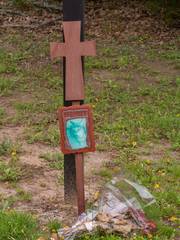 In Wolf Pen Creek Park, a touching handmade memorial honors Henry, a beloved tabby who once roamed the area as part of the local feral cats colony. Featuring a simple wooden cross, a framed portrait, and weathered flowers, this quiet tribute serves as a beautiful reminder that even stray cats can leave a lasting mark on the hearts of their community. College Station, Texas, April 28, 2026  The truck in this close-up is a Soviet-era GAZ-51 (or possibly its four-wheel-drive variant, the GAZ-63), which has been repurposed into a striking, semi-ruined art installation in Tallinn s Old Town. The distinct rounded hood, vertical grille slats, and cab shape identify it as a GAZ-51, one of the most widely produced trucks in the Soviet Union from 1946 to 1975. It was a workhorse of Estonian agriculture and industry during the Soviet occupation. The truck is in a state of deliberate decay, with peeling blue paint revealing rust, missing headlights, and a weather-beaten interior. This "ruined" aesthetic allows it to blend into the surrounding greenery, symbolizing the passage of time. The door features a stylized graffiti tag of a dragonfly, adding a layer of modern urban art to the vintage industrial canvas. A large, green, pipe-like structure (resembling a telescopic boom, grain auger, or water cannon) is mounted on the back. This industrial attachment gives the truck a fantastical, almost "Mad Max" or steampunk appearance, repurposing a utility vehicle into a whimsical sculpture. There is a local story that the owner of this specific plot of land (which is private, unlike the surrounding city-owned park) placed the truck and other objects (like manure heaps or potato patches in previous years) as a form of protest or disruption because the city would not grant permission to construct a new building on the site. Estonia, October 16, 2025  Spores of Ascomycete mushrooms Pulvinula convexella collected earlier 10/1/2025 on a bonfire site near a lake in Kannelyarvi, north from Saint Petersburg, Russia, October 19, 2025  A view of the installation specifically focuses on the memorial dedicated to Alexei Navalny, the Russian opposition leader who died in a penal colony on February 16, 2024. The central poster explicitly states "PUTIN KILLED NAVALNY" in bold red and black letters, echoing the sentiments of protestors worldwide who hold the Kremlin responsible for his death. Below the text is a large, stylized black-and-white portrait of Navalny, marked with the date of his death, February 16, 2024. The main poster is surrounded by smaller photos, drawings, and messages from supporters, including a quote in Russian: "Everything will be fine. And even if it isn t, we will console ourselves that we were honest people". The memorial is integrated into the broader anti-war protest, with signs like "STOPTHEWAR" and "NETVOYNE" (No to War) visible alongside Ukrainian colors. A yellow poster in the background calls for freedom for political prisoners ("SVOBODU POLITZAKLYUCHONNYM"). Tallinn, Estonia, October 16, 2025  Olive Wax Cap mushrooms (Hygrophorus olivaceoalbus) showing snakeskin pattern in a spruce forest. Kannelyarvi, north from Saint Petersburg, Russia, October 1, 2025  Peppered rock tripe lichen (Umbilicaria deusta) on a boulder in Kannelyarvi, 45 miles north from Saint Petersburg. Russia, May 25, 2019  Stinging Nettle leaves (Urtica dioica) covered in a dense layer of hoarfrost in Kannelyarvi. The plant is famous for its trichomes (stinging hairs). In this frozen state, the ice crystals cling preferentially to these fine hairs and the serrated edges of the leaves, turning the plant s defensive mechanism into a surface for ice nucleation. North from Saint Petersburg, Russia, October 1, 2025  Map lichen Rhizocarpon petraeum on a granite boulder in Zakhodskoe (Lounatjoki), 50 miles north from Saint Petersburg. Russia, May 22, 2021  An old transformer substation in Lanskoy Garden on Sampsonievsky Prospekt near Lanskaya train Station. This view of its brick wall focuses entirely on the gritty, tactile reality of the city--where every surface is a battleground between human attempts to cover things up (paint, posters) and nature s tendency to strip them back down (peeling, tearing, weathering). Saint Petersburg, Russia, October 9, 2025  "Bulldozing" trails left by a freshwater mussel of the family Unionidae, most probably the Duck Mussel (Anodonta anatina) or the Painter s Mussel (Unio pictorum) on a beach near Kurort. The deep, meandering furrow left in the sand is a classic "ploughing" trace (known as repichnia). These mussels use a large, muscular foot to drag themselves slowly through the upper layer of sediment, leaving behind the U-shaped groove. Saint Petersburg, Russia, October 9, 2025  Granite and iron bridge in Sergievka Park. The bridge s corners are anchored by sturdy, rough-hewn granite bollards (posts) with rounded tops, which support a decorative black iron railing. The railing features a simple, geometric lattice pattern, typical of the functional yet aesthetic engineering found in the Peterhof estate parks. Old Peterhof, west from Saint Petersburg, Russia, October 13, 2025  Soft green carpet of Knight s Plume Moss (Ptilium crista-castrensis) in a spruce forest Kannelyarvi, north from Saint Petersburg, Russia, October 1, 2025  Stone head made from a boulder in Sergievka Park. Old Peterhof, west from Saint Petersburg, Russia, October 11, 2016  Reconstruction of security police office in Museum of Political History (Kshesinskaya Mansion). Saint Petersburg, Russia, May 29, 2019  Buellia(?) lichen on a stone in a forest in Kannelyarvi, 45 miles north from Saint Petersburg. Russia, May 25, 2019  Deadly webcap mushrooms (Cortinarius rubellus) Kannelyarvi, north from Saint Petersburg, Russia, October 1, 2025  Slimy spike mushrooms (Gomphidius glutinosus) Kannelyarvi, north from Saint Petersburg, Russia, October 1, 2025  Trumpet chanterelle mushrooms (Craterellus tubaeformis) Kannelyarvi, north from Saint Petersburg, Russia, October 1, 2025  Presence of a dead gull on a beach in the Gulf of Finland near Solnechnoe, that is most likely linked to the ongoing highly pathogenic avian influenza (HPAI) outbreak, specifically the H5N1 strain, which has devastated wild bird populations in the Baltic region throughout 2023-2025. Saint Petersburg, Russia, October 9, 2025  A close-up detail from the left-middle section of a huge painting "Phryne at the Festival of Poseidon in Eleusis" (1889) by Henryk Siemiradzki (Polish/Russian, 1843-1902) in Russian Museum. Saint Petersburg, Russia, September 24, 2025  Broken granite stone on a large damaged tomb in Smolenskoe Lutheran Cemetery on Dekabristov Island. Saint Petersburg, Russia, August 12, 2024  Black apothecia of Buellia(?) lichen on a stone in a forest in Kannelyarvi, 45 miles north from Saint Petersburg. Russia, May 25, 2019  Common eyelash mushrooms (Scutellinia scutellata) near a lake Kannelyarvi, north from Saint Petersburg, Russia, October 1, 2025  Fibrecap (Inocybe)(?) mushrooms on a primitive camping site. Kannelyarvi, north from Saint Petersburg, Russia, October 1, 2025  Top view of Trumpet chanterelle mushrooms (Craterellus tubaeformis) Kannelyarvi, north from Saint Petersburg, Russia, October 1, 2025  Ascomycete mushrooms Pulvinula convexella on a bonfire site near a lake Kannelyarvi, north from Saint Petersburg, Russia, October 1, 2025  Cross section of slimy spike mushrooms (Gomphidius glutinosus) Kannelyarvi, north from Saint Petersburg, Russia, October 1, 2025  Side view of Trumpet chanterelle mushrooms (Craterellus tubaeformis) Kannelyarvi, north from Saint Petersburg, Russia, October 1, 2025  Istok Lake at "Golden Hour". The sunrise reveals distinct layers in the forest structure: birch curtain, pine canopy, spruce backdrop. Kannelyarvi, north from Saint Petersburg, Russia, October 1, 2025  The "Adam s Head" (or Golova-valun:feff) sculpture presents a striking profile view, revealing its deep-set eye and prominent nose emerging from the earth. Bright yellow maple leaves carpeting the ground and contrasting with the grey granite. A small spring flows near the base of the sculpture (visible in the foreground as a trickle), adding to the mystical atmosphere that reportedly inspired Lewis Carroll during his visit in 1867. This angle emphasizes the massive scale of the boulder relative to the path, showing how the face was carved directly into the natural granite contours. Sergievka Park, Old Peterhof, west from Saint Petersburg, Russia, October 13, 2025  Scenery around the Chinese Pond (Upper Park Pond) in Oranienbaum Park. The stone pergola, draped in vivid red wild grapes (Parthenocissus), serves as a striking architectural centerpiece across the water. Oranienbaum palace-and-park ensemble in Lomonosov (a suburb of St. Petersburg), Russia, October 13, 2025  Close-up of Ascomycete mushrooms Pulvinula convexella on a bonfire site near a lake Kannelyarvi, north from Saint Petersburg, Russia, October 1, 2025  Church of the Tikhvin Icon of the Mother of God near the train station in Sestroretsk. The huge icon of Jesus and the rocket models is part of a distinct chapel and memorial complex dedicated to the Royal Martyrs (Tsar Nicholas II and his family) and the spiritual protection of Russia. The "Face" Facade: The large face is a giant icon of the Savior Not Made by Hands (Spas Nerukotvorny). Below it, the red banner reads "Holy Royal Martyrs, Pray to God for Us", referring to the canonized Romanov family. Community: This church is known for its "Cossack" guard and a very distinct, staunchly monarchist and patriotic atmosphere that differs from typical Russian Orthodox parishes. Saint Petersburg. Russia, October 9, 2025  Large black scorpion Fat Tail (Androctonus crassicauda) found under a metal sheet (thanks to F. G.) at entrance of Umm Bab in south-western Qatar, March 3, 2014  Conifer roundhead mushroom (Stropharia hornemannii) and Olive Wax Cap (Hygrophorus olivaceoalbus) in moss. Kannelyarvi, north from Saint Petersburg, Russia, October 1, 2025  Knight s Plume Moss (Ptilium crista-castrensis), also known as Ostrich-plume Moss in a spruce forest Kannelyarvi, north from Saint Petersburg, Russia, October 1, 2025  Fused stem of fried chicken mushrooms (Lyophyllum decastes) on a primitive camping site. Kannelyarvi, north from Saint Petersburg, Russia, October 1, 2025  From this more distant perspective, the bridge serves as a gateway through the dense "Golden Autumn" forest, its dark iron silhouette creating a strong focal point amidst the vibrant foliage. Sergievka Park, Old Peterhof, west from Saint Petersburg, Russia, October 13, 2025  Pikk Street (Pikk ta"nav) in Tallinn s Old Town, specifically showing the facades of two notable Art Nouveau buildings at numbers 18 and 16. The building on the right with the dramatic facade featuring dragon sculptures is the famous "Dragon Gallery" (Draakoni galerii). Designed by architect Jacques Rosenbaum and completed in 1910, it is a masterpiece of Art Nouveau architecture. The facade is adorned with fantastical elements, including two large dragons flanking the ground-floor window, Egyptian women, and sphinxes. It currently houses an art gallery managed by the Estonian Artists Association. The building directly next to it on the left (the narrower one with large windows) is Pikk 16. It currently houses the BonVerre shop, visible through the ground-floor window, which specializes in beverages and gourmet products. Further down the street on the left (the grey building with the green flag) is the Kanuti Gildi Saal (St. Canute s Guild Hall), a historic building that now serves as a contemporary performing arts center. Tallinn, Estonia, October 16, 2025  Panoramic view from the Tarkhovka shoreline that looks north-west across the Sestroretsky Razliv (Lake Sestroretsk) toward the city of Sestroretsk. This view captures the dual nature of Sestroretsk: a historic resort town with natural beauty (the lake, reeds, and stones) juxtaposed with modern urban infrastructure (heating plant and high-rise housing). "Three Chimneys" (Center): The most prominent industrial feature is the cluster of three tall red-and-white striped chimneys. These belong to the Sestroretsk District Heating Plant (part of the city s thermal infrastructure). Residential Towers (Left of Chimneys): The tall, beige-and-orange brick apartment buildings are part of the modern residential developments in Sestroretsk, likely along Tokarevskaya Street or the Razliv microdistrict. Church of Peter and Paul (Far Right): On the far right horizon. This is a modern church (consecrated in 2009) built in memory of the Russian submariners. "Pyramid" Building (Far Left): On the far left, there is a distinctive white building with a stepped, pyramid-like shape. This is likely the "Eden" (Edem) residential complex or a similar luxury apartment block, which is known for its terraced architecture. Tarkhovka Park near Sestroretsk, west from Saint Petersburg. Russia, October 3, 2025  Dense, fasciculate cluster of clustered domecap mushrooms (Lyophyllum decastes) on a primitive camping site. Kannelyarvi, north from Saint Petersburg, Russia, October 1, 2025  Pyramid Pavilion, located in a quiet, shady corner of Catherine Park in Tsarskoe Selo (Pushkin). It was originally built in 1770-1772 by the architect Vasily Neyelov and later reconstructed by Charles Cameron in 1782-1783. The pavilion was designed to resemble an ancient Egyptian mausoleum, reflecting the Romantic era s fascination with antiquity and melancholy ruins. It is constructed of brick and faced with trimmed granite. Buried behind the pyramid are three of the Empress s favorite Italian greyhounds: Tom Anderson, Zemira, and Duchesse. Saint Petersburg, Russia, October 10, 2025  One of the two towers forming the Red (Turkish) Cascade (Krasnyy/Turetskiy Kaskad) in Catherine Park. It serves as both a decorative dam and a symbolic monument. Pushkin (former Tsarskoe Selo) near Saint Petersburg, Russia, October 10, 2025  Berry of currant (Russian name Smorodina) near a summer house (Dacha) north from Orekhovo, north from Saint Petersburg. Russia, July 11, 2010  "Bulldozing" trails left by a freshwater mussel of the family Unionidae, most probably the Duck Mussel (Anodonta anatina) or the Painter s Mussel (Unio pictorum) on a beach near Kurort. The shell partially visible at the end of the trail is large, oval, and relatively smooth with a dark, brownish-yellow periostracum (outer skin). Saint Petersburg, Russia, October 9, 2025  The "permanent stage" of memorialization, featuring a row of polished black granite monuments for soldiers such as Andrey Nikolaevich Atlanov (1977-2024) and Danila Denisovich Shutov (2001-2024), a 23-year-old whose age underscores the ongoing loss of young lives. The monuments display diverse portrait styles--ranging from formal military engravings to casual color photos--and are flanked by flags including the VDV (Airborne Forces) banner with the motto "Nobody, but us," reflecting both individual identity and collective unit pride. The orderly arrangement of these finished graves, complete with granite curbs and gravel, stands in contrast to the chaotic temporary sections seen in other places, illustrating the gradual formalization of the war s toll. "Alley of Heroes" at Cemetery of the Victims of January 9, St. Petersburg, Russia, October 4, 2025  Stone head of Russian revolutioner V. I. Lenin in Shalash Memorial near Razliv Lake, north-west from Saint Petersburg. Russia, October 2, 2017  Gray-orange disk lichen (Lecidea lapicida)(?) on a stone in Kannelyarvi, 45 miles north from Saint Petersburg. Russia, May 25, 2019  An old transformer substation (or similar utility building) in Lanskoy Garden on Sampsonievsky Prospekt near Lanskaya train Station. Its brick walls have effectively become an unofficial community billboard, covered in layers of concert posters (e.g., for the singer Linda). Saint Petersburg, Russia, October 9, 2025  Ostrich Fern (Matteuccia struthiopteris) on Alpine Hill (or Alpinarium). Sterile Fronds (The "Feathers"): The large, outer leaves have turned from green to a golden-bronze color. These are the "ostrich feathers" that give the plant its name. They are withering now and will soon collapse for the winter. Fertile Fronds (The Dark Spikes): In the very center, there are the dark brown, stiff, upright spikes. These are the spore-bearing fronds (sporophylls). Unlike the leafy outer fronds, these become woody and persist standing upright through the entire winter, often poking out through the snow. Peter the Great Botanical Garden of Komarov Botanical Institute. Saint Petersburg, Russia, October 8, 2025  View of the Karasta River near the stone bridge in Oranienbaum Park. The stone bridge, with its rustic, unpolished arches, is partially obscured by the golden leaves of a large tree, enhancing the sense of depth and discovery typical of romantic English-style gardens. Oranienbaum palace-and-park ensemble in Lomonosov (a suburb of St. Petersburg), Russia, October 13, 2025  A gate of Christian Orthodox monastery on Konevets Island in Ladozhskoe Lake, with a Russian inscription "Close gate firmly. Draught destroys the painting". North from Saint Petersburg, Russia, September 8, 2002  Fruits of cowberry (lingonberry, Vaccinium vitis-idaea, Russian name Brusnika) on a forest cutting west from Kannelyarvi, 40 miles north from Saint Petersburg. Russia, August 7, 2012  Fall colors around a stone head of Russian revolutioner V. I. Lenin in Shalash Memorial near Razliv Lake, north-west from Saint Petersburg. Russia, October 2, 2017  Stone head made from a boulder in Sergievka Park. Old Peterhof, west from Saint Petersburg, Russia, April 10, 2017  Enclosed pedestrian overpass at the Kannelyarvi railway station, located on the Karelian Isthmus roughly 75 km northwest of St. Petersburg. This overpass is a modular steel structure clad in translucent polycarbonate panels. The structure is a characteristic example of the standardized "blue tube" pedestrian bridges installed by Russian Railways (RZD) during the widespread modernization of the St. Petersburg-Vyborg line in the late 2000s. Russia, October 1, 2025  Rustic, three-arched stone bridge (often referred to as the Ruin Bridge or simply the stone arch bridge) in the "Russian Switzerland" area in Oranienbaum s Upper Park. Built from rough-hewn boulders to mimic a natural or ancient ruin, it harmonizes perfectly with the wild, rugged aesthetic of the Karasta River valley. The bridge spans a small ravine or tributary, surrounded by a golden forest of birch and maple trees that soften the stone s heavy appearance with delicate autumn foliage. Oranienbaum palace-and-park ensemble in Lomonosov (a suburb of St. Petersburg), Russia, October 13, 2025  Texture of map lichen Rhizocarpon petraeum on a granite stone in Zakhodskoe (Lounatjoki), 50 miles north from Saint Petersburg. Russia, May 9, 2019  Close up of map lichen Rhizocarpon petraeum on a granite stone in Zakhodskoe (Lounatjoki), 50 miles north from Saint Petersburg. Russia, May 9, 2019 |