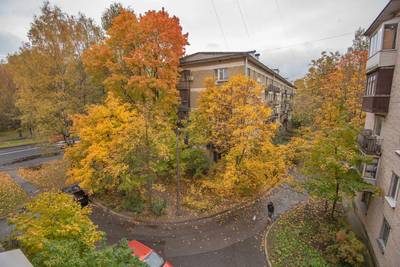
View of a late-Soviet brick residential quarter (kirpichnaya khrushchevka) deeply integrated with the mature nature of the Vyborgsky district, captured at the beautiful but fleeting peak of autumn. View from this window providing a glimpse into Soviet-era urban planning, specifically the residential design of the 1960s. The beige brick buildings visible in the frame are classic examples of "Khrushchevka" (Series 1-528). Unlike the cheaper concrete panel blocks (panelki), these are constructed from silicate brick, which was considered a "premium" material for mass housing at the time. They are easily identified by their 5-story height, hipped roofs (often replaced with metal sheeting), and specific balcony arrangements. Saint Petersburg, Russia, October 11, 2025  Saint Petersburg courtyard near Svetlanovsky Prospekt during "Golden Autumn" (Zolotaya Osen). The foliage is in a transitional phase where the trees are displaying their most vibrant colors (bright yellows and oranges) before shedding completely. The area around Svetlanovsky Prospekt (Vyborgsky/Kalininsky districts) is characterized by residential blocks from the 1960s and 1970s. Unlike the dense city center, these blocks were designed with large, open courtyards (dvory) intended to act as "green lungs" for residents. Russia, October 10, 2025  View from an apartment window showing lived-in atmosphere of a residential block near Svetlanovsky Prospekt, characterized by 1970s brick architecture softened by mature greenery. Saint Petersburg, Russia, October 13, 2025  "Golden Autumn" view from a residential balcony in the Svetlanovsky Prospect area of Saint Petersburg. This view reflects a peaceful, everyday moment of beauty typical of Saint Petersburg s residential "sleeping districts" during the short but spectacular peak of autumn. Russia, October 14, 2025  Panoramic view from the Tarkhovka shoreline that looks north-west across the Sestroretsky Razliv (Lake Sestroretsk) toward the city of Sestroretsk. This view captures the dual nature of Sestroretsk: a historic resort town with natural beauty (the lake, reeds, and stones) juxtaposed with modern urban infrastructure (heating plant and high-rise housing). "Three Chimneys" (Center): The most prominent industrial feature is the cluster of three tall red-and-white striped chimneys. These belong to the Sestroretsk District Heating Plant (part of the city s thermal infrastructure). Residential Towers (Left of Chimneys): The tall, beige-and-orange brick apartment buildings are part of the modern residential developments in Sestroretsk, likely along Tokarevskaya Street or the Razliv microdistrict. Church of Peter and Paul (Far Right): On the far right horizon. This is a modern church (consecrated in 2009) built in memory of the Russian submariners. "Pyramid" Building (Far Left): On the far left, there is a distinctive white building with a stepped, pyramid-like shape. This is likely the "Eden" (Edem) residential complex or a similar luxury apartment block, which is known for its terraced architecture. Tarkhovka Park near Sestroretsk, west from Saint Petersburg. Russia, October 3, 2025  Residential courtyard near Svetlanovsky Prospekt transformed by the vibrant colors of "Golden Autumn". Saint Petersburg, Russia, October 13, 2025  This view from the tower of St. Nicholas Church offers a fascinating contrast between medieval history, post-war reconstruction, and modern urban growth, looking east towards the city center. The most prominent building in the immediate foreground is the large, grey, L-shaped structure known as the Writers House (Kirjanike Maja) on Harju Street. Built in 1963 on the ruins of buildings destroyed during the 1944 Soviet bombing of Tallinn, this modernist structure is a significant cultural landmark. It houses the Estonian Writers Union, a well-known bookstore, and the famous Cafe Pegasus, serving as a hub for the country s literary scene. The street running along the left side of the Writers House is Harju Street, historically one of the city s main commercial arteries. The open green space visible nearby (part of the Harju Street green area) was also created following the wartime destruction, serving as a memorial and recreational space before partial reconstruction debates in recent years. In the background, the view opens up to Tallinn s modern business district. The cluster of high-rise glass buildings, including the distinct wedge-shaped Swisso^tel and the SEB Bank headquarters, illustrates the city s rapid economic development and stands in stark contrast to the red-tiled roofs of the Old Town below. Estonia, October 16, 2025  This view from the St. Nicholas Church (Niguliste) tower looks down towards the dense medieval streets of the lower town, offering a detailed perspective of the residential architecture and rooftops. The narrow, curved street cutting through the scene is Rataskaevu Street, one of the most picturesque lanes in the Old Town. Yellow Building: The prominent, multi-story yellow building in the foreground (with the large red-tiled roof and dormer windows) is likely situated on or near Rataskaevu Street. Buildings in this area often date from the 18th or 19th centuries and now frequently house guest apartments, such as the Rataskaevu Boutique Apartments or Rataskaevu Guest Apartment. Its bright facade and orderly fenestration are typical of the later updates to the medieval fabric. The image showcases the iconic "sea of red roofs" that defines Tallinn s aerial aesthetic. The jumble of gables, chimneys, and varying roof pitches reveals the organic development of the city over centuries. In the background, the spire of St. Olaf s Church (Oleviste kirik) rises above the horizon, providing a vertical anchor to the cityscape and connecting the view to the harbor beyond. Estonia, October 16, 2025  This is the No~elasilma ("Eye of the Needle") Gate, a reconstructed section of the medieval urban fabric located at the end of Niguliste Street. Originally, this area was a densely built-up part of the Old Town, near the historic Harju Gate. However, the neighborhood was largely destroyed during the March 1944 Soviet bombing, which leveled about 20% of Tallinn s buildings, particularly in the Harju and Niguliste street areas. The ruins stood for decades before the area was cleared and later redeveloped as a green space and memorial. The No~elasilma Gate itself was reconstructed in 2006-2007 as part of an effort to restore the medieval street network and mark the historical boundary of the former churchyard. The structure consists of two limestone walls with arched openings, mimicking the narrow passageways typical of the medieval city. Looking through the gate, you see the cobblestones of Niguliste Street. In the background stands a distinct corner tower with a red tiled roof, part of the residential block that survived or was restored after the war. The modern apartment buildings on the left (Harju Street area) are post-war constructions, filling the void left by the bombing. The gate now serves as a poignant reminder of the city s lost layers and its resilience. Estonia, October 16, 2025  Brick buildings at Liteyny Prospekt. Saint Petersburg, Russia, July 9, 2010  This aerial view shows the suburban landscape of Coppell, Texas, where State Highway 121 merges with the Sam Rayburn Tollway, just north-northwest of DFW International Airport. The prominent highway is the confluence of SH 121 and the Sam Rayburn Tollway, a critical artery connecting the northern Dallas suburbs. The complex interchange and heavy traffic are characteristic of the DFW metroplex s extensive highway system. The natural waterway winding through the scene is Denton Creek. The creek and the surrounding ponds create a greenbelt that offers a natural buffer between the highway and residential areas . These water features are integral to the master-planned communities in Coppell, providing both drainage and recreational space. The dense, master-planned neighborhoods with their distinctive gray roofs are typical of Coppell. On the right, the development is part of the Riverchase area, while the homes in the upper left are also part of Coppell s extensive suburban grid. The large white buildings in the lower-left are warehouses and logistics centers, strategically located near DFW Airport and the major highway interchange for easy distribution. View from a window of an airplane from Helsinki to Dallas, Greenland, October 17, 2025  A wooden gate in the wall of a building at Uus 16/1. The gate is covered in layers of graffiti. The most prominent feature is the word "TOY" spray-painted in red over a black-and-white heart symbol. In graffiti culture, the term "toy" is a derogatory slur used to describe an inexperienced or unskilled writer, or someone who disrespects the unwritten rules of the scene (e.g., painting over better work). The underlying black-and-white geometric heart appears to be a stencil or a specific artist s tag that has been "crossed out" (dissed) by another writer using the red paint. This layering tells a story of conflict or rivalry within the local street art community. The gate and the yellow stucco wall are covered in various other tags ("PACollege Station, Texas," "ATAS," "NGR"), typical of the tagging that plagues less-surveilled streets in the Old Town like Uus Street. This gate likely leads to a private courtyard or a utility area behind the residential buildings on Uus Street. Tallinn, Estonia, October 16, 2025  Fall colors of green area between apartment houses near Svetlanovsky Prospect from a balcony on the third floor. The colors are predominantly earthy, muted golds, and olive tones, reflecting the transition of the foliage from late summer green to autumn dormancy. This palette creates a cozy, nostalgic mood, characteristic of a quiet residential courtyard in autumn. Saint Petersburg, Russia, October 9, 2025  This aerial view captures the Tapiola district in Espoo, Finland, just west of Helsinki. Known as a "garden city," Tapiola is famous for its unique urban planning that blends modern architecture with extensive green spaces. Central Basin (Keskusallas): The large body of water in the left-center is the artificial pool or basin at the heart of Tapiola s center. It is surrounded by key landmarks like the Espoo Cultural Centre and the iconic Tapiola Garden Hotel. The image clearly shows the "garden city" concept in action: high-rise apartment blocks (typically white) are scattered amongst dense patches of forest and parks, rather than being packed into tight grids. In the foreground (bottom left), the coastline features marinas and residential areas, likely parts of the affluent Westend or Haukilahti neighborhoods, known for their seaside location. The major road running horizontally through the upper middle is likely La"nsiva"yla" (Western Highway), the main artery connecting Espoo to Helsinki city center (which would be to the right/east). View from a window of an airplane from Tallinn to Helsinki, Finland, October 17, 2025  This quiet cobblestone street is Mu"ndi ("Mint Street"), a short but historically rich passageway in Tallinn s Old Town. Despite being only about 45 meters long, Mu"ndi is one of the oldest streets in the city, with origins dating back to the 13th century when it was a pathway known as "the short one, close to the market". The narrow, curving layout framed by tall pastel-colored buildings creates a classic "canyon" effect typical of medieval urban design. The view looks towards Pikk Street, with the high gable of a merchant house visible in the background. Estonia, October 16, 2025  Evening view that provides a dramatic, upward-looking perspective of St. Olaf s Church (Oleviste kirik) from the street level (near Lai 48), emphasizing the towering scale of its west facade. The image is dominated by the massive limestone tower of St. Olaf s. The perspective highlights the transition from the square base to the octagonal upper stages, a typical feature of Gothic architecture in the Hanseatic region. The long, narrow window with its pointed arch (lancet window) is a defining Gothic element, allowing light into the nave. To the right, you can see the upper stories of the adjacent building (likely Lai 48 or 50). Its simple, plastered facade and regularly spaced windows provide a domestic scale that contrasts with the monumental church. The distinctive rain gutter (downspout) on the left foreground acts as a framing element, drawing the eye upward. This view underscores why St. Olaf s was once the tallest building in the world (1549-1625). The sheer verticality visible here was originally intended to serve as a landmark for trading ships approaching Tallinn s harbor. Tallinn, Estonia, October 16, 2025  A building at 5 lit. B Engelsa Prospect which is a surviving historical service corps of the Orlovo-Novosiltsevskaya Almshouse complex. This small brick structure was originally built as one of the auxiliary buildings (likely for staff or utility purposes) for the larger almshouse institution. The main complex, located at Engelsa 1-5, was a major philanthropic center established in the 1830s. The complex was designed by the renowned architect Iosif Charlemagne (Joseph-Maria Charlemagne-Baudet) in the late Classicist style. It was constructed between 1834 and 1841. Lesnoy Park (Lesotekhnicheskiy Universitet), Saint Petersburg, Russia, October 14, 2025  View of a residential apartment house at Svetlanovsky Prospect and Sosnovka Park behind trees from a window of the house in Saint Petersburg, Russia, April 27, 1999.  Fac,ade of Pikk 18, arguably the most famous Art Nouveau building in Tallinn, known as the Dragon Gallery (Draakoni Galerii). Designed by the renowned Baltic German architect Jacques Rosenbaum and completed in 1910, this building is a prime example of late Art Nouveau (Jugendstil) architecture. The two massive, sculpted dragons flanking the ground-floor window are the building s namesake and most iconic feature. They were created by the sculptor August Volz. Above the dragons, the fac,ade features two stern female figures with Egyptian headdresses projecting from the pilasters. These, along with sphinxes and other exotic ornaments on the upper levels, reflect the eclectic and fantastical influences typical of Rosenbaum s style. The large, horseshoe-shaped window on the ground floor and the undulating gable at the top create a sense of movement and fluidity that contrasts sharply with the rigid lines of the adjacent classical and medieval buildings. Originally built as an apartment house for the merchant Reinhold Reichmann, the ground floor has housed the Draakoni Gallery since 1983, an exhibition space managed by the Estonian Artists Association. The green light visible in the window belongs to a fashion boutique or exhibition currently occupying the space. Tallinn, Estonia, October 16, 2025  Collared parachute mushrooms (Marasmius rotula) in a yard near residential buildings in Saint Petersburg. Russia, August 11, 2024  Pale brittlestem mushrooms (Psathyrella candolleana) in a yard near residential buildings in Saint Petersburg. Russia, August 11, 2024  Close-up of collared parachute mushrooms (Marasmius rotula) in a yard near residential buildings in Saint Petersburg. Russia, August 11, 2024  Underside of a pale brittlestem mushroom (Psathyrella candolleana) in a yard near residential buildings in Saint Petersburg. Russia, August 11, 2024  Small dark brown fibrecap (Inocybe) mushrooms on rich soil in a yard near residential buildings in Saint Petersburg. Russia, August 11, 2024  This view from the St. Nicholas Church tower looks down into the heart of the lower town, specifically capturing the densely packed historic streets below. Ru"u"tli and Rataskaevu Streets: The view likely centers on the intersection or alignment of Ru"u"tli (Knight) and Rataskaevu streets, which run close to the church. These streets are characterized by their medieval layout and historic merchant houses. The prominent yellow building with the red roof in the foreground (bottom center) stands out with its orderly rows of windows and distinct dormers. This is typical of the 18th and 19th-century residential architecture found in this part of the Old Town, often housing guest apartments today. The image perfectly illustrates the "red roofscape" of Tallinn, with various shades of terracotta tiles covering the gabled roofs. You can see the complex interplay of courtyards, chimneys, and firewalls that define the city s historic urban fabric. St. Olaf s in Distance: In the upper right corner, the spire of St. Olaf s Church pierces the skyline, providing a vertical counterpoint to the horizontal spread of the lower town. The view extends to the gray waters of the bay in the background, reinforcing the city s coastal setting. Estonia, October 16, 2025  Lai Street in the Old Town. The row of gabled buildings on the right is known as the "Three Brothers". These medieval merchant houses are less famous than the "Three Sisters" on Pikk Street but are equally historically significant. The white facade in the immediate foreground (right) features a neo-Gothic or historicist style, likely dating from a later renovation (potentially 19th or early 20th century) that unified earlier medieval structures. One can clearly see the transition from the plastered, light-colored facade in the foreground to the simpler, pastel-yellow medieval warehouse-style building next to it. These buildings often retain their original "diele-dornse" layout (a large front room for business and living quarters behind). The perspective highlights the massive scale of St. Olaf s Church (Oleviste kirik) at the end of the street (Lai 50). The tower s copper spire, weathered to green, creates a striking contrast with the red tile roofs and the autumn foliage on the left. Tallinn, Estonia, October 16, 2025  Brick buildings on Vereyskaya Street in Sementsy area. Saint Petersburg, Russia, August 8, 2012  Colorful autumn scene in the historic Vyborgsky District near the intersection of Novorossiyskaya Street and Engelsa Prospect. The view is taken from Novorossiyskaya Street, looking through a decorative iron fence. Lesnoy Park (Lesotekhnicheskiy Universitet), Saint Petersburg, Russia, October 14, 2025  A detailed look at the suburban landscape of Tikkurila, the administrative center of Vantaa, located just north of Helsinki. Kerava River (Keravanjoki): The winding river cutting through the landscape is the Kerava River, a tributary of the Vantaa River. It flows past residential areas and parks, offering a scenic green belt through the suburbs. The denser cluster of buildings in the center-right is the heart of Tikkurila (Dickursby). This area is a major transport hub, home to the Tikkurila railway station (a key stop for airport trains) and the Heureka Science Centre (likely one of the larger modern structures near the river). Suburban Fabric: The image showcases a mix of housing types typical of the Helsinki metropolitan area: detached houses with large gardens in the foreground and denser apartment blocks closer to the Tikkurila center. The presence of a sports field with a running track (red oval, left side) highlights the community-focused planning. Rural-Urban Edge: The top and left portions of the image show open fields and farmland, illustrating how abruptly the urban area transitions into the countryside in this region. This area is minutes away from landing at Helsinki-Vantaa Airport, making it a common sight for travelers. View from a window of an airplane from Tallinn to Helsinki, Finland, October 17, 2025  A vibrant and slightly gritty scene in a courtyard or passage off Viru Street (Viru 13), revealing a hidden side of Tallinn s Old Town nightlife. The wall is covered in colorful, chaotic graffiti tags (e.g., "PASR," "OPG," "SRN"), contrasting with the historic surroundings. The abstract blue and white forms at the bottom right resemble stylized waves or bubbles. This heavy tagging is typical of the semi-hidden courtyards in this area that house alternative bars and clubs. Through the window on the right, you can see the warm interior of a bar. Bottles of alcohol are lined up on shelves, and the lighting suggests a cozy, active atmosphere inside. This juxtaposition--the rough, cold exterior wall versus the inviting, warm interior--encapsulates the "hidden bar" culture of Tallinn. While Viru Street itself is a main tourist artery known for flower stalls and souvenir shops, the courtyards behind the facades (like at Viru 13/15) often host rooftop bars like A"rkel or speakeasy-style venues. Tallinn, Estonia, October 16, 2025  Apartment houses near Svetlanovsky Prospekt from a window of a house. This view presents the "other side" of the Golden Autumn coin: not the crisp, sunny glory, but the damp, reflective, and deeply saturated beauty that follows the city s frequent rains. Saint Petersburg, Russia, October 12, 2025  This view of Mu"ndi Street looks directly towards the intersection with Pikk Street, one of the main historic arteries of Tallinn s Old Town. On the right, the pink building with the "Scho"ller" and "Cinnamon Restoran" signs is a multi-story historic structure. It houses the Scho"ller Ice Cream Cafe and Cinnamon Restaurant. The narrow cobblestone street, flanked by tall pastel-colored facades, creates an intimate, "canyon-like" feel typical of Tallinn s medieval urban plan. Estonia, October 16, 2025  Old Passenger Terminal of Tallinn Airport. Built between 1945 and 1954 (opened in 1955), this building is a classic example of Stalinist architecture. Its symmetrical facade, rusticated ground floor, and the distinctive control tower with a viewing gallery reflect the monumental style favored in the Soviet Union during that period. An earlier Art Deco/Functionalist terminal was designed in 1938 by the architect Arthur Ju"rvetson, but construction was halted by World War II. The post-war redesign incorporated the Soviet aesthetic. This building served as the main passenger terminal until 1980, when a new, larger terminal (the current one) was built for the Moscow Olympics sailing regatta held in Tallinn. Today, this historic building has been repurposed for VIP services and administrative offices. It stands separately from the modern glass-and-steel terminal but remains an integral part of the airport s history, visible to passengers taxiing on the runway. View from a window of an airplane from Tallinn to Helsinki. Estonia, October 17, 2025  This perspective on Harju Street captures a striking mix of Soviet-era modernism and medieval heritage in the heart of Tallinn s Old Town. The prominent grey building on the right is the Writers House (Kirjanike Maja), located at Harju 1. Designed by architects August Volberg and Heili Volberg and completed in 1963, it is a prime example of post-war modernist architecture in Estonia. The foreground reveals traces of the area s turbulent history. The open green space on the left (Harju Street Park) occupies the site of buildings destroyed during the March 1944 Soviet bombing. For decades, these ruins were a painful scar, but the area has since been redeveloped into a recreational space that memorializes the lost urban fabric while providing a breathing room in the dense Old Town. The blue truck cabin visible in the foreground of the Harju Street photo is a GAZ-51, a legendary Soviet-era truck that was a common sight in Estonia for decades. Estonia, October 16, 2025  Old Turkish Railway Water Tower among modern residential buildings. Beer-Sheva, the Middle East, December 22, 2000  Old Cemetery near Allenby Road and Ben Yehuda Street surrounded by residential buildings. Tel Aviv, the Middle East, December 28, 2000  Old Cemetery near Allenby Road and Ben Yehuda Street surrounded by residential buildings. Tel Aviv, the Middle East, December 28, 2000  Old Cemetery near Allenby Road and Ben Yehuda Street surrounded by residential buildings. Tel Aviv, the Middle East, December 28, 2000  An old transformer substation in Lanskoy Garden on Sampsonievsky Prospekt near Lanskaya train Station. This corner can be described as a striking example of urban decay juxtaposed with natural harmony. The scene captures a raw, "wabi-sabi" beauty--an appreciation for things that are imperfect, impermanent, and incomplete. The Wall: The brickwork is rough, weathered, and tactile. The peeling paint and chipped bricks tell a story of age and neglect. The layers of torn posters add a "trash collage" effect (reminiscent of decollage art), creating a chaotic, man-made texture that feels gritty and transient. The Ground: In stark contrast, the ground is covered in a soft, organic carpet of fallen maple leaves. This natural texture is random but harmonious, softening the harsh lines of the brick building. Saint Petersburg, Russia, October 9, 2025  A view along Lai Street (Lai ta"nav) in the Old Town of Tallinn, Estonia, looking towards the iconic St. Olaf s Church. The dominant spire in the background belongs to St. Olaf s Church. This Gothic church was once the tallest building in the world (from 1549 to 1625), and its 124-meter spire remains a defining feature of the Tallinn skyline. As the name suggests, this is one of the wider medieval thoroughfares in the city, running parallel to the busier Pikk ("Long") Street. Historically, it was a prestigious residential area for wealthy merchants and artisans. The street is lined with well-preserved medieval merchant houses. The buildings on the right likely include or are near the famous "Three Brothers" complex (Lai 38, 40, and 42), a group of medieval gabled houses similar to the "Three Sisters" on Pikk Street. The building with the warm light in the window (foreground right) exemplifies the historic limestone architecture characteristic of the Hanseatic era. Tallinn, Estonia, October 16, 2025  Light well courtyard formed by buildings on Klinsky Prospect Street in Sementsy area. Saint Petersburg, Russia, August 8, 2012  Old Turkish railroad water tower situated among residential buildings on Rambam Street. Beer-Sheva, the Middle East, April 24, 2000  A weathered, wooden gate at Tolli Street 8 (Tolli tn 8) in the Old Town of Tallinn. This short, historic street runs north from Pikk Street towards the harbor area. Its name (meaning "Customs") reflects its historical connection to trade and taxation near the old port. The gate likely leads to a private courtyard or garden behind one of the historic residential properties. The wooden gate is visibly aged, with uneven planks and temporary reinforcements, suggesting it is awaiting restoration or is part of a less polished corner of the Old Town. This "shabby chic" aesthetic contrasts with the meticulously renovated facades on nearby Pikk Street. The flanking limestone walls are covered in peeling plaster and graffiti, revealing the raw stone construction typical of Tallinn s medieval infrastructure. The presence of graffiti and the unkempt nature of the gate offer a glimpse into the "lived-in" reality of the city, distinct from the purely tourist-focused attractions. The autumn leaves visible above the gate add a touch of seasonal color to the otherwise gritty scene. Tallinn, Estonia, October 16, 2025  An old transformer substation in Lanskoy Garden on Sampsonievsky Prospekt near Lanskaya train Station. This view of its brick wall focuses entirely on the gritty, tactile reality of the city--where every surface is a battleground between human attempts to cover things up (paint, posters) and nature s tendency to strip them back down (peeling, tearing, weathering). Saint Petersburg, Russia, October 9, 2025  Northern end of Vene Street (Vene ta"nav) at the intersection with Olevima"gi and Bremeni ka"ik. The red brick building on the immediate left is located at Vene 28. It is a historic structure that was originally built in 1912 as a residential building and briefly housed the Estonian Provisional Government in 1918. It stands out with its industrial-style red brick facade contrasting with the medieval stone walls nearby. The large limestone wall with the archway on the far left is part of the city s defensive fortifications, specifically near the Bremen Tower (Bremeni torn). The archway leads into Bremen Passage (Bremeni ka"ik), a short, atmospheric walkway that connects Vene Street to Uus Street through the city wall. The tower itself, a 15th-century horseshoe-shaped defensive structure, is located just behind this wall. In the background, at the end of the street, you can see the yellow tower and facade of the Orthodox Church of St. Nicholas (Nikolai kirik) at Vene 24. Designed by architect Luigi Rusca and built between 1820-1827, this Neoclassical church serves a congregation under the Moscow Patriarchate and is known for its valuable iconostasis. It sits on the site of a much older church that served Novgorod merchants in the Middle Ages. Tallinn, Estonia, October 16, 2025  Masters Courtyard (Meistrite Hoov), located at Vene 6. The courtyard is a dedicated space for master artisans and craftsmen. It houses various workshops and boutiques selling handmade jewelry, ceramics, textiles, and woodcrafts. The mission of the non-profit organization that manages it is to preserve and revive ancient handicraft traditions. The property has a rich history dating back to 1371. Over the centuries, the buildings surrounding the yard have served many purposes and undergone various reconstructions, but the area retains its historic architectural character. Tallinn, Estonia, October 16, 2025  Evening view of Lai Street (looking towards St. Olaf s Church). The large grey building on the right (Lai 44/46) stands out with its curved bay windows and decorative facade elements. This is a fine example of Jugendstil (Art Nouveau) architecture, which appeared in Tallinn during the early 20th century. Its smoother lines and larger windows contrast sharply with the smaller medieval merchant houses nearby. On the left, the yellow building (Lai 33) retains a more traditional, modest scale typical of the street s residential past. At the end of the street, the illuminated white tower of St. Olaf s Church (Lai 50) acts as a dramatic focal point. The lighting accentuates the church s massive walls and the green copper spire against the twilight sky. Tallinn, Estonia, October 16, 2025  Part of the Maze (or Labyrinth) located in the Lower Garden. The area features a classic French formal garden layout with geometrically trimmed hedges and gravel paths, characteristic of the early 18th-century design commissioned by Alexander Menshikov. Oranienbaum palace-and-park ensemble in Lomonosov (a suburb of St. Petersburg), Russia, October 13, 2025  This close-up view of the GAZ-51 truck highlights its surreal juxtaposition against the classic architecture of Tallinn s Old Town. The blue cabin is heavily weathered, with rust eating through the paint and missing headlights, emphasizing its status as a ruin or relic. The large green industrial mechanism mounted on the back--resembling a boom or auger--dominates the frame, extending horizontally like a cannon barrel. Distinct graffiti tags (like "WEK") on the door add a layer of contemporary urban decay, contrasting with the historic setting. Directly behind the truck, across the street, is a building housing a Bu"roomaailm (Office World) store. The truck sits on a grassy slope, part of the Harju Street Green Area, which covers the ruins of buildings destroyed in 1944. The contrast between the lush green grass, the rusting Soviet metal, and the maintained city street captures the eclectic spirit of this specific corner of Tallinn. Estonia, October 16, 2025  An old transformer substation (or similar utility building) in Lanskoy Garden on Sampsonievsky Prospekt near Lanskaya train Station. Its brick walls have effectively become an unofficial community billboard, covered in layers of concert posters (e.g., for the singer Linda). Saint Petersburg, Russia, October 9, 2025  Romantic melancholy of the Russian "Golden Autumn," a recurring theme in both landscape design and literature. The dark, still water acts as a "black mirror," doubling the impact of the golden foliage while adding a somber, contemplative depth to the scene. The contrast between the fading green aquatic grasses, the rusty-red dogwood underbrush, and the bright yellow canopy creates a rich, painterly texture reminiscent of Levitan s landscapes. The framing of the water by dense, encroaching vegetation emphasizes the "wild" nature of this park section, moving away from the formal geometry of the canals toward an intimate, secluded atmosphere. Aleksandrovsky (Alexander) Park in Pushkin (former Tsarskoe Selo) near Saint Petersburg, Russia, October 10, 2025  Saint Petersburg State Forestry University (often referred to historically as the Forestry Academy or Lesotekhnicheskaya Akademiya). Established in 1803 by decree of Emperor Alexander I as the Practical Forestry School in Tsarskoye Selo. In 1811, it was moved to its current location in the Vyborgsky District of Saint Petersburg, occupying the site of an old English dairy farm. The classical white building shown in the photo is the Main Educational Building. Originally constructed as four separate corps between 1826 and 1833 by architects I.F. Lucchini and A. Nellinger, these were later united into a single complex with a central courtyard in the late 1830s. Lesnoy Park (Lesotekhnicheskiy Universitet), Saint Petersburg, Russia, October 14, 2025  A classic alley in Upper Park during the height of autumn. Oranienbaum palace-and-park ensemble in Lomonosov (a suburb of St. Petersburg), Russia, October 13, 2025  The central alley leading to the Arsenal Pavilion, a red-brick neo-Gothic structure designed by Adam Menelaws. Completed in 1834, the Arsenal resembles a medieval castle with crenellated towers and massive arched windows. It was originally built to house Nicholas I s vast collection of medieval arms and armor. The straight alley is a remnant of the formal layout from the earlier "Monbijou" pavilion that stood here, now framed by the mature trees of the surrounding landscape park. After severe damage in WWII, the building was restored and reopened in 2016 as a museum displaying imperial weaponry. Aleksandrovsky (Alexander) Park in Pushkin (former Tsarskoe Selo) near Saint Petersburg, Russia, October 10, 2025  The ideological complexity of the war s memorialization, dominated by a large red Soviet flag flying prominently over fresh graves, invoking nostalgia for the USSR s military power alongside Russian tricolors and VDV (Airborne Forces) banners. In the foreground, the grave of Arkady Vasilyevich Kovalchuk (1974-2024), who died at age 50, exemplifies the demographic trend of older men bearing a significant share of casualties. The scene is one of dense, vibrant mourning, with mounds of artificial flowers covering the raw earth, set against a backdrop of modern commercial buildings that anchor the cemetery in the contemporary urban landscape. "Alley of Heroes" at Cemetery of the Victims of January 9, St. Petersburg, Russia, October 4, 2025  This view from the Small Chinese Bridge captures the northwestern stretch of the Krestovy Canal. The canal creates a straight, reflective corridor lined with golden maples, emphasizing the transition from the formal "New Garden" to the more naturalistic landscape park areas. Looking northwest, the canal leads toward the Alexander Palace and its kitchen buildings, which are situated to the right of this axis, hidden behind the dense tree line. The scene highlights the park s quiet, wooded character, contrasting with the architectural focus of the opposite view towards the Cross Bridge. Aleksandrovsky (Alexander) Park in Pushkin (former Tsarskoe Selo) near Saint Petersburg, Russia, October 10, 2025  The grave of Alexey Vladimirovich Suslov (1976-2024), a 47-year-old casualty whose age reflects Russia s reliance on older reservists and volunteers rather than just young conscripts. His polished black granite monument features a casual color portrait and the epitaph "We were left without you, You remained with us," asserting a continuing spiritual bond despite death. The background juxtaposes the solemn "Alley of Heroes" with modern commercial buildings, visually grounding the war s toll within the everyday urban landscape of St. Petersburg. Cemetery of the Victims of January 9, St. Petersburg, Russia, October 4, 2025  This panoramic view from the newly opened viewing platform of St. Nicholas Church (Niguliste kirik) offers a perspective over Tallinn s Old Town. The prominent spire on the right is St. Olaf s Church (Oleviste kirik), once the tallest building in the world (1549-1625). Its commanding height makes it a key reference point in the city skyline. The sea of red-tiled roofs is a signature feature of Tallinn, interspersed with historic merchant houses and courtyards. In the middle distance, you can spot sections of the medieval city wall and defensive towers (like the ones near the Nunne gate area) that still encircle much of the lower town. In the background, the view stretches out to the Gulf of Finland, highlighting Tallinn s historic role as a major Hanseatic port city connecting trade between East and West. Estonia, October 16, 2025  Church of the Tikhvin Icon of the Mother of God near the train station in Sestroretsk. The huge icon of Jesus and the rocket models is part of a distinct chapel and memorial complex dedicated to the Royal Martyrs (Tsar Nicholas II and his family) and the spiritual protection of Russia. The Rockets: The models of space rockets (one clearly marked "VOSTOK") are part of a unique, patriotic, and somewhat eclectic display. The local spiritual community, led by Father Gavriil (Gabriel), is known for combining intense Orthodox devotion with Soviet/Russian patriotic symbols, viewing the country s history (including the space age) through a spiritual lens. This particular "installation" links the idea of "spiritual ascent" with the physical ascent of space exploration, a quirky but sincere local expression of faith. The "Clock Tower": The transparent model tower with clocks is a stylized representation of the Spasskaya Tower of the Moscow Kremlin. The Kremlin is often associated with state power, and its inclusion here reinforces the church s focus on the spiritual destiny of the Russian state. This is one of the most idiosyncratic religious sites in the St. Petersburg region--a place where Tsarist martyrdom, Orthodox mysticism, and Soviet space achievements are all visually blended together. Russia, October 9, 2025  Brick-brown powdercap mushrooms (Cystodermella granulosa) in Petyayarvi, north from Saint Petersburg, Russia, October 5, 2025  Brick tuft mushrooms (Hypholoma lateritium) in Dubki Park. Sestroretsk near Saint Petersburg, Russia, October 9, 2025  This broader aerial shot, taken from an aircraft heading north towards Helsinki, captures the expansive geography of Tallinn s coastline. The large landmass stretching into the sea on the left is the Kopli Peninsula. Once an industrial zone, it is now a rapidly developing area with trendy neighborhoods like Kalamaja (closer to the center) and burgeoning cultural hubs. The calm, blue waters of Tallinn Bay dominate the background, illustrating the city s intimate connection with the Baltic Sea. Further in the distance, beyond Kopli, one can see the tip of the Paljassaare Peninsula, known for its bird conservation area and beaches. The area in the foreground, characterized by a regular grid of streets and lower-rise buildings (many of them historic wooden houses), is the Kalamaja district. On the coastline to the right, the massive concrete hangars of the Seaplane Harbour museum are visible, a key maritime landmark. Near the Seaplane Harbour, the curved, defensive walls of the Patarei Sea Fortress (a former prison) stand on the water s edge, marking a grim but significant historical site. View from a window of an airplane from Tallinn to Helsinki, Estonia, October 17, 2025  Stone Hall Pavilion (Kammenoe Zalo) in Oranienbaum Park. It is a light pink, two-story stone pavilion designed by architect Antonio Rinaldi (built mid-18th century) for Grand Duke Peter Fedorovich. Originally used for concerts, masquerades, and dances, it later served as a Lutheran church. Oranienbaum palace-and-park ensemble in Lomonosov (a suburb of St. Petersburg), Russia, October 13, 2025  This aerial view, captured on the approach to Helsinki (arriving from the west/southwest towards Helsinki-Vantaa Airport), showcases the stunningly fragmented coastline of the Finnish capital. The Archipelago: The image perfectly illustrates why Helsinki is known as the "Daughter of the Baltic." The coastline is a complex maze of peninsulas, bays, and islands. Western Suburbs: The dense urban areas visible are likely the western districts of Espoo (Finland s second-largest city, part of the capital region) and western Helsinki. Specifically, the large island connected by bridges in the center-left is likely Lauttasaari (Drumso), a major residential island district. To its left, the distinctive curved coastline of Keilaniemi and West Harbour (La"nsisatama) areas might be visible. The landscape is dotted with significant green spaces and forested islands, characteristic of the Helsinki metropolitan area where nature is never far from the urban core. View from a window of an airplane from Tallinn to Helsinki, Finland, October 17, 2025  Ruins of the former "Okhotnichy Domik" (Hunting Lodge) restaurant, built in 1958 in the Stalinist Neoclassical style. The structure, located near Prospekt Engelsa, features a distinctive rotunda with columns and a now-exposed skeletal dome, having fallen into disrepair after a fire in 2010. The ruins are now heavily vandalized with graffiti and overgrown with vegetation, standing as a decaying relic of Soviet-era recreational architecture within the park. Udelnyi Park, St. Petersburg, Russia, October 4, 2025  Neoclassical apartment building located at 108 Bolshoy Sampsonievsky Prospect (corner of Serdobolskaya Street), viewed across Serdobolsky Pond. The dominant structure is a residential complex known locally as the House of Specialists or sometimes nicknamed the "Bastille near Lanskaya". Designed by architects Viktor F. Belov, V.A. Potapov, and M.P. Savkevich. Built between 1953 and 1956, representing the late Stalinist "Empire" style. It was commissioned by the Klimov Plant (Zavod im. Klimova), a major manufacturer of aviation engines, to house its employees. Lesnoy Park (Lesotekhnicheskiy Universitet), Saint Petersburg, Russia, October 14, 2025  Red Cascade or Turkish Cascade in Catherine Park. The Red Cascade is a dam that regulates the water level between the Upper Ponds and the Great Pond. The two "towers" flanking the crossing are designed in the Gothic style, featuring red brick walls with white limestone details, pointed arches, and niche windows. It was built in the 1780s by the engineer Ivan Gerard, likely based on designs by the architect Vasily Neelov. Pushkin (former Tsarskoe Selo) near Saint Petersburg, Russia, October 10, 2025  SNT "Rodnik" (Garden Non-Commercial Partnership "Rodnik") adjacent to the Kannelyarvi railway station in November, showcasing a quiet, frosty late-autumn scene typical of the Karelian Isthmus. North from Saint Petersburg, Russia, October 1, 2025  Estonian Theatre for Young Audiences (formerly known as the NUKU Theatre), located at the corner of Lai 1 and Nunne streets. This corner building is a fine example of early 20th-century architecture (completed in 1907), originally built for the Nobility Club. It blends Neo-Renaissance elements (like the balcony) with Art Nouveau influences (evident in the curved corner and roofline). The warm uplighting emphasizes its elegant proportions and decorative cornice. The building houses Estonia s only professional puppet theatre, founded in 1952, and the Museum of Puppetry Arts. The museum entrance is typically around the corner or through the main glass doors seen here. The theatre complex has expanded over the years to include modern performance halls while retaining its historic fac,ade. The view looks down Nunne Street towards the Toompea hill area. To the right, you can see the edge of the city wall fortifications. The street is paved with traditional cobblestones, and the scene is quiet, likely captured in the late evening or early morning. Tallinn, Estonia, October 16, 2025  View along Mu"ndi Street (Mu"ndi ta"nav), looking towards the Tallinn Town Hall and its iconic spire. This short, cobbled street connects Pikk Street to the Town Hall Square (Raekoja plats). Historically known as "Mu"ndrikute ta"nav" (Street of the Porters), it was a key route for goods moving from the harbor to the market. The large pink building on the right (corner of Mu"ndi and Kinga streets) is a prominent residential and commercial block. Its ground floor houses souvenir shops like Lina, selling traditional linen goods, and the Japarto Crepes & Waffles cafe (visible signage "TURU" further down). The building s mansard roof and regular fenestration are typical of the 19th and early 20th-century renovations in the Old Town. At the end of the street, the Tallinn Town Hall (Tallinna raekoda) rises majestically. It is the oldest surviving Gothic town hall in Northern Europe, completed in 1404. Tallinn, Estonia, October 16, 2025  A distinctive Stalinist Neoclassical residential building located at Bolshoy Sampsonievsky Avenue, 108, from a platform of Lanskaya railway station. Saint Petersburg, Russia, September 26, 2025  This view from the St. Nicholas Church tower looks south-east, contrasting the medieval Old Town with the modern business district in the background. The large, L-shaped building with the dark gray roof in the center-right is the Writers House (Kirjanike Maja) on Harju Street. Completed in 1963, this Soviet-era modernist building stands out among the older red-roofed structures. It was built on the ruins of buildings destroyed in the 1944 March bombing and remains a cultural hub, housing the Estonian Writers Union and a famous bookstore. In the distance, the sleek glass high-rises of Tallinn s modern city center dominate the horizon. Key skyscrapers include the Swisso^tel Tallinn and the twin towers of the Tornima"e complex, symbolizing the city s rapid economic development since regaining independence. The open area visible to the right, just beyond the dense red roofs, is Freedom Square (Vabaduse va"ljak). Although partially obscured, this major public plaza marks the southern edge of the Old Town and is home to the Victory Column of the War of Independence. Estonia, October 16, 2025  Classic "Northern Russian" mixed woodland representing a managed semi-natural mixed forest in transition, view from Alley of the Green Woman in Pavlovsk Park. Pavlovsk, a suburb of Saint Petersburg, Russia, October 6, 2025  Naturalistic style of the English landscape garden, which dominates the areas surrounding the formal canals, with rich textural contrast between the golden maples and dark evergreen firs, creating a painterly composition typical of 19th-century Russian park design. The untamed, wilder growth of the underbrush and tall grasses contrasts with the manicured lawns found elsewhere, evoking a sense of romantic melancholy suited to the "golden autumn" season. The dense, layered foliage creates an intimate, enclosed space that feels removed from the grand palace architecture, focusing entirely on the mood of the forest. Aleksandrovsky (Alexander) Park in Pushkin (former Tsarskoe Selo) near Saint Petersburg, Russia, October 10, 2025  This section of the protest installation outside the Russian Embassy on Pikk Street features striking posters that use language and graphic design to convey urgent anti-war messages. The black banner in the center features stylized white text that mimics the sound or urgency of a warning siren. The Ukrainian text translates to "Air raid alert" (:041f:043e:0432:0456:0442:0440:044f:043d:0430 :0442:0440:0438:0432:043e:0433:0430), followed by the command "KILL" in large red letters. This likely references the constant threat of bombardment facing Ukrainian civilians and calls for defensive action against the aggressors. The poster on the right, designed with yellow and blue text on a white background, carries a message in English: "And you thought that war is simple?" with the word "UKRAINE" stylized in the center. It challenges the viewer to confront the complexities and brutality of the conflict. To the left, there is a collage of photos showing the devastation of Ukrainian cities, including bombed-out residential buildings (likely Mariupol or Kharkiv), serving as visual evidence of war crimes. While partially obscured, other signs in this installation series often include direct messages to Vladimir Putin, such as the famous slogan "Follow your leader" (referencing Hitler s suicide in a bunker), which has been a recurring theme in protests here. Tallinn, Estonia, October 16, 2025  Interior of St. Peter and St. Paul s Cathedral (Peeter-Pauli katedraal), located at Vene 18. This is the main cathedral for the Roman Catholic Diocese of Tallinn and one of the few Catholic churches in a predominantly Protestant and secular country. The church was built between 1841 and 1844 on the walls of the former refectory (dining hall) of the medieval St. Catherine s Monastery. The Neoclassical fac,ade and twin towers were added later in the 1920s by architects Erich Jacoby and Franz de Vries. The space is characterized by its high vaulted ceilings and light, airy atmosphere. Tallinn, Estonia, October 16, 2025  A section of Uus Street (New Street), a quieter and historically significant lane on the eastern edge of Tallinn s Old Town. The sign on the right marks the entrance to the Haus Gallery (Uus 17). Founded in 1997, it is one of the oldest and most respected private art galleries in Estonia, known for exhibiting both classic and contemporary Estonian art. The gallery is located in a historic building with a large courtyard often used for events. Just beyond the gallery, the flag hanging from the building (Uus 15) is the tricolor of Lithuania, identifying the Embassy of the Republic of Lithuania. This establishes the street as a diplomatic quarter as well. The image starkly contrasts the well-maintained facades of the embassy and gallery on the right with the heavily graffitied and peeling wall of the yellow building on the left (likely the rear or side of a building facing the parallel Sulevima"gi street). This juxtaposition highlights the ongoing struggle with tagging in less-monitored corners of the Old Town. Uus Street runs parallel to the old city wall (parts of which are visible nearby). Historically, it was developed later than the central merchant streets (hence "New Street"), originally serving as a defensive zone before being built up with residential houses for craftsmen and lesser merchants. Tallinn, Estonia, October 16, 2025  Leaves of maples turning from green to orange between houses on Svetlanovsky Peospekt in cloudy weather. Saint Petersburg, Russia, October 8, 2025  Area between houses near Svetlanovsky Prospekt at "Golden Hour" shortly before sunset. SPb, October 12, 2025  Dark patterns on a beach in shallow waters that are a classic example of heavy mineral sorting (often called a "placer" formation). Heavy Mineral Streaks: The dark purplish-black areas are concentrated deposits of heavy minerals (magnetite, ilmenite, garnet). Light Mineral Patches: The beige/tan areas are the lighter quartz and feldspar sands. Flow Patterns: The sand is sculpted into fluid, wavy shapes ("swash marks"), showing exactly where water flowed and separated the grains based on density. Sestroretsk near Saint Petersburg, Russia, October 9, 2025  The "initial stage" of memorialization, where fresh earthen graves are crowded with temporary wooden crosses and a profusion of military banners, including the VDV (Airborne Forces) and St. Andrew[CloseCurlyQuote]s Naval flags. The foreground features the grave of Mikhail Ilyich Svyatkin (1986-2025), a 39-year-old casualty, whose cross is adorned with a framed photo of him in uniform, exemplifying the typical profile of recent losses. The scene is saturated with patriotic symbols, including a flag depicting a tank with the slogan "Victory will be ours" and another with the Order of the Great Patriotic War, linking the current conflict to historical narratives of Soviet heroism. "Alley of Heroes" at Cemetery of the Victims of January 9, St. Petersburg, Russia, October 4, 2025  The park s blend of formal structure and natural landscape during autumn. The image captures a long, straight avenue typical of the park s 18th-century layout, creating a mesmerizing "tunnel" effect. :200b Oranienbaum palace-and-park ensemble in Lomonosov (a suburb of St. Petersburg), Russia, October 13, 2025  The installation captures a vivid and direct form of protest directly facing the Russian embassy on Pikk Street. The central panel displays a graphic depiction of Vladimir Putin with a rat s body, lying dead under a Soviet flag with the slogan "Sooner rather than later" and "Putin Zdoh" (a play on words combining the "Z" war symbol with the Russian word for "died" or "croaked"). This reflects the intense anger and desire for regime change among protestors. The red poster on the right translates to "Reveal who gets Kremlin money in Estonia" (Paljastame, kes saavad Kremli raha Eestis), referencing concerns about Russian influence and corruption within Estonian politics and society. A black-and-white photo of Alexei Navalny is pinned to the fence, honoring the Russian opposition leader who died in prison in early 2024. His image serves as a symbol of resistance against the Putin regime. The fence is covered with layers of weather-beaten signs, photos of destroyed Ukrainian apartment blocks (like the one in the top right), and slogans in multiple languages (Estonian, English, Russian, Ukrainian). This accumulation shows that the protest is not a one-time event but a sustained, evolving vigil kept alive by locals and activists. The poster on the far right features a red handprint with names, symbolizing the "blood on the hands" of those complicit in the war or sympathetic to the Kremlin s actions. Tallinn, Estonia, October 16, 2025  Pyramid Pavilion, located in a quiet, shady corner of Catherine Park in Tsarskoe Selo (Pushkin). It was originally built in 1770-1772 by the architect Vasily Neyelov and later reconstructed by Charles Cameron in 1782-1783. The pavilion was designed to resemble an ancient Egyptian mausoleum, reflecting the Romantic era s fascination with antiquity and melancholy ruins. It is constructed of brick and faced with trimmed granite. Buried behind the pyramid are three of the Empress s favorite Italian greyhounds: Tom Anderson, Zemira, and Duchesse. Saint Petersburg, Russia, October 10, 2025  A view of Pikk Street (Pikk ta"nav) in Tallinn s Old Town, specifically looking towards the iconic House of the Brotherhood of Blackheads. The yellow building on the right foreground is Pikk 33. It is a historic property, formerly a merchant s house, that has been renovated into apartments and commercial space. In your photo, the ground floor features a shop with a green, white, and red flag display, likely an Italian restaurant or boutique. Further down the street on the right (at Pikk 26, though partially obscured in this angle) is the famous House of the Brotherhood of Blackheads (Mustpeade maja). This building is renowned for its Renaissance fac,ade, the only one of its kind preserved in Tallinn. It historically served as the headquarters for the guild of unmarried merchants and shipowners. Pikk means "Long," and this street is one of the oldest and most significant in the city. In medieval times, it was the main artery connecting the harbor to the Upper Town (Toompea), lined with the homes of wealthy merchants and powerful guild halls. The street showcases a rich mix of architectural styles, including the Gothic gabled houses seen on the left and the later Renaissance and Baroque facades. The building on the left with the stepped gable is a classic example of Hanseatic merchant architecture. Tallinn, Estonia, October 16, 2025  Rustic stone arch bridge, nestled deep within the Sergievka Park ravine. Built from rough-hewn granite blocks, the bridge was designed to look ancient and weather-beaten even when new, fitting the 19th-century romantic preference for melding architecture with wild nature. The bridge spans a small cascade of the Kristatelka River, where water tumbles over mossy stone steps, creating a soothing auditory backdrop to the visual serenity. The scene is framed by golden maples and fallen leaves that carpet the banks and settle into the stream s rocky bed, enhancing the secluded, fairy-tale atmosphere. Sergievka Park, Old Peterhof, west from Saint Petersburg, Russia, October 13, 2025  Serene autumn scene at Laskovy Beach (Russian: Laskovyy Plyazh) in the settlement of Solnechnoe, located on the shore of the Gulf of Finland, approximately 40 kilometers northwest of Saint Petersburg. Laskovy Beach is one of the most popular beaches in the Kurortny District of Saint Petersburg. The name "Laskovy" translates to "Affectionate" or "Tender," while the settlement name, Solnechnoe, means "Sunny". This area has a rich history as a summer resort destination; formerly known as the Finnish village of Ollila, it became a hub for St. Petersburg s intelligentsia and dacha owners in the late 19th and early 20th centuries. The image shows a trio of birch trees with vibrant yellow and orange leaves, which is characteristic of the "Golden Autumn" season in the Leningrad Region during early-to-mid October. The golden leaves contrast strikingly with the blue sky and the dark blue waters of the Gulf. The large white concrete sphere on the sand is a landscaping feature. Russia, October 9, 2025  Glacial erratic (a large granite boulder) left behind by the retreating Scandinavian Ice Sheet over 11,000 years ago. The inscription ":041d:0415:0422 :0412:041e:0419:041d:0415" (pronounced Net Voyne), meaning "NO TO THE WAR," is a direct political protest against the ongoing Russian invasion of Ukraine. Activists often paint this slogan in forests, on snow, on frozen rivers, or in elevators to avoid CCTV cameras and police patrols found in city centers. This stone serves as a quiet but firm artifact of internal resistance, standing in the silent forest just kilometers from the station and the dacha community. Kannelyarvi, north from Saint Petersburg, Russia, October 1, 2025  Small Lamsky Bridge (Maly Lamskoy Bridge), built in the early 20th century (around 1900) to replace an earlier wooden crossing. Aleksandrovsky (Alexander) Park in Pushkin (former Tsarskoe Selo) near Saint Petersburg, Russia, October 10, 2025  Devil s Bridge (Chertov Most), also known as the Cascade, located near the Upper Ponds in Catherine Park. Built in the 1770s, likely designed by the architect Vasily Neyelov or possibly Antonio Rinaldi, this structure is a classic example of the romantic "ruin" aesthetic popular in 18th-century landscape gardening. Pushkin (former Tsarskoe Selo) near Saint Petersburg, Russia, October 10, 2025  Modern buildings in area of former German camps in Sosnovka Park. Saint Petersburg, Russia, October 3, 2017  Picturesque density of Alexander Park s wilder sections. The vertical rhythm of white birch trunks cuts through the heavy, textured masses of yellow maple and brown shrubbery, creating a depth that feels more like a natural forest than a planted garden. The "golden autumn" palette is fully realized here, with the canopy s bright yellow filtering soft light down to the russet-colored undergrowth, unifying the chaotic vegetation into a warm, cohesive scene. This untamed aesthetic offers a sensory retreat, focusing on the enclosure and stillness of the woods rather than open vistas or architectural focal points. in Pushkin (former Tsarskoe Selo) near Saint Petersburg, Russia, October 10, 2025  A wider view of Pikk Street (Pikk ta"nav) in Tallinn s Old Town, focusing on the Russian Embassy at Pikk 19. The elegant pink building on the right with the balcony and the Russian Federation flag is the Russian Embassy. It is a historic structure dating back to the late 19th century, originally built as a private residence before becoming a diplomatic mission. A marked Estonian police van is parked further down the street on the left. Since the start of the full-scale invasion of Ukraine in 2022, there has been a constant police presence here to monitor the protests and ensure security around the embassy. The metal barriers covered in protest art, flags, and posters run along the entire length of the sidewalk in front of the embassy. This installation has become a defining feature of the street, transforming a diplomatic zone into a site of permanent public demonstration. The view looks down Pikk Street towards the north, showing the narrow, cobblestone character of the Old Town. On the left, you can see other historic buildings, including shops and restaurants like the Cantina Texas (just visible in the distance). The contrast between the beautiful medieval architecture and the tense political atmosphere is striking. Tallinn, Estonia, October 16, 2025  Vibrant "Golden Autumn" (Zolotaya Osen) palette of Norway Maple (Acer platanoides) from a house on Svetlanovsky Peospekt. The dominant colors are: Golden-Orange (~32%): A rich, warm amber color (RGB: 138, 98, 28) covers the largest portion of the canopy, particularly on the sunlit tops of the trees. Deep Greenish-Bronze (~19%): Shadowed or transitioning areas (RGB: 94, 74, 13) add depth. Muted Yellow-Ochre (~15%): The mid-tone of the foliage (RGB: 186, 124, 46), creating the classic "golden" look. Green (~15-18%): Visible on the left side (likely a different tree species or a shaded branch), showing that the transition is not yet 100% complete for all vegetation. Saint Petersburg, Russia, October 8, 2025  Neva River and red and white buildings of the Twelve Collegiums of Petersburg University, view from colonnade of Saint Isaac Cathedral at evening. Saint Petersburg, Russia, December 19, 2005  Petrovsky Bridge in Oranienbaum Park. The bridge is a three-arched stone structure built in 1910 (designed by O. Paulson) to replace an older wooden one. It features rough-hewn stone masonry on the lower arches contrasting with lighter brick detailing and white balustrades along the top. It spans the Karasta River, which flows through a valley currently filled with vibrant orange and golden foliage from the surrounding maple and oak trees. Oranienbaum palace-and-park ensemble in Lomonosov (a suburb of St. Petersburg), Russia, October 13, 2025  A temporary protest installation located directly in front of the Russian Embassy at Pikk 19 in Tallinn s Old Town. The barricades and posters are situated along the sidewalk of Pikk Street, facing the embassy building. This narrow, historic street has become a focal point for public demonstrations since the beginning of the full-scale invasion of Ukraine in February 2022. The installation serves as a persistent protest against the Russian invasion of Ukraine. It features Ukrainian flags, anti-war messages, graphic images of war damage (such as destroyed buildings in Ukrainian cities), and tributes to figures like Alexei Navalny. The display transforms a section of the picturesque Old Town into a politically charged space, forcing diplomats and passersby to confront the realities of the conflict. The protest materials are often updated by activists and local residents to reflect ongoing events. The sign "If they decide to kill me, it means we are incredibly strong - Navalny" references the late Russian opposition leader Alexei Navalny, whose death in prison in February 2024 sparked renewed gatherings and memorials at this exact spot. Tallinn, Estonia, October 16, 2025  This perspective looks further up Pikk Street as it gently curves uphill towards the Pikk Jalg gate and Toompea Hill. On the left, the building housing the Veta knitwear shop is a notable example of Tallinn s layered architecture. The structure itself dates back to the 14th century and survived WWII largely intact, making it one of the city s authentic medieval gems. The bay window with its decorative woodwork on the upper floor adds a touch of elegance to the facade. The right side of the street features handsome brick and plaster facades, typical of the prosperous merchant dwellings that line this historic trade route. The blue sign for Fitness Formula marks a modern business occupying one of these centuries-old spaces. Estonia, October 16, 2025  The truck in this close-up is a Soviet-era GAZ-51 (or possibly its four-wheel-drive variant, the GAZ-63), which has been repurposed into a striking, semi-ruined art installation in Tallinn s Old Town. The distinct rounded hood, vertical grille slats, and cab shape identify it as a GAZ-51, one of the most widely produced trucks in the Soviet Union from 1946 to 1975. It was a workhorse of Estonian agriculture and industry during the Soviet occupation. The truck is in a state of deliberate decay, with peeling blue paint revealing rust, missing headlights, and a weather-beaten interior. This "ruined" aesthetic allows it to blend into the surrounding greenery, symbolizing the passage of time. The door features a stylized graffiti tag of a dragonfly, adding a layer of modern urban art to the vintage industrial canvas. A large, green, pipe-like structure (resembling a telescopic boom, grain auger, or water cannon) is mounted on the back. This industrial attachment gives the truck a fantastical, almost "Mad Max" or steampunk appearance, repurposing a utility vehicle into a whimsical sculpture. There is a local story that the owner of this specific plot of land (which is private, unlike the surrounding city-owned park) placed the truck and other objects (like manure heaps or potato patches in previous years) as a form of protest or disruption because the city would not grant permission to construct a new building on the site. Estonia, October 16, 2025 |