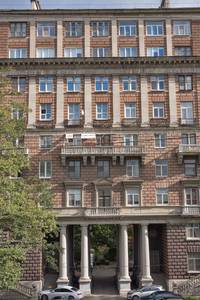
Neoclassical apartment building located at 108 Bolshoy Sampsonievsky Prospect (corner of Serdobolskaya Street), viewed across Serdobolsky Pond. The dominant structure is a residential complex known locally as the House of Specialists or sometimes nicknamed the "Bastille near Lanskaya". Designed by architects Viktor F. Belov, V.A. Potapov, and M.P. Savkevich. Built between 1953 and 1956, representing the late Stalinist "Empire" style. It was commissioned by the Klimov Plant (Zavod im. Klimova), a major manufacturer of aviation engines, to house its employees. Lesnoy Park (Lesotekhnicheskiy Universitet), Saint Petersburg, Russia, October 14, 2025  Ruins of the former "Okhotnichy Domik" (Hunting Lodge) restaurant, built in 1958 in the Stalinist Neoclassical style. The structure, located near Prospekt Engelsa, features a distinctive rotunda with columns and a now-exposed skeletal dome, having fallen into disrepair after a fire in 2010. The ruins are now heavily vandalized with graffiti and overgrown with vegetation, standing as a decaying relic of Soviet-era recreational architecture within the park. Udelnyi Park, St. Petersburg, Russia, October 4, 2025  An old transformer substation (or similar utility building) in Lanskoy Garden on Sampsonievsky Prospekt near Lanskaya train Station. Its brick walls have effectively become an unofficial community billboard, covered in layers of concert posters (e.g., for the singer Linda). Saint Petersburg, Russia, October 9, 2025  Old building of Lanskaya train stop from a passenger platform. Saint Petersburg, Russia, July 29, 2024  Mont Blanc office building on Bolshoy Sampsonievsky Prospect. Saint Petersburg, Russia, August 16, 2016  Mont Blanc office building from a crossing of Bolshoy Sampsonievsky and Finliandsky Prospect. Saint Petersburg, Russia, August 16, 2016  A house at 108 Bolshoy Sampsonievsky Prospect behind Serdobolsky Pond in Lesnoy Park. Saint Petersburg, Russia, September 22, 2016  An old transformer substation in Lanskoy Garden on Sampsonievsky Prospekt near Lanskaya train Station. This view of its brick wall focuses entirely on the gritty, tactile reality of the city--where every surface is a battleground between human attempts to cover things up (paint, posters) and nature s tendency to strip them back down (peeling, tearing, weathering). Saint Petersburg, Russia, October 9, 2025  108 Bolshoy Sampsonievsky Prospect from Serdobolsky Pond in Lesnoy Park. Saint Petersburg, Russia, October 8, 2016  A house at Bolshoy Sampsonievsky Prospect 108 from Lesnoy (Lesotekhnicheskiy Universitet) Park. Saint Petersburg, Russia, August 12, 2016  Pigeon on asphalt of a passenger platform of Lanskaya train stop. Saint Petersburg, Russia, July 29, 2024  Northern end of Vene Street (Vene ta"nav) at the intersection with Olevima"gi and Bremeni ka"ik. The red brick building on the immediate left is located at Vene 28. It is a historic structure that was originally built in 1912 as a residential building and briefly housed the Estonian Provisional Government in 1918. It stands out with its industrial-style red brick facade contrasting with the medieval stone walls nearby. The large limestone wall with the archway on the far left is part of the city s defensive fortifications, specifically near the Bremen Tower (Bremeni torn). The archway leads into Bremen Passage (Bremeni ka"ik), a short, atmospheric walkway that connects Vene Street to Uus Street through the city wall. The tower itself, a 15th-century horseshoe-shaped defensive structure, is located just behind this wall. In the background, at the end of the street, you can see the yellow tower and facade of the Orthodox Church of St. Nicholas (Nikolai kirik) at Vene 24. Designed by architect Luigi Rusca and built between 1820-1827, this Neoclassical church serves a congregation under the Moscow Patriarchate and is known for its valuable iconostasis. It sits on the site of a much older church that served Novgorod merchants in the Middle Ages. Tallinn, Estonia, October 16, 2025  An old transformer substation in Lanskoy Garden on Sampsonievsky Prospekt near Lanskaya train Station. This corner can be described as a striking example of urban decay juxtaposed with natural harmony. The scene captures a raw, "wabi-sabi" beauty--an appreciation for things that are imperfect, impermanent, and incomplete. The Wall: The brickwork is rough, weathered, and tactile. The peeling paint and chipped bricks tell a story of age and neglect. The layers of torn posters add a "trash collage" effect (reminiscent of decollage art), creating a chaotic, man-made texture that feels gritty and transient. The Ground: In stark contrast, the ground is covered in a soft, organic carpet of fallen maple leaves. This natural texture is random but harmonious, softening the harsh lines of the brick building. Saint Petersburg, Russia, October 9, 2025  Panoramic view from the Tarkhovka shoreline that looks north-west across the Sestroretsky Razliv (Lake Sestroretsk) toward the city of Sestroretsk. This view captures the dual nature of Sestroretsk: a historic resort town with natural beauty (the lake, reeds, and stones) juxtaposed with modern urban infrastructure (heating plant and high-rise housing). "Three Chimneys" (Center): The most prominent industrial feature is the cluster of three tall red-and-white striped chimneys. These belong to the Sestroretsk District Heating Plant (part of the city s thermal infrastructure). Residential Towers (Left of Chimneys): The tall, beige-and-orange brick apartment buildings are part of the modern residential developments in Sestroretsk, likely along Tokarevskaya Street or the Razliv microdistrict. Church of Peter and Paul (Far Right): On the far right horizon. This is a modern church (consecrated in 2009) built in memory of the Russian submariners. "Pyramid" Building (Far Left): On the far left, there is a distinctive white building with a stepped, pyramid-like shape. This is likely the "Eden" (Edem) residential complex or a similar luxury apartment block, which is known for its terraced architecture. Tarkhovka Park near Sestroretsk, west from Saint Petersburg. Russia, October 3, 2025  Enclosed pedestrian overpass at the Kannelyarvi railway station, located on the Karelian Isthmus roughly 75 km northwest of St. Petersburg. This overpass is a modular steel structure clad in translucent polycarbonate panels. The structure is a characteristic example of the standardized "blue tube" pedestrian bridges installed by Russian Railways (RZD) during the widespread modernization of the St. Petersburg-Vyborg line in the late 2000s. Russia, October 1, 2025  A quiet, atmospheric section of Pikk Street (near Pikk 5 and 7), one of the oldest and most important commercial streets in medieval Tallinn. Veta Fashion (Pikk 6/8): On the left, the brightly lit shop window belongs to Veta, a well-known Estonian brand specializing in knitwear and linen clothing. The building itself features a classic stucco fac,ade with large display windows that invite passersby to look in. On the right, the building with the blue-and-red wooden door (Pikk 5) is home to the Noku Klubi, a somewhat "secret" bohemian cultural club and restaurant located on the upper floor. The heavy, colorful door is a distinctive landmark for locals knowing where to find this hidden gem. Further up on the right, the red brick building with Gothic-style pointed arches stands out against the plastered facades, adding texture and historical depth to the streetscape. Tallinn, Estonia, October 16, 2025  Old Passenger Terminal of Tallinn Airport. Built between 1945 and 1954 (opened in 1955), this building is a classic example of Stalinist architecture. Its symmetrical facade, rusticated ground floor, and the distinctive control tower with a viewing gallery reflect the monumental style favored in the Soviet Union during that period. An earlier Art Deco/Functionalist terminal was designed in 1938 by the architect Arthur Ju"rvetson, but construction was halted by World War II. The post-war redesign incorporated the Soviet aesthetic. This building served as the main passenger terminal until 1980, when a new, larger terminal (the current one) was built for the Moscow Olympics sailing regatta held in Tallinn. Today, this historic building has been repurposed for VIP services and administrative offices. It stands separately from the modern glass-and-steel terminal but remains an integral part of the airport s history, visible to passengers taxiing on the runway. View from a window of an airplane from Tallinn to Helsinki. Estonia, October 17, 2025  "Golden Autumn" view from a residential balcony in the Svetlanovsky Prospect area of Saint Petersburg. This view reflects a peaceful, everyday moment of beauty typical of Saint Petersburg s residential "sleeping districts" during the short but spectacular peak of autumn. Russia, October 14, 2025  Decorative vase, located in the parterre of the park near the Main Building of the Forestry University, a concrete copy of a 19th-century original. The original vase was created in the 1860s by the famous sculptor David Jensen (1816-1902). The original work was carved from unpolished granite. Today s version is a concrete replica installed in the 1970s. The central motif depicts putti (cherubs), which are playful, chubby male children often found in classical art. The putti appear to be engaged in a playful struggle with a goat, a common allegorical theme in baroque and neoclassical art often representing the abundance of nature or Bacchic festivities. This theme fits well with the park s history as a place of botanical study and appreciation of nature. Lesnoy Park (Lesotekhnicheskiy Universitet), Saint Petersburg, Russia, October 14, 2025  Neoclassical building at 31 Kutuzova Street. Vyborg, Russia, August 5, 2024  Monument to Alexander Lanskoy (often referred to as the Pamyatnik Lanskomu or simply the marble pedestal/urn), located on the Rose Field (Rozovoe Pole) in Catherine Park. It was erected by Catherine the Great in memory of her young favorite, Alexander Lanskoy, who died suddenly in 1784 at the age of 26. The monument is an example of Neoclassical funerary art, likely designed by Antonio Rinaldi or possibly Giacomo Quarenghi. It features a high pedestal made of grey and pink marble, adorned with bas-reliefs and inscriptions (though these are often weathered). Pushkin (former Tsarskoe Selo) near Saint Petersburg, Russia, October 10, 2025  Example of Art Nouveau architecture in Tallinn, located at Pikk 18. It was designed by the renowned Baltic German architect Jacques Rosenbaum and completed in 1910. The design is celebrated for its flamboyant and fantastical style, which stands in stark contrast to the surrounding medieval architecture. The building is often referred to as the Draakoni Gallery (Dragon Gallery) because of the two large, sculpted dragons flanking the main ground-floor window. These sculptures were created by the famous Riga sculptor August Volz. The fac,ade is uniquely decorated with Egyptian-inspired themes, including reliefs of sphinxes and pharaonic figures at the top of the pilasters, adding to its exotic and eclectic appearance. The building features a distinctive curved corner tower with a slender spire, oval windows, and intricate floral ornaments typical of the late Art Nouveau period. Tallinn, Estonia, October 16, 2025  This street scene is located on Pikk Street, just north of the Pikk Jalg gate, looking back towards the city center. The baroque spire visible in the distance belongs to St. Nicholas Church (Niguliste kirik). Originally built in the 13th century and dedicated to the patron saint of merchants and seafarers, it is one of the city s most defining landmarks. The tower now features a glass elevator and viewing platform offering 360-degree views of the Old Town. The building at the corner (implied by the location) is part of the historic Kolmjalg ("Tripod") complex, a notable architectural feature at the junction of Pikk and Voorimehe streets, known for its medieval origins. Estonia, October 16, 2025  Stone bear from an old railway station building on Vokzalnaya Street in Vyborg. Russia, May 24, 2019  Graffiti series, located on the concrete retaining wall separating the beach from the promenade along the Gulf of Finland (near the Sestroretsk Resort or "Kurort" area) which is a fanciful and nostalgic mural composition featuring whimsical animals and nature motifs. A distinct horizontal band runs across part of the mural, depicting a long, grey commuter train (possibly an elektrichka) traveling through a green landscape. This element likely references the vital railway connection between St. Petersburg and the resort towns of the Kurortny District, a familiar sight for locals and visitors. Saint Petersburg, Russia, October 9, 2025  A section of Uus Street (New Street), a quieter and historically significant lane on the eastern edge of Tallinn s Old Town. The sign on the right marks the entrance to the Haus Gallery (Uus 17). Founded in 1997, it is one of the oldest and most respected private art galleries in Estonia, known for exhibiting both classic and contemporary Estonian art. The gallery is located in a historic building with a large courtyard often used for events. Just beyond the gallery, the flag hanging from the building (Uus 15) is the tricolor of Lithuania, identifying the Embassy of the Republic of Lithuania. This establishes the street as a diplomatic quarter as well. The image starkly contrasts the well-maintained facades of the embassy and gallery on the right with the heavily graffitied and peeling wall of the yellow building on the left (likely the rear or side of a building facing the parallel Sulevima"gi street). This juxtaposition highlights the ongoing struggle with tagging in less-monitored corners of the Old Town. Uus Street runs parallel to the old city wall (parts of which are visible nearby). Historically, it was developed later than the central merchant streets (hence "New Street"), originally serving as a defensive zone before being built up with residential houses for craftsmen and lesser merchants. Tallinn, Estonia, October 16, 2025  A view of the Pavlovsk Palace seen from the Triple Lime Avenue. Planted by Charles Cameron in the 1780s using linden trees imported from Lu"beck, this avenue was designed as the grand formal approach to the palace. The building at the end is the garden facade of the Great Palace. The dark figure standing in front of the palace is the statue of Paul I. Pavlovsk, a suburb of Saint Petersburg, Russia, October 15, 2025  Debarcadere (train shed) of the Vitebsky Railway Station in St. Petersburg (industrial Art Nouveau architecture). Russia, October 6, 2025  This view of Pikk Street highlights the blend of commerce and history that has defined the area for centuries. The foreground features the large display windows of Pikk 12 and the red sign for Oh la la, a well-known gift shop at Pikk 10. These buildings continue the street s medieval legacy as the primary commercial artery connecting the harbor to the upper town. On the right, the prominent "LIVONIA" sign marks a shop specializing in traditional Estonian linen and wool products, housed in a building that respects the historic streetscape. Further down at Pikk 12 (corner), the "Veta" sign indicates a brand store known for knitwear, located in a building with a distinctive rounded corner bay window. The blue and yellow flag flying further down the street marks the location of the Swedish Embassy at Pikk 28. Housed in the magnificent von Rosen Palace (dating from the 1670s), it stands as a reminder of the Swedish era in Estonia s history. Estonia, October 16, 2025  Large brick building of the Officer s Building (Officers Assembly) of the Fort Shanetz. Kronstadt, Russia, September 27, 2025  A white vintage stove in a distinctive blue building of Company B, a shop specializing in antiques, vintage-inspired gifts, and home decor at 506 South Main Street. Calvert, Texas, December 13, 2025 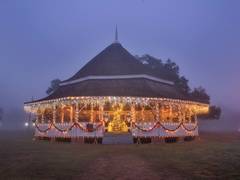 Historic octagonal pavilion (1895) located in Virginia Field Park. It features a distinctive two-tiered roof and elaborate Victorian gingerbread trim ("carpenter Gothic" details). It was designed for concerts, community gatherings, and dancing. It has also been dedicated as the Karen Renee Wiese Memorial Pavilion in more recent years. Calvert, Texas, December 13, 2025  A lively intersection of Suur-Karja and Vana turg. The central white building with the high, decorated gable (Suur-Karja 1) is a significant medieval structure known as the Bishop s House. Dating back to the 13th-14th centuries, it historically served as the residence for the bishops of Tallinn. Its facade features Gothic niches and a hoist beam, typical of wealthy Hanseatic merchant homes. To the right, the outdoor terrace belongs to Kuldse Notsu Ko~rts (Golden Piglet Inn), located at Dunkri 8 (which intersects here). This restaurant is famous for its authentic Estonian cuisine, serving dishes like sausage feasts and pork knuckle based on traditional recipes. On the far left, the corner of the heavy stone building (Suur-Karja 18) houses residential apartments. The area is a bustling hub, filled with restaurants and cafes that spill out onto the cobblestones, overlooked by the spire of St. Nicholas Church in the background. Tallinn, Estonia, October 16, 2025  Grotto Pavilion and Great Pond (Bolshoy Prud) in Catherine Park. Pushkin (former Tsarskoe Selo) near Saint Petersburg, Russia, October 10, 2025  Residential courtyard near Svetlanovsky Prospekt transformed by the vibrant colors of "Golden Autumn". Saint Petersburg, Russia, October 13, 2025  SNT "Rodnik" (Garden Non-Commercial Partnership "Rodnik") adjacent to the Kannelyarvi railway station in November, showcasing a quiet, frosty late-autumn scene typical of the Karelian Isthmus. North from Saint Petersburg, Russia, October 1, 2025  Old Turkish Railway Water Tower among modern residential buildings. Beer-Sheva, the Middle East, December 22, 2000  Serdobolsky Pond of Lesnoy Park near Lanskaya train station. Saint Petersburg, Russia, June 26, 2003  Fall colors at Big Lamsky Pond (Bolshoy Lamskoy Prud). Aleksandrovsky (Alexander) Park in Pushkin (former Tsarskoe Selo) near Saint Petersburg, Russia, October 10, 2025  A museum exhibit inside the historical Coastal Fort "Reef" The scene reconstructs a Soviet-era military office or command post (likely a clerk s or commander s office) located within one of the fort s fortified casemates. Kronstadt, Saint Petersburg, Russia, September 27, 2025  A decommissioned industrial steel fuel storage tank rests along auxiliary railway spurs near a former Soviet military supply depot west of Toksovo, Leningrad Oblast, photographed in September 2000. Boldly hand-painted with a warning deterring scrap-metal scavengers - "Do not take! Private property, guarded!" alongside a St. Petersburg telephone number - the salvaged petroleum reservoir, complete with its intact service ladder, inspection platform, and breather valve, illustrates the turbulent post-Soviet liquidation and commercial repurposing of army assets. 10 miles north from Sankt Petersburg. Russia, September 27, 2000  Area near a metal bridge located near the Small Caprice (Malyi Kapriz) in Catherine Park. Pushkin (former Tsarskoe Selo) near Saint Petersburg, Russia, October 10, 2025  Debarcader (train shed) of the Vitebsky Railway Station, Russian Art Nouveau (Style Moderne). Massive riveted steel spans were designed by architect Stanislav Brzhozovsky and engineer Sima Minash. It is serving the historic route to Tsarskoye Selo (Pushkin) and Pavlovsk. Saint Petersburg, Russia, October 15, 2025  Graffiti on Massinen s residential building at 15 Leningradskoe shosse. Vyborg, Russia, August 5, 2024  Coutyard of Massinen s residential building at 15 Leningradskoe shosse. Vyborg, Russia, August 5, 2024  Entrance of Massinen s residential building at 15 Leningradskoe shosse. Vyborg, Russia, August 5, 2024  Historic Old First National Bank building (1887), former CocoaModa, a high-end chocolate shop and bakery run by chef Ken Wilkinson, and now Vintage Treasures, an antique and collectibles shop, located at 518 South Main Street. Calvert, Texas, December 13, 2025  Memorial Gates "To My Dear Fellow Servants", a historical monument located on the boundary of the Catherine Park in Pushkin (Tsarskoye Selo). Saint Petersburg, Russia, October 10, 2025  Azure blue walls and white columns of Grotto Pavilion sitting on the edge of Great Pond (Bolshoy Prud) in Catherine Park. Pushkin (former Tsarskoe Selo) near Saint Petersburg, Russia, October 10, 2025  Interior of St. Peter and St. Paul s Cathedral (Peeter-Pauli katedraal), located at Vene 18. This is the main cathedral for the Roman Catholic Diocese of Tallinn and one of the few Catholic churches in a predominantly Protestant and secular country. The church was built between 1841 and 1844 on the walls of the former refectory (dining hall) of the medieval St. Catherine s Monastery. The Neoclassical fac,ade and twin towers were added later in the 1920s by architects Erich Jacoby and Franz de Vries. The space is characterized by its high vaulted ceilings and light, airy atmosphere. Tallinn, Estonia, October 16, 2025  View from an apartment window showing lived-in atmosphere of a residential block near Svetlanovsky Prospekt, characterized by 1970s brick architecture softened by mature greenery. Saint Petersburg, Russia, October 13, 2025  Central Railway Station from Railway Square. Helsinki, Finland, July 18, 2015  Spillway of a Finnish hydroelectric power plant on the Volchya River (formerly Saijanjoki), located near the village of Peta"ja"rvi (now Petrovskoye) in the Leningrad Region. Petyayarvi north from Saint Petersburg, Russia, October 5, 2025  Vitebsky Railway Station. Saint Petersburg, Russia, August 23, 2013  Statue of Aleksis Kivi and Central Railway Station from Railway Square. Helsinki, Finland, July 18, 2015  Remnants of an engineering testing structure or "polygon" located on the shoreline near Fort Reef and Fort Shanetz. Kronstadt, Russia, September 27, 2025  A view from a window near Svetlanovsky Prospekt that offers an intimate look into a typical residential courtyard (dvor) of the Vyborgsky District. The beige brick buildings framing the scene are classic examples of brick Khrushchev-era apartments (or early Brezhnev-era), likely built in the 1960s. The 5-story height was standard to avoid the mandatory installation of elevators, which was required for buildings of 6 stories or more. This layout reflects the Soviet microdistrict concept, where residential blocks were arranged around green, communal courtyards to provide light, air, and recreation space away from the main roads. Saint Petersburg, Russia, October 14, 2025  The lower end of Pikk Street, looking back up towards the Town Hall spire. It captures a charming intersection where the street forks. Corner Building (Pikk 12 / Kinga 10): The centerpiece of the image is the distinctive corner building with a mansard roof and red tiles. It houses another branch of the Veta linen and knitwear shop. The building s shape is triangular, adapting to the acute angle where Pikk and Kinga streets meet. Its architecture is a mix of styles, with a portal that hints at older origins but a roofline that suggests 19th or early 20th-century modification. In the distance to the left, you can clearly see the illuminated spire of the Tallinn Town Hall rising above the rooftops, serving as a navigation point for anyone walking up Pikk Street. Tallinn, Estonia, October 16, 2025  Hall of Vitebsky Railway Station. Saint Petersburg, Russia, August 23, 2013  Train in Vitebsky Railway Station. Saint Petersburg, Russia, August 23, 2013  Rataskaevu Street (Rataskaevu ta"nav) in Tallinn s Old Town. The focal point in the small square is the famous Cat s Well (Rataskaevu), which gave the street its name. According to local legend, a water spirit lived in the well, and the townspeople would sacrifice stray cats into it to prevent the wells from running dry. The yellow building on the left (Rataskaevu 7) houses the St. Petersbourg Hotel. It is the oldest operating hotel in Tallinn, originally opened in 1850 and located in a 15th-century building that was once a Russian merchant s home. Opposite the well (out of frame to the right, but significant to the street s lore) is the building at Rataskaevu 16, famously known as the site of "The Devil s Wedding." Legend says the devil held a party in the upper room of this house, and to this day, there is a painted "false window" on the facade to block the view into that haunted room. The building now houses a very popular restaurant of the same name. Tallinn, Estonia, October 16, 2025  A building at 5 lit. B Engelsa Prospect which is a surviving historical service corps of the Orlovo-Novosiltsevskaya Almshouse complex. This small brick structure was originally built as one of the auxiliary buildings (likely for staff or utility purposes) for the larger almshouse institution. The main complex, located at Engelsa 1-5, was a major philanthropic center established in the 1830s. The complex was designed by the renowned architect Iosif Charlemagne (Joseph-Maria Charlemagne-Baudet) in the late Classicist style. It was constructed between 1834 and 1841. Lesnoy Park (Lesotekhnicheskiy Universitet), Saint Petersburg, Russia, October 14, 2025  So~prus Cinema (Kino So~prus). The building is a striking example of Stalinist Empire style (Socialist Classicism) architecture, completed in 1955. Its grand fac,ade features a curved colonnade of octagonal columns and decorative reliefs symbolizing various arts and industries. Originally designed by architect Friedrich Wendach, the project was completed by Peeter Tarvas and August Volberg after Wendach was repressed by Soviet authorities. The name "So~prus" means "friendship" in Estonian. Some sources suggest it was named to mark improved relations between the Soviet Union and China at the time. In the 1990s, financial difficulties led to the closure of one hall, which was converted into a nightclub and casino. Today, the building houses both the cinema and the popular Club Hollywood. Tallinn, Estonia, October 16, 2025  Entrance hall of Vitebsky Railway Station. Saint Petersburg, Russia, August 23, 2013  Grand stairs of Vitebsky Railway Station. Saint Petersburg, Russia, August 23, 2013  Bolshoy Lamskoy Bridge (Large Lamskoy Bridge) area, which connects the Big and Upper Lamskoy Ponds. Aleksandrovsky (Alexander) Park in Pushkin (former Tsarskoe Selo) near Saint Petersburg, Russia, October 10, 2025  Big Lamsky Pond (Bolshoy Lamskoy Prud), part of a system of ponds originally dug in the early 19th century to drain the park s marshy terrain. Aleksandrovsky (Alexander) Park in Pushkin (former Tsarskoe Selo) near Saint Petersburg, Russia, October 10, 2025  Joseph A. Foster House at 307 East Texas Street, a corner of Beech Street. It was built as a Gothic Revival structure in 1878, reflecting the Victorian tastes of the era. The facade is symmetrical with a central entrance, characteristic of the Neoclassical style. The house was severely damaged by a tornado spawned by the 1900 Galveston Hurricane. Following this disaster, it was extensively remodeled into the Neoclassical (Greek Revival) style. It has been the subject of historic preservation efforts, with significant renovation projects reported around 2018. Calvert, Texas, December 13, 2025  Princess Lieven s Island, a small artificial island located in the center of the Rose Pavilion Ponds in Pavlovsk Park. Pavlovsk, a suburb of Saint Petersburg, Russia, October 15, 2025  A.S. in front of a black Lenin s monument on Vitebsky railway station. Saint Petersburg, Russia, April 7, 1999.  The surviving granite base of the 1917 railway water tower on Station Square in Toksovo, Leningrad Oblast. Designed in the Nordic National Romantic style by Finnish architect Urho Pa"llia" for the Saint Petersburg-Hiitola railway line, the structure features rusticated Karelian stone quoins, a segmental arched portal, and a date plaque; its upper half-timbered wooden reservoir reservoir tier had burned down in the 1990s, leaving the masonry plinth derelict prior to receiving regional cultural heritage status. 8 miles north from Saint Petersburg. Russia, August 1, 2012  This aerial view shows the suburban landscape of Coppell, Texas, where State Highway 121 merges with the Sam Rayburn Tollway, just north-northwest of DFW International Airport. The prominent highway is the confluence of SH 121 and the Sam Rayburn Tollway, a critical artery connecting the northern Dallas suburbs. The complex interchange and heavy traffic are characteristic of the DFW metroplex s extensive highway system. The natural waterway winding through the scene is Denton Creek. The creek and the surrounding ponds create a greenbelt that offers a natural buffer between the highway and residential areas . These water features are integral to the master-planned communities in Coppell, providing both drainage and recreational space. The dense, master-planned neighborhoods with their distinctive gray roofs are typical of Coppell. On the right, the development is part of the Riverchase area, while the homes in the upper left are also part of Coppell s extensive suburban grid. The large white buildings in the lower-left are warehouses and logistics centers, strategically located near DFW Airport and the major highway interchange for easy distribution. View from a window of an airplane from Helsinki to Dallas, Greenland, October 17, 2025  Scenery near Bolshoy Prud (Big Pond). The landscape is a rich tapestry of deciduous hardwoods like maple, linden, and birch turning brilliant shades of gold and ochre, contrasted by the deep green of spruce and other evergreens. Sergievka Park near Universitet, Old Peterhof, west from Saint Petersburg, Russia, October 13, 2025  A detailed look at the suburban landscape of Tikkurila, the administrative center of Vantaa, located just north of Helsinki. Kerava River (Keravanjoki): The winding river cutting through the landscape is the Kerava River, a tributary of the Vantaa River. It flows past residential areas and parks, offering a scenic green belt through the suburbs. The denser cluster of buildings in the center-right is the heart of Tikkurila (Dickursby). This area is a major transport hub, home to the Tikkurila railway station (a key stop for airport trains) and the Heureka Science Centre (likely one of the larger modern structures near the river). Suburban Fabric: The image showcases a mix of housing types typical of the Helsinki metropolitan area: detached houses with large gardens in the foreground and denser apartment blocks closer to the Tikkurila center. The presence of a sports field with a running track (red oval, left side) highlights the community-focused planning. Rural-Urban Edge: The top and left portions of the image show open fields and farmland, illustrating how abruptly the urban area transitions into the countryside in this region. This area is minutes away from landing at Helsinki-Vantaa Airport, making it a common sight for travelers. View from a window of an airplane from Tallinn to Helsinki, Finland, October 17, 2025  Maple alley near a building of the Forestry Academy. Lesnoy Park (Lesotekhnicheskiy Universitet), Saint Petersburg, Russia, October 14, 2025  A yard on Bolshoy Prospekt of Petrogradskaya Storona District. Sankt Petersburg, Russia, September 29, 2000  Vana turg (Old Market) square, a historic intersection where several streets meet. The white building on the right with the prominent hoist beam and red sack is the Peppersack restaurant (Vana turg 6). It is a well-known medieval-themed venue located in a 14th-century merchant s house. The large, pinkish building on the left (at the corner of Suur-Karja and Kuninga) is the Bishop s House (Piiskopi maja). It stands on the site of the medieval residence of the bishops of Tallinn. The current facade is later, but the core of the building is ancient, and it has historically housed the Consistory of the Estonian Evangelical Lutheran Church. Just out of frame or partially visible (depending on the exact angle, as it is adjacent to Peppersack), this area is also home to Olde Hansa, another famous medieval restaurant housed in a historic warehouse. Tallinn, Estonia, October 16, 2025  Grand Cascade (also known as the Ruined Cascade), located near the Round Pond in the Old Sylvia/White Birch district of Pavlovsk Park. Designed by Vincenzo Brenna in 1794, it was built to look like a romantic "antique ruin." Pavlovsk, a suburb of Saint Petersburg, Russia, October 6, 2025  View of a late-Soviet brick residential quarter (kirpichnaya khrushchevka) deeply integrated with the mature nature of the Vyborgsky district, captured at the beautiful but fleeting peak of autumn. View from this window providing a glimpse into Soviet-era urban planning, specifically the residential design of the 1960s. The beige brick buildings visible in the frame are classic examples of "Khrushchevka" (Series 1-528). Unlike the cheaper concrete panel blocks (panelki), these are constructed from silicate brick, which was considered a "premium" material for mass housing at the time. They are easily identified by their 5-story height, hipped roofs (often replaced with metal sheeting), and specific balcony arrangements. Saint Petersburg, Russia, October 11, 2025  A rustic stone bridge of Sergievka Park s hydraulic system, spanning the small creek that connects the Bolshoy Prud (Big Pond) and the Ogorodny Prud (Kitchen Garden Pond). Sergievka Park, Old Peterhof, west from Saint Petersburg, Russia, October 13, 2025  Evening view of Lai Street (looking towards St. Olaf s Church). The large grey building on the right (Lai 44/46) stands out with its curved bay windows and decorative facade elements. This is a fine example of Jugendstil (Art Nouveau) architecture, which appeared in Tallinn during the early 20th century. Its smoother lines and larger windows contrast sharply with the smaller medieval merchant houses nearby. On the left, the yellow building (Lai 33) retains a more traditional, modest scale typical of the street s residential past. At the end of the street, the illuminated white tower of St. Olaf s Church (Lai 50) acts as a dramatic focal point. The lighting accentuates the church s massive walls and the green copper spire against the twilight sky. Tallinn, Estonia, October 16, 2025  Saint Petersburg State Forestry University (often referred to historically as the Forestry Academy or Lesotekhnicheskaya Akademiya). Established in 1803 by decree of Emperor Alexander I as the Practical Forestry School in Tsarskoye Selo. In 1811, it was moved to its current location in the Vyborgsky District of Saint Petersburg, occupying the site of an old English dairy farm. The classical white building shown in the photo is the Main Educational Building. Originally constructed as four separate corps between 1826 and 1833 by architects I.F. Lucchini and A. Nellinger, these were later united into a single complex with a central courtyard in the late 1830s. Lesnoy Park (Lesotekhnicheskiy Universitet), Saint Petersburg, Russia, October 14, 2025  This view of the installation near the Russian embassy on Pikk Street captures a broader perspective of the protest site, showing how it stretches along the sidewalk in front of the embassy building. The white banner in the foreground originally read "FOR THE VICTIMS OF WARS STARTED BY RUSSIA" (with the Russian translation on the right). However, someone has vandalized the sign by crossing out "RUSSIA" and scrawling "US" and a Star of David (hexagram) over it. This act of vandalism attempts to deflect blame from Russia by invoking anti-American and antisemitic tropes, a tactic often seen in pro-Kremlin disinformation campaigns. On the left side of the street, the building with the distinctive Art Nouveau facade (Pikk 18) houses the Ron Verlin salon, visible through the large arched window. This contrasts the elegant, peaceful commercial life of the street with the raw political conflict playing out just meters away. The fencing extends far down the street, covered in layers of posters, flags, and messages. This indicates the sustained nature of the demonstration, which has become a semi-permanent fixture in the Old Town since the start of the full-scale invasion. Tallinn, Estonia, October 16, 2025  This rustic bench is a distinctive feature of landscaping style, known as the "Sentimentalist" tradition. Unlike the ornate iron benches, this bench is made of simple, whitewashed logs. This design choice is deliberate, reflecting the 18th-century fashion for "rural simplicity" (championed by Maria Feodorovna and designers like Charles Cameron). Pavlovsk, a suburb of Saint Petersburg, Russia, October 15, 2025  People waiting elektrichka (electric train) to go to their dachas (summer houses), on the platform of Deviatkino Station. Saint Petersburg, Russia, July 28, 2005  A.S. at 52 Bolshoy Prospect of Vasilyevsky Island. Saint Petersburg, Russia, May 16, 2015  Devil s Bridge (Chertov Most), also known as the Cascade, located near the Upper Ponds in Catherine Park. Built in the 1770s, likely designed by the architect Vasily Neyelov or possibly Antonio Rinaldi, this structure is a classic example of the romantic "ruin" aesthetic popular in 18th-century landscape gardening. Pushkin (former Tsarskoe Selo) near Saint Petersburg, Russia, October 10, 2025  Remains of a Finnish hydroelectric power plant on the Volchya River (formerly Saijanjoki), located near the village of Peta"ja"rvi (now Petrovskoye) in the Leningrad Region. The dam structure, including the concrete pillars and spillway, is still standing, creating a scenic waterfall that is a popular tourist stop on the Vyaryamyanselka Ridge eco-trail. Petyayarvi north from Saint Petersburg, Russia, October 5, 2025  View of Indiana Avenue around intersection with Capitol Avenue from the 17th floor of One American Square building. Indianapolis, December 1, 1999.  Hutchings - Sealy Building (c. 1895) at 2326-28 Strand Avenue, a corner of Mitchell Avenue. Galveston, Texas, March 2, 2008  Bolshoy Prospect of Vasilyevsky Island. Saint Petersburg, Russia, February 1, 2000  Passage at 64 Bolshoy Prospect of Vasilyevsky Island. Saint Petersburg, Russia, May 16, 2015  Residential building QQ-07 in Qanat Quartier (Venetian style waterfront village) at sunrise. Pearl Development Project, Doha, Qatar, January 23, 2015  Entrance of a house near 52 Bolshoy Prospect of Vasilyevsky Island. Saint Petersburg, Russia, May 16, 2015  A yard on Shpalernaya Street opposite to Bolshoy Dom. Saint Petersburg, Russia, August 27, 2007  11 Naberezhnaya Reki Bolshoy nevki on Kamennyi Ostrov. Saint Petersburg, Russia, June 14, 2009  In a yard near Bolshoy Prospect in Petrogradskaya Storona neighborhood. Saint Petersburg, Russia, July 30, 2004  Liteiny Bridge at night, with KGB headquarters (Bolshoy Dom) in background. Saint Petersburg, Russia, August 4, 2004  Bolshoy Dom, FSB (secret police) headquarters on Liteyny Prospect. Saint Petersburg, Russia, August 27, 2007 |