 |
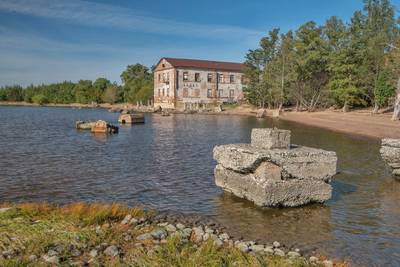
3755-06. Large brick building of the Officer s Building (Officers Assembly) of the Fort Shanetz. Kronstadt, Russia, September 27, 2025Similar picturesLarge thumbnails | Use small thumbnails | View as slideshow |
|
3755-06. Large brick building of the Officer s Building (Officers Assembly) of the Fort Shanetz. Kronstadt, Russia, September 27, 2025Similar picturesLarge thumbnails | Use small thumbnails | View as slideshow |
 Ruined brick tower on the beach, which is the remains of a searchlight station (prozhektornaya stantsiya) belonging to Fort Shanetz. Kronstadt, Russia, September 27, 2025  Rangefinder (dalnomernyi) pavilion belonging to one of the coastal batteries of the Kronstadt fortress, situated near Fort Shanetz. Kronstadt, Russia, September 27, 2025  Remnants of an engineering testing structure or "polygon" located on the shoreline near Fort Reef and Fort Shanetz. Kronstadt, Russia, September 27, 2025  Interior of a shaft for a "disappearing" Moncrieff gun within the fort s underground galleries in the historical Coastal Fort "Reef". The large hole in the ceiling "Oculus" is not a window or a skylight, but a gun pit. The rough, stained concrete walls and heavy metal brackets on the walls are remnants of the lifting mechanism and the platforms where the gun crew would operate. Kronstadt, Russia, September 27, 2025  A quiet, atmospheric section of Pikk Street (near Pikk 5 and 7), one of the oldest and most important commercial streets in medieval Tallinn. Veta Fashion (Pikk 6/8): On the left, the brightly lit shop window belongs to Veta, a well-known Estonian brand specializing in knitwear and linen clothing. The building itself features a classic stucco fac,ade with large display windows that invite passersby to look in. On the right, the building with the blue-and-red wooden door (Pikk 5) is home to the Noku Klubi, a somewhat "secret" bohemian cultural club and restaurant located on the upper floor. The heavy, colorful door is a distinctive landmark for locals knowing where to find this hidden gem. Further up on the right, the red brick building with Gothic-style pointed arches stands out against the plastered facades, adding texture and historical depth to the streetscape. Tallinn, Estonia, October 16, 2025  Va"ike-Karja Street (Va"ike-Karja ta"nav), likely taken near its intersection with Suur-Karja Street. The building on the right with the large grey stone archway and iron gates corresponds to Va"ike-Karja 1 (also known as the Saarinen House), a prominent Art Nouveau building designed by Finnish architect Eliel Saarinen. The street features a mix of architectural styles. The grey stone building on the right is a notable example of early 20th-century national romanticism. Further down the street, you can see pastel-colored facades typical of Tallinn s Old Town. Tallinn, Estonia, October 16, 2025  A striking architectural contrast on Sauna Street (Sauna ta"nav), near the intersection with Va"ike-Karja Street. On the left, a modern glass-and-steel building features large display windows and industrial-style staircases, illuminated by neon lights. This building is part of the Helios Hall complex (formerly the Helios Cinema), which has been repurposed as an event venue and art space. The transparent facade allows a view into the contemporary interior, contrasting sharply with the solid, historic walls of the Old Town. On the right, the corner of an older, plastered building (Sauna 12) is covered in colorful, abstract graffiti. This gritty, urban element acts as a foil to the clean lines and slick surfaces of the modern building opposite it, highlighting the eclectic mix of styles in this part of the city. Tallinn, Estonia, October 16, 2025  A perspective of Rataskaevu Street, looking up the gentle slope towards the intersection with Niguliste Street. The building on the right with the striking yellow and grey modern facade and large arched window is home to Casa Alta, an Italian restaurant. The architecture of this building stands out for its postmodern interpretation of the gabled roofline, contrasting with the older structures nearby. The pinkish-red building on the left side of the street (Rataskaevu 6) is a historic property. It currently houses Restoran O~ (or a similar establishment depending on recent changes), known for its fine dining in a medieval setting. Further down on the left, you can see signs for other venues like De 6 and Vana Tallinn. Tallinn, Estonia, October 16, 2025  Ruins of Administration Building, flagstaff and Officers Row in Camp Reynolds (West Garrison) near Perimeter Road in Angel Island State Park near San Francisco. Tiburon, California, March 15, 2024  Pikk Street (Pikk ta"nav) in Tallinn s Old Town, specifically showing the facades of two notable Art Nouveau buildings at numbers 18 and 16. The building on the right with the dramatic facade featuring dragon sculptures is the famous "Dragon Gallery" (Draakoni galerii). Designed by architect Jacques Rosenbaum and completed in 1910, it is a masterpiece of Art Nouveau architecture. The facade is adorned with fantastical elements, including two large dragons flanking the ground-floor window, Egyptian women, and sphinxes. It currently houses an art gallery managed by the Estonian Artists Association. The building directly next to it on the left (the narrower one with large windows) is Pikk 16. It currently houses the BonVerre shop, visible through the ground-floor window, which specializes in beverages and gourmet products. Further down the street on the left (the grey building with the green flag) is the Kanuti Gildi Saal (St. Canute s Guild Hall), a historic building that now serves as a contemporary performing arts center. Tallinn, Estonia, October 16, 2025  A museum exhibit inside the historical Coastal Fort "Reef" The scene reconstructs a Soviet-era military office or command post (likely a clerk s or commander s office) located within one of the fort s fortified casemates. Kronstadt, Saint Petersburg, Russia, September 27, 2025  An old transformer substation (or similar utility building) in Lanskoy Garden on Sampsonievsky Prospekt near Lanskaya train Station. Its brick walls have effectively become an unofficial community billboard, covered in layers of concert posters (e.g., for the singer Linda). Saint Petersburg, Russia, October 9, 2025  Old service building near a brick house at 12 Krasina Street. Vyborg, Russia, August 5, 2024  Northern end of Vene Street (Vene ta"nav) at the intersection with Olevima"gi and Bremeni ka"ik. The red brick building on the immediate left is located at Vene 28. It is a historic structure that was originally built in 1912 as a residential building and briefly housed the Estonian Provisional Government in 1918. It stands out with its industrial-style red brick facade contrasting with the medieval stone walls nearby. The large limestone wall with the archway on the far left is part of the city s defensive fortifications, specifically near the Bremen Tower (Bremeni torn). The archway leads into Bremen Passage (Bremeni ka"ik), a short, atmospheric walkway that connects Vene Street to Uus Street through the city wall. The tower itself, a 15th-century horseshoe-shaped defensive structure, is located just behind this wall. In the background, at the end of the street, you can see the yellow tower and facade of the Orthodox Church of St. Nicholas (Nikolai kirik) at Vene 24. Designed by architect Luigi Rusca and built between 1820-1827, this Neoclassical church serves a congregation under the Moscow Patriarchate and is known for its valuable iconostasis. It sits on the site of a much older church that served Novgorod merchants in the Middle Ages. Tallinn, Estonia, October 16, 2025  Rebuilding of the Forest Building (Russian: Lesnoy Korpus) in a major reconstruction project at the historic Sestroretsk Resort (Sestroretsky Kurort). The original Sestroretsk Resort was a famous health spa complex founded in 1898 by engineer Peter Avenarius. It featured several grand wooden structures, including a massive Kursaal (concert hall), a mud bath facility, and the Forest Building. The resort was a hub for St. Petersburg s elite and intelligentsia in the early 20th century. The original Forest Building was a beautiful wooden hotel and sanatorium building constructed in the early 1900s. It was a key part of the ensemble but was destroyed during World War II. The new structure faithfully replicates the "Northern Art Nouveau" style of the original resort architecture, characterized by its complex roofline, spires, towers, and wooden detailing that harmonizes with the surrounding pine forest and dunes. The exterior appears nearly complete, showing the elaborate wooden facade, the large central dome, and the corner towers with their needle-like spires. The scaffolding indicates that finishing work is still in progress. Saint Petersburg, Russia, October 9, 2025  Vana turg (Old Market) square, a historic intersection where several streets meet. The white building on the right with the prominent hoist beam and red sack is the Peppersack restaurant (Vana turg 6). It is a well-known medieval-themed venue located in a 14th-century merchant s house. The large, pinkish building on the left (at the corner of Suur-Karja and Kuninga) is the Bishop s House (Piiskopi maja). It stands on the site of the medieval residence of the bishops of Tallinn. The current facade is later, but the core of the building is ancient, and it has historically housed the Consistory of the Estonian Evangelical Lutheran Church. Just out of frame or partially visible (depending on the exact angle, as it is adjacent to Peppersack), this area is also home to Olde Hansa, another famous medieval restaurant housed in a historic warehouse. Tallinn, Estonia, October 16, 2025  Remains of the Engineer Department s Experimental Battery, also known as the "Engineer Polygon". These structures were bombarded to test the resistance of Portland cement. Coastal Fort "Reef", Kronstadt, Russia, September 27, 2025  A section of Uus Street (New Street), a quieter and historically significant lane on the eastern edge of Tallinn s Old Town. The sign on the right marks the entrance to the Haus Gallery (Uus 17). Founded in 1997, it is one of the oldest and most respected private art galleries in Estonia, known for exhibiting both classic and contemporary Estonian art. The gallery is located in a historic building with a large courtyard often used for events. Just beyond the gallery, the flag hanging from the building (Uus 15) is the tricolor of Lithuania, identifying the Embassy of the Republic of Lithuania. This establishes the street as a diplomatic quarter as well. The image starkly contrasts the well-maintained facades of the embassy and gallery on the right with the heavily graffitied and peeling wall of the yellow building on the left (likely the rear or side of a building facing the parallel Sulevima"gi street). This juxtaposition highlights the ongoing struggle with tagging in less-monitored corners of the Old Town. Uus Street runs parallel to the old city wall (parts of which are visible nearby). Historically, it was developed later than the central merchant streets (hence "New Street"), originally serving as a defensive zone before being built up with residential houses for craftsmen and lesser merchants. Tallinn, Estonia, October 16, 2025  A view from the gun deck of the Moncrieff gun pit, with the "shaft" construction visible as a two-level system: the Gun Deck (Top), the Crew Floor (Bottom), Mechanism Traces. Coastal Fort "Reef", Kronstadt, Russia, September 27, 2025  A distinctive Stalinist Neoclassical residential building located at Bolshoy Sampsonievsky Avenue, 108, from a platform of Lanskaya railway station. Saint Petersburg, Russia, September 26, 2025  Gulf of Finland in Sestroretsk, with Kotlin Island on the horizon. A tall building is Maritime Cathedral in Kronstadt. Near Saint Petersburg, Russia, August 1, 2001  Brick building of City Hall (1915) at 600 Railroad Street in Calvert. Texas, July 24, 2022  Armored cupola of an experimental observation post, built in 1891. This was part of the "Engineer Polygon" tests to see how well concrete structures combined with armor could withstand enemy fire. Coastal Fort "Reef", Kronstadt, Russia, September 27, 2025  Wrigley Building and Equitable Building on North Michigan Street, view from Wacker Drive, Chicago, October 12, 1999.  Rataskaevu Street (Rataskaevu ta"nav) in Tallinn s Old Town. The focal point in the small square is the famous Cat s Well (Rataskaevu), which gave the street its name. According to local legend, a water spirit lived in the well, and the townspeople would sacrifice stray cats into it to prevent the wells from running dry. The yellow building on the left (Rataskaevu 7) houses the St. Petersbourg Hotel. It is the oldest operating hotel in Tallinn, originally opened in 1850 and located in a 15th-century building that was once a Russian merchant s home. Opposite the well (out of frame to the right, but significant to the street s lore) is the building at Rataskaevu 16, famously known as the site of "The Devil s Wedding." Legend says the devil held a party in the upper room of this house, and to this day, there is a painted "false window" on the facade to block the view into that haunted room. The building now houses a very popular restaurant of the same name. Tallinn, Estonia, October 16, 2025  Red brick old daily news building (c. 1884) on Mechanic Street in Strand Historic District. Galveston, Texas, January 1, 2011  Evening view of Lai Street (looking towards St. Olaf s Church). The large grey building on the right (Lai 44/46) stands out with its curved bay windows and decorative facade elements. This is a fine example of Jugendstil (Art Nouveau) architecture, which appeared in Tallinn during the early 20th century. Its smoother lines and larger windows contrast sharply with the smaller medieval merchant houses nearby. On the left, the yellow building (Lai 33) retains a more traditional, modest scale typical of the street s residential past. At the end of the street, the illuminated white tower of St. Olaf s Church (Lai 50) acts as a dramatic focal point. The lighting accentuates the church s massive walls and the green copper spire against the twilight sky. Tallinn, Estonia, October 16, 2025  View of Fort Alexander (Plague) from Fort Constantine, Kronstadt. Saint Petersburg, Russia, June 21, 2011  Ruins of Fort Pavel I (Risbank), view from Fort Constantine, Kronstadt. Saint Petersburg, Russia, June 21, 2011  Evening Hall (Vecherniy Zal) in Catherine Park. It was built between 1796 and 1810 under the supervision of architect P.V. Neyelov (and possibly Luigi Rusca). This pavilion was intended for evening gatherings, small concerts, and balls. The building is a simple, rectangular Classical structure with a low dome and large arched windows Pushkin (former Tsarskoe Selo) near Saint Petersburg, Russia, October 10, 2025  Fort Pavel I (Risbank) with Lomonosov in background, view from Fort Constantine, Kronstadt. Saint Petersburg, Russia, June 21, 2011  A politically charged scene on Pikk Street (specifically at Pikk 19) in front of the Russian Embassy in Tallinn. The metal barricades lining the street have become a permanent protest installation since Russia s full-scale invasion of Ukraine in February 2022. The barriers are covered in posters, slogans, and artwork condemning the war and Russian leadership. The large banner in the foreground reads "FOR THE VICTIMS OF WARS STARTED BY RUSSIA". Other signs visible on the fence typically document war crimes or satirize political figures. A police officer in a high-visibility yellow jacket is patrolling the area. A constant police presence has been standard here to maintain order given the high tensions surrounding the embassy. The Russian Embassy occupies a historic Art Nouveau building at Pikk 19. Ironically, this street is one of the most picturesque and tourist-heavy routes in the Old Town, creating a surreal juxtaposition between medieval charm and modern geopolitical conflict. Across the street (visible in the background) is the famous Maiasmokk Cafe, the oldest operating cafe in Tallinn, further highlighting the clash between leisure tourism and serious political activism in this specific location. Tallinn, Estonia, October 16, 2025  Small commercial brick building with galleries at 1601 Magazine Street on a triangular island between Richard and Felicity streets, in Lower Garden District. New Orleans, Louisiana, May 20, 2006  The lower end of Pikk Street, looking back up towards the Town Hall spire. It captures a charming intersection where the street forks. Corner Building (Pikk 12 / Kinga 10): The centerpiece of the image is the distinctive corner building with a mansard roof and red tiles. It houses another branch of the Veta linen and knitwear shop. The building s shape is triangular, adapting to the acute angle where Pikk and Kinga streets meet. Its architecture is a mix of styles, with a portal that hints at older origins but a roofline that suggests 19th or early 20th-century modification. In the distance to the left, you can clearly see the illuminated spire of the Tallinn Town Hall rising above the rooftops, serving as a navigation point for anyone walking up Pikk Street. Tallinn, Estonia, October 16, 2025  Maple alley near a building of the Forestry Academy. Lesnoy Park (Lesotekhnicheskiy Universitet), Saint Petersburg, Russia, October 14, 2025  This view of the installation near the Russian embassy on Pikk Street captures a broader perspective of the protest site, showing how it stretches along the sidewalk in front of the embassy building. The white banner in the foreground originally read "FOR THE VICTIMS OF WARS STARTED BY RUSSIA" (with the Russian translation on the right). However, someone has vandalized the sign by crossing out "RUSSIA" and scrawling "US" and a Star of David (hexagram) over it. This act of vandalism attempts to deflect blame from Russia by invoking anti-American and antisemitic tropes, a tactic often seen in pro-Kremlin disinformation campaigns. On the left side of the street, the building with the distinctive Art Nouveau facade (Pikk 18) houses the Ron Verlin salon, visible through the large arched window. This contrasts the elegant, peaceful commercial life of the street with the raw political conflict playing out just meters away. The fencing extends far down the street, covered in layers of posters, flags, and messages. This indicates the sustained nature of the demonstration, which has become a semi-permanent fixture in the Old Town since the start of the full-scale invasion. Tallinn, Estonia, October 16, 2025  Intersection on Pikk Street (at Pikk 17), looking towards the Town Hall Square area. The view is dominated by two historically significant buildings and a lively restaurant scene. The large, gabled building on the right (Pikk 17) is the Great Guild Hall, built in 1417. For centuries, this was the meeting place for the city s most powerful merchants (the Great Guild), who controlled the town council. The building is a masterpiece of medieval limestone architecture, featuring a prominent Gothic portal and a high saddle roof. Today, it houses the Estonian History Museum. The smaller archway next to it (right foreground) is a historic passage, the "Bo"rsi ka"ik" (Exchange Passage), leading towards the Holy Spirit Church. Though partially obscured, the building further down the street with the stepped gable is connected to the complex of the Church of the Holy Spirit. This church is famous for its 17th-century painted clock, the oldest in Tallinn, which faces Pikk Street (though not clearly visible from this specific angle). This section of Pikk Street is a major pedestrian artery, connecting the northern part of the Old Town (where St. Olaf s is) to the central Town Hall Square. Tallinn, Estonia, October 16, 2025  Vana Turg (Old Market) square, dominated by the Peppersack restaurant building. The central white building with the high gable and hoist beam is Peppersack (Viru 2 / Vana turg 6). Dating back to 1370, this historic structure was originally a merchant s house and granary. The name "Peppersack" refers to a nickname given to wealthy merchants (who traded in expensive spices like pepper) or possibly a specific owner, Hans Peppersack. Today, it is a popular medieval-themed restaurant known for its sword-fighting shows and hearty Estonian cuisine. To the right of Peppersack is the Art Nouveau building housing Scheeli Restaurant (Vana turg 2). Known for its elegant interior and romantic atmosphere, it offers a contrast to the rustic medieval style of its neighbor, serving refined European cuisine in a setting that recalls the 1920s. The square features a stunning ensemble of Gothic and Art Nouveau architecture. The Peppersack building retains its medieval pulley system (visible on the facade), which was used to hoist goods into the storage floors. The red sack hanging from the facade is a playful nod to the building s name. This spot is a major intersection in the Old Town, where Viru Street meets the Old Market, just steps away from the Town Hall Square. Tallinn, Estonia, October 16, 2025  Example of Art Nouveau architecture in Tallinn, located at Pikk 18. It was designed by the renowned Baltic German architect Jacques Rosenbaum and completed in 1910. The design is celebrated for its flamboyant and fantastical style, which stands in stark contrast to the surrounding medieval architecture. The building is often referred to as the Draakoni Gallery (Dragon Gallery) because of the two large, sculpted dragons flanking the main ground-floor window. These sculptures were created by the famous Riga sculptor August Volz. The fac,ade is uniquely decorated with Egyptian-inspired themes, including reliefs of sphinxes and pharaonic figures at the top of the pilasters, adding to its exotic and eclectic appearance. The building features a distinctive curved corner tower with a slender spire, oval windows, and intricate floral ornaments typical of the late Art Nouveau period. Tallinn, Estonia, October 16, 2025  View of Fort Rif from a rocky beach in West Kotlin Nature Reserve in Kronstadt. Saint Petersburg, Russia, September 2, 2018  View along Mu"ndi Street (Mu"ndi ta"nav), looking towards the Tallinn Town Hall and its iconic spire. This short, cobbled street connects Pikk Street to the Town Hall Square (Raekoja plats). Historically known as "Mu"ndrikute ta"nav" (Street of the Porters), it was a key route for goods moving from the harbor to the market. The large pink building on the right (corner of Mu"ndi and Kinga streets) is a prominent residential and commercial block. Its ground floor houses souvenir shops like Lina, selling traditional linen goods, and the Japarto Crepes & Waffles cafe (visible signage "TURU" further down). The building s mansard roof and regular fenestration are typical of the 19th and early 20th-century renovations in the Old Town. At the end of the street, the Tallinn Town Hall (Tallinna raekoda) rises majestically. It is the oldest surviving Gothic town hall in Northern Europe, completed in 1404. Tallinn, Estonia, October 16, 2025  Fac,ade of Pikk 18, arguably the most famous Art Nouveau building in Tallinn, known as the Dragon Gallery (Draakoni Galerii). Designed by the renowned Baltic German architect Jacques Rosenbaum and completed in 1910, this building is a prime example of late Art Nouveau (Jugendstil) architecture. The two massive, sculpted dragons flanking the ground-floor window are the building s namesake and most iconic feature. They were created by the sculptor August Volz. Above the dragons, the fac,ade features two stern female figures with Egyptian headdresses projecting from the pilasters. These, along with sphinxes and other exotic ornaments on the upper levels, reflect the eclectic and fantastical influences typical of Rosenbaum s style. The large, horseshoe-shaped window on the ground floor and the undulating gable at the top create a sense of movement and fluidity that contrasts sharply with the rigid lines of the adjacent classical and medieval buildings. Originally built as an apartment house for the merchant Reinhold Reichmann, the ground floor has housed the Draakoni Gallery since 1983, an exhibition space managed by the Estonian Artists Association. The green light visible in the window belongs to a fashion boutique or exhibition currently occupying the space. Tallinn, Estonia, October 16, 2025  A building at 5 lit. B Engelsa Prospect which is a surviving historical service corps of the Orlovo-Novosiltsevskaya Almshouse complex. This small brick structure was originally built as one of the auxiliary buildings (likely for staff or utility purposes) for the larger almshouse institution. The main complex, located at Engelsa 1-5, was a major philanthropic center established in the 1830s. The complex was designed by the renowned architect Iosif Charlemagne (Joseph-Maria Charlemagne-Baudet) in the late Classicist style. It was constructed between 1834 and 1841. Lesnoy Park (Lesotekhnicheskiy Universitet), Saint Petersburg, Russia, October 14, 2025  This view of Pikk Street highlights the blend of commerce and history that has defined the area for centuries. The foreground features the large display windows of Pikk 12 and the red sign for Oh la la, a well-known gift shop at Pikk 10. These buildings continue the street s medieval legacy as the primary commercial artery connecting the harbor to the upper town. On the right, the prominent "LIVONIA" sign marks a shop specializing in traditional Estonian linen and wool products, housed in a building that respects the historic streetscape. Further down at Pikk 12 (corner), the "Veta" sign indicates a brand store known for knitwear, located in a building with a distinctive rounded corner bay window. The blue and yellow flag flying further down the street marks the location of the Swedish Embassy at Pikk 28. Housed in the magnificent von Rosen Palace (dating from the 1670s), it stands as a reminder of the Swedish era in Estonia s history. Estonia, October 16, 2025  Saint Petersburg State Forestry University (often referred to historically as the Forestry Academy or Lesotekhnicheskaya Akademiya). Established in 1803 by decree of Emperor Alexander I as the Practical Forestry School in Tsarskoye Selo. In 1811, it was moved to its current location in the Vyborgsky District of Saint Petersburg, occupying the site of an old English dairy farm. The classical white building shown in the photo is the Main Educational Building. Originally constructed as four separate corps between 1826 and 1833 by architects I.F. Lucchini and A. Nellinger, these were later united into a single complex with a central courtyard in the late 1830s. Lesnoy Park (Lesotekhnicheskiy Universitet), Saint Petersburg, Russia, October 14, 2025  View of Pikk Street (Pikk ta"nav), one of the most architecturally diverse streets in Tallinn s Old Town. The spectacular grey Art Nouveau building on the right (with the corner turret) is a masterpiece designed by architect Jacques Rosenbaum in 1910. It is famous for its fantastical facade featuring two large dragons and Egyptian-inspired motifs. Today, the ground floor houses the Draakoni Gallery. On the left side of the street (the red and grey facade), one can see the St. Canute s Guild Hall (Kanuti Gildi Saal). Originally built in the 13th century and remodeled in the 19th century with Tudor-style windows and statues of St. Canute and Martin Luther on the facade. It now serves as a contemporary performing arts center. The yellow building on the immediate right foreground is Pikk 22, which houses the Estonian Handicraft House (Eesti Ka"sito"o" Maja). This shop is a go-to place for authentic Estonian folk art and crafts. Tallinn, Estonia, October 16, 2025  Old railroad service building at 3 Vtoraya Pristanskaya Street. Sortavala (Karelia), Russia, September 19, 2015  Historic Casimir Drugstore building (1869) (now Starr Studios) at 512 South Main Street. Calvert, Texas, December 13, 2025  Old Passenger Terminal of Tallinn Airport. Built between 1945 and 1954 (opened in 1955), this building is a classic example of Stalinist architecture. Its symmetrical facade, rusticated ground floor, and the distinctive control tower with a viewing gallery reflect the monumental style favored in the Soviet Union during that period. An earlier Art Deco/Functionalist terminal was designed in 1938 by the architect Arthur Ju"rvetson, but construction was halted by World War II. The post-war redesign incorporated the Soviet aesthetic. This building served as the main passenger terminal until 1980, when a new, larger terminal (the current one) was built for the Moscow Olympics sailing regatta held in Tallinn. Today, this historic building has been repurposed for VIP services and administrative offices. It stands separately from the modern glass-and-steel terminal but remains an integral part of the airport s history, visible to passengers taxiing on the runway. View from a window of an airplane from Tallinn to Helsinki. Estonia, October 17, 2025  This street scene captures the historic Vana Turg (Old Market) area in Tallinn s Old Town, viewed from the intersection near Viru Street. The prominent white building with the stepped gable in the center is the medieval Packinghouse, now home to the famous Olde Hansa restaurant. Dating back to the 15th century and later rebuilt in the 1650s, this structure originally served as a warehouse for foreign merchants and is a key example of Tallinn s Hanseatic architecture. To the left, the tall yellow building is the Peppersack restaurant, another historic merchant house that dates back to the 14th-15th centuries. Estonia, October 16, 2025  Gothic building of capella in Alexandria Park in Peterhof, west from Saint Petersburg. Russia, September 28, 2015  Panoramic view from the Tarkhovka shoreline that looks north-west across the Sestroretsky Razliv (Lake Sestroretsk) toward the city of Sestroretsk. This view captures the dual nature of Sestroretsk: a historic resort town with natural beauty (the lake, reeds, and stones) juxtaposed with modern urban infrastructure (heating plant and high-rise housing). "Three Chimneys" (Center): The most prominent industrial feature is the cluster of three tall red-and-white striped chimneys. These belong to the Sestroretsk District Heating Plant (part of the city s thermal infrastructure). Residential Towers (Left of Chimneys): The tall, beige-and-orange brick apartment buildings are part of the modern residential developments in Sestroretsk, likely along Tokarevskaya Street or the Razliv microdistrict. Church of Peter and Paul (Far Right): On the far right horizon. This is a modern church (consecrated in 2009) built in memory of the Russian submariners. "Pyramid" Building (Far Left): On the far left, there is a distinctive white building with a stepped, pyramid-like shape. This is likely the "Eden" (Edem) residential complex or a similar luxury apartment block, which is known for its terraced architecture. Tarkhovka Park near Sestroretsk, west from Saint Petersburg. Russia, October 3, 2025  Maples near Kitchen Building in Alexander Park. Pushkin (former Tsarskoe Selo), south from Saint Petersburg, Russia, September 24, 2015  The central alley leading to the Arsenal Pavilion, a red-brick neo-Gothic structure designed by Adam Menelaws. Completed in 1834, the Arsenal resembles a medieval castle with crenellated towers and massive arched windows. It was originally built to house Nicholas I s vast collection of medieval arms and armor. The straight alley is a remnant of the formal layout from the earlier "Monbijou" pavilion that stood here, now framed by the mature trees of the surrounding landscape park. After severe damage in WWII, the building was restored and reopened in 2016 as a museum displaying imperial weaponry. Aleksandrovsky (Alexander) Park in Pushkin (former Tsarskoe Selo) near Saint Petersburg, Russia, October 10, 2025  This street is Rataskaevu, famously known as the location of the Cat s Well and the legendary "Devil s Wedding" house. The pink building on the right (Rataskaevu 16) is one of the most famous houses in Tallinn folklore. Legend says the devil once held his wedding here in the upper-left room, which was later bricked up to trap the evil spirits inside. Today, the building houses the highly rated Rataskaevu 16 restaurant, celebrated for its warm atmosphere and modern Estonian cuisine. Just out of view (near the intersection) is the historic well that gave the street its name ("Wheel Well"). In medieval times, locals believed an evil spirit lived in it and sacrificed stray cats to prevent the water from running dry, earning it the grim nickname "Cat s Well". Estonia, October 16, 2025  This view from the St. Nicholas Church tower looks south-east, contrasting the medieval Old Town with the modern business district in the background. The large, L-shaped building with the dark gray roof in the center-right is the Writers House (Kirjanike Maja) on Harju Street. Completed in 1963, this Soviet-era modernist building stands out among the older red-roofed structures. It was built on the ruins of buildings destroyed in the 1944 March bombing and remains a cultural hub, housing the Estonian Writers Union and a famous bookstore. In the distance, the sleek glass high-rises of Tallinn s modern city center dominate the horizon. Key skyscrapers include the Swisso^tel Tallinn and the twin towers of the Tornima"e complex, symbolizing the city s rapid economic development since regaining independence. The open area visible to the right, just beyond the dense red roofs, is Freedom Square (Vabaduse va"ljak). Although partially obscured, this major public plaza marks the southern edge of the Old Town and is home to the Victory Column of the War of Independence. Estonia, October 16, 2025  Large bonnet (Mycena) mushroom on a rotten log in West Kotlin Nature Reserve in Kronstadt. Saint Petersburg, Russia, September 2, 2018  A quiet, historic section of Rataskaevu Street, just up from the well-known Cat s Well. The large bronze relief on the yellow wall to the left (Rataskaevu 10) is a memorial to Voldemar Panso (1920-1977), a legendary Estonian actor, director, and drama teacher. The building houses the Drama School of the Estonian Academy of Music and Theatre, which Panso founded. The relief, created by sculptor Jaak Soans in 1979, depicts Panso s profile emerging from the "stage curtain" of the wall. The building at Rataskaevu 22 (just beyond the Panso relief) is historically significant as the former home of the renowned Renaissance painter Michel Sittow (c. 1469-1525). He was born in Tallinn (then Reval) and became a court portraitist for European royalty, including Isabella of Castile and Henry VII of England. The street features well-preserved medieval merchant houses with their characteristic high gables and hoist beams (used for lifting goods into storage lofts). The narrow, cobblestone path winds gently uphill, creating an intimate atmosphere distinct from the wider commercial streets below. Tallinn, Estonia, October 16, 2025  Large fly agaric mushrooms (Amanita muscaria) on roadside in West Kotlin Nature Reserve in Kronstadt. Saint Petersburg, Russia, September 2, 2018  This view from the St. Nicholas Church (Niguliste) tower looks down towards the dense medieval streets of the lower town, offering a detailed perspective of the residential architecture and rooftops. The narrow, curved street cutting through the scene is Rataskaevu Street, one of the most picturesque lanes in the Old Town. Yellow Building: The prominent, multi-story yellow building in the foreground (with the large red-tiled roof and dormer windows) is likely situated on or near Rataskaevu Street. Buildings in this area often date from the 18th or 19th centuries and now frequently house guest apartments, such as the Rataskaevu Boutique Apartments or Rataskaevu Guest Apartment. Its bright facade and orderly fenestration are typical of the later updates to the medieval fabric. The image showcases the iconic "sea of red roofs" that defines Tallinn s aerial aesthetic. The jumble of gables, chimneys, and varying roof pitches reveals the organic development of the city over centuries. In the background, the spire of St. Olaf s Church (Oleviste kirik) rises above the horizon, providing a vertical anchor to the cityscape and connecting the view to the harbor beyond. Estonia, October 16, 2025  - the lab in Fondren Science Building (Dallas - Norman OK, July 7 - September 23, 1996)  - the lab in Fondren Science Building (Dallas - Norman OK, July 7 - September 23, 1996)  View of Kronstadt from Fort Constantine. Saint Petersburg, Russia, June 21, 2011  Intersection of Pikk Street and Pikk jalg (Long Leg) Street, one of the most historically significant spots in Tallinn, marking the boundary between the Lower Town and the Upper Town (Toompea). The massive white tower on the right is the Long Leg Gate Tower, built in the 14th century (c. 1380). It served as the primary fortified gateway connecting the merchant Lower Town to the aristocratic Upper Town. Historically, this gate was locked at night to separate the two distinct social classes. The street rising steeply through the gate arch is Pikk jalg. Its name distinguishes it from the parallel "Short Leg" (Lu"hike jalg), which is a pedestrian-only staircase.:200b The clock attached to the wall on the far right (though partially cut off) is not the famous Holy Spirit Church clock but a decorative element often associated with the Krause Pharmacy building or nearby shops in this tourist-heavy zone. The pink building on the left corner (housing "Krause" and "Eesti Ka"sito"o"" shops) is a classic example of Old Town architecture, with its chamfered corner entrance and large shop windows. Tallinn, Estonia, October 16, 2025  A building on El-Wadi Road in Old City of Jerusalem. The Middle East, September 19, 2000  An old transformer substation in Lanskoy Garden on Sampsonievsky Prospekt near Lanskaya train Station. This corner can be described as a striking example of urban decay juxtaposed with natural harmony. The scene captures a raw, "wabi-sabi" beauty--an appreciation for things that are imperfect, impermanent, and incomplete. The Wall: The brickwork is rough, weathered, and tactile. The peeling paint and chipped bricks tell a story of age and neglect. The layers of torn posters add a "trash collage" effect (reminiscent of decollage art), creating a chaotic, man-made texture that feels gritty and transient. The Ground: In stark contrast, the ground is covered in a soft, organic carpet of fallen maple leaves. This natural texture is random but harmonious, softening the harsh lines of the brick building. Saint Petersburg, Russia, October 9, 2025  So~prus Cinema (Kino So~prus). The building is a striking example of Stalinist Empire style (Socialist Classicism) architecture, completed in 1955. Its grand fac,ade features a curved colonnade of octagonal columns and decorative reliefs symbolizing various arts and industries. Originally designed by architect Friedrich Wendach, the project was completed by Peeter Tarvas and August Volberg after Wendach was repressed by Soviet authorities. The name "So~prus" means "friendship" in Estonian. Some sources suggest it was named to mark improved relations between the Soviet Union and China at the time. In the 1990s, financial difficulties led to the closure of one hall, which was converted into a nightclub and casino. Today, the building houses both the cinema and the popular Club Hollywood. Tallinn, Estonia, October 16, 2025  View of a lighthouse from Fort Constantine, Kronstadt. Saint Petersburg, Russia, June 21, 2011  Powder bunker in Fort Constantine, Kronstadt. Saint Petersburg, Russia, June 21, 2011  Fort Alexander (Chumnoy). Kronstadt (part of Saint Petersburg), Russia, July 11, 2009  A view of Pikk Street (Pikk ta"nav) in Tallinn s Old Town, specifically looking towards the iconic House of the Brotherhood of Blackheads. The yellow building on the right foreground is Pikk 33. It is a historic property, formerly a merchant s house, that has been renovated into apartments and commercial space. In your photo, the ground floor features a shop with a green, white, and red flag display, likely an Italian restaurant or boutique. Further down the street on the right (at Pikk 26, though partially obscured in this angle) is the famous House of the Brotherhood of Blackheads (Mustpeade maja). This building is renowned for its Renaissance fac,ade, the only one of its kind preserved in Tallinn. It historically served as the headquarters for the guild of unmarried merchants and shipowners. Pikk means "Long," and this street is one of the oldest and most significant in the city. In medieval times, it was the main artery connecting the harbor to the Upper Town (Toompea), lined with the homes of wealthy merchants and powerful guild halls. The street showcases a rich mix of architectural styles, including the Gothic gabled houses seen on the left and the later Renaissance and Baroque facades. The building on the left with the stepped gable is a classic example of Hanseatic merchant architecture. Tallinn, Estonia, October 16, 2025  Basement of a building opposite to Ezdan Hotel in West Bay. Doha, Qatar, September 17, 2014  Fort of Kronshlot in Gulf of Finland. Kronstadt (part of Saint Petersburg), Russia, July 11, 2009  Fort Menshikov (Menshikovskaya Batareya). Kronstadt (part of Saint Petersburg), Russia, July 11, 2009  Gun battery "Kane" (1897) in Fort Constantine, Kronstadt. Saint Petersburg, Russia, June 21, 2011  Firerug inkcap mushrooms (Coprinellus domesticus) on a fallen twig under large trees in West Kotlin Nature Reserve in Kronstadt. Saint Petersburg, Russia, September 2, 2018  Purdue University Mall and Electrical Engineering Building. West Lafayette, Indiana, September 26, 1999.  A white vintage stove in a distinctive blue building of Company B, a shop specializing in antiques, vintage-inspired gifts, and home decor at 506 South Main Street. Calvert, Texas, December 13, 2025  Navigation sign north from Fort of Kronshlot. Kronstadt (part of Saint Petersburg), Russia, July 11, 2009  Stone stairs of Gril Platz in Fort Constantine, Kronstadt. Saint Petersburg, Russia, June 21, 2011  Lighthouse south-west from Fort Menshikov. Kronstadt (part of Saint Petersburg), Russia, July 11, 2009  Lighthouse of Fort of Kronshlot in Gulf of Finland. Kronstadt (part of Saint Petersburg), Russia, July 11, 2009  A view of Pikk Street (Pikk ta"nav) in Tallinn s Old Town, capturing a section lined with colorful and historically significant buildings. The yellow building on the left with the Estonian flag is Pikk 29. It houses the Meriton Old Town Garden Hotel, which occupies a historic merchant house first mentioned in 1355. The hotel connects through a courtyard to Lai Street, preserving much of its medieval structure and atmosphere. The grand pink building on the right (partially obscured) is Pikk 28, also known as the von Rosen Palace (von Roseni palee). Built in the 1670s, it is considered the finest example of Baroque architecture in Tallinn. It has served as the Embassy of Sweden since the 1990s and is notable for its intricate stucco decorations and portal. The yellow building next to the Swedish Embassy (on the immediate right foreground) is Pikk 27, home to another branch of the Estonian Handicraft House (Eesti Ka"sito"o"). This shop showcases high-quality traditional crafts, knitwear, and folk art, supporting local artisans. This section of Pikk Street is a prime example of the "long street s" historical role as a wealthy merchant avenue, featuring a mix of Gothic, Renaissance, and Baroque facades that now house embassies, hotels, and boutiques. Tallinn, Estonia, October 16, 2025  This perspective looks further up Pikk Street as it gently curves uphill towards the Pikk Jalg gate and Toompea Hill. On the left, the building housing the Veta knitwear shop is a notable example of Tallinn s layered architecture. The structure itself dates back to the 14th century and survived WWII largely intact, making it one of the city s authentic medieval gems. The bay window with its decorative woodwork on the upper floor adds a touch of elegance to the facade. The right side of the street features handsome brick and plaster facades, typical of the prosperous merchant dwellings that line this historic trade route. The blue sign for Fitness Formula marks a modern business occupying one of these centuries-old spaces. Estonia, October 16, 2025  A vibrant intersection in Tallinn s Old Town where Pikk Street meets Pu"havaimu Street. The white building with the stepped gable and tall, slender spire on the right is the Church of the Holy Spirit (Pu"havaimu kirik). It is a 14th-century church that originally served the common people. A prominent feature on the church s white facade is the magnificent painted clock. Created by the woodcarver Christian Ackermann in 1684, it is the oldest public timepiece in Tallinn and is still in working order. The yellow building on the left (Pikk 16) is the famous Maiasmokk Cafe. Operating since 1864, it is the oldest continuously running cafe in Estonia. The ground floor features a beautifully preserved interior that has remained largely unchanged for nearly a century. Tallinn, Estonia, October 16, 2025  View of Purdue University Mall from the second floor of Electrical Engineering Building. West Lafayette, Indiana, September 21, 1999.  Historic Old First National Bank building (1887), former CocoaModa, a high-end chocolate shop and bakery run by chef Ken Wilkinson, and now Vintage Treasures, an antique and collectibles shop, located at 518 South Main Street. Calvert, Texas, December 13, 2025  A view along Lai Street (Lai ta"nav) in the Old Town of Tallinn, Estonia, looking towards the iconic St. Olaf s Church. The dominant spire in the background belongs to St. Olaf s Church. This Gothic church was once the tallest building in the world (from 1549 to 1625), and its 124-meter spire remains a defining feature of the Tallinn skyline. As the name suggests, this is one of the wider medieval thoroughfares in the city, running parallel to the busier Pikk ("Long") Street. Historically, it was a prestigious residential area for wealthy merchants and artisans. The street is lined with well-preserved medieval merchant houses. The buildings on the right likely include or are near the famous "Three Brothers" complex (Lai 38, 40, and 42), a group of medieval gabled houses similar to the "Three Sisters" on Pikk Street. The building with the warm light in the window (foreground right) exemplifies the historic limestone architecture characteristic of the Hanseatic era. Tallinn, Estonia, October 16, 2025  This view is taken from Vanaturu kael ("Old Market Neck"), a short historic street that connects the Old Market (Vana Turg) with the Town Hall Square (Raekoja Plats) in Tallinn s Old Town. The dominant structure in the center is the eastern gable of the Tallinn Town Hall (Tallinna raekoda), the oldest surviving Gothic town hall in Northern Europe and the Baltic region. The building s iconic 64-meter tower rises prominently, topped by the Old Thomas (Vana Toomas) weather vane (visible at the very tip), which has been a symbol of the city since 1530. The limestone facade features a distinct Gothic archway at street level and a small, high window on the gable. To the right, the cream-colored building with the "Hopner House" sign (partially visible) is historically significant, often associated with merchant history. Estonia, October 16, 2025  Passage of a building in Qanat Quartier (Venetian style waterfront village), in Pearl Development Project. Doha, Qatar, September 3, 2015  Bank of Finland (Suomen Pankki) office building built in 1915 by architect Uno Werner Ullberg, now National Bank of the Republic of Karelia. Sortavala (Karelia), Russia, September 19, 2015  Apartment building at 4 Nekrasova Street. Vyborg, Russia, August 5, 2024  Statue at the top of a building on Griboedova Canal. Saint Petersburg, Russia, May 26, 2011  Gate of a building at 3 Nekrasova Street. Vyborg, Russia, August 5, 2024  Neoclassical building at 31 Kutuzova Street. Vyborg, Russia, August 5, 2024  Apartment building at 8 Chernomorskiy Pereulok. Vyborg, Russia, August 5, 2024 |


