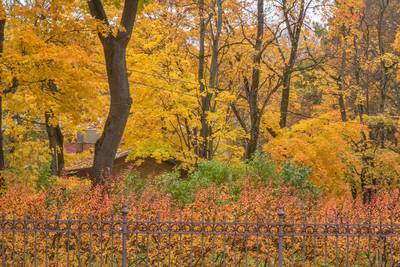
Garden fence near 5 lit. B Engelsa Street, view from Novorossiyskaya Street. Lesnoy Park (Lesotekhnicheskiy Universitet), Saint Petersburg, Russia, October 14, 2025  Garden fence near 2 Novorossiyskaya Street. Lesnoy Park (Lesotekhnicheskiy Universitet), Saint Petersburg, Russia, October 14, 2025  Novosiltsevsky Pereulok from 4 Novorossiyskaya Street. Lesnoy Park (Lesotekhnicheskiy Universitet), Saint Petersburg, Russia, October 14, 2025  Garden fence near 5 lit. B Engelsa Street. Lesnoy Park (Lesotekhnicheskiy Universitet), Saint Petersburg, Russia, October 14, 2025  A building at 5 lit. B Engelsa Prospect which is a surviving historical service corps of the Orlovo-Novosiltsevskaya Almshouse complex. This small brick structure was originally built as one of the auxiliary buildings (likely for staff or utility purposes) for the larger almshouse institution. The main complex, located at Engelsa 1-5, was a major philanthropic center established in the 1830s. The complex was designed by the renowned architect Iosif Charlemagne (Joseph-Maria Charlemagne-Baudet) in the late Classicist style. It was constructed between 1834 and 1841. Lesnoy Park (Lesotekhnicheskiy Universitet), Saint Petersburg, Russia, October 14, 2025  A path in Lesnoy Park (Lesotekhnicheskiy Universitet), Saint Petersburg, Russia, October 14, 2025  Fall colors of Lesnoy Park (Lesotekhnicheskiy Universitet), Saint Petersburg, Russia, October 14, 2025  Akademicheskaya Alley in Lesnoy Park (Lesotekhnicheskiy Universitet), Saint Petersburg, Russia, October 14, 2025  Institutsky Pereulok in Lesnoy Park (Lesotekhnicheskiy Universitet), Saint Petersburg, Russia, October 14, 2025  Serdobolsky Pond. Lesnoy Park (Lesotekhnicheskiy Universitet), Saint Petersburg, Russia, October 14, 2025  Maple alley in Lesnoy Park (Lesotekhnicheskiy Universitet), Saint Petersburg, Russia, October 14, 2025  Yellow maple trees Lesnoy Park (Lesotekhnicheskiy Universitet), Saint Petersburg, Russia, October 14, 2025  Alley near Dendrology Garden. Lesnoy Park (Lesotekhnicheskiy Universitet), Saint Petersburg, Russia, October 14, 2025  Yellow maple leaves in Lesnoy Park (Lesotekhnicheskiy Universitet), Saint Petersburg, Russia, October 14, 2025  Fall colors of Serdobolsky Pond. Lesnoy Park (Lesotekhnicheskiy Universitet), Saint Petersburg, Russia, October 14, 2025  Maple alley near the Forestry Academy. Lesnoy Park (Lesotekhnicheskiy Universitet), Saint Petersburg, Russia, October 14, 2025  Jordan Pond from Kaygorodova Alley. Lesnoy Park (Lesotekhnicheskiy Universitet), Saint Petersburg, Russia, October 14, 2025  Fallen yellow maple leaves. Lesnoy Park (Lesotekhnicheskiy Universitet), Saint Petersburg, Russia, October 14, 2025  A path covered by yellow maple leaves. Lesnoy Park (Lesotekhnicheskiy Universitet), Saint Petersburg, Russia, October 14, 2025  Maple alley near a building of the Forestry Academy. Lesnoy Park (Lesotekhnicheskiy Universitet), Saint Petersburg, Russia, October 14, 2025  Fall colors of maple alley near the Forestry Academy. Lesnoy Park (Lesotekhnicheskiy Universitet), Saint Petersburg, Russia, October 14, 2025  A house at Bolshoy Sampsonievsky Prospect 108 from Lesnoy (Lesotekhnicheskiy Universitet) Park. Saint Petersburg, Russia, August 12, 2016  Saint Petersburg State Forestry University (often referred to historically as the Forestry Academy or Lesotekhnicheskaya Akademiya). Established in 1803 by decree of Emperor Alexander I as the Practical Forestry School in Tsarskoye Selo. In 1811, it was moved to its current location in the Vyborgsky District of Saint Petersburg, occupying the site of an old English dairy farm. The classical white building shown in the photo is the Main Educational Building. Originally constructed as four separate corps between 1826 and 1833 by architects I.F. Lucchini and A. Nellinger, these were later united into a single complex with a central courtyard in the late 1830s. Lesnoy Park (Lesotekhnicheskiy Universitet), Saint Petersburg, Russia, October 14, 2025  Neoclassical apartment building located at 108 Bolshoy Sampsonievsky Prospect (corner of Serdobolskaya Street), viewed across Serdobolsky Pond. The dominant structure is a residential complex known locally as the House of Specialists or sometimes nicknamed the "Bastille near Lanskaya". Designed by architects Viktor F. Belov, V.A. Potapov, and M.P. Savkevich. Built between 1953 and 1956, representing the late Stalinist "Empire" style. It was commissioned by the Klimov Plant (Zavod im. Klimova), a major manufacturer of aviation engines, to house its employees. Lesnoy Park (Lesotekhnicheskiy Universitet), Saint Petersburg, Russia, October 14, 2025  Oak trees in Lesnoy Park (Lesotekhnicheskiy Universitet). Saint Petersburg, Russia, July 30, 2017  Flowerbeds in Lesnoy Park (Lesotekhnicheskiy Universitet). Saint Petersburg, Russia, July 30, 2017  A tomb of Egbert Ludwigowitsch Wolf., a distinguished botanist and dendrologist. Egbert Wolf (1860-1931) was a German-born Russian scientist who served as the chief gardener and later a scientific specialist at the Saint Petersburg Forestry Institute. Lesnoy Park (Lesotekhnicheskiy Universitet), Saint Petersburg, Russia, October 14, 2025  Ornamental vase in Lesnoy Park (Lesotekhnicheskiy Universitet). Saint Petersburg, Russia, July 30, 2017  Sculptures in Long Pond of Lesnoy (Lesotekhnicheskiy Universitet) Park. Saint Petersburg, Russia, August 12, 2016  "Golden Autumn" view from a residential balcony in the Svetlanovsky Prospect area of Saint Petersburg. This view reflects a peaceful, everyday moment of beauty typical of Saint Petersburg s residential "sleeping districts" during the short but spectacular peak of autumn. Russia, October 14, 2025  Main building of Forestry University in Lesnoy Park (Lesotekhnicheskiy Universitet). Saint Petersburg, Russia, July 30, 2017  Ornamental vase in front of the main building in Lesnoy Park (Lesotekhnicheskiy Universitet). Saint Petersburg, Russia, July 30, 2017  Dissected young mushroom Buchwaldoboletus lignicola in Lesnoy Park (Lesotekhnicheskiy Universitet). Saint Petersburg, Russia, July 30, 2017  Gelatinous droplets of a fungus Hypocrea gelatinosa on rotting wood in Lesnoy Park (Lesotekhnicheskiy Universitet). Saint Petersburg, Russia, July 30, 2017  Dyer s mazegill mushrooms (Phaeolus schweinitzii)(?) covered by a golden mold fungus in Lesnoy Park (Lesotekhnicheskiy Universitet). Saint Petersburg, Russia, July 30, 2017  Forest scene near the railroad tracks. Sergievka Park near Universitet, Old Peterhof, west from Saint Petersburg, Russia, October 13, 2025  Young rusty brown mushroom Buchwaldoboletus lignicola on the base of larch, parasitic of Ph. schweinitzii, in Lesnoy Park (Lesotekhnicheskiy Universitet). Saint Petersburg, Russia, July 30, 2017  Dyer s mazegill mushroom (Phaeolus schweinitzii)(?) at the base of larch covered by a golden mold fungus in Lesnoy Park (Lesotekhnicheskiy Universitet). Saint Petersburg, Russia, July 30, 2017  Decorative vase, located in the parterre of the park near the Main Building of the Forestry University, a concrete copy of a 19th-century original. The original vase was created in the 1860s by the famous sculptor David Jensen (1816-1902). The original work was carved from unpolished granite. Today s version is a concrete replica installed in the 1970s. The central motif depicts putti (cherubs), which are playful, chubby male children often found in classical art. The putti appear to be engaged in a playful struggle with a goat, a common allegorical theme in baroque and neoclassical art often representing the abundance of nature or Bacchic festivities. This theme fits well with the park s history as a place of botanical study and appreciation of nature. Lesnoy Park (Lesotekhnicheskiy Universitet), Saint Petersburg, Russia, October 14, 2025  Gelatinous droplets of a fungus Hypocrea gelatinosa together with common glasscup fungus (Orbilia xanthostigma) in Lesnoy Park (Lesotekhnicheskiy Universitet). Saint Petersburg, Russia, July 30, 2017  Monument of heroes of Great October Socialist Revolution. It is a mass grave monument dedicated to Red Guards who died during the 1917 October Revolution and the subsequent Civil War. The site originated in 1917 as a burial ground for workers and Red Guards from the nearby Novy Lessner Plant (now the Karl Marx Machine-Building Plant). These fighters were killed in battles against the troops of General Pyotr Krasnov near Pulkovo during the defense of Petrograd. In 1953, a wooden structure was replaced by the current grey granite obelisk seen today. It was designed by architect Yuri Wiesenthal. This monument is a solemn reminder of the intense revolutionary history of the Vyborg Side, a district historically populated by industrial workers who were pivotal to the Bolshevik cause. Lesnoy Park (Lesotekhnicheskiy Universitet), Saint Petersburg, Russia, October 14, 2025  Mixed forest path, where the untamed woodland creates a natural tunnel of "Golden Autumn" foliage. Sergievka Park near Universitet, Old Peterhof, west from Saint Petersburg, Russia, October 13, 2025  Narrow, cobblestone alley is Va"ike-Karja Street (Va"ike-Karja ta"nav) at the intersection with Sauna Street, a spot known for its vibrant nightlife. The black sign reading "FRANK" visible down the street on the right marks the entrance to FRANK Bistro & Cocktail Bar. This popular venue, located on the corner, is known for its New York-style interior and a hidden underground cocktail lounge ("Frank Underground"). The wall on the immediate right is heavily tagged with graffiti (visible tags include "FRANK" and other abstract designs), reflecting the street s gritty, urban character typical of the "Bermuda Triangle" nightlife district. The view looks down the narrow passage towards the intersection where Va"ike-Karja meets Sauna Street. The cobblestones are well-worn, and the narrowness of the street amplifies the intimate, medieval feel, despite the modern graffiti and bar signs. Tallinn, Estonia, October 16, 2025  A view from a window near Svetlanovsky Prospekt that offers an intimate look into a typical residential courtyard (dvor) of the Vyborgsky District. The beige brick buildings framing the scene are classic examples of brick Khrushchev-era apartments (or early Brezhnev-era), likely built in the 1960s. The 5-story height was standard to avoid the mandatory installation of elevators, which was required for buildings of 6 stories or more. This layout reflects the Soviet microdistrict concept, where residential blocks were arranged around green, communal courtyards to provide light, air, and recreation space away from the main roads. Saint Petersburg, Russia, October 14, 2025  View from the Small Chinese Bridge looks down the Krestovy Canal in the opposite direction from the Cross Bridge. The photo captures the linear vista of the canal, flanked by an avenue of mature maple trees displaying vibrant autumn colors. The foreground highlights the Small Chinese Bridge s decorative iron railing, featuring a geometric lattice pattern with gilded rosettes, cast in 1786. This section of the canal borders the regular "New Garden" area, leading toward the Chinese Village. Aleksandrovsky (Alexander) Park in Pushkin (former Tsarskoe Selo) near Saint Petersburg, Russia, October 10, 2025  This view of Mu"ndi Street looks directly towards the intersection with Pikk Street, one of the main historic arteries of Tallinn s Old Town. On the right, the pink building with the "Scho"ller" and "Cinnamon Restoran" signs is a multi-story historic structure. It houses the Scho"ller Ice Cream Cafe and Cinnamon Restaurant. The narrow cobblestone street, flanked by tall pastel-colored facades, creates an intimate, "canyon-like" feel typical of Tallinn s medieval urban plan. Estonia, October 16, 2025  This street scene captures the historic Vana Turg (Old Market) area in Tallinn s Old Town, viewed from the intersection near Viru Street. The prominent white building with the stepped gable in the center is the medieval Packinghouse, now home to the famous Olde Hansa restaurant. Dating back to the 15th century and later rebuilt in the 1650s, this structure originally served as a warehouse for foreign merchants and is a key example of Tallinn s Hanseatic architecture. To the left, the tall yellow building is the Peppersack restaurant, another historic merchant house that dates back to the 14th-15th centuries. Estonia, October 16, 2025  View of a late-Soviet brick residential quarter (kirpichnaya khrushchevka) deeply integrated with the mature nature of the Vyborgsky district, captured at the beautiful but fleeting peak of autumn. View from this window providing a glimpse into Soviet-era urban planning, specifically the residential design of the 1960s. The beige brick buildings visible in the frame are classic examples of "Khrushchevka" (Series 1-528). Unlike the cheaper concrete panel blocks (panelki), these are constructed from silicate brick, which was considered a "premium" material for mass housing at the time. They are easily identified by their 5-story height, hipped roofs (often replaced with metal sheeting), and specific balcony arrangements. Saint Petersburg, Russia, October 11, 2025  Autumn landscape of Third Pond of Grand Cascade in Catherine Park from Pavlovsky Bridge of Sadovaya Street. Pushkin (former Tsarskoe Selo) near Saint Petersburg, Russia, October 10, 2025  Autumn scene of Karasta River in Oranienbaum Park. Oranienbaum palace-and-park ensemble in Lomonosov (a suburb of St. Petersburg), Russia, October 13, 2025  Traffic on Prospect Engelsa, view from a back door of a shuttle bus. Saint Petersburg, Russia, July 1, 2011  A striking architectural contrast on Sauna Street (Sauna ta"nav), near the intersection with Va"ike-Karja Street. On the left, a modern glass-and-steel building features large display windows and industrial-style staircases, illuminated by neon lights. This building is part of the Helios Hall complex (formerly the Helios Cinema), which has been repurposed as an event venue and art space. The transparent facade allows a view into the contemporary interior, contrasting sharply with the solid, historic walls of the Old Town. On the right, the corner of an older, plastered building (Sauna 12) is covered in colorful, abstract graffiti. This gritty, urban element acts as a foil to the clean lines and slick surfaces of the modern building opposite it, highlighting the eclectic mix of styles in this part of the city. Tallinn, Estonia, October 16, 2025  Visconti Bridge (Viskontiyev most) viewed from the roadway level. This angle highlights the bridge s function as a promenade. It invites the viewer to walk across, suggesting the continuation of the path into the colorful autumn forest beyond. Pavlovsk, a suburb of Saint Petersburg, Russia, October 6, 2025  Va"ike-Karja Street (Va"ike-Karja ta"nav), likely taken near its intersection with Suur-Karja Street. The building on the right with the large grey stone archway and iron gates corresponds to Va"ike-Karja 1 (also known as the Saarinen House), a prominent Art Nouveau building designed by Finnish architect Eliel Saarinen. The street features a mix of architectural styles. The grey stone building on the right is a notable example of early 20th-century national romanticism. Further down the street, you can see pastel-colored facades typical of Tallinn s Old Town. Tallinn, Estonia, October 16, 2025  SNT "Rodnik" (Garden Non-Commercial Partnership "Rodnik") adjacent to the Kannelyarvi railway station in November, showcasing a quiet, frosty late-autumn scene typical of the Karelian Isthmus. North from Saint Petersburg, Russia, October 1, 2025  A modest stone bridge with simple iron railings crossings a quiet, reflective section of the Kristatelka River, showcasing the "Golden Autumn". Sergievka Park, Old Peterhof, west from Saint Petersburg, Russia, October 13, 2025  Granite and iron bridge in Sergievka Park. The bridge s corners are anchored by sturdy, rough-hewn granite bollards (posts) with rounded tops, which support a decorative black iron railing. The railing features a simple, geometric lattice pattern, typical of the functional yet aesthetic engineering found in the Peterhof estate parks. Old Peterhof, west from Saint Petersburg, Russia, October 13, 2025  Cast iron fence on Petrovskaya Street in Kronstadt. Saint Petersburg, Russia, January 3, 2016  Cast iron fence of a garden on Petrovskaya Street in Kronstadt. Saint Petersburg, Russia, January 3, 2016  Fall colors of green area between apartment houses near Svetlanovsky Prospect from a balcony on the third floor. The colors are predominantly earthy, muted golds, and olive tones, reflecting the transition of the foliage from late summer green to autumn dormancy. This palette creates a cozy, nostalgic mood, characteristic of a quiet residential courtyard in autumn. Saint Petersburg, Russia, October 9, 2025  Serene autumn scene at Laskovy Beach (Russian: Laskovyy Plyazh) in the settlement of Solnechnoe, located on the shore of the Gulf of Finland, approximately 40 kilometers northwest of Saint Petersburg. Laskovy Beach is one of the most popular beaches in the Kurortny District of Saint Petersburg. The name "Laskovy" translates to "Affectionate" or "Tender," while the settlement name, Solnechnoe, means "Sunny". This area has a rich history as a summer resort destination; formerly known as the Finnish village of Ollila, it became a hub for St. Petersburg s intelligentsia and dacha owners in the late 19th and early 20th centuries. The image shows a trio of birch trees with vibrant yellow and orange leaves, which is characteristic of the "Golden Autumn" season in the Leningrad Region during early-to-mid October. The golden leaves contrast strikingly with the blue sky and the dark blue waters of the Gulf. The large white concrete sphere on the sand is a landscaping feature. Russia, October 9, 2025  A weathered, wooden gate at Tolli Street 8 (Tolli tn 8) in the Old Town of Tallinn. This short, historic street runs north from Pikk Street towards the harbor area. Its name (meaning "Customs") reflects its historical connection to trade and taxation near the old port. The gate likely leads to a private courtyard or garden behind one of the historic residential properties. The wooden gate is visibly aged, with uneven planks and temporary reinforcements, suggesting it is awaiting restoration or is part of a less polished corner of the Old Town. This "shabby chic" aesthetic contrasts with the meticulously renovated facades on nearby Pikk Street. The flanking limestone walls are covered in peeling plaster and graffiti, revealing the raw stone construction typical of Tallinn s medieval infrastructure. The presence of graffiti and the unkempt nature of the gate offer a glimpse into the "lived-in" reality of the city, distinct from the purely tourist-focused attractions. The autumn leaves visible above the gate add a touch of seasonal color to the otherwise gritty scene. Tallinn, Estonia, October 16, 2025  Estonian Theatre for Young Audiences (formerly known as the NUKU Theatre), located at the corner of Lai 1 and Nunne streets. This corner building is a fine example of early 20th-century architecture (completed in 1907), originally built for the Nobility Club. It blends Neo-Renaissance elements (like the balcony) with Art Nouveau influences (evident in the curved corner and roofline). The warm uplighting emphasizes its elegant proportions and decorative cornice. The building houses Estonia s only professional puppet theatre, founded in 1952, and the Museum of Puppetry Arts. The museum entrance is typically around the corner or through the main glass doors seen here. The theatre complex has expanded over the years to include modern performance halls while retaining its historic fac,ade. The view looks down Nunne Street towards the Toompea hill area. To the right, you can see the edge of the city wall fortifications. The street is paved with traditional cobblestones, and the scene is quiet, likely captured in the late evening or early morning. Tallinn, Estonia, October 16, 2025  From this more distant perspective, the bridge serves as a gateway through the dense "Golden Autumn" forest, its dark iron silhouette creating a strong focal point amidst the vibrant foliage. Sergievka Park, Old Peterhof, west from Saint Petersburg, Russia, October 13, 2025  Golden Autumn scene along a winding path in the Upper Park, showing a gravel or dirt path curving gently uphill, completely covered in a carpet of fallen yellow maple leaves. Oranienbaum palace-and-park ensemble in Lomonosov (a suburb of St. Petersburg), Russia, October 13, 2025  Nevsky Prospect (main street of the city) near Liteyny Prospect Street. Saint Petersburg, Russia, July 31, 2012  Scene from Bible at the top of a building, view from Inzhenernaya(?) Street. Saint Petersburg, Russia, May 26, 2011  108 Bolshoy Sampsonievsky Prospect from Serdobolsky Pond in Lesnoy Park. Saint Petersburg, Russia, October 8, 2016  Mu"u"rivahe Street (Mu"u"rivahe ta"nav), looking towards the intersection with Viru Street. The image is taken near Mu"u"rivahe 23, which is the location of the Armanda clothing boutique visible on the left. The narrow, cobblestone street retains its medieval charm, winding between historic buildings that date back centuries. In the background, one can see a striking turquoise-colored tower with a weathervane. This is part of the building complex at the corner of Viru and Mu"u"rivahe streets, adding a distinct vertical accent to the streetscape. Tallinn, Estonia, October 16, 2025  Intersection on Pikk Street (at Pikk 17), looking towards the Town Hall Square area. The view is dominated by two historically significant buildings and a lively restaurant scene. The large, gabled building on the right (Pikk 17) is the Great Guild Hall, built in 1417. For centuries, this was the meeting place for the city s most powerful merchants (the Great Guild), who controlled the town council. The building is a masterpiece of medieval limestone architecture, featuring a prominent Gothic portal and a high saddle roof. Today, it houses the Estonian History Museum. The smaller archway next to it (right foreground) is a historic passage, the "Bo"rsi ka"ik" (Exchange Passage), leading towards the Holy Spirit Church. Though partially obscured, the building further down the street with the stepped gable is connected to the complex of the Church of the Holy Spirit. This church is famous for its 17th-century painted clock, the oldest in Tallinn, which faces Pikk Street (though not clearly visible from this specific angle). This section of Pikk Street is a major pedestrian artery, connecting the northern part of the Old Town (where St. Olaf s is) to the central Town Hall Square. Tallinn, Estonia, October 16, 2025  Intersection of State Street with South Street (The Village area, shopping district). West Lafayette, Indiana, March 10, 1998.  Prospect Street in historic Highlands District. Fall River, Massachusetts, December 7, 2003  Prospect(?) Street in historic Highlands District. Fall River, Massachusetts, December 7, 2003  Saint Petersburg courtyard near Svetlanovsky Prospekt during "Golden Autumn" (Zolotaya Osen). The foliage is in a transitional phase where the trees are displaying their most vibrant colors (bright yellows and oranges) before shedding completely. The area around Svetlanovsky Prospekt (Vyborgsky/Kalininsky districts) is characterized by residential blocks from the 1960s and 1970s. Unlike the dense city center, these blocks were designed with large, open courtyards (dvory) intended to act as "green lungs" for residents. Russia, October 10, 2025  A house at Prospect Street in historic Highlands District. Fall River, Massachusetts, November 13, 2004  A doorway of a house at Prospect Street in historic Highlands District. Fall River, Massachusetts, November 13, 2004  A politically charged scene on Pikk Street (specifically at Pikk 19) in front of the Russian Embassy in Tallinn. The metal barricades lining the street have become a permanent protest installation since Russia s full-scale invasion of Ukraine in February 2022. The barriers are covered in posters, slogans, and artwork condemning the war and Russian leadership. The large banner in the foreground reads "FOR THE VICTIMS OF WARS STARTED BY RUSSIA". Other signs visible on the fence typically document war crimes or satirize political figures. A police officer in a high-visibility yellow jacket is patrolling the area. A constant police presence has been standard here to maintain order given the high tensions surrounding the embassy. The Russian Embassy occupies a historic Art Nouveau building at Pikk 19. Ironically, this street is one of the most picturesque and tourist-heavy routes in the Old Town, creating a surreal juxtaposition between medieval charm and modern geopolitical conflict. Across the street (visible in the background) is the famous Maiasmokk Cafe, the oldest operating cafe in Tallinn, further highlighting the clash between leisure tourism and serious political activism in this specific location. Tallinn, Estonia, October 16, 2025  This view is captured from the intersection of Pikk and Voorimehe streets, looking up towards the Pikk Jalg (Long Leg) Gate Tower. The prominent white tower with the red tiled roof at the end of the street is the 14th-century gate tower that guards the entrance to Toompea Hill. Historically, this was one of two main gateways separating the merchants of the lower town from the nobility on the hill. On the left, the building with the "VeTa" sign (visible at Pikk 4) houses a well-known Estonian brand specializing in linen and knitwear. The arched doorway and display windows are set into a facade that typifies the street s historic character. To the right, the street branches off into Voorimehe, a smaller lane known for charming spots like the Karu Talu Svokolaad chocolate shop (located at Voorimehe 6) and Pulla Bakery. Estonia, October 16, 2025  Forest-like atmosphere and natural landscape in Sergievka Park near Universitet. Old Peterhof, west from Saint Petersburg, Russia, October 13, 2025  A view of Suur-Karja Street (Suur-Karja ta"nav), one of the main arteries in Tallinn s Old Town. This street is famously (or infamously) known as the "Bermuda Triangle" of Tallinn s nightlife. The intersection of Suur-Karja and Va"ike-Karja streets is packed with bars, pubs, and clubs, making it the busiest party spot in the city on weekends. The street is lined with historic buildings that date back centuries. For instance, the building at Suur-Karja 12 (partially visible on the left) is a late-Gothic merchant house with roots in the 15th century. It has recently undergone extensive renovation to modernize its interiors while preserving its medieval stone fac,ade and window details. The street name "Suur-Karja" translates to "Great Cattle Street," referencing its medieval function as the route used to drive cattle from the city center out to pastures through the Karja Gate. Today, it connects the heart of the Old Town with Pa"rnu Road and the modern city center. Tallinn, Estonia, October 16, 2025  Evening view of Lai Street (looking towards St. Olaf s Church). The large grey building on the right (Lai 44/46) stands out with its curved bay windows and decorative facade elements. This is a fine example of Jugendstil (Art Nouveau) architecture, which appeared in Tallinn during the early 20th century. Its smoother lines and larger windows contrast sharply with the smaller medieval merchant houses nearby. On the left, the yellow building (Lai 33) retains a more traditional, modest scale typical of the street s residential past. At the end of the street, the illuminated white tower of St. Olaf s Church (Lai 50) acts as a dramatic focal point. The lighting accentuates the church s massive walls and the green copper spire against the twilight sky. Tallinn, Estonia, October 16, 2025  A perspective of Rataskaevu Street, looking up the gentle slope towards the intersection with Niguliste Street. The building on the right with the striking yellow and grey modern facade and large arched window is home to Casa Alta, an Italian restaurant. The architecture of this building stands out for its postmodern interpretation of the gabled roofline, contrasting with the older structures nearby. The pinkish-red building on the left side of the street (Rataskaevu 6) is a historic property. It currently houses Restoran O~ (or a similar establishment depending on recent changes), known for its fine dining in a medieval setting. Further down on the left, you can see signs for other venues like De 6 and Vana Tallinn. Tallinn, Estonia, October 16, 2025  One of the two towers forming the Red (Turkish) Cascade (Krasnyy/Turetskiy Kaskad) in Catherine Park. It serves as both a decorative dam and a symbolic monument. Pushkin (former Tsarskoe Selo) near Saint Petersburg, Russia, October 10, 2025  A vibrant and slightly gritty scene in a courtyard or passage off Viru Street (Viru 13), revealing a hidden side of Tallinn s Old Town nightlife. The wall is covered in colorful, chaotic graffiti tags (e.g., "PASR," "OPG," "SRN"), contrasting with the historic surroundings. The abstract blue and white forms at the bottom right resemble stylized waves or bubbles. This heavy tagging is typical of the semi-hidden courtyards in this area that house alternative bars and clubs. Through the window on the right, you can see the warm interior of a bar. Bottles of alcohol are lined up on shelves, and the lighting suggests a cozy, active atmosphere inside. This juxtaposition--the rough, cold exterior wall versus the inviting, warm interior--encapsulates the "hidden bar" culture of Tallinn. While Viru Street itself is a main tourist artery known for flower stalls and souvenir shops, the courtyards behind the facades (like at Viru 13/15) often host rooftop bars like A"rkel or speakeasy-style venues. Tallinn, Estonia, October 16, 2025  This street is Rataskaevu, famously known as the location of the Cat s Well and the legendary "Devil s Wedding" house. The pink building on the right (Rataskaevu 16) is one of the most famous houses in Tallinn folklore. Legend says the devil once held his wedding here in the upper-left room, which was later bricked up to trap the evil spirits inside. Today, the building houses the highly rated Rataskaevu 16 restaurant, celebrated for its warm atmosphere and modern Estonian cuisine. Just out of view (near the intersection) is the historic well that gave the street its name ("Wheel Well"). In medieval times, locals believed an evil spirit lived in it and sacrificed stray cats to prevent the water from running dry, earning it the grim nickname "Cat s Well". Estonia, October 16, 2025  Colorful doorway at 16 Al Thaqafa Street in Al Ghanim Al Qadeem district. Doha, Qatar, April 2, 2011  View to the east on Conference Centre Street in West Bay from intersection with Omar Al Mukhtar Street. Doha, Qatar, November 17, 2015  "Golden Autumn" forest near Leuchtenberg Palace. Sergievka Park, Old Peterhof, west from Saint Petersburg, Russia, October 13, 2025  Nevsky Prospect near Liteyny Prospect Street. Saint Petersburg, Russia, July 31, 2012  "Golden Autumn" of the shores of the Great Pond in Catherine Park. Pushkin (former Tsarskoe Selo) near Saint Petersburg, Russia, October 10, 2025  Foliage near Red Cascade showin "Golden Autumn" in Catherine Park. Pushkin (former Tsarskoe Selo) near Saint Petersburg, Russia, October 10, 2025  Colorful painted gates at 16 Saad Bin Ubada Street in Al Ghanim Al Qadeem district. Doha, Qatar, April 2, 2011  Nevsky Prospect at Liteyny Prospect Street crossing. Saint Petersburg, Russia, July 31, 2012  Street cat at Lenina Prospect in Vyborg, north from Saint Petersburg. Russia, October 7, 2016  This street scene is located on Pikk Street, just north of the Pikk Jalg gate, looking back towards the city center. The baroque spire visible in the distance belongs to St. Nicholas Church (Niguliste kirik). Originally built in the 13th century and dedicated to the patron saint of merchants and seafarers, it is one of the city s most defining landmarks. The tower now features a glass elevator and viewing platform offering 360-degree views of the Old Town. The building at the corner (implied by the location) is part of the historic Kolmjalg ("Tripod") complex, a notable architectural feature at the junction of Pikk and Voorimehe streets, known for its medieval origins. Estonia, October 16, 2025  Defunct fountain in downtown Beer-Sheva, view from intersection of HaHistadrut and K. K. L. Street. The Middle East, October 28, 2000  Old City of Beer-Sheva during Shabbat, view from intersection of Trumpledor and Hadassah Street. The Middle East, October 28, 2000  Apartment houses near Svetlanovsky Prospekt from a window of a house. This view presents the "other side" of the Golden Autumn coin: not the crisp, sunny glory, but the damp, reflective, and deeply saturated beauty that follows the city s frequent rains. Saint Petersburg, Russia, October 12, 2025  A house in Old City of Beer-Sheva, view from intersection of Beit Eshel and HaAtzmaut Street. The Middle East, October 28, 2000 |