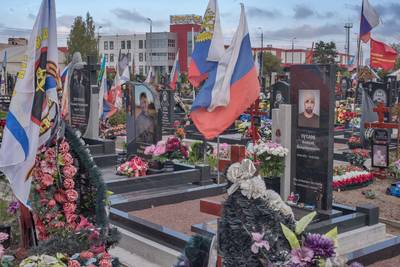
The dense concentration of recent casualties, with fresh earthen mounds tightly packed together and adorned with the ubiquitous Russian tricolor. In the foreground, the grave of Aleksandr Vladimirovich Dementyev (1962-2025) is marked by a wooden cross and a color portrait, identifying a 63-year-old soldier whose age highlights the heavy toll on older reservists and volunteers. The background reveals the integration of the cemetery into the urban fabric, with modern commercial buildings visible just beyond the sea of flags and wreaths, grounding the war[CloseCurlyQuote]s losses in the everyday reality of St. Petersburg. "Alley of Heroes" at Cemetery of the Victims of January 9, St. Petersburg, Russia, October 4, 2025  The diverse visual language of mourning in the "Alley of Heroes," showing a mix of permanent granite monuments and temporary graves decorated with flags, including the Russian Imperial black-yellow-white tricolor and a Soviet red banner. In the foreground, the polished black headstone of Ivan Vladimirovich Semenov (1995-2024) features a color portrait of the 28-year-old soldier, while nearby, two women stand amidst the graves, highlighting the cemetery as an active site of personal grief. The scene captures the juxtaposition of varied ideological symbols--imperial, communist, and modern state--united within the shared space of military sacrifice. Cemetery of the Victims of January 9, St. Petersburg, Russia, October 4, 2025  The "permanent stage" of memorialization, featuring a row of polished black granite monuments for soldiers such as Andrey Nikolaevich Atlanov (1977-2024) and Danila Denisovich Shutov (2001-2024), a 23-year-old whose age underscores the ongoing loss of young lives. The monuments display diverse portrait styles--ranging from formal military engravings to casual color photos--and are flanked by flags including the VDV (Airborne Forces) banner with the motto "Nobody, but us," reflecting both individual identity and collective unit pride. The orderly arrangement of these finished graves, complete with granite curbs and gravel, stands in contrast to the chaotic temporary sections seen in other places, illustrating the gradual formalization of the war s toll. "Alley of Heroes" at Cemetery of the Victims of January 9, St. Petersburg, Russia, October 4, 2025  The diverse visual languages of mourning in the "Alley of Heroes," contrasting a solemn monochrome engraving of a soldier in full combat gear--distinguished by the Order of Courage medal--with the vibrant, smiling color portrait of Yuri Bogdanov on the adjacent grave. The background is saturated with a chaotic array of flags, including the black-yellow-white Russian Imperial tricolor and red Soviet banners, visually capturing the "hybrid" ideological landscape, where conflicting historical symbols are merged to support the war effort. Cemetery of the Victims of January 9, St. Petersburg, Russia, October 4, 2025  The ideological complexity of the war s memorialization, dominated by a large red Soviet flag flying prominently over fresh graves, invoking nostalgia for the USSR s military power alongside Russian tricolors and VDV (Airborne Forces) banners. In the foreground, the grave of Arkady Vasilyevich Kovalchuk (1974-2024), who died at age 50, exemplifies the demographic trend of older men bearing a significant share of casualties. The scene is one of dense, vibrant mourning, with mounds of artificial flowers covering the raw earth, set against a backdrop of modern commercial buildings that anchor the cemetery in the contemporary urban landscape. "Alley of Heroes" at Cemetery of the Victims of January 9, St. Petersburg, Russia, October 4, 2025  The permanent monument of Denis Alekseevich Mikhailov (1983-2024), a 40-year-old soldier whose polished black granite headstone displays a detailed engraving of him in full combat gear, holding a rifle and wearing a parachute badge, alongside a real blue beret left as a personal tribute. The grave is flanked by the blue and yellow flag of the VDV (Airborne Forces) with the motto "Nobody, but us," underscoring his elite unit affiliation, while surrounding graves show a mix of portrait styles and military banners, reflecting the individualized yet collective nature of the memorialization. "Alley of Heroes" at Cemetery of the Victims of January 9, St. Petersburg, Russia, October 4, 2025  Blending of religious and patriotic symbolism in the "Alley of Heroes". The foreground monument features a poignant epitaph addressing the deceased ("And you stand before our eyes, Alive... We keep you in our hearts") alongside an elaborate engraving of a soldier ascending a staircase toward a Christ-like figure, framing death as a spiritual journey. In the background, a distinctive broken-heart monument depicts a split image of a bridge at night surrounded by flags from various military branches, including the VDV and Russian Naval Infantry. Cemetery of the Victims of January 9, St. Petersburg, Russia, October 4, 2025  A granite monument bearing the poignant epitaph, "My today is a sacrifice for your tomorrow," framing the soldier[CloseCurlyQuote]s death as a redemptive gift to future generations. The grave is flanked by the black and yellow flags of the Motorized Rifle Troops--Russia s primary ground combat formations--distinguished by the Kalashnikov insignia and the motto "Loyalty". In the background, rows of temporary wooden crosses extend into the distance, contrasting the finished memorial with the raw, fresh graves of recent casualties. "Alley of Heroes" at Cemetery of the Victims of January 9, St. Petersburg, Russia, October 4, 2025  The "initial stage" of memorialization, where fresh earthen graves are densely covered in massive wreaths of artificial flowers and a forest of flags. In the foreground, the wooden cross of Aleksandr Vitalyevich Rogachev (1964-2025) identifies a 61-year-old casualty, representative of the older demographic of mobilized soldiers and volunteers. The scene highlights the diverse composition of the forces, with the flag of Uzbekistan visible in the background--indicating the recruitment of foreign nationals--while a lone mourner tends to a grave amidst the dense rows, adding a human scale to the extensive loss. "Alley of Heroes" at Cemetery of the Victims of January 9, St. Petersburg, Russia, October 4, 2025  The grave of Mikhail Ilyich Svyatkin (1986-2025), a 39-year-old soldier whose death in May 2025 aligns with the surge in casualties during the spring and summer of that year. His wooden cross bears a framed photo of him in combat gear holding a rifle, surrounded by wreaths inscribed "From Mother," highlighting the personal grief embedded in the mass loss. The background is crowded with similar fresh graves, flags, and flowers, reinforcing the density and continuity of the burials at this active military cemetery. "Alley of Heroes" at Cemetery of the Victims of January 9, St. Petersburg, Russia, October 4, 2025  The dense visual cacophony of the cemetery s "temporary" section, where rows of wooden crosses are submerged in a sea of Russian tricolors and military intelligence (GRU/Spetsnaz) flags bearing the bat insignia. In the foreground, the grave of Kirill Arkadyevich Sharkov (1975-2025), a 49-year-old casualty, is marked by a simple cross and a photo of him in uniform, surrounded by wreaths in patriotic red, white, and blue colors. The scene conveys the sheer volume of recent losses, with flags fluttering chaotically over uneven mounds of earth, while a tractor in the far left background hints at the ongoing expansion of the burial grounds. "Alley of Heroes" at Cemetery of the Victims of January 9, St. Petersburg, Russia, October 4, 2025  A cluster of fresh graves from the summer of 2025, including that of Igor Vadimovich Lebedev (1969-2025), a 56-year-old casualty. The scene is densely packed with temporary wooden crosses, massive wreaths in the Russian tricolor, and various unit flags--including the VDV (Airborne Forces) and Motorized Rifle Troops--while a lone mourner in the background tends to a plot, emphasizing the personal grief amidst the mass scale of death. "Alley of Heroes" at Cemetery of the Victims of January 9, St. Petersburg, Russia, October 4, 2025  The "initial stage" of mass burial, depicting a dense field of fresh earthen mounds marked only by temporary wooden crosses and overwhelmed by a sea of Russian tricolors, Soviet red banners, and VDV flags. The ground is raw and uneven, with a single permanent black granite curb visible in the foreground as the only sign of the eventual transition to formal memorialization. In the background, industrial infrastructure frames the scene, emphasizing the integration of this expanding military necropolis into the everyday civilian landscape of St. Petersburg "Alley of Heroes" at Cemetery of the Victims of January 9, St. Petersburg, Russia, October 4, 2025  Revealing the multinational and irregular composition of the Russian forces, featuring the flag of Uzbekistan prominently displayed alongside the black "Assault Troops" banner and the Russian tricolor. In the foreground, the grave of Aleksandr Borisovich Vasiliev (1973-2025), a 52-year-old soldier, is marked by a framed photograph of him in combat gear standing in a field, humanizing the older demographic of recent casualties. The scene captures the raw, crowded nature of the "initial stage" of burial, with fresh earthen mounds and a chaotic mix of personal and military symbols extending into the background. "Alley of Heroes" at Cemetery of the Victims of January 9, St. Petersburg, Russia, October 4, 2025  "Alley of Heroes," a section of the cemetery dedicated to Russian soldiers killed in the war in Ukraine. In the foreground stands a permanent black granite monument featuring a detailed engraving of a soldier in combat gear with the "Z" insignia and a stoic epitaph reading, "Having given everything, I will not rise from the dust... I, having killed the fear within myself, fought". The background reveals rows of additional graves densely adorned with wreaths and flags representing various military branches (including the VDV and Naval Infantry) and private military contractors, illustrating the ongoing scale and diverse composition of the casualties. Cemetery of the Victims of January 9, St. Petersburg, Russia, October 4, 2025  The "initial stage" of memorialization, where fresh earthen graves are crowded with temporary wooden crosses and a profusion of military banners, including the VDV (Airborne Forces) and St. Andrew[CloseCurlyQuote]s Naval flags. The foreground features the grave of Mikhail Ilyich Svyatkin (1986-2025), a 39-year-old casualty, whose cross is adorned with a framed photo of him in uniform, exemplifying the typical profile of recent losses. The scene is saturated with patriotic symbols, including a flag depicting a tank with the slogan "Victory will be ours" and another with the Order of the Great Patriotic War, linking the current conflict to historical narratives of Soviet heroism. "Alley of Heroes" at Cemetery of the Victims of January 9, St. Petersburg, Russia, October 4, 2025  Religious and symbolic narrative of sacrifice, featuring a granite monument with an elaborate engraving of a soldier ascending a staircase toward a welcoming Christ-like figure and a birch tree, blending Christian theology with Russian nationalism. The epitaph laments, "You loved life... But the thread was cut too soon," emphasizing personal loss alongside martial duty. In the background, a chaotic array of VDV (Airborne Forces) and Russian flags flies over rows of fresh, temporary graves, contrasting the permanent serenity of the foreground monument with the raw immediacy of ongoing casualties. "Alley of Heroes" at Cemetery of the Victims of January 9, St. Petersburg, Russia, October 4, 2025  The expanding scale of the "Alley of Heroes," with construction machinery visible in the left background clearing land for new burial plots, confirming the site s active status. The foreground displays a dense cluster of polished granite monuments flanked by diverse military insignia, including the St. Andrew[CloseCurlyQuote]s flag of the Navy and a unit banner for a Motorized Rifle formation, reflecting the hybrid force structure composed of regular troops, mobilized personnel, and specialized units. Cemetery of the Victims of January 9, St. Petersburg, Russia, October 4, 2025  The dense, chaotic stage of recent burial in the "Alley of Heroes," where fresh earthen graves are overwhelmed by a profusion of flags, including the Russian tricolor, the blue flag of the Aerospace Forces (VKS), and banners of various volunteer and assault units. The foreground shows a simple wooden cross with a framed photo of a young soldier, surrounded by vibrant wreaths of artificial flowers, while in the background, a woman walks amongst the rows, emphasizing the cemetery s role as an active site of public mourning. The sheer number of flags and the raw state of the ground visually confirm a continuous, high-volume flow of casualties processed at this site. Cemetery of the Victims of January 9, St. Petersburg, Russia, October 4, 2025  Wide-angle view of the overwhelming scale of the cemetery s "temporary" sector, where row upon row of fresh earthen graves stretch toward the horizon, each topped with a dense carpet of wreaths and a chaotic thicket of flags. The visual field is dominated by the Russian tricolor, but punctuated by Soviet red banners, VDV (Airborne) flags, and Naval ensigns, reflecting the "hybrid" composition of forces. The raw, unpaved ground and the sheer density of the burials underscore the industrial pace of the war s casualties, set against a mundane urban backdrop that integrates this mass death into daily life. "Alley of Heroes" at Cemetery of the Victims of January 9, St. Petersburg, Russia, October 4, 2025  "Section 69 A" marker within the "temporary" burial sector, where fresh earthen mounds stretch toward a forested perimeter, contrasting the ordered numbering system with the raw immediacy of mass death. A solitary mourner in a green coat stands quietly by a cross, tending to flowers amidst a sea of Russian tricolors and unit flags, including the blue and yellow banner of the Aerospace Forces, adding a human scale to the vast, impersonal landscape of casualties. The scene highlights the rapid expansion of the cemetery, with the dense rows of wooden crosses indicating the continuous flow of new burials. "Alley of Heroes" at Cemetery of the Victims of January 9, St. Petersburg, Russia, October 4, 2025  Monument of heroes of Great October Socialist Revolution. It is a mass grave monument dedicated to Red Guards who died during the 1917 October Revolution and the subsequent Civil War. The site originated in 1917 as a burial ground for workers and Red Guards from the nearby Novy Lessner Plant (now the Karl Marx Machine-Building Plant). These fighters were killed in battles against the troops of General Pyotr Krasnov near Pulkovo during the defense of Petrograd. In 1953, a wooden structure was replaced by the current grey granite obelisk seen today. It was designed by architect Yuri Wiesenthal. This monument is a solemn reminder of the intense revolutionary history of the Vyborg Side, a district historically populated by industrial workers who were pivotal to the Bolshevik cause. Lesnoy Park (Lesotekhnicheskiy Universitet), Saint Petersburg, Russia, October 14, 2025  The initial "temporary" stage of burial, showing rows of fresh earthen mounds topped with simple wooden Orthodox crosses and small identification plaques. Despite the lack of permanent monuments, the graves are densely decorated with vibrant artificial flowers and a profusion of flags--including the Russian tricolor, a Soviet hammer-and-sickle banner, and the flag of Uzbekistan--highlighting the diverse origins and ideological affiliations of the recently deceased. The raw, uneven ground and the sheer number of identical crosses extending into the background visually confirm the high volume of recent casualties processed at the site. "Alley of Heroes" at Cemetery of the Victims of January 9, St. Petersburg, Russia, October 4, 2025  A striking architectural contrast on Sauna Street (Sauna ta"nav), near the intersection with Va"ike-Karja Street. On the left, a modern glass-and-steel building features large display windows and industrial-style staircases, illuminated by neon lights. This building is part of the Helios Hall complex (formerly the Helios Cinema), which has been repurposed as an event venue and art space. The transparent facade allows a view into the contemporary interior, contrasting sharply with the solid, historic walls of the Old Town. On the right, the corner of an older, plastered building (Sauna 12) is covered in colorful, abstract graffiti. This gritty, urban element acts as a foil to the clean lines and slick surfaces of the modern building opposite it, highlighting the eclectic mix of styles in this part of the city. Tallinn, Estonia, October 16, 2025  Ancient linden alley near the Feodorovsky Gorodok (Fyodorovsky Town) which is a remnant of the park s imperial landscape design. The gnarled, dark trunks of the linden trees (Tilia) create a solemn, cathedral-like atmosphere. Pushkin (former Tsarskoe Selo) near Saint Petersburg, Russia, October 10, 2025  This view from the tower of St. Nicholas Church offers a fascinating contrast between medieval history, post-war reconstruction, and modern urban growth, looking east towards the city center. The most prominent building in the immediate foreground is the large, grey, L-shaped structure known as the Writers House (Kirjanike Maja) on Harju Street. Built in 1963 on the ruins of buildings destroyed during the 1944 Soviet bombing of Tallinn, this modernist structure is a significant cultural landmark. It houses the Estonian Writers Union, a well-known bookstore, and the famous Cafe Pegasus, serving as a hub for the country s literary scene. The street running along the left side of the Writers House is Harju Street, historically one of the city s main commercial arteries. The open green space visible nearby (part of the Harju Street green area) was also created following the wartime destruction, serving as a memorial and recreational space before partial reconstruction debates in recent years. In the background, the view opens up to Tallinn s modern business district. The cluster of high-rise glass buildings, including the distinct wedge-shaped Swisso^tel and the SEB Bank headquarters, illustrates the city s rapid economic development and stands in stark contrast to the red-tiled roofs of the Old Town below. Estonia, October 16, 2025  A detailed look at the suburban landscape of Tikkurila, the administrative center of Vantaa, located just north of Helsinki. Kerava River (Keravanjoki): The winding river cutting through the landscape is the Kerava River, a tributary of the Vantaa River. It flows past residential areas and parks, offering a scenic green belt through the suburbs. The denser cluster of buildings in the center-right is the heart of Tikkurila (Dickursby). This area is a major transport hub, home to the Tikkurila railway station (a key stop for airport trains) and the Heureka Science Centre (likely one of the larger modern structures near the river). Suburban Fabric: The image showcases a mix of housing types typical of the Helsinki metropolitan area: detached houses with large gardens in the foreground and denser apartment blocks closer to the Tikkurila center. The presence of a sports field with a running track (red oval, left side) highlights the community-focused planning. Rural-Urban Edge: The top and left portions of the image show open fields and farmland, illustrating how abruptly the urban area transitions into the countryside in this region. This area is minutes away from landing at Helsinki-Vantaa Airport, making it a common sight for travelers. View from a window of an airplane from Tallinn to Helsinki, Finland, October 17, 2025  Panoramic view from the Tarkhovka shoreline that looks north-west across the Sestroretsky Razliv (Lake Sestroretsk) toward the city of Sestroretsk. This view captures the dual nature of Sestroretsk: a historic resort town with natural beauty (the lake, reeds, and stones) juxtaposed with modern urban infrastructure (heating plant and high-rise housing). "Three Chimneys" (Center): The most prominent industrial feature is the cluster of three tall red-and-white striped chimneys. These belong to the Sestroretsk District Heating Plant (part of the city s thermal infrastructure). Residential Towers (Left of Chimneys): The tall, beige-and-orange brick apartment buildings are part of the modern residential developments in Sestroretsk, likely along Tokarevskaya Street or the Razliv microdistrict. Church of Peter and Paul (Far Right): On the far right horizon. This is a modern church (consecrated in 2009) built in memory of the Russian submariners. "Pyramid" Building (Far Left): On the far left, there is a distinctive white building with a stepped, pyramid-like shape. This is likely the "Eden" (Edem) residential complex or a similar luxury apartment block, which is known for its terraced architecture. Tarkhovka Park near Sestroretsk, west from Saint Petersburg. Russia, October 3, 2025  This evening view is likely a side street or courtyard just off the bustling Viru Street, possibly near the intersection with Vene Street or Sauna Street given the architectural style and proximity to nightlife areas. The most striking feature is the graffiti-covered wooden doors on the right. The words KID3:feff, PINTSEL:feff (meaning "paintbrush" in Estonian), and other tags cover the chevron-patterned double doors. This type of street art is common in the "alternative" or less-polished corners of the Old Town, often near bars and clubs. To the left, a brightly lit shop window with modern art prints or posters suggests this is a commercial area that remains active into the evening. The purple and blue lighting effects contribute to a club-like atmosphere, consistent with the nearby Viru Street and Sauna Street nightlife districts. The narrow cobblestone street slopes gently upward, flanked by tall, plastered buildings in pastel colors (pink, yellow, purple). The building on the right features a distinctive green downspout and a small blue diamond-shaped sign (likely a utility marker). Tallinn, Estonia, October 16, 2025  "Golden Autumn" view from a residential balcony in the Svetlanovsky Prospect area of Saint Petersburg. This view reflects a peaceful, everyday moment of beauty typical of Saint Petersburg s residential "sleeping districts" during the short but spectacular peak of autumn. Russia, October 14, 2025  Granite and iron bridge in Sergievka Park. The bridge s corners are anchored by sturdy, rough-hewn granite bollards (posts) with rounded tops, which support a decorative black iron railing. The railing features a simple, geometric lattice pattern, typical of the functional yet aesthetic engineering found in the Peterhof estate parks. Old Peterhof, west from Saint Petersburg, Russia, October 13, 2025  A view of the installation specifically focuses on the memorial dedicated to Alexei Navalny, the Russian opposition leader who died in a penal colony on February 16, 2024. The central poster explicitly states "PUTIN KILLED NAVALNY" in bold red and black letters, echoing the sentiments of protestors worldwide who hold the Kremlin responsible for his death. Below the text is a large, stylized black-and-white portrait of Navalny, marked with the date of his death, February 16, 2024. The main poster is surrounded by smaller photos, drawings, and messages from supporters, including a quote in Russian: "Everything will be fine. And even if it isn t, we will console ourselves that we were honest people". The memorial is integrated into the broader anti-war protest, with signs like "STOPTHEWAR" and "NETVOYNE" (No to War) visible alongside Ukrainian colors. A yellow poster in the background calls for freedom for political prisoners ("SVOBODU POLITZAKLYUCHONNYM"). Tallinn, Estonia, October 16, 2025  This is the No~elasilma ("Eye of the Needle") Gate, a reconstructed section of the medieval urban fabric located at the end of Niguliste Street. Originally, this area was a densely built-up part of the Old Town, near the historic Harju Gate. However, the neighborhood was largely destroyed during the March 1944 Soviet bombing, which leveled about 20% of Tallinn s buildings, particularly in the Harju and Niguliste street areas. The ruins stood for decades before the area was cleared and later redeveloped as a green space and memorial. The No~elasilma Gate itself was reconstructed in 2006-2007 as part of an effort to restore the medieval street network and mark the historical boundary of the former churchyard. The structure consists of two limestone walls with arched openings, mimicking the narrow passageways typical of the medieval city. Looking through the gate, you see the cobblestones of Niguliste Street. In the background stands a distinct corner tower with a red tiled roof, part of the residential block that survived or was restored after the war. The modern apartment buildings on the left (Harju Street area) are post-war constructions, filling the void left by the bombing. The gate now serves as a poignant reminder of the city s lost layers and its resilience. Estonia, October 16, 2025  Church of the Tikhvin Icon of the Mother of God near the train station in Sestroretsk. The huge icon of Jesus and the rocket models is part of a distinct chapel and memorial complex dedicated to the Royal Martyrs (Tsar Nicholas II and his family) and the spiritual protection of Russia. The Rockets: The models of space rockets (one clearly marked "VOSTOK") are part of a unique, patriotic, and somewhat eclectic display. The local spiritual community, led by Father Gavriil (Gabriel), is known for combining intense Orthodox devotion with Soviet/Russian patriotic symbols, viewing the country s history (including the space age) through a spiritual lens. This particular "installation" links the idea of "spiritual ascent" with the physical ascent of space exploration, a quirky but sincere local expression of faith. The "Clock Tower": The transparent model tower with clocks is a stylized representation of the Spasskaya Tower of the Moscow Kremlin. The Kremlin is often associated with state power, and its inclusion here reinforces the church s focus on the spiritual destiny of the Russian state. This is one of the most idiosyncratic religious sites in the St. Petersburg region--a place where Tsarist martyrdom, Orthodox mysticism, and Soviet space achievements are all visually blended together. Russia, October 9, 2025  A stone arch bridge of the Kristatelka River situated downstream from the "Adam s Head" sculpture. The bridge features a solid, polished masonry arch topped with a simple, functional black iron railing. Spanning a cascade of moss-covered boulders and small waterfalls, the bridge sits deep within the ravine, creating a secluded atmosphere amplified by the dense canopy of trees. Sergievka Park, Old Peterhof, west from Saint Petersburg, Russia, October 13, 2025  View towards Repino from the Laskovy Beach area in Solnechnoe highlighting a transition in the coastal landscape of the Gulf of Finland, marked by rugged natural textures and distinct geological features typical of the Karelian Isthmus shoreline. Unlike the wide, smooth sandy expanses of the main Laskovy Beach, the stretch towards Repino is characterized by a "stony belt" of glacial boulders and pebbles. The rocks visible in the shallow water and on the sand--primarily rapakivi granite and gneiss--are glacial erratics left behind by retreating ice sheets. Their reddish and grey hues (wet from the waves) contrast sharply with the rust-colored sand. Several hooded crows (Corvus cornix) are visible foraging along the shoreline. Saint Petersburg, Russia, October 9, 2025  Monument to Alexander Lanskoy (often referred to as the Pamyatnik Lanskomu or simply the marble pedestal/urn), located on the Rose Field (Rozovoe Pole) in Catherine Park. It was erected by Catherine the Great in memory of her young favorite, Alexander Lanskoy, who died suddenly in 1784 at the age of 26. The monument is an example of Neoclassical funerary art, likely designed by Antonio Rinaldi or possibly Giacomo Quarenghi. It features a high pedestal made of grey and pink marble, adorned with bas-reliefs and inscriptions (though these are often weathered). Pushkin (former Tsarskoe Selo) near Saint Petersburg, Russia, October 10, 2025  A view from a window near Svetlanovsky Prospekt that offers an intimate look into a typical residential courtyard (dvor) of the Vyborgsky District. The beige brick buildings framing the scene are classic examples of brick Khrushchev-era apartments (or early Brezhnev-era), likely built in the 1960s. The 5-story height was standard to avoid the mandatory installation of elevators, which was required for buildings of 6 stories or more. This layout reflects the Soviet microdistrict concept, where residential blocks were arranged around green, communal courtyards to provide light, air, and recreation space away from the main roads. Saint Petersburg, Russia, October 14, 2025  Septarian nodule-like texture of back of a black granite tomb in Smolenskoe Lutheran Cemetery on Dekabristov Island. Saint Petersburg, Russia, August 12, 2024  A perspective of Rataskaevu Street, looking up the gentle slope towards the intersection with Niguliste Street. The building on the right with the striking yellow and grey modern facade and large arched window is home to Casa Alta, an Italian restaurant. The architecture of this building stands out for its postmodern interpretation of the gabled roofline, contrasting with the older structures nearby. The pinkish-red building on the left side of the street (Rataskaevu 6) is a historic property. It currently houses Restoran O~ (or a similar establishment depending on recent changes), known for its fine dining in a medieval setting. Further down on the left, you can see signs for other venues like De 6 and Vana Tallinn. Tallinn, Estonia, October 16, 2025  Modern buildings in area of former German camps in Sosnovka Park. Saint Petersburg, Russia, October 3, 2017  Alley of North Cemetery in Pargolovo, near Saint Petersburg. Russia, October 14, 2025  Russian Switzerland in Oranienbaum Park. The landscape features rolling, grassy mounds covered in a scattering of fallen yellow leaves, creating a soft, textured carpet that emphasizes the undulating topography of this "Swiss" inspired area. Oranienbaum palace-and-park ensemble in Lomonosov (a suburb of St. Petersburg), Russia, October 13, 2025  This scene showcases a sophisticated understanding of color layering in landscape design, using native species to create depth. The distinct red-purple haze of the Red-barked dogwood (Cornus alba or Swida alba) in the foreground acts as a grounding base, contrasting sharply with the luminous yellow of the maples and the vertical white lines of the birch trunks behind it. The dogwood s dense, fine twig structure (which turns vibrant blood-red in winter) adds a chaotic, bushy texture that complements the more open, airy canopy of the deciduous forest. This composition highlights the transition of seasons; while the canopy glows with "golden autumn," the understory dogwood is already revealing the red bark that will provide visual interest throughout the snowy Russian winter. Aleksandrovsky (Alexander) Park in Pushkin (former Tsarskoe Selo) near Saint Petersburg, Russia, October 10, 2025  This view of the protest installation outside the Russian Embassy on Pikk Street highlights several direct appeals and condemnations aimed at the Russian government. "STOP KILLING PEOPLE": A large, hand-painted sign on the right bluntly demands an end to the violence. This slogan has become a staple of anti-war protests worldwide. "STOP WAR CRIMINALS": The banner on the bottom left features a missile marked with the Russian flag and the demand to stop "war criminals." This reflects the widespread accusation that Russian leadership is committing war crimes in Ukraine. The large white sheet in the center is covered with drawings of cats in blue and yellow bowties, likely representing innocent lives or perhaps a specific children s art project. The text on the right translates from Estonian: "TO THE VICTIMS OF WARS STARTED BY RUSSIA" (Venemaa poolt alustatud so~dade ohvritele). This frames the current conflict as part of a longer history of Russian aggression. The central drawing includes poignant handwritten messages like "NOBODY LOVES YOU!" and "WE DON T WANT WAR!", expressing a mix of personal disdain for the aggressors and a universal plea for peace. Tallinn, Estonia, October 16, 2025  Art installation titled "Portrait of a One-Year-Old Boy with a Sheep" by the artist Artem Filatov as part of the "Crypto/Farm" exhibition held at the Imperial Farm in the Tsarskoe Selo State Museum-Reserve. Saint Petersburg, Russia, September 21, 2025  Monument of heroes of Great October Socialist Revolution in Alexander Park. Pushkin (former Tsarskoe Selo), south from Saint Petersburg, Russia, September 24, 2015  Monument of glory to fallen heroes fought for Great October Socialist Revolution in Alexander Park in Pushkin (former Tsarskoe Selo) near Saint Petersburg. Russia, May 18, 2021  Wider view of the Volle family plot in the Calvert City Cemetery. Volle Family Stone (Left): The large, upright granite headstone on the left commemorates the parents of the "Little Robert" statue. J.G. Volle: Born Oct 23, 1843, Died Nov 19, 1908. He was a prominent local merchant. Mary Ellen Volle: Born Dec 8, 1855, Died Apr 14, 1906. She was J.G. s wife. "Little Robert" Statue (Center-Background): The statue of the cherub ("Holly Robert Volle"). Large "VOLLE" Block (Right): A massive granite block with the family name "VOLLE" carved in relief stands in the foreground, serving as the central family plot marker. Calvert, Texas, December 13, 2025  This aerial view, captured on the approach to Helsinki (arriving from the west/southwest towards Helsinki-Vantaa Airport), showcases the stunningly fragmented coastline of the Finnish capital. The Archipelago: The image perfectly illustrates why Helsinki is known as the "Daughter of the Baltic." The coastline is a complex maze of peninsulas, bays, and islands. Western Suburbs: The dense urban areas visible are likely the western districts of Espoo (Finland s second-largest city, part of the capital region) and western Helsinki. Specifically, the large island connected by bridges in the center-left is likely Lauttasaari (Drumso), a major residential island district. To its left, the distinctive curved coastline of Keilaniemi and West Harbour (La"nsisatama) areas might be visible. The landscape is dotted with significant green spaces and forested islands, characteristic of the Helsinki metropolitan area where nature is never far from the urban core. View from a window of an airplane from Tallinn to Helsinki, Finland, October 17, 2025  Another view of the Friedlander and Klawetter family plot in the Calvert Jewish Cemetery. In the background, a small, corrugated metal shed is visible among the trees. This is likely a maintenance shed for the cemetery groundskeeper, typical in older rural cemeteries. Calvert, Texas, December 13, 2025  Layered complexity of the mixed deciduous forest in Alexander Park. The image is a study in yellow, dominated by the luminous canopy of Norway maples and silver birches. The rough, dark bark of the oaks and maples provides a strong vertical rhythm that cuts through the delicate, hazy texture of the foliage. The white, paper-like bark of the birch trees adds a secondary visual accent typical of the Russian landscape. The composition includes a rich understory of turning shrubs--likely hazel or young rowan--which adds density and depth, grounding the soaring trunks in a thicket of earthy reds and browns. Aleksandrovsky (Alexander) Park in Pushkin (former Tsarskoe Selo) near Saint Petersburg, Russia, October 10, 2025  This aerial view captures the Tapiola district in Espoo, Finland, just west of Helsinki. Known as a "garden city," Tapiola is famous for its unique urban planning that blends modern architecture with extensive green spaces. Central Basin (Keskusallas): The large body of water in the left-center is the artificial pool or basin at the heart of Tapiola s center. It is surrounded by key landmarks like the Espoo Cultural Centre and the iconic Tapiola Garden Hotel. The image clearly shows the "garden city" concept in action: high-rise apartment blocks (typically white) are scattered amongst dense patches of forest and parks, rather than being packed into tight grids. In the foreground (bottom left), the coastline features marinas and residential areas, likely parts of the affluent Westend or Haukilahti neighborhoods, known for their seaside location. The major road running horizontally through the upper middle is likely La"nsiva"yla" (Western Highway), the main artery connecting Espoo to Helsinki city center (which would be to the right/east). View from a window of an airplane from Tallinn to Helsinki, Finland, October 17, 2025  scenery near the Chinese Palace in the Upper Park. The foreground features a massive, aged oak tree with a prominent hollow in its trunk. This "veteran tree" adds a sense of history and wildness, characteristic of 19th-century English landscape gardens that prized such picturesque imperfections. Oranienbaum palace-and-park ensemble in Lomonosov (a suburb of St. Petersburg), Russia, October 13, 2025  This view from the St. Nicholas Church tower looks south-east, contrasting the medieval Old Town with the modern business district in the background. The large, L-shaped building with the dark gray roof in the center-right is the Writers House (Kirjanike Maja) on Harju Street. Completed in 1963, this Soviet-era modernist building stands out among the older red-roofed structures. It was built on the ruins of buildings destroyed in the 1944 March bombing and remains a cultural hub, housing the Estonian Writers Union and a famous bookstore. In the distance, the sleek glass high-rises of Tallinn s modern city center dominate the horizon. Key skyscrapers include the Swisso^tel Tallinn and the twin towers of the Tornima"e complex, symbolizing the city s rapid economic development since regaining independence. The open area visible to the right, just beyond the dense red roofs, is Freedom Square (Vabaduse va"ljak). Although partially obscured, this major public plaza marks the southern edge of the Old Town and is home to the Victory Column of the War of Independence. Estonia, October 16, 2025  Classical linden alley in the Upper Park, a perfectly straight, tree-lined corridor, a hallmark of the formal garden design elements retained within the landscape park. Oranienbaum palace-and-park ensemble in Lomonosov (a suburb of St. Petersburg), Russia, October 13, 2025  Petrovsky Bridge in Oranienbaum Park. The bridge is a three-arched stone structure built in 1910 (designed by O. Paulson) to replace an older wooden one. It features rough-hewn stone masonry on the lower arches contrasting with lighter brick detailing and white balustrades along the top. It spans the Karasta River, which flows through a valley currently filled with vibrant orange and golden foliage from the surrounding maple and oak trees. Oranienbaum palace-and-park ensemble in Lomonosov (a suburb of St. Petersburg), Russia, October 13, 2025  This view emphasizes the imposing nature of Hermann Castle while revealing the stark reality of the modern frontier. From this angle, the Tall Hermann Tower looms directly overhead, showcasing its 51-meter height and white-washed stone upper sections. The massive limestone walls of the fortress rise steeply from the riverbank, illustrating why this stronghold was the northernmost defensive point of Livonia. In the foreground, the Friendship Bridge is heavily fortified, contrasting sharply with the medieval architecture. Rows of concrete "dragon s teeth" (pyramidal anti-tank obstacles) and coils of razor wire block the roadway. These fortifications, installed by Estonia around 2024-2025, serve as a physical barrier against potential military threats and unauthorized vehicle crossings, marking the bridge s transformation from a trade route into a secure defensive line. A blue, black, and white flag flies from the castle wall, asserting Estonian sovereignty. Modern security cameras are mounted on the utility pole in the foreground, highlighting the intense monitoring of this border zone. Estonia, October 16, 2025  Modern art installation "Self-portrait" (2014) by Sergey Pasukhin in Erarta Museum of Contemporary Art. Saint Petersburg, Russia, May 29, 2019  Memorial of blind victims in Levashovskaya Pustosh Memorial Cemetery. Levashovo near Saint Petersburg, Russia, October 30, 2016  Spores of Calocybe-like mushrooms collected earlier 10/8/2025 under silvery fir trees behind Lenin s monument in Botanical Garden, Saint Petersburg, Russia, October 19, 2025  This section of the protest installation outside the Russian Embassy on Pikk Street features striking posters that use language and graphic design to convey urgent anti-war messages. The black banner in the center features stylized white text that mimics the sound or urgency of a warning siren. The Ukrainian text translates to "Air raid alert" (:041f:043e:0432:0456:0442:0440:044f:043d:0430 :0442:0440:0438:0432:043e:0433:0430), followed by the command "KILL" in large red letters. This likely references the constant threat of bombardment facing Ukrainian civilians and calls for defensive action against the aggressors. The poster on the right, designed with yellow and blue text on a white background, carries a message in English: "And you thought that war is simple?" with the word "UKRAINE" stylized in the center. It challenges the viewer to confront the complexities and brutality of the conflict. To the left, there is a collage of photos showing the devastation of Ukrainian cities, including bombed-out residential buildings (likely Mariupol or Kharkiv), serving as visual evidence of war crimes. While partially obscured, other signs in this installation series often include direct messages to Vladimir Putin, such as the famous slogan "Follow your leader" (referencing Hitler s suicide in a bunker), which has been a recurring theme in protests here. Tallinn, Estonia, October 16, 2025  This aerial view shows the suburban landscape of Coppell, Texas, where State Highway 121 merges with the Sam Rayburn Tollway, just north-northwest of DFW International Airport. The prominent highway is the confluence of SH 121 and the Sam Rayburn Tollway, a critical artery connecting the northern Dallas suburbs. The complex interchange and heavy traffic are characteristic of the DFW metroplex s extensive highway system. The natural waterway winding through the scene is Denton Creek. The creek and the surrounding ponds create a greenbelt that offers a natural buffer between the highway and residential areas . These water features are integral to the master-planned communities in Coppell, providing both drainage and recreational space. The dense, master-planned neighborhoods with their distinctive gray roofs are typical of Coppell. On the right, the development is part of the Riverchase area, while the homes in the upper left are also part of Coppell s extensive suburban grid. The large white buildings in the lower-left are warehouses and logistics centers, strategically located near DFW Airport and the major highway interchange for easy distribution. View from a window of an airplane from Helsinki to Dallas, Greenland, October 17, 2025  Galina Starovoitova grave (she was a politician of Perestroika, killed in October 1998) in Alexandro-Nevskaya Lavra (memorial cemetery). Saint Petersburg, Russia, April 7, 1999.  Button lichen (Buellia) on a polished granite surface of Bible on a tomb in Odd Fellow Cemetery. Anderson, Texas, December 31, 2018  Old Town at the foot of Toompea Hill, specifically near Nunne Street 5. The illuminated stone staircase on the left is the start of the Patkuli Stairs. Built in 1903, these 157 steps connect the Lower Town (from Nunne Street) to the Patkuli viewing platform on the upper limestone plateau of Toompea. The striking street art on the wall to the right is titled "Okay, Queen...". Created by the artist Marie Soosaar in 2022, this stencil graffiti depicts a queen-like figure holding a lamb, flanked by a knight and a castle tower. It adds a modern, whimsical touch to the medieval surroundings and has quickly become a popular photo spot. The massive limestone wall in the background supports the Toompea hill. The buildings visible at the top (with the pink facade) are part of the complex of government and noble residences that historically occupied the Upper Town. The large trees on the left are part of the green belt (Snelli Park area) that surrounds the Old Town fortifications, providing a lush contrast to the stone architecture. Tallinn, Estonia, October 16, 2025  A Kneeling Angel statue on the grave of Mary Drennan by Aristide Maillol (1861-1944)(?) in the Calvert City Cemetery. Mary Drennan (November 20, 1882 - January 8, 1901) was the daughter of John Hill Drennan (1839-1921) and Mary Agnes Garrett Drennan (1846-1929), prominent residents buried nearby in the same family plot. The plot also contains other elaborate statuary, including a larger standing angel leaning against a cross (marking the grave of her sister, Adelaide Drennan Westall, who also died young in 1898). Calvert, Texas, December 13, 2025  Alley of Heroes in Sosnovka Park. Saint Petersburg, Russia, September 3, 2018  This quiet cobblestone street is Mu"ndi ("Mint Street"), a short but historically rich passageway in Tallinn s Old Town. Despite being only about 45 meters long, Mu"ndi is one of the oldest streets in the city, with origins dating back to the 13th century when it was a pathway known as "the short one, close to the market". The narrow, curving layout framed by tall pastel-colored buildings creates a classic "canyon" effect typical of medieval urban design. The view looks towards Pikk Street, with the high gable of a merchant house visible in the background. Estonia, October 16, 2025  Forest-like atmosphere and natural landscape in Sergievka Park near Universitet. Old Peterhof, west from Saint Petersburg, Russia, October 13, 2025  Close up of button lichen (Buellia) on a polished granite surface of Bible on a tomb in Odd Fellow Cemetery. Anderson, Texas, December 31, 2018  This view of the installation near the Russian embassy on Pikk Street captures a broader perspective of the protest site, showing how it stretches along the sidewalk in front of the embassy building. The white banner in the foreground originally read "FOR THE VICTIMS OF WARS STARTED BY RUSSIA" (with the Russian translation on the right). However, someone has vandalized the sign by crossing out "RUSSIA" and scrawling "US" and a Star of David (hexagram) over it. This act of vandalism attempts to deflect blame from Russia by invoking anti-American and antisemitic tropes, a tactic often seen in pro-Kremlin disinformation campaigns. On the left side of the street, the building with the distinctive Art Nouveau facade (Pikk 18) houses the Ron Verlin salon, visible through the large arched window. This contrasts the elegant, peaceful commercial life of the street with the raw political conflict playing out just meters away. The fencing extends far down the street, covered in layers of posters, flags, and messages. This indicates the sustained nature of the demonstration, which has become a semi-permanent fixture in the Old Town since the start of the full-scale invasion. Tallinn, Estonia, October 16, 2025  This close-up reveals the intricate half-open view of the Rode Altarpiece, one of the most significant medieval artworks in Northern Europe. In this position, the altarpiece functions as a visual storybook, displaying painted panels that narrate the lives of two key saints: Left Wings (St. Nicholas): The panels on the left depict scenes from the life and miracles of St. Nicholas, the patron saint of the church and protector of merchants and sailors. Right Wings (St. Victor): The panels on the right illustrate the martyrdom and legend of St. Victor of Marseilles, the patron saint of Tallinn. Notably, one of these scenes features a detailed cityscape in the background that is believed to be a depiction of medieval Lu"beck, the city where the altar was made. Estonia, October 16, 2025  Spiral trail left by a freshwater mussel on a beach near Kurort which is a specific behavioral trace often associated with disorientation or stress. When these simple organisms lack a strong environmental cue (like a clear water current to guide them), their movement becomes less directional. Without a "current signal" to orient against (rheotaxis), their left/right muscular asymmetry can cause them to drift continually to one side, resulting in a tightening spiral. This behavior is sometimes colloquially called a "death spiral," though that is a dramatic term. It often occurs when a mussel is stranded in shallow water or exposed sediment and is desperately trying to find deeper water or a suitable substrate to burrow into. The spiral indicates the mussel has been moving for a sustained period without success, expending significant energy. Saint Petersburg, Russia, October 9, 2025  Alley of Heroes in mist in Sosnovka Park. Saint Petersburg, Russia, September 3, 2018  Tragic graves of the Couter family, likely victims of the devastating 1873 Yellow Fever Epidemic, in the Calvert City Cemetery. George Couter (Left Stone): The headstone is inscribed "In Memory of GEO. COUTER". Dates: Born Dec. 11, 1839 (or 1830) - Died Oct. 16, 1873. Context: He died just days before his wife, a common occurrence during the yellow fever outbreak that claimed hundreds of lives in Calvert between August and November of 1873. Mary Reese Couter (Right Stone): The stone reads "MARY REESE, Wife of G. COUTER". Dates: Born June 20, 1850 - Died Oct. 21, 1873. Tragedy: She died only 5 days after her husband. She was just 23 years old. The proximity of their deaths highlights the swift and deadly impact of the epidemic on local families. Visible in the background is a large, elaborate monument featuring a seated woman (mourner) with her head bowed in grief. Calvert, Texas, December 13, 2025  A wooden double door set within a limestone portal at approximately Pikk 67 in Tallinn s Old Town. The door is framed by a round-arched limestone portal, a common feature in Tallinn s medieval Hanseatic architecture. The rough-hewn stone blocks (voussoirs) forming the arch are clearly visible where the plaster has fallen away, revealing the underlying construction technique. The surrounding wall features peeling stucco in shades of ochre and grey, exposing the limestone masonry beneath. This texture speaks to the building s age and the ongoing challenge of maintaining historic structures in the local climate. The door itself is made of diagonal wooden planks, a traditional style for utility or courtyard entrances in the Old Town. It appears to be a secondary entrance rather than a main portal for a wealthy merchant s house. The juxtaposition of the medieval stone arch with modern urban graffiti creates a stark contrast between the city s protected history and contemporary urban challenges. Tallinn, Estonia, October 16, 2025  "Framed" perspective looking towards the trees near the Marble Bridge in Catherine Park. The arches create a "picture window" effect, a classic technique in landscape architecture designed to direct the viewer s gaze to specific idealized scenes of nature. The stone ball finials on the balustrade add a rhythmic, formal element that contrasts with the organic chaos of the forest background. Pushkin (former Tsarskoe Selo) near Saint Petersburg, Russia, October 10, 2025  Lai Street in the Old Town. The row of gabled buildings on the right is known as the "Three Brothers". These medieval merchant houses are less famous than the "Three Sisters" on Pikk Street but are equally historically significant. The white facade in the immediate foreground (right) features a neo-Gothic or historicist style, likely dating from a later renovation (potentially 19th or early 20th century) that unified earlier medieval structures. One can clearly see the transition from the plastered, light-colored facade in the foreground to the simpler, pastel-yellow medieval warehouse-style building next to it. These buildings often retain their original "diele-dornse" layout (a large front room for business and living quarters behind). The perspective highlights the massive scale of St. Olaf s Church (Oleviste kirik) at the end of the street (Lai 50). The tower s copper spire, weathered to green, creates a striking contrast with the red tile roofs and the autumn foliage on the left. Tallinn, Estonia, October 16, 2025  Granite tomb in Novodevichye Cemetery at Moskovskiy Prospect. Saint Petersburg, Russia, October 18, 2016  Granite tomb in Novodevichye Cemetery at Moskovskiy Prospect. Saint Petersburg, Russia, October 18, 2016  "Draped Column" in Calvert Cemetery. The monument features a white marble column that appears to be "broken" or unfinished at the top, draped with a sculpted funeral cloth (shroud) with tassels. Calvert, Texas, December 13, 2025  View from the Slavyanka valley showing the mastery of Pietro Gonzaga s "landscape painting" technique. Pavlovsk, a suburb of Saint Petersburg, Russia, October 6, 2025  Graffiti series, located on the concrete retaining wall separating the beach from the promenade along the Gulf of Finland (near the Sestroretsk Resort or "Kurort" area) which is a fanciful and nostalgic mural composition featuring whimsical animals and nature motifs. This section features a large bear with a cub, rendered in a sketch-like style with soft shading. The bears are set against a background of rolling green hills and a cloudy sky, evoking a gentle, fairytale forest atmosphere. Saint Petersburg, Russia, October 9, 2025  The textural complexity of the park s planting, which moves beyond simple color contrast. The towering, evergreen spruces (likely Norway spruce) act as dark, architectural columns that anchor the scene, breaking up the horizontal sweep of the deciduous canopy. Their deep, somber green provides a necessary counterpoint to the "burning" oranges and yellows of the maples and birches, preventing the scene from becoming visually flat. The untouched, grassy banks and fallen logs floating in the water reinforce the "wild forest" illusion (a deliberate design choice known as paysage), evoking the moody, introspective landscapes of Russian Realist painters like Shishkin or Nesterov. Aleksandrovsky (Alexander) Park in Pushkin (former Tsarskoe Selo) near Saint Petersburg, Russia, October 10, 2025  Totalitarianism monument in Levashovskaya Pustosh Memorial Cemetery. Levashovo near Saint Petersburg, Russia, October 30, 2016  Pink granite pillars in Novodevichye Cemetery at Moskovskiy Prospect. Saint Petersburg, Russia, October 18, 2016  Left side of Bronze Horseman Monument on Senatskaya Square. Saint Petersburg, Russia, December 17, 2016  Mu"u"rivahe Street (Mu"u"rivahe ta"nav), looking towards the intersection with Viru Street. The image is taken near Mu"u"rivahe 23, which is the location of the Armanda clothing boutique visible on the left. The narrow, cobblestone street retains its medieval charm, winding between historic buildings that date back centuries. In the background, one can see a striking turquoise-colored tower with a weathervane. This is part of the building complex at the corner of Viru and Mu"u"rivahe streets, adding a distinct vertical accent to the streetscape. Tallinn, Estonia, October 16, 2025  Granite tombstones on Krymskaya Lane in Smolenskoe Cemetery of Vasilievsliy Island. Saint Petersburg, Russia, October 27, 2016  Granite obelisk on Mikhailovskaya Lane in Smolenskoe Cemetery of Vasilievsliy Island. Saint Petersburg, Russia, October 27, 2016  Granite sculpture on Kozhevnikova Lane in Smolenskoe Cemetery of Vasilievsliy Island. Saint Petersburg, Russia, October 27, 2016  Broken granite stone on a large damaged tomb in Smolenskoe Lutheran Cemetery on Dekabristov Island. Saint Petersburg, Russia, August 12, 2024  Autumn landscape of Third Pond of Grand Cascade in Catherine Park from Pavlovsky Bridge of Sadovaya Street. Pushkin (former Tsarskoe Selo) near Saint Petersburg, Russia, October 10, 2025  Bronze monument on a tomb in Necropolis of Alexander Nevsky Lavra (Lazarevskoe Cemetery). Saint Petersburg, Russia, January 2, 2015  Left side of Bronze Horseman Monument on Senatskaya Square at morning. Saint Petersburg, Russia, December 17, 2016  Granite pillar on Architecture Lane in Literatorskie Mostki section of Volkovo Cemetery. Saint Petersburg, Russia, October 17, 2016  Large damaged granite tomb of unknown person on 19-th section in Smolenskoe Lutheran Cemetery on Dekabristov Island. Saint Petersburg, Russia, August 12, 2024  Granite tomb of Bertha Maria Pallisen (died in 1864) in Smolenskoe Lutheran Cemetery on Dekabristov Island. Saint Petersburg, Russia, August 12, 2024 |