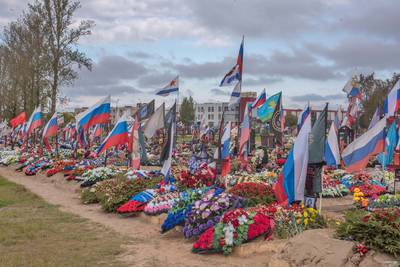
The dense, chaotic stage of recent burial in the "Alley of Heroes," where fresh earthen graves are overwhelmed by a profusion of flags, including the Russian tricolor, the blue flag of the Aerospace Forces (VKS), and banners of various volunteer and assault units. The foreground shows a simple wooden cross with a framed photo of a young soldier, surrounded by vibrant wreaths of artificial flowers, while in the background, a woman walks amongst the rows, emphasizing the cemetery s role as an active site of public mourning. The sheer number of flags and the raw state of the ground visually confirm a continuous, high-volume flow of casualties processed at this site. Cemetery of the Victims of January 9, St. Petersburg, Russia, October 4, 2025  "Section 69 A" marker within the "temporary" burial sector, where fresh earthen mounds stretch toward a forested perimeter, contrasting the ordered numbering system with the raw immediacy of mass death. A solitary mourner in a green coat stands quietly by a cross, tending to flowers amidst a sea of Russian tricolors and unit flags, including the blue and yellow banner of the Aerospace Forces, adding a human scale to the vast, impersonal landscape of casualties. The scene highlights the rapid expansion of the cemetery, with the dense rows of wooden crosses indicating the continuous flow of new burials. "Alley of Heroes" at Cemetery of the Victims of January 9, St. Petersburg, Russia, October 4, 2025  A cluster of fresh graves from the summer of 2025, including that of Igor Vadimovich Lebedev (1969-2025), a 56-year-old casualty. The scene is densely packed with temporary wooden crosses, massive wreaths in the Russian tricolor, and various unit flags--including the VDV (Airborne Forces) and Motorized Rifle Troops--while a lone mourner in the background tends to a plot, emphasizing the personal grief amidst the mass scale of death. "Alley of Heroes" at Cemetery of the Victims of January 9, St. Petersburg, Russia, October 4, 2025  The ideological complexity of the war s memorialization, dominated by a large red Soviet flag flying prominently over fresh graves, invoking nostalgia for the USSR s military power alongside Russian tricolors and VDV (Airborne Forces) banners. In the foreground, the grave of Arkady Vasilyevich Kovalchuk (1974-2024), who died at age 50, exemplifies the demographic trend of older men bearing a significant share of casualties. The scene is one of dense, vibrant mourning, with mounds of artificial flowers covering the raw earth, set against a backdrop of modern commercial buildings that anchor the cemetery in the contemporary urban landscape. "Alley of Heroes" at Cemetery of the Victims of January 9, St. Petersburg, Russia, October 4, 2025  The "initial stage" of mass burial, depicting a dense field of fresh earthen mounds marked only by temporary wooden crosses and overwhelmed by a sea of Russian tricolors, Soviet red banners, and VDV flags. The ground is raw and uneven, with a single permanent black granite curb visible in the foreground as the only sign of the eventual transition to formal memorialization. In the background, industrial infrastructure frames the scene, emphasizing the integration of this expanding military necropolis into the everyday civilian landscape of St. Petersburg "Alley of Heroes" at Cemetery of the Victims of January 9, St. Petersburg, Russia, October 4, 2025  The grave of Mikhail Ilyich Svyatkin (1986-2025), a 39-year-old soldier whose death in May 2025 aligns with the surge in casualties during the spring and summer of that year. His wooden cross bears a framed photo of him in combat gear holding a rifle, surrounded by wreaths inscribed "From Mother," highlighting the personal grief embedded in the mass loss. The background is crowded with similar fresh graves, flags, and flowers, reinforcing the density and continuity of the burials at this active military cemetery. "Alley of Heroes" at Cemetery of the Victims of January 9, St. Petersburg, Russia, October 4, 2025  The initial "temporary" stage of burial, showing rows of fresh earthen mounds topped with simple wooden Orthodox crosses and small identification plaques. Despite the lack of permanent monuments, the graves are densely decorated with vibrant artificial flowers and a profusion of flags--including the Russian tricolor, a Soviet hammer-and-sickle banner, and the flag of Uzbekistan--highlighting the diverse origins and ideological affiliations of the recently deceased. The raw, uneven ground and the sheer number of identical crosses extending into the background visually confirm the high volume of recent casualties processed at the site. "Alley of Heroes" at Cemetery of the Victims of January 9, St. Petersburg, Russia, October 4, 2025  Religious and symbolic narrative of sacrifice, featuring a granite monument with an elaborate engraving of a soldier ascending a staircase toward a welcoming Christ-like figure and a birch tree, blending Christian theology with Russian nationalism. The epitaph laments, "You loved life... But the thread was cut too soon," emphasizing personal loss alongside martial duty. In the background, a chaotic array of VDV (Airborne Forces) and Russian flags flies over rows of fresh, temporary graves, contrasting the permanent serenity of the foreground monument with the raw immediacy of ongoing casualties. "Alley of Heroes" at Cemetery of the Victims of January 9, St. Petersburg, Russia, October 4, 2025  The "initial stage" of memorialization, where fresh earthen graves are crowded with temporary wooden crosses and a profusion of military banners, including the VDV (Airborne Forces) and St. Andrew[CloseCurlyQuote]s Naval flags. The foreground features the grave of Mikhail Ilyich Svyatkin (1986-2025), a 39-year-old casualty, whose cross is adorned with a framed photo of him in uniform, exemplifying the typical profile of recent losses. The scene is saturated with patriotic symbols, including a flag depicting a tank with the slogan "Victory will be ours" and another with the Order of the Great Patriotic War, linking the current conflict to historical narratives of Soviet heroism. "Alley of Heroes" at Cemetery of the Victims of January 9, St. Petersburg, Russia, October 4, 2025  The dense concentration of recent casualties, with fresh earthen mounds tightly packed together and adorned with the ubiquitous Russian tricolor. In the foreground, the grave of Aleksandr Vladimirovich Dementyev (1962-2025) is marked by a wooden cross and a color portrait, identifying a 63-year-old soldier whose age highlights the heavy toll on older reservists and volunteers. The background reveals the integration of the cemetery into the urban fabric, with modern commercial buildings visible just beyond the sea of flags and wreaths, grounding the war[CloseCurlyQuote]s losses in the everyday reality of St. Petersburg. "Alley of Heroes" at Cemetery of the Victims of January 9, St. Petersburg, Russia, October 4, 2025  The "initial stage" of memorialization, where fresh earthen graves are densely covered in massive wreaths of artificial flowers and a forest of flags. In the foreground, the wooden cross of Aleksandr Vitalyevich Rogachev (1964-2025) identifies a 61-year-old casualty, representative of the older demographic of mobilized soldiers and volunteers. The scene highlights the diverse composition of the forces, with the flag of Uzbekistan visible in the background--indicating the recruitment of foreign nationals--while a lone mourner tends to a grave amidst the dense rows, adding a human scale to the extensive loss. "Alley of Heroes" at Cemetery of the Victims of January 9, St. Petersburg, Russia, October 4, 2025  The dense visual cacophony of the cemetery s "temporary" section, where rows of wooden crosses are submerged in a sea of Russian tricolors and military intelligence (GRU/Spetsnaz) flags bearing the bat insignia. In the foreground, the grave of Kirill Arkadyevich Sharkov (1975-2025), a 49-year-old casualty, is marked by a simple cross and a photo of him in uniform, surrounded by wreaths in patriotic red, white, and blue colors. The scene conveys the sheer volume of recent losses, with flags fluttering chaotically over uneven mounds of earth, while a tractor in the far left background hints at the ongoing expansion of the burial grounds. "Alley of Heroes" at Cemetery of the Victims of January 9, St. Petersburg, Russia, October 4, 2025  The diverse visual languages of mourning in the "Alley of Heroes," contrasting a solemn monochrome engraving of a soldier in full combat gear--distinguished by the Order of Courage medal--with the vibrant, smiling color portrait of Yuri Bogdanov on the adjacent grave. The background is saturated with a chaotic array of flags, including the black-yellow-white Russian Imperial tricolor and red Soviet banners, visually capturing the "hybrid" ideological landscape, where conflicting historical symbols are merged to support the war effort. Cemetery of the Victims of January 9, St. Petersburg, Russia, October 4, 2025  "Alley of Heroes," a section of the cemetery dedicated to Russian soldiers killed in the war in Ukraine. In the foreground stands a permanent black granite monument featuring a detailed engraving of a soldier in combat gear with the "Z" insignia and a stoic epitaph reading, "Having given everything, I will not rise from the dust... I, having killed the fear within myself, fought". The background reveals rows of additional graves densely adorned with wreaths and flags representing various military branches (including the VDV and Naval Infantry) and private military contractors, illustrating the ongoing scale and diverse composition of the casualties. Cemetery of the Victims of January 9, St. Petersburg, Russia, October 4, 2025  Revealing the multinational and irregular composition of the Russian forces, featuring the flag of Uzbekistan prominently displayed alongside the black "Assault Troops" banner and the Russian tricolor. In the foreground, the grave of Aleksandr Borisovich Vasiliev (1973-2025), a 52-year-old soldier, is marked by a framed photograph of him in combat gear standing in a field, humanizing the older demographic of recent casualties. The scene captures the raw, crowded nature of the "initial stage" of burial, with fresh earthen mounds and a chaotic mix of personal and military symbols extending into the background. "Alley of Heroes" at Cemetery of the Victims of January 9, St. Petersburg, Russia, October 4, 2025  The diverse visual language of mourning in the "Alley of Heroes," showing a mix of permanent granite monuments and temporary graves decorated with flags, including the Russian Imperial black-yellow-white tricolor and a Soviet red banner. In the foreground, the polished black headstone of Ivan Vladimirovich Semenov (1995-2024) features a color portrait of the 28-year-old soldier, while nearby, two women stand amidst the graves, highlighting the cemetery as an active site of personal grief. The scene captures the juxtaposition of varied ideological symbols--imperial, communist, and modern state--united within the shared space of military sacrifice. Cemetery of the Victims of January 9, St. Petersburg, Russia, October 4, 2025  A granite monument bearing the poignant epitaph, "My today is a sacrifice for your tomorrow," framing the soldier[CloseCurlyQuote]s death as a redemptive gift to future generations. The grave is flanked by the black and yellow flags of the Motorized Rifle Troops--Russia s primary ground combat formations--distinguished by the Kalashnikov insignia and the motto "Loyalty". In the background, rows of temporary wooden crosses extend into the distance, contrasting the finished memorial with the raw, fresh graves of recent casualties. "Alley of Heroes" at Cemetery of the Victims of January 9, St. Petersburg, Russia, October 4, 2025  The "permanent stage" of memorialization, featuring a row of polished black granite monuments for soldiers such as Andrey Nikolaevich Atlanov (1977-2024) and Danila Denisovich Shutov (2001-2024), a 23-year-old whose age underscores the ongoing loss of young lives. The monuments display diverse portrait styles--ranging from formal military engravings to casual color photos--and are flanked by flags including the VDV (Airborne Forces) banner with the motto "Nobody, but us," reflecting both individual identity and collective unit pride. The orderly arrangement of these finished graves, complete with granite curbs and gravel, stands in contrast to the chaotic temporary sections seen in other places, illustrating the gradual formalization of the war s toll. "Alley of Heroes" at Cemetery of the Victims of January 9, St. Petersburg, Russia, October 4, 2025  The permanent monument of Denis Alekseevich Mikhailov (1983-2024), a 40-year-old soldier whose polished black granite headstone displays a detailed engraving of him in full combat gear, holding a rifle and wearing a parachute badge, alongside a real blue beret left as a personal tribute. The grave is flanked by the blue and yellow flag of the VDV (Airborne Forces) with the motto "Nobody, but us," underscoring his elite unit affiliation, while surrounding graves show a mix of portrait styles and military banners, reflecting the individualized yet collective nature of the memorialization. "Alley of Heroes" at Cemetery of the Victims of January 9, St. Petersburg, Russia, October 4, 2025  Blending of religious and patriotic symbolism in the "Alley of Heroes". The foreground monument features a poignant epitaph addressing the deceased ("And you stand before our eyes, Alive... We keep you in our hearts") alongside an elaborate engraving of a soldier ascending a staircase toward a Christ-like figure, framing death as a spiritual journey. In the background, a distinctive broken-heart monument depicts a split image of a bridge at night surrounded by flags from various military branches, including the VDV and Russian Naval Infantry. Cemetery of the Victims of January 9, St. Petersburg, Russia, October 4, 2025  The expanding scale of the "Alley of Heroes," with construction machinery visible in the left background clearing land for new burial plots, confirming the site s active status. The foreground displays a dense cluster of polished granite monuments flanked by diverse military insignia, including the St. Andrew[CloseCurlyQuote]s flag of the Navy and a unit banner for a Motorized Rifle formation, reflecting the hybrid force structure composed of regular troops, mobilized personnel, and specialized units. Cemetery of the Victims of January 9, St. Petersburg, Russia, October 4, 2025  The grave of Alexey Vladimirovich Suslov (1976-2024), a 47-year-old casualty whose age reflects Russia s reliance on older reservists and volunteers rather than just young conscripts. His polished black granite monument features a casual color portrait and the epitaph "We were left without you, You remained with us," asserting a continuing spiritual bond despite death. The background juxtaposes the solemn "Alley of Heroes" with modern commercial buildings, visually grounding the war s toll within the everyday urban landscape of St. Petersburg. Cemetery of the Victims of January 9, St. Petersburg, Russia, October 4, 2025  A wide, panoramic view of the "Three Graces" sculpture within its autumn context. The dark bronze sculpture of the three women acts as a vertical anchor in a landscape dominated by towering trees. The wider angle emphasizes the scale of the forest compared to the artwork, placing human creativity within the embrace of nature. Oranienbaum palace-and-park ensemble in Lomonosov (a suburb of St. Petersburg), Russia, October 13, 2025  Layered complexity of the mixed deciduous forest in Alexander Park. The image is a study in yellow, dominated by the luminous canopy of Norway maples and silver birches. The rough, dark bark of the oaks and maples provides a strong vertical rhythm that cuts through the delicate, hazy texture of the foliage. The white, paper-like bark of the birch trees adds a secondary visual accent typical of the Russian landscape. The composition includes a rich understory of turning shrubs--likely hazel or young rowan--which adds density and depth, grounding the soaring trunks in a thicket of earthy reds and browns. Aleksandrovsky (Alexander) Park in Pushkin (former Tsarskoe Selo) near Saint Petersburg, Russia, October 10, 2025  This view of the installation near the Russian embassy on Pikk Street captures a broader perspective of the protest site, showing how it stretches along the sidewalk in front of the embassy building. The white banner in the foreground originally read "FOR THE VICTIMS OF WARS STARTED BY RUSSIA" (with the Russian translation on the right). However, someone has vandalized the sign by crossing out "RUSSIA" and scrawling "US" and a Star of David (hexagram) over it. This act of vandalism attempts to deflect blame from Russia by invoking anti-American and antisemitic tropes, a tactic often seen in pro-Kremlin disinformation campaigns. On the left side of the street, the building with the distinctive Art Nouveau facade (Pikk 18) houses the Ron Verlin salon, visible through the large arched window. This contrasts the elegant, peaceful commercial life of the street with the raw political conflict playing out just meters away. The fencing extends far down the street, covered in layers of posters, flags, and messages. This indicates the sustained nature of the demonstration, which has become a semi-permanent fixture in the Old Town since the start of the full-scale invasion. Tallinn, Estonia, October 16, 2025  A birch grove in Aleksandrovsky (Alexander) Park. The composition is defined by the striking, repeating vertical lines of the white birch trunks. This "bar code" pattern creates a strong visual rhythm that cuts through the soft, chaotic texture of the foliage. Pushkin (former Tsarskoe Selo) near Saint Petersburg, Russia, October 10, 2025  A temporary protest installation located directly in front of the Russian Embassy at Pikk 19 in Tallinn s Old Town. The barricades and posters are situated along the sidewalk of Pikk Street, facing the embassy building. This narrow, historic street has become a focal point for public demonstrations since the beginning of the full-scale invasion of Ukraine in February 2022. The installation serves as a persistent protest against the Russian invasion of Ukraine. It features Ukrainian flags, anti-war messages, graphic images of war damage (such as destroyed buildings in Ukrainian cities), and tributes to figures like Alexei Navalny. The display transforms a section of the picturesque Old Town into a politically charged space, forcing diplomats and passersby to confront the realities of the conflict. The protest materials are often updated by activists and local residents to reflect ongoing events. The sign "If they decide to kill me, it means we are incredibly strong - Navalny" references the late Russian opposition leader Alexei Navalny, whose death in prison in February 2024 sparked renewed gatherings and memorials at this exact spot. Tallinn, Estonia, October 16, 2025  View of a late-Soviet brick residential quarter (kirpichnaya khrushchevka) deeply integrated with the mature nature of the Vyborgsky district, captured at the beautiful but fleeting peak of autumn. View from this window providing a glimpse into Soviet-era urban planning, specifically the residential design of the 1960s. The beige brick buildings visible in the frame are classic examples of "Khrushchevka" (Series 1-528). Unlike the cheaper concrete panel blocks (panelki), these are constructed from silicate brick, which was considered a "premium" material for mass housing at the time. They are easily identified by their 5-story height, hipped roofs (often replaced with metal sheeting), and specific balcony arrangements. Saint Petersburg, Russia, October 11, 2025  This scene showcases a sophisticated understanding of color layering in landscape design, using native species to create depth. The distinct red-purple haze of the Red-barked dogwood (Cornus alba or Swida alba) in the foreground acts as a grounding base, contrasting sharply with the luminous yellow of the maples and the vertical white lines of the birch trunks behind it. The dogwood s dense, fine twig structure (which turns vibrant blood-red in winter) adds a chaotic, bushy texture that complements the more open, airy canopy of the deciduous forest. This composition highlights the transition of seasons; while the canopy glows with "golden autumn," the understory dogwood is already revealing the red bark that will provide visual interest throughout the snowy Russian winter. Aleksandrovsky (Alexander) Park in Pushkin (former Tsarskoe Selo) near Saint Petersburg, Russia, October 10, 2025  View of BGU from Sederot Uri Street. Flags are lowered because of death of Leah, a wife of Rabin (?). Beer-Sheva, the Middle East, November 11, 2000  Graves belonging to the Foster and Phernetton families (specifically referencing Mattie Phernetton) in the Calvert City Cemetery. These graves are located in the older section of the cemetery, evidenced by the Victorian symbolism and the weathering of the white marble/limestone markers. Calvert, Texas, December 13, 2025  An old transformer substation in Lanskoy Garden on Sampsonievsky Prospekt near Lanskaya train Station. This corner can be described as a striking example of urban decay juxtaposed with natural harmony. The scene captures a raw, "wabi-sabi" beauty--an appreciation for things that are imperfect, impermanent, and incomplete. The Wall: The brickwork is rough, weathered, and tactile. The peeling paint and chipped bricks tell a story of age and neglect. The layers of torn posters add a "trash collage" effect (reminiscent of decollage art), creating a chaotic, man-made texture that feels gritty and transient. The Ground: In stark contrast, the ground is covered in a soft, organic carpet of fallen maple leaves. This natural texture is random but harmonious, softening the harsh lines of the brick building. Saint Petersburg, Russia, October 9, 2025  Wide angle view of a model of Peter the Great s head for the monument Bronze Horseman by M.-A. Collot in Russian Museum. Saint Petersburg, Russia, February 9, 2018  The wilder, naturalistic aesthetic of Alexander Park s landscape section. The visual appeal lies in the layered textures of the undergrowth--a mix of golden birch leaves and red shrubbery--creating a chaotic but harmonious "tapestry" effect. Unlike the formal alleys, this scene emphasizes density and verticality, with thin birch trunks contrasting against the soft, diffuse background of the forest depth. It evokes the intimacy of a forest interior (uncultivated nature), a deliberate romantic counterpoint to the manicured geometry of the nearby "New Garden". Aleksandrovsky (Alexander) Park in Pushkin (former Tsarskoe Selo) near Saint Petersburg, Russia, October 10, 2025  Forest floor with a dense carpet of fallen leaves. The ground is thickly blanketed in thousands of yellow maple leaves, intermixed with brown oak and linden litter. Sergievka Park, Old Peterhof, west from Saint Petersburg, Russia, October 13, 2025  Monument of heroes of Great October Socialist Revolution. It is a mass grave monument dedicated to Red Guards who died during the 1917 October Revolution and the subsequent Civil War. The site originated in 1917 as a burial ground for workers and Red Guards from the nearby Novy Lessner Plant (now the Karl Marx Machine-Building Plant). These fighters were killed in battles against the troops of General Pyotr Krasnov near Pulkovo during the defense of Petrograd. In 1953, a wooden structure was replaced by the current grey granite obelisk seen today. It was designed by architect Yuri Wiesenthal. This monument is a solemn reminder of the intense revolutionary history of the Vyborg Side, a district historically populated by industrial workers who were pivotal to the Bolshevik cause. Lesnoy Park (Lesotekhnicheskiy Universitet), Saint Petersburg, Russia, October 14, 2025  Rows of unidentified graves without headstones marked with temporary markers in Oak Hill Cemetery in Camp Swift north from Bastrop. Texas, September 15, 2012  View of Istok Lake at sunrise ("Golden Hour"), when the sun barely clears the horizon. Its rays strike the trees almost horizontally. This low angle filters out blue light, intensifying the warm yellows, oranges, and reddish-browns of the remaining foliage and tree trunks. Kannelyarvi, north from Saint Petersburg, Russia, October 1, 2025  Wide angle view of a field of spear grass (Stipa capensis) in a roadside depression of Khawzan Road. Qatar, February 20, 2016  Alley of North Cemetery in Pargolovo, near Saint Petersburg. Russia, October 14, 2025  A wider view of Pikk Street (Pikk ta"nav) in Tallinn s Old Town, focusing on the Russian Embassy at Pikk 19. The elegant pink building on the right with the balcony and the Russian Federation flag is the Russian Embassy. It is a historic structure dating back to the late 19th century, originally built as a private residence before becoming a diplomatic mission. A marked Estonian police van is parked further down the street on the left. Since the start of the full-scale invasion of Ukraine in 2022, there has been a constant police presence here to monitor the protests and ensure security around the embassy. The metal barriers covered in protest art, flags, and posters run along the entire length of the sidewalk in front of the embassy. This installation has become a defining feature of the street, transforming a diplomatic zone into a site of permanent public demonstration. The view looks down Pikk Street towards the north, showing the narrow, cobblestone character of the Old Town. On the left, you can see other historic buildings, including shops and restaurants like the Cantina Texas (just visible in the distance). The contrast between the beautiful medieval architecture and the tense political atmosphere is striking. Tallinn, Estonia, October 16, 2025  Evening view that provides a dramatic, upward-looking perspective of St. Olaf s Church (Oleviste kirik) from the street level (near Lai 48), emphasizing the towering scale of its west facade. The image is dominated by the massive limestone tower of St. Olaf s. The perspective highlights the transition from the square base to the octagonal upper stages, a typical feature of Gothic architecture in the Hanseatic region. The long, narrow window with its pointed arch (lancet window) is a defining Gothic element, allowing light into the nave. To the right, you can see the upper stories of the adjacent building (likely Lai 48 or 50). Its simple, plastered facade and regularly spaced windows provide a domestic scale that contrasts with the monumental church. The distinctive rain gutter (downspout) on the left foreground acts as a framing element, drawing the eye upward. This view underscores why St. Olaf s was once the tallest building in the world (1549-1625). The sheer verticality visible here was originally intended to serve as a landmark for trading ships approaching Tallinn s harbor. Tallinn, Estonia, October 16, 2025  Rustic stone arch bridge, nestled deep within the Sergievka Park ravine. Built from rough-hewn granite blocks, the bridge was designed to look ancient and weather-beaten even when new, fitting the 19th-century romantic preference for melding architecture with wild nature. The bridge spans a small cascade of the Kristatelka River, where water tumbles over mossy stone steps, creating a soothing auditory backdrop to the visual serenity. The scene is framed by golden maples and fallen leaves that carpet the banks and settle into the stream s rocky bed, enhancing the secluded, fairy-tale atmosphere. Sergievka Park, Old Peterhof, west from Saint Petersburg, Russia, October 13, 2025  The "Adam s Head" (or Golova-valun:feff) sculpture presents a striking profile view, revealing its deep-set eye and prominent nose emerging from the earth. Bright yellow maple leaves carpeting the ground and contrasting with the grey granite. A small spring flows near the base of the sculpture (visible in the foreground as a trickle), adding to the mystical atmosphere that reportedly inspired Lewis Carroll during his visit in 1867. This angle emphasizes the massive scale of the boulder relative to the path, showing how the face was carved directly into the natural granite contours. Sergievka Park, Old Peterhof, west from Saint Petersburg, Russia, October 13, 2025  Scenery on a slope to Karasta River. A dense mix of oak, maple, and fir trees creates a rich tapestry of color, dominated by vibrant yellows and deep golds that completely cover the canopy. Oranienbaum palace-and-park ensemble in Lomonosov (a suburb of St. Petersburg), Russia, October 13, 2025  Wild, impressionistic beauty of Alexander Park s naturalistic sections. The image is dominated by the rough, dark bark of mature oaks (likely Quercus robur) in the foreground, which contrasts sharply with the soft, hazy backdrop of golden maples and underbrush. The dense layering of vegetation--from the grassy forest floor to the tangled mid-story shrubs (like hazel or dogwood) and the towering canopy--creates a sense of enclosure and depth, reminiscent of a Levitan landscape painting. The scene captures the full richness of the "Golden Autumn," where the vibrant yellows and russets of the foliage seem to glow from within the forest, creating a warm, immersive atmosphere despite the overcast sky. Aleksandrovsky (Alexander) Park in Pushkin (former Tsarskoe Selo) near Saint Petersburg, Russia, October 10, 2025  Memorial of blind victims in Levashovskaya Pustosh Memorial Cemetery. Levashovo near Saint Petersburg, Russia, October 30, 2016  Linden alley in Oranienbaum Park. Mature linden trees form a dense, golden tunnel overhead. The long, converging lines of the tree trunks draw the eye toward the distant tractor, emphasizing the scale of the park (which covers over 160 hectares) and the ongoing maintenance required to preserve its historic appearance. Oranienbaum palace-and-park ensemble in Lomonosov (a suburb of St. Petersburg), Russia, October 13, 2025  Panoramic view from the Tarkhovka shoreline that looks north-west across the Sestroretsky Razliv (Lake Sestroretsk) toward the city of Sestroretsk. This view captures the dual nature of Sestroretsk: a historic resort town with natural beauty (the lake, reeds, and stones) juxtaposed with modern urban infrastructure (heating plant and high-rise housing). "Three Chimneys" (Center): The most prominent industrial feature is the cluster of three tall red-and-white striped chimneys. These belong to the Sestroretsk District Heating Plant (part of the city s thermal infrastructure). Residential Towers (Left of Chimneys): The tall, beige-and-orange brick apartment buildings are part of the modern residential developments in Sestroretsk, likely along Tokarevskaya Street or the Razliv microdistrict. Church of Peter and Paul (Far Right): On the far right horizon. This is a modern church (consecrated in 2009) built in memory of the Russian submariners. "Pyramid" Building (Far Left): On the far left, there is a distinctive white building with a stepped, pyramid-like shape. This is likely the "Eden" (Edem) residential complex or a similar luxury apartment block, which is known for its terraced architecture. Tarkhovka Park near Sestroretsk, west from Saint Petersburg. Russia, October 3, 2025  Imperial Horse Cemetery at the Pensioner s Stable in Tsarskoe Selo. This cemetery is the final resting place for over 120 favorite horses of the Russian Emperors, from Alexander I to Nicholas II. The neat rows of white tombstones are the result of a major restoration project completed recently. Saint Petersburg, Russia, September 21, 2025  A tomb of a Soviet ballerina A. Shelest in Literatorskie Mostki section of Volkovo Cemetery. Saint Petersburg, Russia, October 17, 2016  A tomb of a Soviet sculptor Yu. N. Lokhovinin in Literatorskie Mostki section of Volkovo Cemetery. Saint Petersburg, Russia, October 17, 2016  A tomb of a Soviet composer I. Shvarts in Literatorskie Mostki section of Volkovo Cemetery. Saint Petersburg, Russia, October 17, 2016  A tomb of a Soviet artist P. T. Fomin in Literatorskie Mostki section of Volkovo Cemetery. Saint Petersburg, Russia, October 17, 2016  This view from the Small Chinese Bridge captures the northwestern stretch of the Krestovy Canal. The canal creates a straight, reflective corridor lined with golden maples, emphasizing the transition from the formal "New Garden" to the more naturalistic landscape park areas. Looking northwest, the canal leads toward the Alexander Palace and its kitchen buildings, which are situated to the right of this axis, hidden behind the dense tree line. The scene highlights the park s quiet, wooded character, contrasting with the architectural focus of the opposite view towards the Cross Bridge. Aleksandrovsky (Alexander) Park in Pushkin (former Tsarskoe Selo) near Saint Petersburg, Russia, October 10, 2025  Side view of a mossy stone head of a Soviet physiologist E. A. Ganike in Literatorskie Mostki section of Volkovo Cemetery. Saint Petersburg, Russia, July 13, 2016  From the elevated terrace of the Leuchtenberg Palace, a thoughtfully designed "prospect" (vista) opens up towards the Gulf of Finland, offering a serene coastal panorama framed by autumn foliage. This clearing was intentionally cut through the forest in the 19th century to create a direct visual link between the palace and the sea, a common feature in romantic landscape architecture. The busy road visible in the middle ground is the Oranienbaum Highway, which separates the upper park from the lower coastal meadows. In the distance, the grey-blue waters of the Gulf of Finland merge with the overcast sky, creating a vast, moody backdrop that emphasizes the estate s prime coastal location. Sergievka Park, Old Peterhof, west from Saint Petersburg, Russia, October 13, 2025  This perspective on Harju Street captures a striking mix of Soviet-era modernism and medieval heritage in the heart of Tallinn s Old Town. The prominent grey building on the right is the Writers House (Kirjanike Maja), located at Harju 1. Designed by architects August Volberg and Heili Volberg and completed in 1963, it is a prime example of post-war modernist architecture in Estonia. The foreground reveals traces of the area s turbulent history. The open green space on the left (Harju Street Park) occupies the site of buildings destroyed during the March 1944 Soviet bombing. For decades, these ruins were a painful scar, but the area has since been redeveloped into a recreational space that memorializes the lost urban fabric while providing a breathing room in the dense Old Town. The blue truck cabin visible in the foreground of the Harju Street photo is a GAZ-51, a legendary Soviet-era truck that was a common sight in Estonia for decades. Estonia, October 16, 2025  The truck in this close-up is a Soviet-era GAZ-51 (or possibly its four-wheel-drive variant, the GAZ-63), which has been repurposed into a striking, semi-ruined art installation in Tallinn s Old Town. The distinct rounded hood, vertical grille slats, and cab shape identify it as a GAZ-51, one of the most widely produced trucks in the Soviet Union from 1946 to 1975. It was a workhorse of Estonian agriculture and industry during the Soviet occupation. The truck is in a state of deliberate decay, with peeling blue paint revealing rust, missing headlights, and a weather-beaten interior. This "ruined" aesthetic allows it to blend into the surrounding greenery, symbolizing the passage of time. The door features a stylized graffiti tag of a dragonfly, adding a layer of modern urban art to the vintage industrial canvas. A large, green, pipe-like structure (resembling a telescopic boom, grain auger, or water cannon) is mounted on the back. This industrial attachment gives the truck a fantastical, almost "Mad Max" or steampunk appearance, repurposing a utility vehicle into a whimsical sculpture. There is a local story that the owner of this specific plot of land (which is private, unlike the surrounding city-owned park) placed the truck and other objects (like manure heaps or potato patches in previous years) as a form of protest or disruption because the city would not grant permission to construct a new building on the site. Estonia, October 16, 2025  Soykinskaya Alley (or Road) in Oranienbaum Park. This is a major thoroughfare in the Upper Park, notable for its impressive width and the straight, long perspective it creates, reminiscent of the "prospekts" designed in the 18th century. The alley is flanked by mature, stately trees--predominantly oaks and lindens--whose canopies form a "golden tunnel" overhead. The fallen leaves completely cover the ground, creating a continuous carpet of orange and yellow that mirrors the canopy above. Oranienbaum palace-and-park ensemble in Lomonosov (a suburb of St. Petersburg), Russia, October 13, 2025  This view across the Friendship Bridge offers a stark look at the Ivangorod Fortress in Russia, directly contrasting with previous Estonian views. The most striking element in this image is the heavy modern fortification in the foreground. The bridge, which once facilitated vehicle traffic, is now blocked by rows of razor wire and concrete "dragon s teeth" anti-tank obstacles. These defensive measures, installed by Estonia, reflect the heightened geopolitical tension and the bridge s current status as a restricted crossing (open only to pedestrians as of 2024-2025). Dominating the background is the formidable Ivangorod Fortress, established in 1492 by Ivan III to counter the Teutonic Order on the opposite bank. A large Russian flag flies prominently atop one of the towers, serving as a deliberate counterpart to the Estonian and NATO flags visible from the other side of the river. Estonia, October 16, 2025  View of Jewish Cemetery, Russian Church of Mary Magdalene and Moslem Cemetery behind it from Mount of Olives. Jerusalem, the Middle East, July 12, 2001  Wide angle view of interior of Museum of Islamic Art. Doha, Qatar, May 9, 2014  Wide angle view of the dome of Museum of Islamic Art. Doha, Qatar, May 9, 2014  Wide angle view from the first floor of Museum of Islamic Art. Doha, Qatar, May 9, 2014  Wide angle view from grand staircase of Museum of Islamic Art. Doha, Qatar, May 9, 2014  Field violet (Viola tricolor, Russian name Fialka) in Urochishche Teterevskoe open space, between Orekhovo and Lembolovo, north from Saint Petersburg. Russia, June 30, 2010  Wide angle view of perforated chandelier and a dome of Museum of Islamic Art. Doha, Qatar, May 9, 2014  Wide angle view of perforated chandelier and grand staircase of Museum of Islamic Art. Doha, Qatar, May 9, 2014  A bronze copy of the famous ancient Greek group "Laocoo"n and His Sons" near the Chinese Palace. The dynamic composition depicts the Trojan priest Laocoo"n and his two sons in their agonizing death struggle against sea serpents sent by the gods (usually attributed to Athena or Poseidon) as punishment for warning the Trojans about the wooden horse. Oranienbaum palace-and-park ensemble in Lomonosov (a suburb of St. Petersburg), Russia, October 13, 2025  Expansive view looking north-northwest from the southern end of the Sestroretsk coastline towards the Sestroretsk Resort (Kurort) and, further in the distance, the settlement of Solnechnoe (Sunny). The coastline curves gently inward. This specific geography near Sestroretsk causes the eastward littoral drift (sand movement) to weaken, resulting in a very wide, accretional beach (up to 140 meters wide) known for its fine sand and extensive dunes. The foreground shows a sandy spit or sandbar created by the outflow of water. The shallow water here creates the wide, calm pools seen in the foreground, which are popular with birds. Sestroretsk near Saint Petersburg, Russia, October 9, 2025  Wide angle view of plants of Linaria albifrons on roadside south from Ras Laffan. North-eastern Qatar, February 19, 2016  Wide angle view of a blooming spurge Euphorbia retusa in a large roadside depression near Route 77 to Ras Laffan. Qatar, February 6, 2016  Wide angle view of a rare plant Euphorbia retusa in a large roadside depression near Route 77 to Ras Laffan. Qatar, February 6, 2016  Wide angle view of a rare spurge Euphorbia retusa in a large roadside depression near Route 77 to Ras Laffan. Qatar, February 6, 2016  View towards Repino from the Laskovy Beach area in Solnechnoe highlighting a transition in the coastal landscape of the Gulf of Finland, marked by rugged natural textures and distinct geological features typical of the Karelian Isthmus shoreline. Unlike the wide, smooth sandy expanses of the main Laskovy Beach, the stretch towards Repino is characterized by a "stony belt" of glacial boulders and pebbles. The rocks visible in the shallow water and on the sand--primarily rapakivi granite and gneiss--are glacial erratics left behind by retreating ice sheets. Their reddish and grey hues (wet from the waves) contrast sharply with the rust-colored sand. Several hooded crows (Corvus cornix) are visible foraging along the shoreline. Saint Petersburg, Russia, October 9, 2025  Narrow, cobblestone alley is Va"ike-Karja Street (Va"ike-Karja ta"nav) at the intersection with Sauna Street, a spot known for its vibrant nightlife. The black sign reading "FRANK" visible down the street on the right marks the entrance to FRANK Bistro & Cocktail Bar. This popular venue, located on the corner, is known for its New York-style interior and a hidden underground cocktail lounge ("Frank Underground"). The wall on the immediate right is heavily tagged with graffiti (visible tags include "FRANK" and other abstract designs), reflecting the street s gritty, urban character typical of the "Bermuda Triangle" nightlife district. The view looks down the narrow passage towards the intersection where Va"ike-Karja meets Sauna Street. The cobblestones are well-worn, and the narrowness of the street amplifies the intimate, medieval feel, despite the modern graffiti and bar signs. Tallinn, Estonia, October 16, 2025  Wide angle view of chicory (Cichorium pumilum) on the median strip of Al Istiqlal Street in Onaiza area. Doha, Qatar, April 14, 2016  Wide angle view of spurge Euphorbia retusa on gravel soil in a large roadside depression near Route 77 to Ras Laffan. Qatar, February 6, 2016  Classic "Northern Russian" mixed woodland representing a managed semi-natural mixed forest in transition, view from Alley of the Green Woman in Pavlovsk Park. Pavlovsk, a suburb of Saint Petersburg, Russia, October 6, 2025  Swampy alley in Nikolskoe Cemetery of Alexander Nevsky Lavra. Saint Petersburg, Russia, January 2, 2015  Wheeled excavator (specifically a Cat model) stationed within the drained bed of the Longitudinal Pond in Catherine Park. It is engaged in dredging and channel cleaning operations. It is chosen for its versatility and mobility on firm surfaces like the temporary track laid out in the canal bed. It is equipped with a ditching bucket (wide and flat-edged). The excavator is removing accumulated silt, mud, and decaying organic matter (leaves, branches) from the bottom of the pond. Pushkin (former Tsarskoe Selo) near Saint Petersburg, Russia, October 10, 2025  Maple leaves carpeting ground in Smolenskoe Lutheran Cemetery on Dekabristov Island. Saint Petersburg, Russia, October 28, 2016  A diverse bryophyte community colonizing disturbed soil on a pipeline corridor. The scene is dominated by a dense, dark-green carpet of pioneer mosses (likely Weissia controversa or Ceratodon purpureus). Scattered throughout are the distinct, pale green, pear-shaped capsules of Bonfire Moss (Funaria hygrometrica), a classic indicator of disturbed or burned ground. In the center, you can see the bluish-green, star-shaped rosettes of a Crystalwort (Riccia species), identifiable by their deep central grooves and dichotomous branching. Fort Boggy State Park. Leon County, Texas, February 21, 2026  This close-up view of the GAZ-51 truck highlights its surreal juxtaposition against the classic architecture of Tallinn s Old Town. The blue cabin is heavily weathered, with rust eating through the paint and missing headlights, emphasizing its status as a ruin or relic. The large green industrial mechanism mounted on the back--resembling a boom or auger--dominates the frame, extending horizontally like a cannon barrel. Distinct graffiti tags (like "WEK") on the door add a layer of contemporary urban decay, contrasting with the historic setting. Directly behind the truck, across the street, is a building housing a Bu"roomaailm (Office World) store. The truck sits on a grassy slope, part of the Harju Street Green Area, which covers the ruins of buildings destroyed in 1944. The contrast between the lush green grass, the rusting Soviet metal, and the maintained city street captures the eclectic spirit of this specific corner of Tallinn. Estonia, October 16, 2025  Wide angle view of a rare plant Euphorbia retusa on gravel soil in a large roadside depression near Route 77 to Ras Laffan. Qatar, February 6, 2016  Abandoned graves of solders of Red Army died at the beginning of World War II (1941) in Lutheran Cemetery on Citadel Road in Kronstadt. Saint Petersburg, Russia, July 4, 2010  House entrance decorated by flags at Zurara Bin Amir Street in Al Doha Al Jadeeda neighborhood. Doha, Qatar, January 31, 2014  Symbols of death on a tomb in Necropolis of Alexander Nevsky Lavra (Lazarevskoe Cemetery). Saint Petersburg, Russia, June 3, 2009  Picturesque density of Alexander Park s wilder sections. The vertical rhythm of white birch trunks cuts through the heavy, textured masses of yellow maple and brown shrubbery, creating a depth that feels more like a natural forest than a planted garden. The "golden autumn" palette is fully realized here, with the canopy s bright yellow filtering soft light down to the russet-colored undergrowth, unifying the chaotic vegetation into a warm, cohesive scene. This untamed aesthetic offers a sensory retreat, focusing on the enclosure and stillness of the woods rather than open vistas or architectural focal points. in Pushkin (former Tsarskoe Selo) near Saint Petersburg, Russia, October 10, 2025  Tomb of a Soviet ballerina A. Shelest (1919 - 1998) in Literatorskiye Mostki section of Volkovo Cemetery. Saint Petersburg, Russia, May 28, 2011  Wide angle view of some slender plant of aster(?) family on a periphery of Green Circles (center-pivot irrigation) in Irkhaya (Irkaya) Farms. Qatar, April 22, 2016  Forest composition at shoreline of Istok (Ha"rka"lammet) Lake. Kannelyarvi, north from Saint Petersburg, Russia, October 1, 2025  A stone arch bridge of the Kristatelka River situated downstream from the "Adam s Head" sculpture. The bridge features a solid, polished masonry arch topped with a simple, functional black iron railing. Spanning a cascade of moss-covered boulders and small waterfalls, the bridge sits deep within the ravine, creating a secluded atmosphere amplified by the dense canopy of trees. Sergievka Park, Old Peterhof, west from Saint Petersburg, Russia, October 13, 2025  Naturalistic style of the English landscape garden, which dominates the areas surrounding the formal canals, with rich textural contrast between the golden maples and dark evergreen firs, creating a painterly composition typical of 19th-century Russian park design. The untamed, wilder growth of the underbrush and tall grasses contrasts with the manicured lawns found elsewhere, evoking a sense of romantic melancholy suited to the "golden autumn" season. The dense, layered foliage creates an intimate, enclosed space that feels removed from the grand palace architecture, focusing entirely on the mood of the forest. Aleksandrovsky (Alexander) Park in Pushkin (former Tsarskoe Selo) near Saint Petersburg, Russia, October 10, 2025  A patriotic soviet-era sculpture composition in vestibule of Narvskaya Subway Station (there are speculations that there was a figure of J. Stalin in the center). Saint Petersburg, Russia, July 18, 2005  View of Russian Church of Mary Magdalene, Yeriho Road, and Moslem cemetery from Mount of Olives. Jerusalem, the Middle East, January 11, 2002  View of Russian Church of Mary Magdalene, Yeriho Road, and Moslem cemetery from Mount of Olives. Jerusalem, the Middle East, January 11, 2002  Mossy stone head of a Soviet physiologist E. A. Ganike in Literatorskie Mostki section of Volkovo Cemetery. Saint Petersburg, Russia, July 13, 2016 |