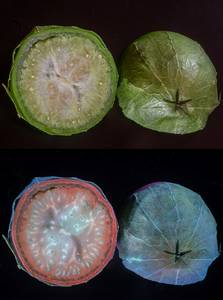
Section of tomatillo (Mexican husk tomato) both in natural light and under 365 nm ultraviolet (UV-A) blacklight from Kroger Supermarket. College Station, Texas, November 6, 2025  This composite image documents four stems of Hedeoma hispida (Rough False Pennyroyal) demonstrating the plant s appearance under two different lighting conditions against a dark background. The top panel shows the specimens under standard white light. The stems feature opposite, linear leaves and are covered in fine, bristly hairs, giving the plant its "rough" descriptor. Clusters of tiny, tubular, purplish-blue flowers emerge from the leaf axils along the upper portions of the stems, nestled within spiky, bristly calyces. The overall coloration is a vibrant, natural green with delicate violet floral accents. The bottom panel reveals the same four specimens illuminated by a 365 nm ultraviolet (UV-A) blacklight. Under UV excitation, the plant exhibits striking fluorescence. The previously purplish-blue flowers fluoresce a brilliant, vivid pinkish-red, while the green stems, leaves, and bristly hairs emit a cool, icy blue-white glow. This stark contrast highlights the complex photochemical properties of the plant tissues, transforming the subtle daytime appearance into a dramatic, high-contrast display. College Station, Texas, April 30, 2026 Blooming Rough False Pennyroyal (Hedeoma hispida) both in natural light and under 365 nm ultraviolet (UV-A) blacklight collected on a lawn at crossing of Holleman Drive and Dartmouth Street. College Station, Texas, April 30, 2026  This comparative photo contrasts a salad in natural light (top) with its hidden chemical fluorescence under 365 nm ultraviolet light (bottom). The glowing blue-white haze on the seemingly empty ceramic plate exposes microscopic traces of organic residue and fats left over from previous meals. The brightest glow comes from the cottage cheese, which emits a brilliant yellow-green light due to its high riboflavin and protein content. The plant ingredients show a more subtle, tissue-specific response: green olives shift to a pale salmon hue from chlorophyll and phenols, while the red pepper[CloseCurlyQuote]s thin cuticles light up in blue-purple tones. In contrast, the water-dense cucumber and tomato slices absorb most of the UV light and remain dark against the glowing background. College Station, Texas, May 2, 2026 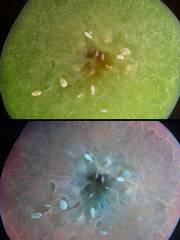 Cross section of a fruit of tomatillo from Kroger supermarket under both white light and a 365 nm ultraviolet (UV-A) LED flashlight. College Station, Texas, May 27, 2026  Rotting log both in natural light and under 365 nm ultraviolet (UV-A) blacklight near Krugovaya Alley in Sosnovka Park. The intense blue or blue-green glow comes from the wood itself, specifically from lignin and cellulose. The red fluorescence comes from Chlorophyll from algae/moss or Porphyrins from bacteria. Saint Petersburg, Russia, September 23, 2025 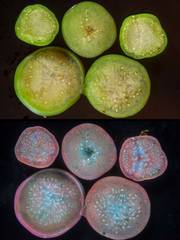 Sections of a fruit of tomatillo from Kroger supermarket both in natural light and under 365 nm ultraviolet (UV-A) blacklight. College Station, Texas, May 27, 2026  Plant with red fluorescence in ultraviolet light in Lick Creek Park. College Station, Texas, October 7, 2024  Fluorescence of water fern (Azolla) and duckweed in ultraviolet light in Bee Creek Park. College Station, Texas, November 11, 2024  Round patches of crustose lichen with bright orange fluorescence on a granite tomb both in natural light and under 365 nm ultraviolet (UV-A) blacklight in Odd Fellow Cemetery. Anderson, Texas, November 9, 2024  Gills of common bonnet mushrooms (Mycena galericulata) showing blue fluorescence under ultraviolet light near Lisiy Nos, west from Saint Petersburg. Russia, July 19, 2024  Yellow-green fluorescence of gills of sulphur tuft mushrooms (Hypholoma fasciculare) under ultraviolet light, collected in Sosnovka Park. Saint Petersburg, Russia, August 6, 2024  a young, actively growing shoot of eastern poison ivy (Toxicodendron radicans) emerging from the shadows of a thicket. The image is dramatically lit, isolating the central stem and fresh leaves against a nearly pitch-black background, which brings the complex textures and colors of the plant into sharp relief. The lighting emphasizes the plant s characteristic "leaves of three" structure, making the distinct anatomy of the new spring growth unmistakably clear. Wolf Pen Creek Park. College Station, Texas, March 23, 2026  Yellow Bells (Tecoma stans) both in natural light and under 365 nm ultraviolet (UV-A) blacklight (UV image reveals how the flower communicates with pollinators) in Leach Teaching Gardens at Texas A and M University. College Station, Texas, September 12, 2025  Fluorescence of olive edge bonnet mushrooms (Mycena viridimarginata) under ultraviolet light, collected in Sosnovka Park. Saint Petersburg, Russia, August 6, 2024  Fluorescence of gills of olive edge bonnet mushrooms (Mycena viridimarginata) under ultraviolet light, collected in Sosnovka Park. Saint Petersburg, Russia, August 6, 2024  Blue fluorescence of gills of warty cavalier mushrooms (Melanoleuca verrucipes) under ultraviolet light, collected in Sosnovka Park. Saint Petersburg, Russia, August 6, 2024  A pair of fresh, newly emerged leaves from a rusty blackhaw viburnum (Viburnum rufidulum). The image was captured with strong backlighting against a completely black background, which effectively isolates the foliage and acts like an x-ray, illuminating the intricate internal structure of the plant. This bright, glowing green display highlights the vigorous seasonal flush typical of native Texas understory trees breaking dormancy in the spring. Lick Creek Park. College Station, Texas, March 25, 2026  Crustose lichen with bright orange fluorescence on a granite tomb when exposed to regular daylight as well as when illuminated by a 365 nm ultraviolet (UV-A) blacklight in Odd Fellow Cemetery. Anderson, Texas, November 9, 2024 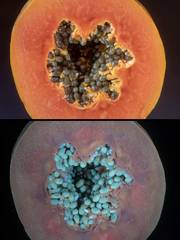 Section of fruit of papaya under both white light and a 365 nm ultraviolet (UV-A) LED flashlight from Kroger Supermarket. College Station, Texas, July 30, 2026 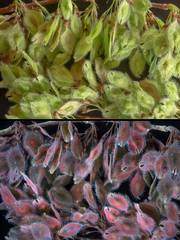 Green seeds of elm under both white light and a 365 nm ultraviolet (UV-A) LED flashlight in Wolf Pen Creek Park. College Station, Texas, March 2, 2026  Fruit of balloon cherry (cutleaf groundcherry, Physalis angulata) on Green Circles (center-pivot irrigation) in Irkhaya (Irkaya) Farms. South-western Qatar, November 15, 2014  Section of fruit of pomegranate both in natural light and under 365 nm ultraviolet (UV-A) blacklight from Kroger supermarket. College Station, Texas, September 12, 2024  Fleshy fruit of strawberry with seeds in pits in TAMU Holistic Garden in Texas A and M University. College Station, Texas, May 11, 2008 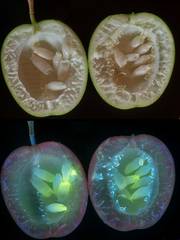 Dissected fruit of purple passionflower (Passiflora incarnata) under both white light and a 365 nm ultraviolet (UV-A) LED flashlight from Lick Creek Park. College Station, Texas, June 29, 2026  Fruit of balloon cherry (cutleaf groundcherry, Physalis angulata) on Green Circles (center-pivot irrigation) in Irkhaya (Irkaya) Farms. South-western Qatar, October 25, 2014  Close up of a fruit of balloon cherry (cutleaf groundcherry, Physalis angulata) on Green Circles (center-pivot irrigation) in Irkhaya (Irkaya) Farms. South-western Qatar, October 25, 2014  Mu"u"rivahe Street (Mu"u"rivahe ta"nav), looking towards the intersection with Viru Street. The image is taken near Mu"u"rivahe 23, which is the location of the Armanda clothing boutique visible on the left. The narrow, cobblestone street retains its medieval charm, winding between historic buildings that date back centuries. In the background, one can see a striking turquoise-colored tower with a weathervane. This is part of the building complex at the corner of Viru and Mu"u"rivahe streets, adding a distinct vertical accent to the streetscape. Tallinn, Estonia, October 16, 2025  Seeds in a cross section of a fruit of Carica papaya taken from Carrefour Supermarket. Doha, Qatar, July 3, 2015  Aerial view of the Schweizerland Alps in East Greenland, likely near the Sermilik Fjord region. The jagged, snow-covered peaks visible in the foreground are part of the Schweizerland mountain range (also known as the Schweizerland Alps). This is one of the highest and most alpine regions in Greenland, located just west of the town of Tasiilaq. The image shows deep valleys filled with snow and ice, with massive glaciers flowing down from the high peaks towards the fjords. The interplay of sharp ridges (are^tes) and ice-filled basins (cirques) creates a classic, high-alpine landscape that rivals the European Alps in ruggedness but on a much wilder scale. The large body of water visible in the background (center-right) is likely Sermilik Fjord, a major fjord known for being choked with icebergs calved from the Helheim and other glaciers. The water reflects the sunlight, creating a bright contrast against the darker mountains. View from a window of an airplane from Helsinki to Dallas, Greenland, October 17, 2025  Large, creamy-white petals with a deep crimson/pink center of hibiscus flowers both in natural light and under 365 nm ultraviolet (UV-A) blacklight in Leach Teaching Gardens at Texas A and M University. College Station, Texas, September 12, 2025  Fruit of strawberry with seeds (achenes) in pits embedded in pulpy mass of red, fleshy receptacle tissue in TAMU Holistic Garden in Texas A and M University. College Station, Texas, April 5, 2008  Close-up of fruit of pomegranate both in natural light and under 365 nm ultraviolet (UV-A) blacklight from Kroger supermarket. College Station, Texas, September 12, 2024 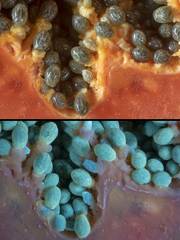 Close-up of fruit of papaya both in natural light and under 365 nm ultraviolet (UV-A) blacklight from Kroger Supermarket. College Station, Texas, July 30, 2026  Center of Maximilian sunflower (Helianthus maximiliani) both in natural light and under 365 nm ultraviolet (UV-A) blacklight, collected on Anderson Street in College Station, Texas, September 10, 2025  This aerial view captures the Tapiola district in Espoo, Finland, just west of Helsinki. Known as a "garden city," Tapiola is famous for its unique urban planning that blends modern architecture with extensive green spaces. Central Basin (Keskusallas): The large body of water in the left-center is the artificial pool or basin at the heart of Tapiola s center. It is surrounded by key landmarks like the Espoo Cultural Centre and the iconic Tapiola Garden Hotel. The image clearly shows the "garden city" concept in action: high-rise apartment blocks (typically white) are scattered amongst dense patches of forest and parks, rather than being packed into tight grids. In the foreground (bottom left), the coastline features marinas and residential areas, likely parts of the affluent Westend or Haukilahti neighborhoods, known for their seaside location. The major road running horizontally through the upper middle is likely La"nsiva"yla" (Western Highway), the main artery connecting Espoo to Helsinki city center (which would be to the right/east). View from a window of an airplane from Tallinn to Helsinki, Finland, October 17, 2025  Seeds of red dragon fruit (Ivan Big Tree, 3040) when exposed to regular daylight as well as when illuminated by a 365 nm ultraviolet (UV-A) blacklight from HEB Supermarket. College Station, Texas, September 16, 2024  Seeds of beefsteak plant (Perilla frutescens) both in natural light and under 365 nm ultraviolet (UV-A) blacklight from Caney Creek section of Lone Star Hiking Trail in Sam Houston National Forest north from Montgomery. Texas, October 10, 2024 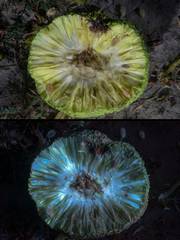 Half-eaten fruit of maclura tree both in natural light and under 365 nm ultraviolet (UV-A) blacklight in Bee Creek Park. College Station, Texas, July 31, 2026 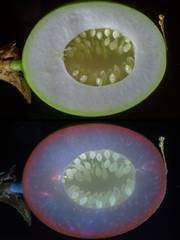 Fruit of purple passionflower (Passiflora incarnata) both in natural light and under 365 nm ultraviolet (UV-A) blacklight from Lick Creek Park. College Station, Texas, May 20, 2026  Ostrich Fern (Matteuccia struthiopteris) on Alpine Hill (or Alpinarium). Sterile Fronds (The "Feathers"): The large, outer leaves have turned from green to a golden-bronze color. These are the "ostrich feathers" that give the plant its name. They are withering now and will soon collapse for the winter. Fertile Fronds (The Dark Spikes): In the very center, there are the dark brown, stiff, upright spikes. These are the spore-bearing fronds (sporophylls). Unlike the leafy outer fronds, these become woody and persist standing upright through the entire winter, often poking out through the snow. Peter the Great Botanical Garden of Komarov Botanical Institute. Saint Petersburg, Russia, October 8, 2025  Spotted leaves of Chinese Tallow exhibiting a phenomenon known as the "green island" effect. The infection sites produce or retain cytokinins (plant hormones) that keep the chlorophyll active in that specific spot. As a result, while the rest of the leaf receives the signal to shut down for winter (losing its green chlorophyll and revealing the red anthocyanin pigments), the infected "islands" stay green and photosynthetically active. Bee Creek Park. College Station, Texas, November 7, 2025  This aerial view, captured on the approach to Helsinki (arriving from the west/southwest towards Helsinki-Vantaa Airport), showcases the stunningly fragmented coastline of the Finnish capital. The Archipelago: The image perfectly illustrates why Helsinki is known as the "Daughter of the Baltic." The coastline is a complex maze of peninsulas, bays, and islands. Western Suburbs: The dense urban areas visible are likely the western districts of Espoo (Finland s second-largest city, part of the capital region) and western Helsinki. Specifically, the large island connected by bridges in the center-left is likely Lauttasaari (Drumso), a major residential island district. To its left, the distinctive curved coastline of Keilaniemi and West Harbour (La"nsisatama) areas might be visible. The landscape is dotted with significant green spaces and forested islands, characteristic of the Helsinki metropolitan area where nature is never far from the urban core. View from a window of an airplane from Tallinn to Helsinki, Finland, October 17, 2025  A close look at the distinctive, bristly texture of a Pincushion Moss (Leucobryum species) found near Lake Trail at Fort Boggy State Park. While often casually identified as Leucobryum glaucum, this is almost certainly its southern sister species, Leucobryum albidum (White Pincushion Moss), which is much more common in East Texas. The moss gets its pale, frosted-green color from a unique leaf structure: the outer layers consist of large, clear, hollow cells that hide the green chlorophyll beneath. When it rains, these empty cells fill with water and turn the cushion bright green; when dry, they fill with air, giving the plant a silvery-white appearance. Fort Boggy State Park. Leon County, Texas, February 21, 2026 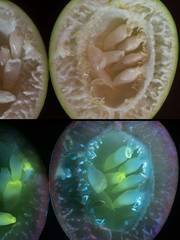 Close-up of fruit of purple passionflower (Passiflora incarnata) both in natural light and under 365 nm ultraviolet (UV-A) blacklight from Lick Creek Park. College Station, Texas, June 29, 2026  Calving front (terminus) of one of the major outlet glaciers, likely where the Helheim or Midgard glacier meets the waters of Sermilik Fjord. The most dramatic feature is the boundary where the massive river of ice (center) meets the open water (top right). This "calving front" is where giant icebergs break off into the fjord. The water in the fjord is a milky turquoise, a telltale sign of rock flour (glacial sediment) suspended in the meltwater. The image illustrates how the ice sheet flows like a slow-moving liquid around the resistant mountain peaks (nunataks) in the foreground. You can see the ice splitting and rejoining around these rock islands, creating distinct flow lines and medial moraines (stripes of debris) on the glacier surface. The bare, rocky slopes visible on the nunataks above the current ice level (the "trim line") suggest that the ice was historically thicker here, a visual marker of the glacier s retreat over recent decades. In the center, multiple tributary glaciers appear to be merging into the main channel, contributing to the chaotic, crevassed surface texture as different ice flows collide and accelerate towards the sea. View from a window of an airplane from Helsinki to Dallas, Greenland, October 17, 2025  Leaves of saw Greenbrier (Smilax bona-nox) showing natural genetic expression and seasonal aging. The white/cream blotches in the center of the leaves are likely natural variegation. In November, the green chlorophyll has died off to reveal the red anthocyanins (fall color). Richards Loop Trail in Sam Houston National Forest. Texas, November 15, 2025  A detailed look at the suburban landscape of Tikkurila, the administrative center of Vantaa, located just north of Helsinki. Kerava River (Keravanjoki): The winding river cutting through the landscape is the Kerava River, a tributary of the Vantaa River. It flows past residential areas and parks, offering a scenic green belt through the suburbs. The denser cluster of buildings in the center-right is the heart of Tikkurila (Dickursby). This area is a major transport hub, home to the Tikkurila railway station (a key stop for airport trains) and the Heureka Science Centre (likely one of the larger modern structures near the river). Suburban Fabric: The image showcases a mix of housing types typical of the Helsinki metropolitan area: detached houses with large gardens in the foreground and denser apartment blocks closer to the Tikkurila center. The presence of a sports field with a running track (red oval, left side) highlights the community-focused planning. Rural-Urban Edge: The top and left portions of the image show open fields and farmland, illustrating how abruptly the urban area transitions into the countryside in this region. This area is minutes away from landing at Helsinki-Vantaa Airport, making it a common sight for travelers. View from a window of an airplane from Tallinn to Helsinki, Finland, October 17, 2025  Partridge berry with white flowers and a last year fruit on South Wilderness Loop Trail at Little Lake Creek Wilderness in Sam Houston National Forest near Richards. Texas, April 2, 2023  Seeds of saw palmetto (Serenoa repens) in animal droppings, together with seeds of other plants in ultraviolet light on Caney Creek Trail (Little Lake Creek Loop Trail) in Sam Houston National Forest north from Montgomery. Texas, October 10, 2024  Ball moss (Tillandsia recurvata) with seeds fallen from an oak both in natural light and under 365 nm ultraviolet (UV-A) blacklight from Wolf Pen Creek Park. College Station, Texas, October 28, 2024  White heath aster (Symphyotrichum ericoides) both in natural light and under 365 nm ultraviolet (UV-A) blacklight in Wolf Pen Creek Park. College Station, Texas, November 5, 2025  Fluffy seeds of groundsel bush (seepwillow, Baccharis halimifolia) both in natural light and under 365 nm ultraviolet (UV-A) blacklight from Lick Creek Park. College Station, Texas, October 1, 2024  Close-up of fluffy seeds of wand blackroot (Pterocaulon virgatum) both in natural light and under 365 nm ultraviolet (UV-A) blacklight from Lick Creek Park. College Station, Texas, September 11, 2024  Flowers of white heath aster (Symphyotrichum ericoides) both in natural light and under 365 nm ultraviolet (UV-A) blacklight in Wolf Pen Creek Park. College Station, Texas, November 5, 2025  White flowers of partridge berry and red seeds of coral beans on Lone Star Hiking Trail near Pole Creek in Sam Houston National Forest. Richards, Texas, April 9, 2020  White heath aster (Symphyotrichum ericoides) covered in a dense carpet of tiny white flowers with yellow centers both in natural light and under 365 nm ultraviolet (UV-A) blacklight in Wolf Pen Creek Park. College Station, Texas, November 5, 2025  Enclosed pedestrian overpass at the Kannelyarvi railway station, located on the Karelian Isthmus roughly 75 km northwest of St. Petersburg. This overpass is a modular steel structure clad in translucent polycarbonate panels. The structure is a characteristic example of the standardized "blue tube" pedestrian bridges installed by Russian Railways (RZD) during the widespread modernization of the St. Petersburg-Vyborg line in the late 2000s. Russia, October 1, 2025  Partridge berry (Mitchella repens) fruit with 2 eyespots in Big Thicket park on Kirby Trail. Texas, April 26, 2008  Section of a fresh green kiwi fruit from a supermarket when exposed to regular daylight as well as when illuminated by a 365 nm ultraviolet (UV-A) blacklight. College Station, Texas, August 26, 2024  Rock rose (Pavonia) in ultraviolet light behind Nature Center in Lick Creek Park. College Station, Texas, October 6, 2024  Spider lily (Hymenocallis) near Nature Center under ultraviolet light in Lick Creek Park. College Station, Texas, September 9, 2024  Red peeled ripe fruit with seeds of Caper plant (Capparis spinosa) taken from area of Uwaynat Bin Husayn near Simaisma. Qatar, May 29, 2015  Close-up of a section of a fresh green kiwi fruit from a supermarket when exposed to regular daylight as well as when illuminated by a 365 nm ultraviolet (UV-A) blacklight. College Station, Texas, August 26, 2024  Partridge berry (Mitchella repens) with flowers and a fruit in Big Creek Scenic Area of Sam Houston National Forest. Shepherd, Texas, April 28, 2018  Red fruit of partridge berry on Lone Star Hiking Trail near Pole Creek in Sam Houston National Forest. Richards, Texas, January 22, 2022  Red interior with seeds of opened ripe fruit of Caper plant (Capparis spinosa) taken from area of Uwaynat Bin Husayn near Simaisma. Qatar, May 29, 2015  Istok Lake at "Golden Hour". The sunrise reveals distinct layers in the forest structure: birch curtain, pine canopy, spruce backdrop. Kannelyarvi, north from Saint Petersburg, Russia, October 1, 2025  Close up of red interior with seeds of opened ripe fruit of Caper plant (Capparis spinosa) taken from area of Uwaynat Bin Husayn near Simaisma. Qatar, May 29, 2015  Ripe fruit of passion flower (Passiflora) with seeds taken from Lick Creek Park. College Station, Texas, August 9, 2014  Sabre Kais and Qicun Shi discuss electronic shell structure and correlations in scattering of an electron on lithium-like atom with a variable nuclear charge slightly above two after a lecture of Imad Ladadwa about ionization cross sections at internal meeting of the quantum chemistry group. Purdue University, West Lafayette, Indiana, October 1, 1999.  Ripe fruit split to reveal its content of red flesh and seeds of Caper plant (Capparis spinosa) taken from area of Uwaynat Bin Husayn near Simaisma. Qatar, May 29, 2015  Seeds inside opened fruit of passion flower (Passiflora) taken from Lick Creek Park. College Station, Texas, August 9, 2014  Seeds inside opened ripe fruit of Passion flower (Passiflora) in Lemontree Park. College Station, Texas, July 27, 2014  Section of fruit of a pineapple when exposed to regular daylight as well as when illuminated by a 365 nm ultraviolet (UV-A) blacklight from Kroger supermarket. College Station, Texas, November 15, 2024  This view is taken from Vanaturu kael ("Old Market Neck"), a short historic street that connects the Old Market (Vana Turg) with the Town Hall Square (Raekoja Plats) in Tallinn s Old Town. The dominant structure in the center is the eastern gable of the Tallinn Town Hall (Tallinna raekoda), the oldest surviving Gothic town hall in Northern Europe and the Baltic region. The building s iconic 64-meter tower rises prominently, topped by the Old Thomas (Vana Toomas) weather vane (visible at the very tip), which has been a symbol of the city since 1530. The limestone facade features a distinct Gothic archway at street level and a small, high window on the gable. To the right, the cream-colored building with the "Hopner House" sign (partially visible) is historically significant, often associated with merchant history. Estonia, October 16, 2025  This aerial view captures the "horseshoe" terminal design characteristic of Dallas-Fort Worth International Airport (DFW), taken just after takeoff. The large, semi-circular terminal in the foreground is Terminal C. This is American Airlines primary domestic hub terminal. The distinctive curved parking garages nestled inside the "U" shape are a signature feature of DFW s original design, minimizing walking distance from car to gate. The extension visible on the left side of the terminal arc is known as the "High C" gates (gates C35-C39). This area was renovated earlier than the rest of the terminal and serves many American Eagle regional flights. In the background (top right), across the highway spine, is Terminal E. One can identify it by the Spirit Airlines aircraft (yellow livery) parked at the gates, as Spirit operates primarily from Terminal E. The elevated guideway running above the terminal roof and connecting the different arms of the horseshoe is the Skylink automated people mover system. This bi-directional train connects all five terminals inside the secure area, allowing passengers to transfer without re-clearing security. The multi-lane highway running through the center of the image (between the terminals) is International Parkway, the main spine road that bisects the airport north-to-south. View from a window of an airplane from Dallas to College Station, Texas, October 18, 2025  Center of Maximilian sunflower (Helianthus maximiliani) both in natural light and under 365 nm ultraviolet (UV-A) blacklight from David E. Schob Nature Preserve at 906 Ashburn Street. College Station, Texas, September 18, 2024 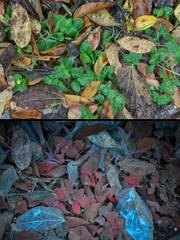 Dry leaves of hackberry and elm both in natural light and under 365 nm ultraviolet (UV-A) blacklight in Bee Creek Park. College Station, Texas, November 21, 2025  Seeds of Johnson grass (Sorghum halepense) on Green Circles (center-pivot irrigation) in Irkhaya (Irkaya) Farms. South-western Qatar, November 15, 2014  Seeds of Argentine peppercress (Lepidium bonariense) on Green Circles (center-pivot irrigation) in Irkhaya (Irkaya) Farms. South-western Qatar, November 15, 2014  Serene autumn scene at Laskovy Beach (Russian: Laskovyy Plyazh) in the settlement of Solnechnoe, located on the shore of the Gulf of Finland, approximately 40 kilometers northwest of Saint Petersburg. Laskovy Beach is one of the most popular beaches in the Kurortny District of Saint Petersburg. The name "Laskovy" translates to "Affectionate" or "Tender," while the settlement name, Solnechnoe, means "Sunny". This area has a rich history as a summer resort destination; formerly known as the Finnish village of Ollila, it became a hub for St. Petersburg s intelligentsia and dacha owners in the late 19th and early 20th centuries. The image shows a trio of birch trees with vibrant yellow and orange leaves, which is characteristic of the "Golden Autumn" season in the Leningrad Region during early-to-mid October. The golden leaves contrast strikingly with the blue sky and the dark blue waters of the Gulf. The large white concrete sphere on the sand is a landscaping feature. Russia, October 9, 2025  Focusing closer, the photograph reveals the intricate, densely packed structure of the cursed buttercup (Ranunculus sceleratus) as it colonizes the dried mud. The plants exhibit a vibrant, fleshy appearance, characterized by deeply lobed, shiny green leaves that vaguely resemble flat-leaf parsley or young celery--giving the plant its alternate name, the celery-leaved buttercup. In this dense thicket, the stout, hollow stems branch frequently, creating a tangled, multi-layered canopy. Tiny, five-petaled pale yellow flowers dot the upper stems, standing out brightly against the dark backdrop of the soil and the deeper green foliage below. Flag Pond near Nails Creek Unit of Somerville Lake State Park. Texas, March 14, 2026  Red pulp with seeds of a fruit of strawberry in TAMU Horticultural Gardens in Texas A and M University. College Station, Texas, December 29, 2008  Small green flowers of pigeon-berry (Rivina humilis, rouge-plant) in a forest near Onion Creek in McKinney Falls State Park. Austin, Texas, October 26, 2008  Close up of seeds of Johnson grass (Sorghum halepense) taken from Green Circles (center-pivot irrigation) in Irkhaya (Irkaya) Farms. South-western Qatar, November 15, 2014  Sandstone with green algae on a path in ultraviolet light in Lick Creek Park. College Station, Texas, November 8, 2024  Seeds of white nymph (Trepocarpus aethusae) with a small green grasshopper in Lick Creek Park. College Station, June 15, 2008  Blue and orange fluorescent lichens on bark of hackberry in ultraviolet light in Lemontree Park. College Station, Texas, November 5, 2024  This view from the tower of St. Nicholas Church offers a fascinating contrast between medieval history, post-war reconstruction, and modern urban growth, looking east towards the city center. The most prominent building in the immediate foreground is the large, grey, L-shaped structure known as the Writers House (Kirjanike Maja) on Harju Street. Built in 1963 on the ruins of buildings destroyed during the 1944 Soviet bombing of Tallinn, this modernist structure is a significant cultural landmark. It houses the Estonian Writers Union, a well-known bookstore, and the famous Cafe Pegasus, serving as a hub for the country s literary scene. The street running along the left side of the Writers House is Harju Street, historically one of the city s main commercial arteries. The open green space visible nearby (part of the Harju Street green area) was also created following the wartime destruction, serving as a memorial and recreational space before partial reconstruction debates in recent years. In the background, the view opens up to Tallinn s modern business district. The cluster of high-rise glass buildings, including the distinct wedge-shaped Swisso^tel and the SEB Bank headquarters, illustrates the city s rapid economic development and stands in stark contrast to the red-tiled roofs of the Old Town below. Estonia, October 16, 2025  Green seeds of curly dock (Rumex crispus) on Green Circles (center-pivot irrigation) in Irkhaya (Irkaya) Farms. Qatar, February 20, 2015  Close-up of blue and orange fluorescent lichens on bark of hackberry in ultraviolet light in Lemontree Park. College Station, Texas, November 5, 2024  Flowers of Golden Thryallis (Galphimia gracilis) in ultraviolet (UV-A) blacklight (the buds and bracts show a distinct dark patterning in UV that isn t visible to the naked eye) in Leach Teaching Gardens at Texas A and M University. College Station, Texas, September 12, 2025 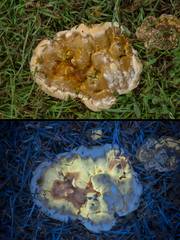 Polypore mushroom Ganoderma sessile on a lawn both in natural light and under 365 nm ultraviolet (UV-A) blacklight in Bee Creek Park. College Station, Texas, November 21, 2025 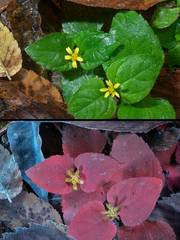 Straggler Daisy (Calyptocarpus vialis) both in natural light and under 365 nm ultraviolet (UV-A) blacklight on a lawn in Bee Creek Park. College Station, Texas, November 21, 2025 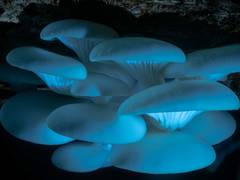 Young oyster mushrooms (Pleurotus ostreatus) on a fallen oak in ultraviolet light in Lick Creek Park. College Station, Texas, November 29, 2025  Deeper inland over the East Greenland coast, likely near the major glacial systems feeding into the Sermilik Fjord complex. The massive, heavily crevassed glacier visible in the lower center (flowing from left to right) is characteristic of the major outlet glaciers in this region, such as Helheim Glacier or Midgard Glacier. These are some of the largest and fastest-flowing glaciers in Greenland, draining huge volumes of ice from the interior ice sheet into the fjords.:200b The intensely wrinkled texture of the glacier surface is caused by deep crevasses (cracks) that form as the ice flows over uneven bedrock and bends around mountains. The chaotic, shattered appearance indicates rapid movement and significant stress within the ice. The dark, jagged peaks rising above the ice are part of the coastal mountain ranges (likely the Schweizerland Alps mentioned previously). In this view, you can see how the ice sheet wraps around and flows between these mountains, essentially burying the valleys in ice. In the bottom right corner, a turquoise-colored lake is visible. This is a proglacial lake, formed by meltwater trapped between the glacier and the mountains. The distinctive color comes from "glacial flour" (fine rock particles) suspended in the water. This transition from the rugged coastal peaks (in the previous image) to the massive, flowing rivers of ice marks the boundary between the coastal mountains and the vast Greenland Ice Sheet proper. It is the dynamic edge where the ice sheet discharges into the ocean, a critical zone for understanding global sea-level rise. View from a window of an airplane from Helsinki to Dallas, Greenland, October 17, 2025  Fruit of Tribulus pentandrus(?) on Green Circles (center-pivot irrigation) in Irkhaya (Irkaya) Farms. South-western Qatar, October 25, 2014  Upper section of a wooden fence of a small foot bridge in ultraviolet light in Lick Creek Park. College Station, Texas, October 6, 2024 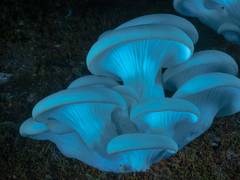 Underside of young oyster mushrooms (Pleurotus ostreatus) on a fallen oak in ultraviolet light in Lick Creek Park. College Station, Texas, November 29, 2025 |