 |
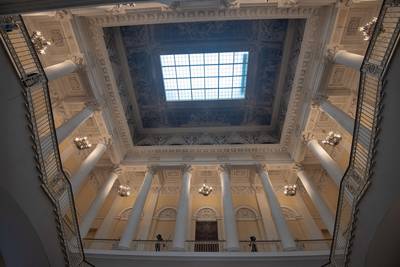
3754-09. Main Staircase of the Mikhailovsky Palace designed by the architect Carlo Rossi in the 1820s in Russian Museum. Saint Petersburg, Russia, September 24, 2025Similar picturesLarge thumbnails | Use small thumbnails | View as slideshow |
|
3754-09. Main Staircase of the Mikhailovsky Palace designed by the architect Carlo Rossi in the 1820s in Russian Museum. Saint Petersburg, Russia, September 24, 2025Similar picturesLarge thumbnails | Use small thumbnails | View as slideshow |
 Grand Menshikov Palace (Bolshoy Menshikovsky Dvorets). It is the palace s majestic Northern Facade, designed in the Petrine Baroque style by architects Giovanni Mario Fontana and Gottfried Scha"del between 1710 and 1727. The palace sits atop a natural ridge, enhancing its monumentality. A grand system of stone terraces and a double-flight staircase descends from the main entrance to the Lower Garden. Oranienbaum palace-and-park ensemble in Lomonosov (a suburb of St. Petersburg), Russia, October 13, 2025  Mikhailovsky Palace (Russian Museum) at evening. Saint Petersburg, Russia, December 26, 2005  Debarcader (train shed) of the Vitebsky Railway Station, Russian Art Nouveau (Style Moderne). Massive riveted steel spans were designed by architect Stanislav Brzhozovsky and engineer Sima Minash. It is serving the historic route to Tsarskoye Selo (Pushkin) and Pavlovsk. Saint Petersburg, Russia, October 15, 2025  Main staircase in Hermitage Museum. Saint Petersburg, Russia, November 16, 2016  Hermitage Pavilion in Catherine Park, designed by the Italian court architect Francesco Bartolomeo Rastrelli in Elizabethan Baroque style. Pushkin (former Tsarskoe Selo) near Saint Petersburg, Russia, October 10, 2025  View from main staircase in Hermitage Museum. Saint Petersburg, Russia, November 16, 2016  Columns of Main Staircase in Hermitage Museum. Saint Petersburg, Russia, June 17, 2014  Gallery over Main Staircase in Hermitage Museum. Saint Petersburg, Russia, January 2, 2016  Central landing of Main Staircase of Catherine Palace in Pushkin (Tsarskoe Selo), suburb of Saint Petersburg. Russia, December 17, 2005  Gallery of marble sculptures above Main Staircase in Hermitage Museum. Saint Petersburg, Russia, May 19, 2015  A view of the Pavlovsk Palace seen from the Triple Lime Avenue. Planted by Charles Cameron in the 1780s using linden trees imported from Lu"beck, this avenue was designed as the grand formal approach to the palace. The building at the end is the garden facade of the Great Palace. The dark figure standing in front of the palace is the statue of Paul I. Pavlovsk, a suburb of Saint Petersburg, Russia, October 15, 2025  Sculpture of Avel by Giovanni Dupre above Main Staircase in Hermitage Museum. Saint Petersburg, Russia, May 19, 2015  Leuchtenberg Palace, designed by architect Andrei Stackenschneider and completed in 1842. The facade reflects the Late Classicism style (resembling a Roman villa), characterized by a grand portico with Corinthian columns, symmetrical window arrangements, and a pediment that gives the structure a noble, temple-like appearance. The palace s yellow stucco walls show signs of weathering and peeling paint, contributing to the estate s romantic, slightly melancholic atmosphere of a "forgotten" royal residence. The palace is situated on a terrace overlooking the Gulf of Finland, with its color palette harmonizing with the surrounding golden autumn foliage, reinforcing the seamless blend of architecture and nature intended by its designers. Sergievka Park, Old Peterhof, west from Saint Petersburg, Russia, October 13, 2025  Avel sculpture by Giovanni Dupre above Main Staircase in Hermitage Museum. Saint Petersburg, Russia, June 17, 2014  Kain sculpture by Giovanni Dupre above Main Staircase in Hermitage Museum. Saint Petersburg, Russia, June 17, 2014  Stone Hall Pavilion (Kammenoe Zalo) in Oranienbaum Park. It is a light pink, two-story stone pavilion designed by architect Antonio Rinaldi (built mid-18th century) for Grand Duke Peter Fedorovich. Originally used for concerts, masquerades, and dances, it later served as a Lutheran church. Oranienbaum palace-and-park ensemble in Lomonosov (a suburb of St. Petersburg), Russia, October 13, 2025  Sculpture of a woman with fat legs (Faith by Lorenzo Bartolini) above Main Staircase in Hermitage Museum. Saint Petersburg, Russia, June 17, 2014  Replica of an ancient sculpture of a woman (Erminia by Rinato Rinaldi) above Main Staircase in Hermitage Museum. Saint Petersburg, Russia, June 17, 2014  Main Staircase of the New Hermitage in Hermitage Museum. Saint Petersburg, Russia, June 10, 2009  Main Staircase of the New Hermitage in Hermitage Museum. Saint Petersburg, Russia, February 7, 2013  Grand staircase in Russian Museum. Saint Petersburg, Russia, February 9, 2018  Grand staircase of Russian Museum. Saint Petersburg, Russia, January 8, 2016  Marble statues near Main Staircase of New Hermitage in Hermitage Museum. Saint Petersburg, Russia, June 10, 2009  A building at 5 lit. B Engelsa Prospect which is a surviving historical service corps of the Orlovo-Novosiltsevskaya Almshouse complex. This small brick structure was originally built as one of the auxiliary buildings (likely for staff or utility purposes) for the larger almshouse institution. The main complex, located at Engelsa 1-5, was a major philanthropic center established in the 1830s. The complex was designed by the renowned architect Iosif Charlemagne (Joseph-Maria Charlemagne-Baudet) in the late Classicist style. It was constructed between 1834 and 1841. Lesnoy Park (Lesotekhnicheskiy Universitet), Saint Petersburg, Russia, October 14, 2025  Pediment of Mikhailovsky Palace on Inzhenernaya Street. Saint Petersburg, Russia, December 23, 2016  Devil s Bridge (Chertov Most), also known as the Cascade, located near the Upper Ponds in Catherine Park. Built in the 1770s, likely designed by the architect Vasily Neyelov or possibly Antonio Rinaldi, this structure is a classic example of the romantic "ruin" aesthetic popular in 18th-century landscape gardening. Pushkin (former Tsarskoe Selo) near Saint Petersburg, Russia, October 10, 2025  Grand staircase on the second floor of Yusupov Palace. Saint Petersburg, Russia, September 6, 2007  Grand staircase on the first floor of Yusupov Palace. Saint Petersburg, Russia, September 6, 2007  Head sculpture of Tsar Peter the Great at upper staircase landing in Russian Museum. Saint Petersburg, Russia, February 4, 2013  A close-up detail from the left-middle section of a huge painting "Phryne at the Festival of Poseidon in Eleusis" (1889) by Henryk Siemiradzki (Polish/Russian, 1843-1902) in Russian Museum. Saint Petersburg, Russia, September 24, 2025  Gothic Gate (Goticheskie Vorota) in the landscape section of Catherine Park. Erected in 1778, the gate was designed by the architect Yury Felten (Georg Friedrich Veldten). The design mimics a Gothic cathedral portal, featuring slender columns that branch into pointed arches with intricate "lace-like" tracery. Pushkin (former Tsarskoe Selo) near Saint Petersburg, Russia, October 10, 2025  Lower garden from grand staircase of Great (Menshikov s) Palace in Lomonosov (Oranienbaum). West from Saint Petersburg, Russia, September 11, 2013  A detail from "The Last Day of Pompeii" by Karl Brullov (1833) showing the central tragedy of the painting in Russian Museum. Saint Petersburg, Russia, September 24, 2025  Winding gravel path in the Upper Park of Oranienbaum. This area was called "Russian Switzerland" because of its rugged, hilly terrain, steep river banks, and the winding Karasta River valley, which landscape architects designed to resemble a wild, mountainous alpine landscape on a miniature scale. Oranienbaum palace-and-park ensemble in Lomonosov (a suburb of St. Petersburg), Russia, October 13, 2025  Red Cascade or Turkish Cascade in Catherine Park. The Red Cascade is a dam that regulates the water level between the Upper Ponds and the Great Pond. The two "towers" flanking the crossing are designed in the Gothic style, featuring red brick walls with white limestone details, pointed arches, and niche windows. It was built in the 1780s by the engineer Ivan Gerard, likely based on designs by the architect Vasily Neelov. Pushkin (former Tsarskoe Selo) near Saint Petersburg, Russia, October 10, 2025  Detail from a painting "The Brazen Serpent" (1841) by Fyodor Bruni (1799-1875) showing the head of a bearded man in agony in Russian Museum. Saint Petersburg, Russia, September 24, 2025  Grand staircase in Hermitage Museum. Petersburg, Russia, September 3, 2013  Grand Staircase of Yusupov Palace. Saint Petersburg, Russia, July 8, 2009  Plafond over grand staircase in Hermitage Museum. Petersburg, Russia, September 3, 2013  Grand Staircase (upper landing) of Yusupov Palace. Saint Petersburg, Russia, July 8, 2009  Pyramid Pavilion, located in a quiet, shady corner of Catherine Park in Tsarskoe Selo (Pushkin). It was originally built in 1770-1772 by the architect Vasily Neyelov and later reconstructed by Charles Cameron in 1782-1783. The pavilion was designed to resemble an ancient Egyptian mausoleum, reflecting the Romantic era s fascination with antiquity and melancholy ruins. It is constructed of brick and faced with trimmed granite. Buried behind the pyramid are three of the Empress s favorite Italian greyhounds: Tom Anderson, Zemira, and Duchesse. Saint Petersburg, Russia, October 10, 2025  Visconti Bridge (Viskontiyev most) built by Andrei Voronikhin in 1803 (and named after the mason Carlo Visconti) spanning Slavyanka River in Pavlovsk Park. Pavlovsk, a suburb of Saint Petersburg, Russia, October 6, 2025  Stasov Staircase in Catherine Palace. Pushkin (Tsarskoe Selo), suburb of Saint Petersburg, Russia, December 17, 2005  Painting "Christ and the Woman Taken in Adultery" (1888) by Vasily Polenov (1844-1927) (the right side of the canvas, where the angry crowd, bearded men in robes, is dragging or presenting the frightened woman) in Russian Museum. Saint Petersburg, Russia, September 24, 2025  Painting Bayan (1910) by Viktor Vasnetsov (1848-1926) showing a legendary Slavic bard (a "Bayan") playing the gusli (a traditional string instrument) to a group of warriors on a hilltop, in Russian Museum. Saint Petersburg, Russia, September 24, 2025  Grand staircase in Hermitage Museum. Saint Petersburg, Russia, May 19, 2015  This stone bridge serves as a picturesque crossing over the Kristatelka River ravine, situated at the foot of the slope directly beneath the Leuchtenberg Palace. As part of the 19th-century Sergievka ensemble, this bridge links the wilder, lower ravine paths (near the "Adam s Head" boulder) with the landscaped grounds surrounding the palace on the upper terrace. It features a solid masonry arch topped with simple iron railings, designed to provide a functional yet scenic vantage point for viewing the deep ravine that defines the estate s geography. Sergievka Park, Old Peterhof, west from Saint Petersburg, Russia, October 13, 2025  Council Staircase in Hermitage Museum. Saint Petersburg, Russia, December 16, 2005  Marble Bridge (also known as the Palladian Bridge or Siberian Marble Gallery) in Catherine Park. Built in 1772-1774 by the architect Vasily Neelov, it is modeled after the famous Palladian Bridge at Wilton House in England (designed by Inigo Jones and Roger Morris). The bridge is constructed entirely from Ural marble (hence "Siberian"). It features a covered Ionic colonnade resting on a rusticated arch base. It spans a narrow channel connecting the Great Pond with the smaller neighboring ponds (Swan Islands). Pushkin (former Tsarskoe Selo) near Saint Petersburg, Russia, October 10, 2025  Kitchen Ruin (Kukhnya-Ruina) which is one of the most historically fascinating and visually authentic follies in Catherine Park. Built between 1785 and 1786, it was designed by the Italian architect Giacomo Quarenghi. It was constructed specifically to serve as a "service pavilion" (a kitchen) for the nearby Concert Hall. Quarenghi incorporated authentic ancient Roman fragments into its brick walls. These include broken columns, capitals, cornices, and friezes with carved garlands, which were brought to Russia from Italy. The headless statue in the niche is a prominent feature, emphasizing the theme of lost time and the decay of empires. Pushkin (former Tsarskoe Selo) near Saint Petersburg, Russia, October 10, 2025  Marble staircase in Stieglitz Museum of Applied Arts. Saint Petersburg, Russia, November 18, 2016  Wooden staircase in Museum of Political History (Kshesinskaya Mansion). Saint Petersburg, Russia, May 29, 2019  Landing of grand staircase in Stieglitz Museum of Applied Arts. Saint Petersburg, Russia, November 18, 2016  Hall on the Island in Catherine Park, view from Ferry Crossing. It was originally built in the late 1740s by the architect Savva Chevakinsky in the Baroque style, with decorations based on sketches by Rastrelli. In 1794, under Catherine the Great, the architect Giacomo Quarenghi completely rebuilt it in the Classical style. He simplified the decor, giving it the restrained, elegant appearance seen today--white walls, large arched windows, and a modest green roof. Pushkin (former Tsarskoe Selo) near Saint Petersburg, Russia, October 10, 2025  From the elevated terrace of the Leuchtenberg Palace, a thoughtfully designed "prospect" (vista) opens up towards the Gulf of Finland, offering a serene coastal panorama framed by autumn foliage. This clearing was intentionally cut through the forest in the 19th century to create a direct visual link between the palace and the sea, a common feature in romantic landscape architecture. The busy road visible in the middle ground is the Oranienbaum Highway, which separates the upper park from the lower coastal meadows. In the distance, the grey-blue waters of the Gulf of Finland merge with the overcast sky, creating a vast, moody backdrop that emphasizes the estate s prime coastal location. Sergievka Park, Old Peterhof, west from Saint Petersburg, Russia, October 13, 2025  Example of Art Nouveau architecture in Tallinn, located at Pikk 18. It was designed by the renowned Baltic German architect Jacques Rosenbaum and completed in 1910. The design is celebrated for its flamboyant and fantastical style, which stands in stark contrast to the surrounding medieval architecture. The building is often referred to as the Draakoni Gallery (Dragon Gallery) because of the two large, sculpted dragons flanking the main ground-floor window. These sculptures were created by the famous Riga sculptor August Volz. The fac,ade is uniquely decorated with Egyptian-inspired themes, including reliefs of sphinxes and pharaonic figures at the top of the pilasters, adding to its exotic and eclectic appearance. The building features a distinctive curved corner tower with a slender spire, oval windows, and intricate floral ornaments typical of the late Art Nouveau period. Tallinn, Estonia, October 16, 2025  Zodchego Rossi Street at morning. Saint Petersburg, Russia, December 20, 2016  Artificial waterfall on the Karasta River in Oranienbaum Park serving as a connection between the Upper and Lower Parks. It is a tiered spillway designed with granite steps that allow the water to cascade gracefully from the Lower Pond, flowing underneath a massive stone bridge (the Lower Bridge/Dam Bridge) Oranienbaum palace-and-park ensemble in Lomonosov (a suburb of St. Petersburg), Russia, October 13, 2025  Sculpture of Russian Tsar Catherine the Great in Russian Museum. Saint Petersburg, Russia, February 9, 2018  Sculpture of Russian Tsar Catherine the Great in Russian Museum. Saint Petersburg, Russia, February 4, 2013  Grand staircase and monument of Russian Tsar Nikolay I (that recently replaced V. I. Lenin) in Vitebsky Vokzal (train station). Saint Petersburg. Russia, July 10, 2010  Head of Russian Tsar Peter the Great at entrance of Russian Museum. Saint Petersburg, Russia, February 4, 2013  Zodchego Rossi Street from Lomonosova Square. Saint Petersburg, Russia, December 24, 2016  Night illumination of Mikhailovsky Castle. Saint Petersburg, Russia, August 7, 2004  Museum guard in Benois Building (Corpus Benua) in Russian Museum. Saint Petersburg, Russia, December 28, 2005  Engineers (Mikhailovsky) Castle at early morning. Saint Petersburg, Russia, August 7, 2004  A spire of Mikhailovsky Castle at Sadovaya Street. Saint Petersburg, Russia, April 13, 1999.  Museum staff during a break for smoking (perekur, in Russian), view from a window of Hermitage Museum. Saint Petersburg, Russia, July 22, 2005  Vene Street (Vene ta"nav), one of the most historic and culturally significant streets in Tallinn s Old Town. The creamy yellow building on the right (Vene 17) is the main branch of the Tallinn City Museum (Tallinna Linnamuuseum). It is housed in a medieval merchant s home that dates back to the 14th century, offering visitors a deep dive into the city s history from prehistory to the 20th century. The name Vene means "Russian" in Estonian. The street was historically the center of the Russian merchant community and housed the trade yards and churches of Russian traders, dating back to the 12th century. The streetscape here is an example of Tallinn s Hanseatic architecture. The museum building itself was formed by combining a Gothic merchant house with two granaries, creating the structure seen today. One can also see the distinctive "hoist beam" and cargo hatch on the facade, used for lifting goods into storage. Tallinn, Estonia, October 16, 2025  A sculpture on the wall at the main entrance of Hermitage Museum. Saint Petersburg, Russia, December 16, 2005  The surviving granite base of the 1917 railway water tower on Station Square in Toksovo, Leningrad Oblast. Designed in the Nordic National Romantic style by Finnish architect Urho Pa"llia" for the Saint Petersburg-Hiitola railway line, the structure features rusticated Karelian stone quoins, a segmental arched portal, and a date plaque; its upper half-timbered wooden reservoir reservoir tier had burned down in the 1990s, leaving the masonry plinth derelict prior to receiving regional cultural heritage status. 8 miles north from Saint Petersburg. Russia, August 1, 2012  Chinese Gazebo (often called the Creaking Pagoda or Skripuchaya Besedka) which is one of the most eccentric and picturesque structures in Catherine Park. Built between 1778 and 1786, this pavilion was designed by Yury Felten (Georg Friedrich Veldten) at the height of the 18th-century craze for Chinoiserie (Chinese-style art). The pavilion gets its popular nickname from the metal weather vane on its roof. Shaped like a Chinese banner, it was intentionally designed to creak loudly in the wind. Originally, such pavilions served as tea houses or resting spots for the Empress and her court during their walks. Pushkin (former Tsarskoe Selo) near Saint Petersburg, Russia, October 10, 2025  Russian Switzerland in Oranienbaum Park that highlights the serene, painterly quality of the Upper Park s landscape. Oranienbaum palace-and-park ensemble in Lomonosov (a suburb of St. Petersburg), Russia, October 13, 2025  Old Passenger Terminal of Tallinn Airport. Built between 1945 and 1954 (opened in 1955), this building is a classic example of Stalinist architecture. Its symmetrical facade, rusticated ground floor, and the distinctive control tower with a viewing gallery reflect the monumental style favored in the Soviet Union during that period. An earlier Art Deco/Functionalist terminal was designed in 1938 by the architect Arthur Ju"rvetson, but construction was halted by World War II. The post-war redesign incorporated the Soviet aesthetic. This building served as the main passenger terminal until 1980, when a new, larger terminal (the current one) was built for the Moscow Olympics sailing regatta held in Tallinn. Today, this historic building has been repurposed for VIP services and administrative offices. It stands separately from the modern glass-and-steel terminal but remains an integral part of the airport s history, visible to passengers taxiing on the runway. View from a window of an airplane from Tallinn to Helsinki. Estonia, October 17, 2025  Religious and symbolic narrative of sacrifice, featuring a granite monument with an elaborate engraving of a soldier ascending a staircase toward a welcoming Christ-like figure and a birch tree, blending Christian theology with Russian nationalism. The epitaph laments, "You loved life... But the thread was cut too soon," emphasizing personal loss alongside martial duty. In the background, a chaotic array of VDV (Airborne Forces) and Russian flags flies over rows of fresh, temporary graves, contrasting the permanent serenity of the foreground monument with the raw immediacy of ongoing casualties. "Alley of Heroes" at Cemetery of the Victims of January 9, St. Petersburg, Russia, October 4, 2025  Monument of heroes of Great October Socialist Revolution. It is a mass grave monument dedicated to Red Guards who died during the 1917 October Revolution and the subsequent Civil War. The site originated in 1917 as a burial ground for workers and Red Guards from the nearby Novy Lessner Plant (now the Karl Marx Machine-Building Plant). These fighters were killed in battles against the troops of General Pyotr Krasnov near Pulkovo during the defense of Petrograd. In 1953, a wooden structure was replaced by the current grey granite obelisk seen today. It was designed by architect Yuri Wiesenthal. This monument is a solemn reminder of the intense revolutionary history of the Vyborg Side, a district historically populated by industrial workers who were pivotal to the Bolshevik cause. Lesnoy Park (Lesotekhnicheskiy Universitet), Saint Petersburg, Russia, October 14, 2025  False saffron milkcap mushroom (Lactarius deterrimus, Russian name Ryzhik) on Leninskaya Tropa Trail near Dibuny, north-west from Saint Petersburg. Russia, September 25, 2025  Petrovsky Bridge in Oranienbaum Park. The bridge is a three-arched stone structure built in 1910 (designed by O. Paulson) to replace an older wooden one. It features rough-hewn stone masonry on the lower arches contrasting with lighter brick detailing and white balustrades along the top. It spans the Karasta River, which flows through a valley currently filled with vibrant orange and golden foliage from the surrounding maple and oak trees. Oranienbaum palace-and-park ensemble in Lomonosov (a suburb of St. Petersburg), Russia, October 13, 2025  Church of Winter Palace in Hermitage Museum. Saint Petersburg, Russia, February 7, 2018  Church of Winter Palace in Hermitage Museum. Saint Petersburg, Russia, November 16, 2016  This structure is the celebrated Bridge of Pipedreams (Pont des Re^ves Tubulaires), a provocative modernist installation by the French brutalist architect Jean-Luc Beton-Brut. Conceived as a deliberate counterpoint to the park s romanticism, its design emphasizes raw honesty and the tension between industry and nature. The bridge s aesthetic lies in its stark minimalism. The unapologetic linearity of the twin pipes slices through the landscape, while their raw, oxidizing steel is intended to mirror the natural decay of autumn. The simple arch frames the surrounding forest, and the industrial grey of the metal creates a seamless chromatic dialogue with the overcast sky, blending the man-made object into its environment through color and form. See AI-generated descriptions: (a) and (b). Oranienbaum palace-and-park ensemble in Lomonosov (a suburb of St. Petersburg), Russia, October 13, 2025  Rossi Pavilion in Pavlovsk Park. Pavlovsk, a suburb of Saint Petersburg, Russia, May 16, 2019  Vaults of Church of Winter Palace in Hermitage Museum. Saint Petersburg, Russia, February 7, 2018  Vaults of church of Winter Palace in Hermitage Museum. Saint Petersburg, Russia, November 16, 2016  Ceiling of church of Winter Palace in Hermitage Museum. Saint Petersburg, Russia, November 16, 2016  An ancient stone staircase crossing the Kristatelka River which is a charming remnant of the park s 19th-century romantic landscape design. Sergievka Park, Old Peterhof, west from Saint Petersburg, Russia, October 13, 2025  Katalnaya Gorka Pavilion (Sliding Hill Pavilion), a masterpiece of 18th-century architecture located in the Upper Park of Oranienbaum. Designed by Antonio Rinaldi, this 33-meter-high pavilion is a striking blend of Baroque and early Classicism. Its festive, light-blue and white facade, tiered "wedding-cake" shape, and crowning bell-shaped dome make it resemble a lighthouse rising above the park s trees. Oranienbaum palace-and-park ensemble in Lomonosov (a suburb of St. Petersburg), Russia, October 13, 2025  Monument of V. I. Lenin, a leader of Russian Bolshevik Revolution, at main entrance of Botanic Gardens of Komarov Botanical Institute. Saint Petersburg, Russia, May 29, 2009  Children s Island (Ostrov Detskogo Domika) of the Great Pond concealed within the dense autumn foliage in Catherine Park. Built in 1830 by architect Alexei Gornostayev, it was a playhouse created for the children of Emperor Nicholas I. Pushkin (former Tsarskoe Selo) near Saint Petersburg, Russia, October 10, 2025  Prayer hall of a church of Winter Palace in Hermitage Museum. Saint Petersburg, Russia, November 16, 2016  A decoration in Alexander Hall in Hermitage museum (Winter Palace). Saint Petersburg, Russia, July 22, 2005  Monument of Mariya Fiodorovna in Rossi Pavilion in Pavlovsk Park. Pavlovsk, suburb of Saint Petersburg, Russia, October 4, 2016  Soykinskaya Alley (or Road) in Oranienbaum Park. This is a major thoroughfare in the Upper Park, notable for its impressive width and the straight, long perspective it creates, reminiscent of the "prospekts" designed in the 18th century. The alley is flanked by mature, stately trees--predominantly oaks and lindens--whose canopies form a "golden tunnel" overhead. The fallen leaves completely cover the ground, creating a continuous carpet of orange and yellow that mirrors the canopy above. Oranienbaum palace-and-park ensemble in Lomonosov (a suburb of St. Petersburg), Russia, October 13, 2025  Va"ike-Karja Street (Va"ike-Karja ta"nav), likely taken near its intersection with Suur-Karja Street. The building on the right with the large grey stone archway and iron gates corresponds to Va"ike-Karja 1 (also known as the Saarinen House), a prominent Art Nouveau building designed by Finnish architect Eliel Saarinen. The street features a mix of architectural styles. The grey stone building on the right is a notable example of early 20th-century national romanticism. Further down the street, you can see pastel-colored facades typical of Tallinn s Old Town. Tallinn, Estonia, October 16, 2025  Museum keeper in Alexander Palace in Pushkin (former Tsarskoe Selo) south from Saint Petersburg, Russia, June 29, 2010  Grand Cascade (also known as the Ruined Cascade), located near the Round Pond in the Old Sylvia/White Birch district of Pavlovsk Park. Designed by Vincenzo Brenna in 1794, it was built to look like a romantic "antique ruin." Pavlovsk, a suburb of Saint Petersburg, Russia, October 6, 2025  "Golden Autumn" forest near Leuchtenberg Palace. Sergievka Park, Old Peterhof, west from Saint Petersburg, Russia, October 13, 2025 |

