
Equestrian statue of Emperor Alexander III in front of Marble Palace. Saint Petersburg, Russia, July 25, 2005

Own Garden of Emperor Paul I in Gatchina Park. Gatchina, a suburb of Saint Petersburg, Russia, September 4, 2013

A statue of a Russion emperor that recently replaced V. I. Lenin monument in Vitebsky Vokzal train station. Saint Petersburg, Russia, January 1, 2006

Pet cemetery in Own Garden of Emperor Paul I in Gatchina Park. Gatchina, a suburb of Saint Petersburg, Russia, September 4, 2013

Sculpture in Own Garden of Emperor Paul I in Gatchina Park. Gatchina, a suburb of Saint Petersburg, Russia, September 4, 2013

Back wall of Gatchina Palace from Own Garden of Emperor Paul I. Gatchina, a suburb of Saint Petersburg, Russia, September 4, 2013

Tau emperor moth (Aglia tau, Saturniidae) south from Mys Moryin Nos near Ladoga Lake, east from Saint Petersburg. Russia, May 14, 2019

The stall labeled "Moskva" that honors a favorite horse of Emperor Nicholas I in Pensioner Stable (Pensionnaya Konyushnya) in Alexander Park, Tsarskoe Selo. This horse, a veteran of military reviews like the one in Elisavetgrad, spent its retirement in the stable built by the Emperor for his own and his predecessor s faithful steeds. The nameplate was reinstated during the 2024-2025 restoration of the pavilion. Saint Petersburg, Russia, September 21, 2025

Imperial Horse Cemetery at the Pensioner s Stable in Tsarskoe Selo. This cemetery is the final resting place for over 120 favorite horses of the Russian Emperors, from Alexander I to Nicholas II. The neat rows of white tombstones are the result of a major restoration project completed recently. Saint Petersburg, Russia, September 21, 2025

Bronze sculpture of Marcus Cocceius Nerva (reigned 96-98 AD), the first of the "Five Good Emperors" of Rome on the "Great Lawn" (Parterre) of the Landscape Park, directly in front of the Granite Terrace in Catherine Park. He is depicted seated, draped in a toga that exposes his muscular torso, holding a scroll (a symbol of law or wisdom) in his right hand. Catherine the Great and her successors viewed their own reign through the lens of Enlightened Absolutism, often drawing parallels between the Russian Empire and the Pax Romana. Pushkin (former Tsarskoe Selo) near Saint Petersburg, Russia, October 10, 2025

Turkish Bath, a picturesque pavilion situated on a small peninsula in the Great Pond in Catherine Park. Commissioned by Emperor Nicholas I, this was the last structure built in the imperial park, completed between 1850 and 1852. It was designed by Ippolito Monighetti, who used the appearance of a Turkish mosque as his inspiration. The building features a central gilded dome, a tall minaret crowned with a crescent, and intricate relief ornaments on the white facade. The pavilion serves as a victory monument to the Russo-Turkish War of 1828-1829. Pushkin (former Tsarskoe Selo) near Saint Petersburg, Russia, October 10, 2025

Children s Island (Ostrov Detskogo Domika) of the Great Pond concealed within the dense autumn foliage in Catherine Park. Built in 1830 by architect Alexei Gornostayev, it was a playhouse created for the children of Emperor Nicholas I. Pushkin (former Tsarskoe Selo) near Saint Petersburg, Russia, October 10, 2025

Saint Petersburg State Forestry University (often referred to historically as the Forestry Academy or Lesotekhnicheskaya Akademiya). Established in 1803 by decree of Emperor Alexander I as the Practical Forestry School in Tsarskoye Selo. In 1811, it was moved to its current location in the Vyborgsky District of Saint Petersburg, occupying the site of an old English dairy farm. The classical white building shown in the photo is the Main Educational Building. Originally constructed as four separate corps between 1826 and 1833 by architects I.F. Lucchini and A. Nellinger, these were later united into a single complex with a central courtyard in the late 1830s. Lesnoy Park (Lesotekhnicheskiy Universitet), Saint Petersburg, Russia, October 14, 2025

Princess Lieven Column in Pavlovsk Park. The column is dedicated to Princess Charlotte Lieven, the beloved governess of Emperor Paul I s children. It stands on the Parade Field (Russian: :041f:0430:0440:0430:0434:043d:043e:0435 :043f:043e:043b:0435:feff), specifically on the peninsula between the Rose Pavilion Ponds. Originally, this column was crowned with a gilded metal ball (sphere), which gave it a more finished look. Pavlovsk, a suburb of Saint Petersburg, Russia, October 15, 2025

Temple of Friendship in Pavlovsk Park. Built by Charles Cameron between 1780 and 1784, it was the very first building constructed in the park. It was officially dedicated to Empress Catherine the Great by her son Paul (the future Emperor) and his wife Maria Feodorovna as a gesture of thanks for gifting them the Pavlovsk lands. However, it was also a politically savvy move to rename it the "Temple of Friendship" to honor the visit of Joseph II, the Holy Roman Emperor, framing it as a symbol of enlightened European alliance. Pavlovsk, a suburb of Saint Petersburg, Russia, October 15, 2025

Sculpture titled "The Emperor" (":0418:043c:043f:0435:0440:0430:0442:043e:0440") by the St. Petersburg artist Dima PZh (:0414:043c:0438:0442:0440:0438:0439 :041f:0416 / :0414:043c:0438:0442:0440:0438:0439 :0416:0443:043a:043e:0432) in Erarta Museum of Contemporary Art. Saint Petersburg, Russia, September 4, 2026
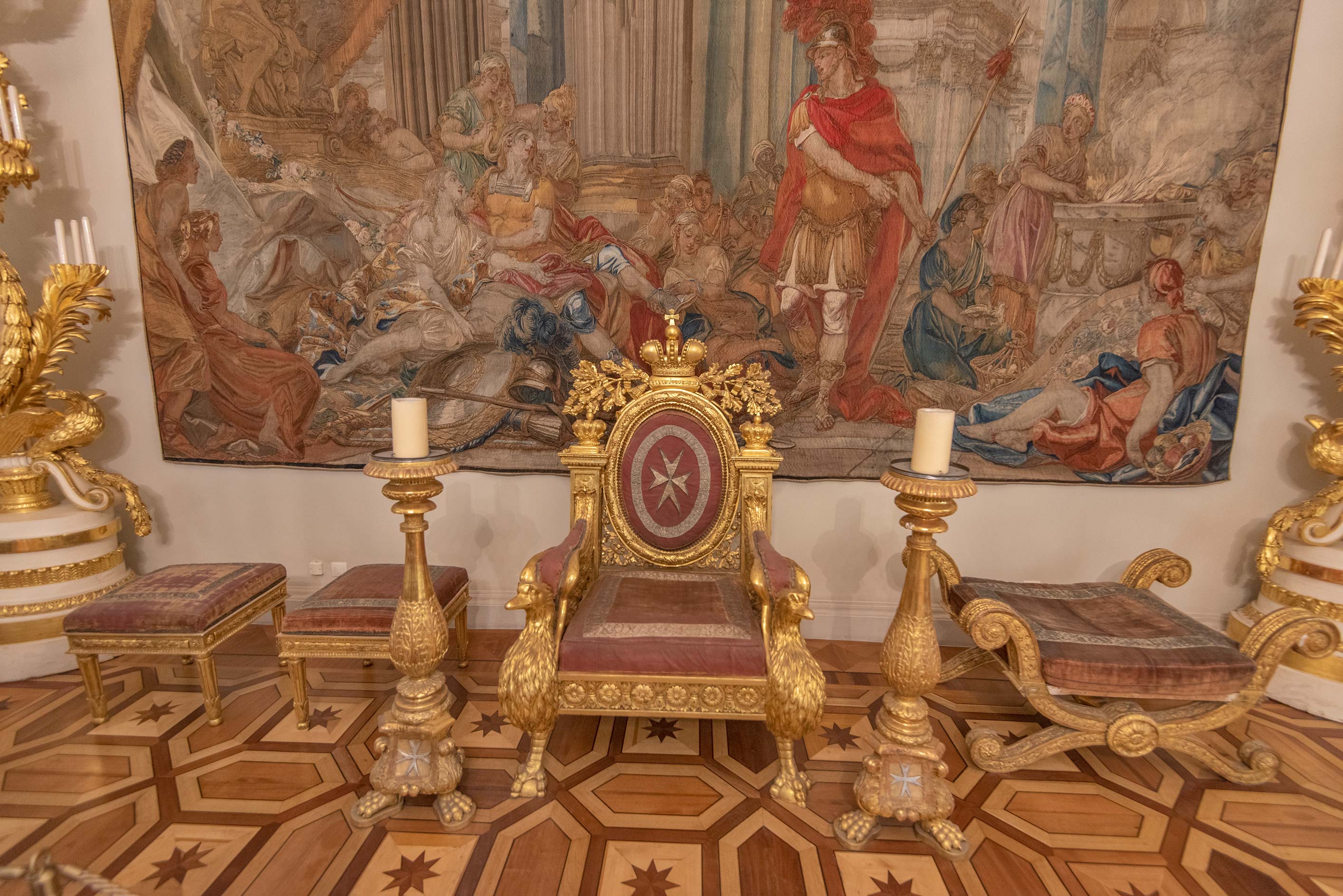
Designed by architect Giacomo Quarenghi and crafted by Telesforo Bonaveri in 1799-1800, the gilded Throne of Emperor Paul I as Grand Master of the Order of Malta--upholstered in crimson velvet embroidered with the silver Maltese cross and supported by sculpted eagles--stands on a star-inlaid geometric parquet floor in the Winter Palace. Flanked by carved gilt torche`res, matching stools, and a curule bench, the ceremonial ensemble sits beneath a monumental 1773 St. Petersburg Imperial Tapestry Manufactory hanging depicting Hector Rebuking Paris in the State Hermitage Museum in Saint Petersburg, Russia, September 10, 2026
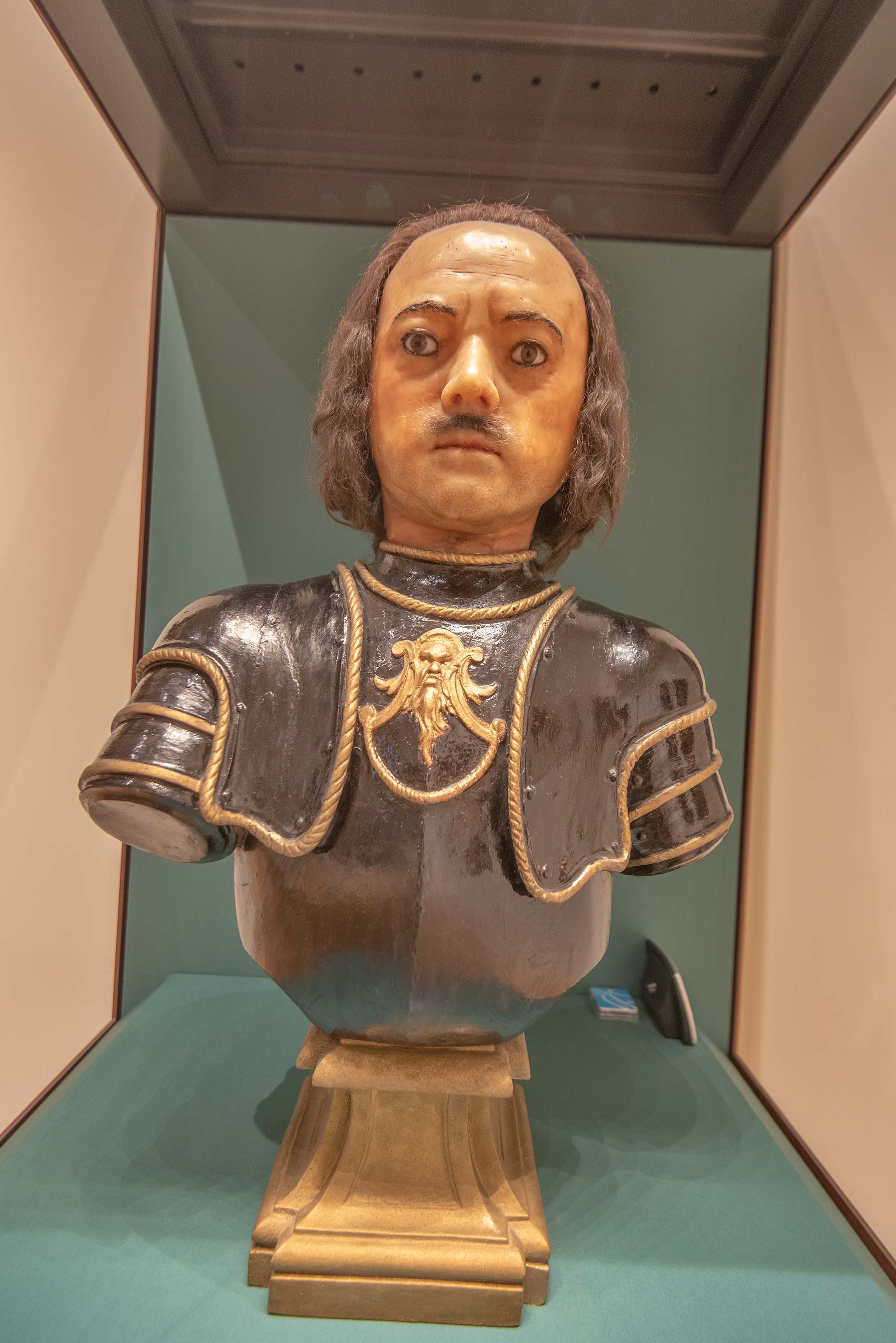
Created from life by Italian sculptor Bartolomeo Carlo Rastrelli around 1719-1720, this hyper-realistic wax bust of Emperor Peter the Great--displayed in a glass vitrine in the Gallery of Peter the Great at the Winter Palace--combines painted wax, enameled glass eyes, and a wig made from the Tsar s own real hair. Resting on a gilded stepped pedestal, the portrait bust depicts the ruler in black painted plaster armor adorned with gold-trimmed roping and a central bearded gorgon relief in the State Hermitage Museum in Saint Petersburg, Russia, September 10, 2026
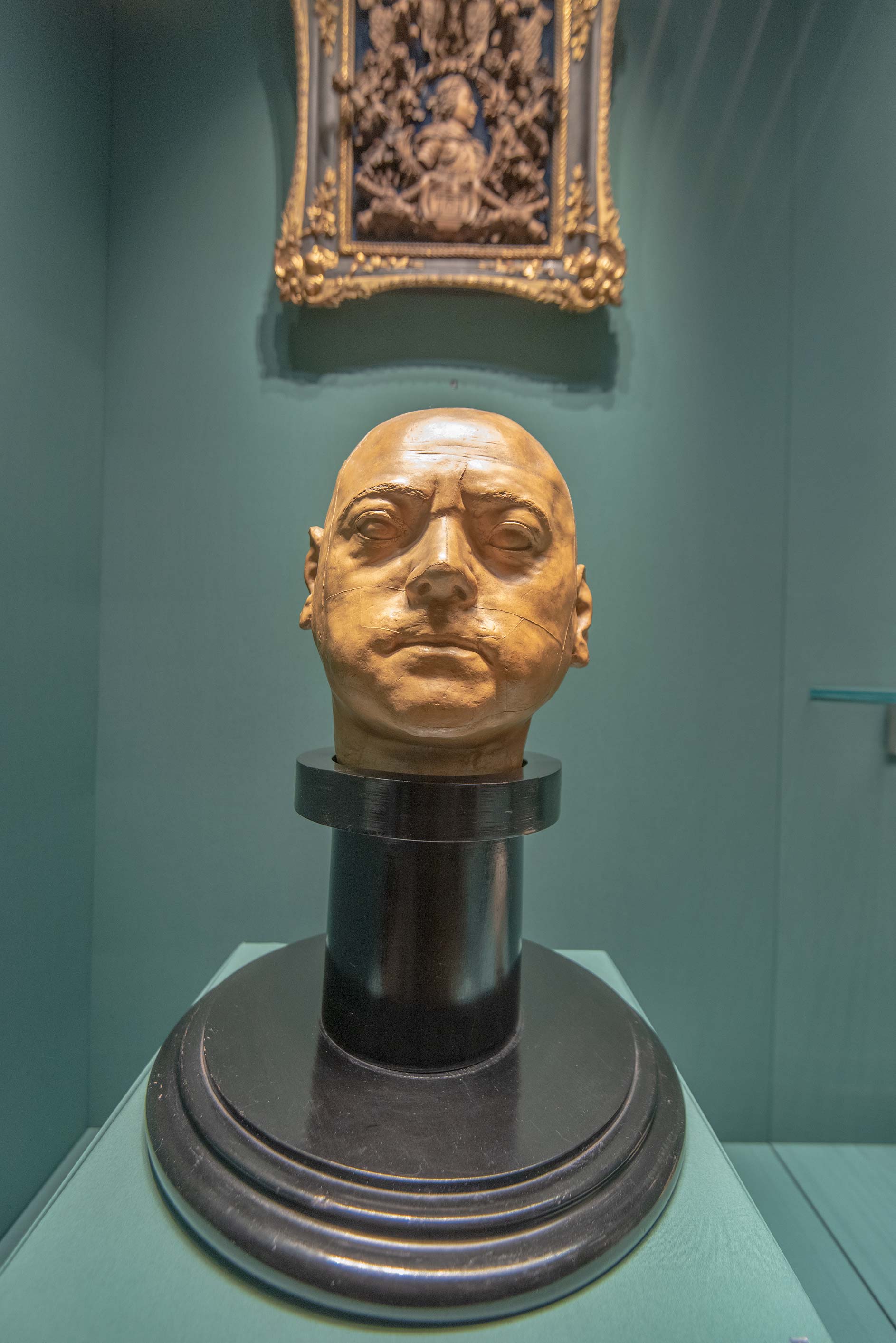
Sculpted from tinted plaster by Bartolomeo Carlo Rastrelli in 1721 based on a life mask taken directly from the Tsar s face, this bald head of Emperor Peter the Great--mounted on a stepped black pedestal in the Gallery of Peter the Great at the Winter Palace--served as a working anatomical model for later bronze portraits and the famous Wax Effigy (Wax Persona). Displayed inside a teal-backed glass vitrine beneath an ornate carved-and-gilt miniature relief portrait, the stark, hairless cast reveals fine mold seam lines across the cheeks and forehead in the State Hermitage Museum in Saint Petersburg, Russia, September 10, 2026
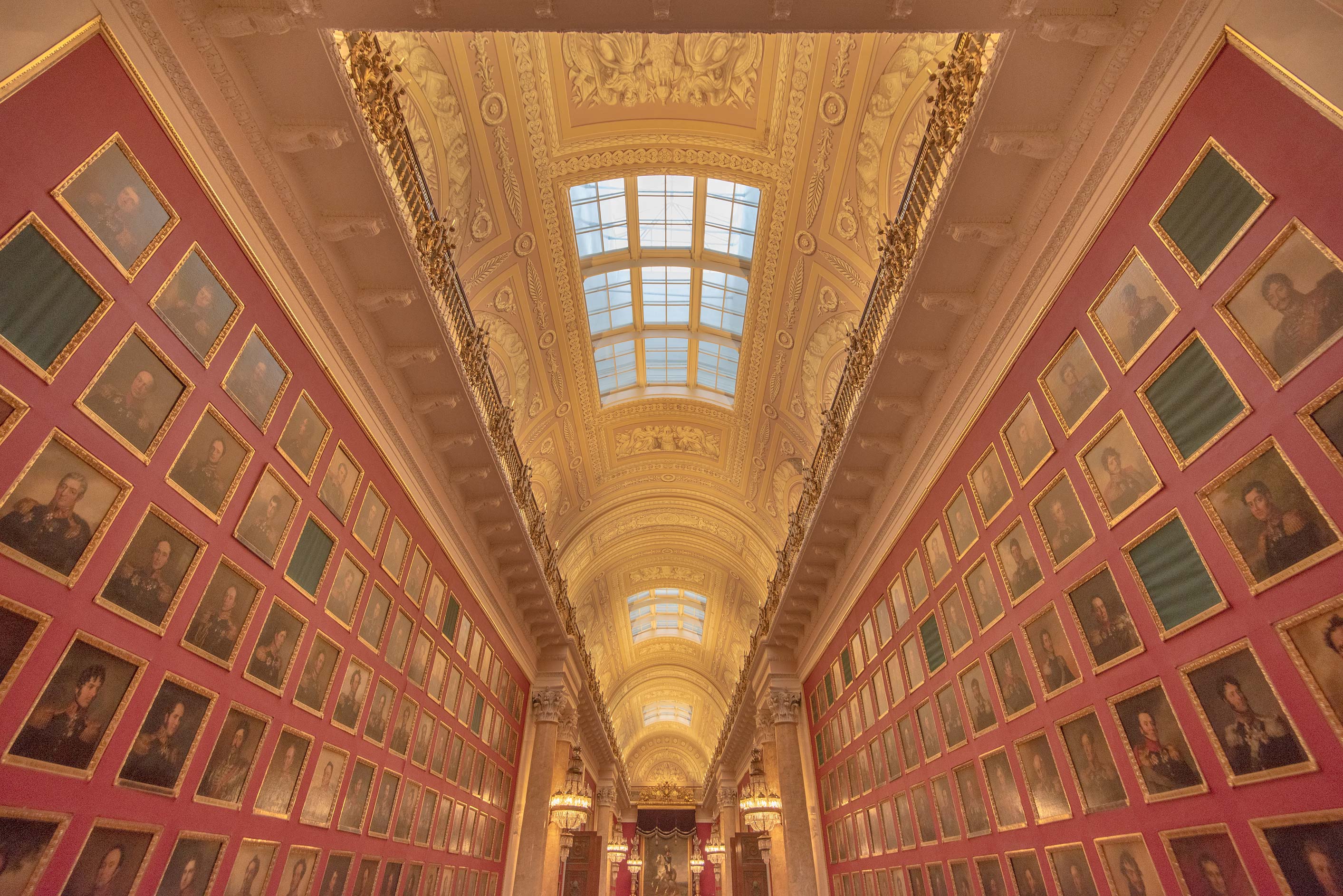
Designed by architect Carlo Rossi in 1826 and rebuilt by Vasily Stasov after the 1837 fire, the Military Gallery of 1812 in the Winter Palace features red-upholstered walls densely hung with five tiers of gilt-framed portraits of Russian generals who fought against Napoleon--painted primarily by English artist George Dawe and his assistants, alongside green silk-draped frames representing generals who died without surviving portraits. Overhead, a coffered barrel-vaulted ceiling decorated with stucco military trophies and glazed skylights runs between gilded upper gallery railings, leading the eye toward paired Corinthian columns, tiered chandeliers, and a monumental equestrian portrait of Emperor Alexander I at the far end in the State Hermitage Museum in Saint Petersburg, Russia, September 10, 2026
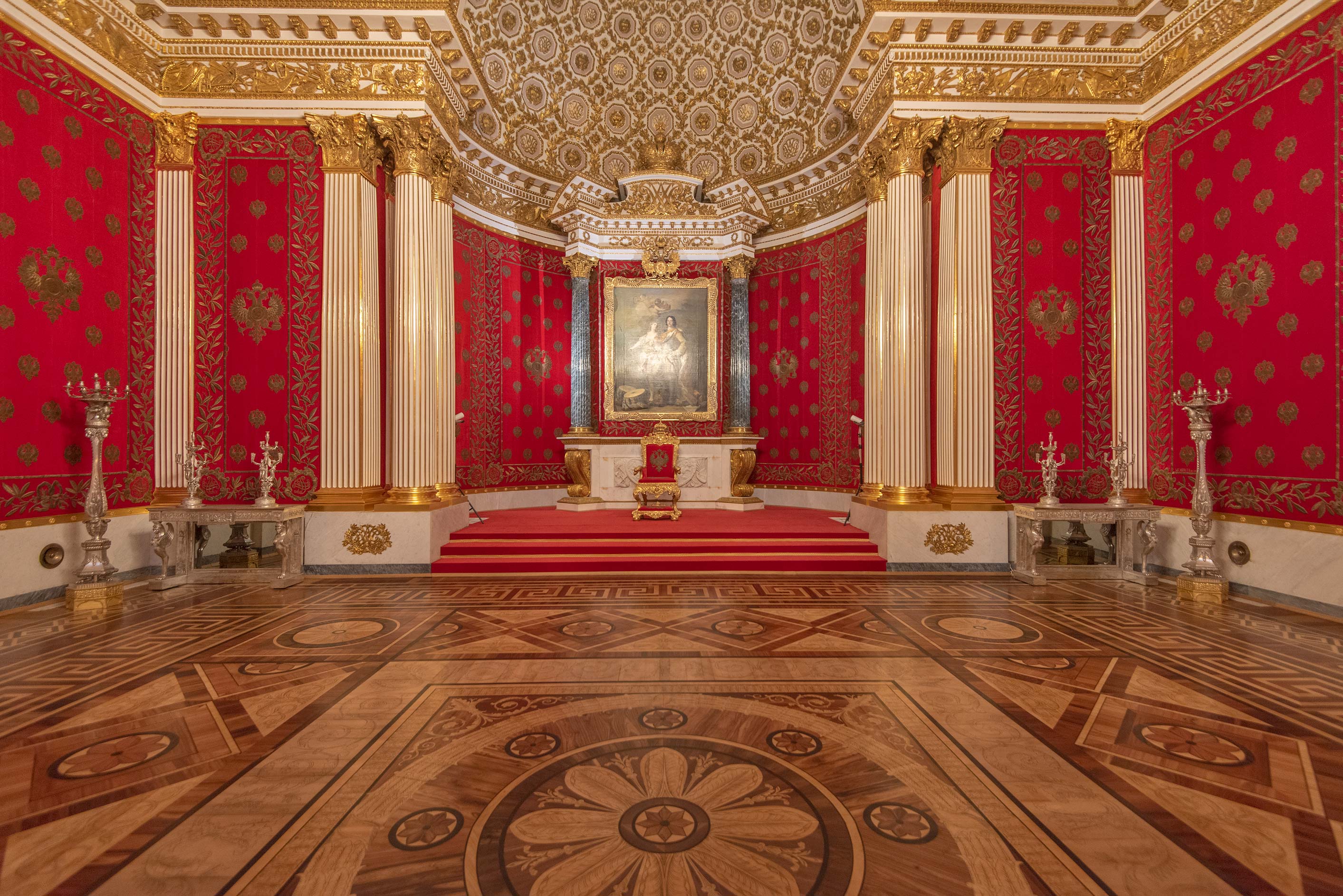
Designed by architect Auguste de Montferrand in 1833 in honor of Emperor Peter the Great and restored by Vasily Stasov after the 1837 fire, the Small Throne Room (or Peter Hall) of the Winter Palace features walls draped in crimson Lyon velvet embroidered with silver-gilt double-headed eagles, fluted white columns with gilded Corinthian capitals, and a coffered vaulted ceiling. In the central apse atop a stepped red-carpeted dais, the 1731 London-made gilt-wood and crimson-velvet throne sits beneath Jacopo Amigoni s monumental painting Peter the Great with the Goddess Minerva framed by jasper columns, while an intricate floral-and-geometric parquet floor and chased silver console tables and candelabra complete the room in the State Hermitage Museum in Saint Petersburg, Russia, September 10, 2026
