
Stone wall with windows in old fishing village (ghost town) of Al Ghariyah on north-eastern coast, Ash Shamal area. Qatar, December 19, 2015

Stone walls with windows in old fishing village (ghost town) of Al Ghariyah on north-eastern coast, Ash Shamal area. Qatar, December 19, 2015

Area of Spear, with Southern Pacific Railroad and Wellborn Road to the left, Old Railroad Grade (Marion Pugh Drive) to the right, George Bush Drive and Rodeo Ground on the bottom, view from a window of a plane. College Station, Texas, January 8, 2008


Old wooden window in Musheirib neighborhood area. Doha, Qatar, January 24, 2014

Old City from a window of a small church Dominus Flevit on a slope of Mount of Olives. Jerusalem, the Middle East, October 31, 2002

Old window of State Agrarian University in Pushkin, former Tsarskoe Selo, near Saint Petersburg. Russia, September 7, 2017

Old window in Fiodorovsky Village (Gorodok) in Pushkin (former Tsarskoe Selo), a suburb of Saint Petersburg, Russia, June 21, 2009

Old city prison, view from a window of a train. Vyborg, Russia, August 12, 2012

Horse in a window of a trailer parked near Old Faithful Geyser. Yellowstone Park, Wyoming, July 24, 2010

Old newspapers used as air filters in a window at Al Jassasiya Street, Musheirib area. Doha, Qatar, March 29, 2013

Tabby cat in a window at Krepostnaya Street in old city of Vyborg. Russia, May 24, 2019

Tallinn old town (in the center) from a window of a plane from Tallinn to Helsinki. Estonia, August 15, 2024

Leuchtenberg Palace, designed by architect Andrei Stackenschneider and completed in 1842. The facade reflects the Late Classicism style (resembling a Roman villa), characterized by a grand portico with Corinthian columns, symmetrical window arrangements, and a pediment that gives the structure a noble, temple-like appearance. The palace s yellow stucco walls show signs of weathering and peeling paint, contributing to the estate s romantic, slightly melancholic atmosphere of a "forgotten" royal residence. The palace is situated on a terrace overlooking the Gulf of Finland, with its color palette harmonizing with the surrounding golden autumn foliage, reinforcing the seamless blend of architecture and nature intended by its designers. Sergievka Park, Old Peterhof, west from Saint Petersburg, Russia, October 13, 2025

This view is taken from Vanaturu kael ("Old Market Neck"), a short historic street that connects the Old Market (Vana Turg) with the Town Hall Square (Raekoja Plats) in Tallinn s Old Town. The dominant structure in the center is the eastern gable of the Tallinn Town Hall (Tallinna raekoda), the oldest surviving Gothic town hall in Northern Europe and the Baltic region. The building s iconic 64-meter tower rises prominently, topped by the Old Thomas (Vana Toomas) weather vane (visible at the very tip), which has been a symbol of the city since 1530. The limestone facade features a distinct Gothic archway at street level and a small, high window on the gable. To the right, the cream-colored building with the "Hopner House" sign (partially visible) is historically significant, often associated with merchant history. Estonia, October 16, 2025

This view from the St. Nicholas Church (Niguliste kirik) viewing platform offers a detailed look at the dense, red-roofed tapestry of Tallinn s Old Town, looking north towards the harbor. Dominating the skyline on the right is the spire of St. Olaf s Church (Oleviste kirik), which historically served as a navigational landmark for ships. Its green copper spire contrasts sharply with the surrounding red clay tiles. Looking directly down into the "canyon" of streets, one can trace Rataskaevu Street winding through the heart of the lower town. The prominent yellow building in the foreground (with the red roof and dormer windows) is likely part of the historic housing blocks near Rataskaevu and Ru"u"tli streets. Its bright facade stands out against the more muted tones of the neighboring structures. The view captures the intricate layers of the city s architecture--chimneys, dormer windows, and varying roof pitches that reveal the organic growth of the medieval city over centuries. Estonia, October 16, 2025

This view from the St. Nicholas Church tower looks down into the heart of the lower town, specifically capturing the densely packed historic streets below. Ru"u"tli and Rataskaevu Streets: The view likely centers on the intersection or alignment of Ru"u"tli (Knight) and Rataskaevu streets, which run close to the church. These streets are characterized by their medieval layout and historic merchant houses. The prominent yellow building with the red roof in the foreground (bottom center) stands out with its orderly rows of windows and distinct dormers. This is typical of the 18th and 19th-century residential architecture found in this part of the Old Town, often housing guest apartments today. The image perfectly illustrates the "red roofscape" of Tallinn, with various shades of terracotta tiles covering the gabled roofs. You can see the complex interplay of courtyards, chimneys, and firewalls that define the city s historic urban fabric. St. Olaf s in Distance: In the upper right corner, the spire of St. Olaf s Church pierces the skyline, providing a vertical counterpoint to the horizontal spread of the lower town. The view extends to the gray waters of the bay in the background, reinforcing the city s coastal setting. Estonia, October 16, 2025

This view from the St. Nicholas Church (Niguliste) tower looks down towards the dense medieval streets of the lower town, offering a detailed perspective of the residential architecture and rooftops. The narrow, curved street cutting through the scene is Rataskaevu Street, one of the most picturesque lanes in the Old Town. Yellow Building: The prominent, multi-story yellow building in the foreground (with the large red-tiled roof and dormer windows) is likely situated on or near Rataskaevu Street. Buildings in this area often date from the 18th or 19th centuries and now frequently house guest apartments, such as the Rataskaevu Boutique Apartments or Rataskaevu Guest Apartment. Its bright facade and orderly fenestration are typical of the later updates to the medieval fabric. The image showcases the iconic "sea of red roofs" that defines Tallinn s aerial aesthetic. The jumble of gables, chimneys, and varying roof pitches reveals the organic development of the city over centuries. In the background, the spire of St. Olaf s Church (Oleviste kirik) rises above the horizon, providing a vertical anchor to the cityscape and connecting the view to the harbor beyond. Estonia, October 16, 2025

This picturesque courtyard is located at Ru"u"tli 28, tucked away near the medieval city wall and the fortifications of Toompea. The site features a charming, small white building with red doors and window frames, nestled directly against the limestone cliff and city wall fortifications. The lush ivy covering the stone walls turns a vibrant red in autumn, creating a "fairytale" aesthetic that contrasts with the defensive nature of the surrounding structures. The wooden walkway visible above the cliff is part of the Kiek in de Ko"k Fortifications Museum complex. This gallery connects the Maiden Tower (Neitsitorn), the Stable Tower (Marstall), and the Kiek in de Ko"k artillery tower, allowing visitors to walk along the old defensive perimeter. The courtyard below sits in the shadow of these massive fortifications, which once protected the city from invaders. Estonia, October 16, 2025

A view of Suur-Karja Street (Suur-Karja ta"nav), one of the main arteries in Tallinn s Old Town. This street is famously (or infamously) known as the "Bermuda Triangle" of Tallinn s nightlife. The intersection of Suur-Karja and Va"ike-Karja streets is packed with bars, pubs, and clubs, making it the busiest party spot in the city on weekends. The street is lined with historic buildings that date back centuries. For instance, the building at Suur-Karja 12 (partially visible on the left) is a late-Gothic merchant house with roots in the 15th century. It has recently undergone extensive renovation to modernize its interiors while preserving its medieval stone fac,ade and window details. The street name "Suur-Karja" translates to "Great Cattle Street," referencing its medieval function as the route used to drive cattle from the city center out to pastures through the Karja Gate. Today, it connects the heart of the Old Town with Pa"rnu Road and the modern city center. Tallinn, Estonia, October 16, 2025

View of Pikk Street (Pikk ta"nav), one of the most architecturally diverse streets in Tallinn s Old Town. The spectacular grey Art Nouveau building on the right (with the corner turret) is a masterpiece designed by architect Jacques Rosenbaum in 1910. It is famous for its fantastical facade featuring two large dragons and Egyptian-inspired motifs. Today, the ground floor houses the Draakoni Gallery. On the left side of the street (the red and grey facade), one can see the St. Canute s Guild Hall (Kanuti Gildi Saal). Originally built in the 13th century and remodeled in the 19th century with Tudor-style windows and statues of St. Canute and Martin Luther on the facade. It now serves as a contemporary performing arts center. The yellow building on the immediate right foreground is Pikk 22, which houses the Estonian Handicraft House (Eesti Ka"sito"o" Maja). This shop is a go-to place for authentic Estonian folk art and crafts. Tallinn, Estonia, October 16, 2025

Pikk Street (Pikk ta"nav) in Tallinn s Old Town, specifically showing the facades of two notable Art Nouveau buildings at numbers 18 and 16. The building on the right with the dramatic facade featuring dragon sculptures is the famous "Dragon Gallery" (Draakoni galerii). Designed by architect Jacques Rosenbaum and completed in 1910, it is a masterpiece of Art Nouveau architecture. The facade is adorned with fantastical elements, including two large dragons flanking the ground-floor window, Egyptian women, and sphinxes. It currently houses an art gallery managed by the Estonian Artists Association. The building directly next to it on the left (the narrower one with large windows) is Pikk 16. It currently houses the BonVerre shop, visible through the ground-floor window, which specializes in beverages and gourmet products. Further down the street on the left (the grey building with the green flag) is the Kanuti Gildi Saal (St. Canute s Guild Hall), a historic building that now serves as a contemporary performing arts center. Tallinn, Estonia, October 16, 2025

This view of the installation near the Russian embassy on Pikk Street captures a broader perspective of the protest site, showing how it stretches along the sidewalk in front of the embassy building. The white banner in the foreground originally read "FOR THE VICTIMS OF WARS STARTED BY RUSSIA" (with the Russian translation on the right). However, someone has vandalized the sign by crossing out "RUSSIA" and scrawling "US" and a Star of David (hexagram) over it. This act of vandalism attempts to deflect blame from Russia by invoking anti-American and antisemitic tropes, a tactic often seen in pro-Kremlin disinformation campaigns. On the left side of the street, the building with the distinctive Art Nouveau facade (Pikk 18) houses the Ron Verlin salon, visible through the large arched window. This contrasts the elegant, peaceful commercial life of the street with the raw political conflict playing out just meters away. The fencing extends far down the street, covered in layers of posters, flags, and messages. This indicates the sustained nature of the demonstration, which has become a semi-permanent fixture in the Old Town since the start of the full-scale invasion. Tallinn, Estonia, October 16, 2025

Rataskaevu Street (Rataskaevu ta"nav) in Tallinn s Old Town. The focal point in the small square is the famous Cat s Well (Rataskaevu), which gave the street its name. According to local legend, a water spirit lived in the well, and the townspeople would sacrifice stray cats into it to prevent the wells from running dry. The yellow building on the left (Rataskaevu 7) houses the St. Petersbourg Hotel. It is the oldest operating hotel in Tallinn, originally opened in 1850 and located in a 15th-century building that was once a Russian merchant s home. Opposite the well (out of frame to the right, but significant to the street s lore) is the building at Rataskaevu 16, famously known as the site of "The Devil s Wedding." Legend says the devil held a party in the upper room of this house, and to this day, there is a painted "false window" on the facade to block the view into that haunted room. The building now houses a very popular restaurant of the same name. Tallinn, Estonia, October 16, 2025

A view along Lai Street (Lai ta"nav) in the Old Town of Tallinn, Estonia, looking towards the iconic St. Olaf s Church. The dominant spire in the background belongs to St. Olaf s Church. This Gothic church was once the tallest building in the world (from 1549 to 1625), and its 124-meter spire remains a defining feature of the Tallinn skyline. As the name suggests, this is one of the wider medieval thoroughfares in the city, running parallel to the busier Pikk ("Long") Street. Historically, it was a prestigious residential area for wealthy merchants and artisans. The street is lined with well-preserved medieval merchant houses. The buildings on the right likely include or are near the famous "Three Brothers" complex (Lai 38, 40, and 42), a group of medieval gabled houses similar to the "Three Sisters" on Pikk Street. The building with the warm light in the window (foreground right) exemplifies the historic limestone architecture characteristic of the Hanseatic era. Tallinn, Estonia, October 16, 2025

Intersection of Pikk Street and Pikk jalg (Long Leg) Street, one of the most historically significant spots in Tallinn, marking the boundary between the Lower Town and the Upper Town (Toompea). The massive white tower on the right is the Long Leg Gate Tower, built in the 14th century (c. 1380). It served as the primary fortified gateway connecting the merchant Lower Town to the aristocratic Upper Town. Historically, this gate was locked at night to separate the two distinct social classes. The street rising steeply through the gate arch is Pikk jalg. Its name distinguishes it from the parallel "Short Leg" (Lu"hike jalg), which is a pedestrian-only staircase.:200b The clock attached to the wall on the far right (though partially cut off) is not the famous Holy Spirit Church clock but a decorative element often associated with the Krause Pharmacy building or nearby shops in this tourist-heavy zone. The pink building on the left corner (housing "Krause" and "Eesti Ka"sito"o"" shops) is a classic example of Old Town architecture, with its chamfered corner entrance and large shop windows. Tallinn, Estonia, October 16, 2025

This evening view is likely a side street or courtyard just off the bustling Viru Street, possibly near the intersection with Vene Street or Sauna Street given the architectural style and proximity to nightlife areas. The most striking feature is the graffiti-covered wooden doors on the right. The words KID3:feff, PINTSEL:feff (meaning "paintbrush" in Estonian), and other tags cover the chevron-patterned double doors. This type of street art is common in the "alternative" or less-polished corners of the Old Town, often near bars and clubs. To the left, a brightly lit shop window with modern art prints or posters suggests this is a commercial area that remains active into the evening. The purple and blue lighting effects contribute to a club-like atmosphere, consistent with the nearby Viru Street and Sauna Street nightlife districts. The narrow cobblestone street slopes gently upward, flanked by tall, plastered buildings in pastel colors (pink, yellow, purple). The building on the right features a distinctive green downspout and a small blue diamond-shaped sign (likely a utility marker). Tallinn, Estonia, October 16, 2025

A vibrant and slightly gritty scene in a courtyard or passage off Viru Street (Viru 13), revealing a hidden side of Tallinn s Old Town nightlife. The wall is covered in colorful, chaotic graffiti tags (e.g., "PASR," "OPG," "SRN"), contrasting with the historic surroundings. The abstract blue and white forms at the bottom right resemble stylized waves or bubbles. This heavy tagging is typical of the semi-hidden courtyards in this area that house alternative bars and clubs. Through the window on the right, you can see the warm interior of a bar. Bottles of alcohol are lined up on shelves, and the lighting suggests a cozy, active atmosphere inside. This juxtaposition--the rough, cold exterior wall versus the inviting, warm interior--encapsulates the "hidden bar" culture of Tallinn. While Viru Street itself is a main tourist artery known for flower stalls and souvenir shops, the courtyards behind the facades (like at Viru 13/15) often host rooftop bars like A"rkel or speakeasy-style venues. Tallinn, Estonia, October 16, 2025

A striking architectural contrast on Sauna Street (Sauna ta"nav), near the intersection with Va"ike-Karja Street. On the left, a modern glass-and-steel building features large display windows and industrial-style staircases, illuminated by neon lights. This building is part of the Helios Hall complex (formerly the Helios Cinema), which has been repurposed as an event venue and art space. The transparent facade allows a view into the contemporary interior, contrasting sharply with the solid, historic walls of the Old Town. On the right, the corner of an older, plastered building (Sauna 12) is covered in colorful, abstract graffiti. This gritty, urban element acts as a foil to the clean lines and slick surfaces of the modern building opposite it, highlighting the eclectic mix of styles in this part of the city. Tallinn, Estonia, October 16, 2025

Old Passenger Terminal of Tallinn Airport. Built between 1945 and 1954 (opened in 1955), this building is a classic example of Stalinist architecture. Its symmetrical facade, rusticated ground floor, and the distinctive control tower with a viewing gallery reflect the monumental style favored in the Soviet Union during that period. An earlier Art Deco/Functionalist terminal was designed in 1938 by the architect Arthur Ju"rvetson, but construction was halted by World War II. The post-war redesign incorporated the Soviet aesthetic. This building served as the main passenger terminal until 1980, when a new, larger terminal (the current one) was built for the Moscow Olympics sailing regatta held in Tallinn. Today, this historic building has been repurposed for VIP services and administrative offices. It stands separately from the modern glass-and-steel terminal but remains an integral part of the airport s history, visible to passengers taxiing on the runway. View from a window of an airplane from Tallinn to Helsinki. Estonia, October 17, 2025

Aerial view of Tallinn. The heart of the image is the medieval Old Town, identifiable by its dense cluster of red-tiled roofs, church spires (including the tall St. Olaf s Church), and the fortified Toompea Hill. Surrounding the Old Town are the modern high-rises of the financial district (left foreground), including the Swisso^tel and Tornima"e towers. To the right, the Port of Tallinn (Vanasadam) stretches out into the Baltic Sea, with ferries and cruise ships visible. The sweeping coastline of the Tallinn Bay dominates the background. The clear blue sky and the calm sea suggest a crisp, sunny morning. View from a window of an airplane from Tallinn to Helsinki. Estonia, October 17, 2025

Looking along Viru Street into Tallinn[CloseCurlyQuote]s Old Town, with the Town Hall tower visible above the roofs ahead. At the junction with Vana-Viru Street, the tall corner building on the right has a projecting bay, a curved gable, and geometric fac,ade decoration, contrasting with the lower, pastel-coloured buildings opposite. Arched shop windows occupy its ground floor, while cafe tables and pedestrians share the cobbled street. Tallinn, Estonia, August 26, 2026

Looking along Kuninga Street toward Vana Turg, the high white gable on the left displays the tall recessed panels, small storage openings, and projecting hoisting beam associated with Tallinn[CloseCurlyQuote]s medieval merchant houses. These buildings combined living quarters with upper-floor warehouses, reflecting the city[CloseCurlyQuote]s role in Hanseatic trade. The narrow white-gabled house facing the street in the distance, now occupied by Peppersack, also preserves this medieval building type. The pink building on the right contrasts with the warehouse fac,ades through its regular window arrangement, decorative white surrounds, and horizontal cornices above a limestone ground floor. Red-tiled roofs, iron wall anchors, and rooftop weather vanes retain details from different periods of the Old Town[CloseCurlyQuote]s architecture. Tallinn, Estonia, August 26, 2026

The courtyard of the Estonian Museum of Applied Art and Design at Lai 17 occupies a former storage complex. The museum[CloseCurlyQuote]s main building was constructed as a granary in 1683-1695 and adapted for exhibition use before opening in 1980, preserving an example of the Old Town[CloseCurlyQuote]s working architecture rather than its ceremonial fac,ades. Red-tiled roofs, small windows, and shuttered upper loading openings retain the buildings[CloseCurlyQuote] utilitarian character. Worn ochre plaster exposes patches of masonry on the lower wing, while climbing greenery covers much of the wall opposite. Stone paving and the irregular arrangement of adjoining buildings define the enclosed yard, now furnished with chairs, tables, and a sculptural white seat. Tallinn, Estonia, August 26, 2026

The narrow passage beside Lai 19 is Aida Street, winding through the Lower Old Town near Tallinn City Theatre[CloseCurlyQuote]s complex of historic merchant houses. Unlike the broader Lai Street, Aida preserves the enclosed scale and irregular course of a medieval lane. Red and ochre plastered fac,ades give way to exposed limestone masonry around the bend, where small arched openings and narrow windows retain the appearance of older storage buildings. A low wooden door with diagonal boarding and iron ring handles, outward-opening casement windows, and wall-mounted lanterns distinguish the foreground buildings. A central strip of paving slabs provides a smoother walking surface between the rounded cobblestones. Tallinn, Estonia, August 26, 2026

Looking along Lai Street near number 38 toward St. Olaf[CloseCurlyQuote]s Church (Oleviste kirik), whose square limestone tower and copper-clad spire rise above the surrounding houses to a height of 123.7 metres. Tall pointed recesses divide the tower[CloseCurlyQuote]s lower walls, while paired arched openings and four small corner pinnacles mark the transition to the spire. The houses on the right retain steep gables, small attic openings, and shuttered upper loading doors associated with their former storage use. Their irregular window arrangements and rough plaster contrast with the adjoining taller building[CloseCurlyQuote]s projecting bays and more elaborate fac,ade. Red-tiled roofs and the broad cobbled roadway define this section of Lai--[OpenCurlyDoubleQuote]Wide Street[CloseCurlyDoubleQuote]--within the Lower Old Town. Tallinn, Estonia, August 26, 2026

At Vana Turg (Old Market), the narrow white-gabled house occupied by Peppersack preserves the form of a medieval merchant[CloseCurlyQuote]s dwelling and warehouse. Its pointed stone entrance portal sits below upper storage openings, a shuttered loading door, and a projecting hoisting beam. The building dates from the fifteenth century, when homes in Tallinn[CloseCurlyQuote]s trading centre commonly combined residential and storage functions. The adjoining yellow house has a more regular fac,ade with moulded window surrounds and a hipped tiled roof, contrasting with the steep gables beside it. On the right, pointed-arch ground-floor windows with decorative iron grilles reinforce the square[CloseCurlyQuote]s Gothic architectural character. A wooden stall with a canvas canopy and barrel occupies the foreground, while Viru Street opens downhill to the left. Tallinn, Estonia, August 26, 2026

At Vana Turg, the elaborate corner building marked [OpenCurlyDoubleQuote]Demini[CloseCurlyDoubleQuote] contrasts with the medieval merchant house occupied by Peppersack on the right. The Demin house at Viru 1 belonged to a wealthy fish merchant; its pink-and-white fac,ade has rusticated corners, pilasters, ornamental window surrounds, and a curved parapet framing an oval window above the corner bay. Peppersack[CloseCurlyQuote]s whitewashed gable presents a more utilitarian arrangement: a pointed stone entrance portal below vertically aligned storage openings, with a shuttered loading door and hoisting beam near the roof. Between the two buildings, Viru Street descends from the old market area, showing how later, richly decorated fac,ades stand alongside the surviving forms of Tallinn[CloseCurlyQuote]s warehouse architecture. Tallinn, Estonia, August 26, 2026
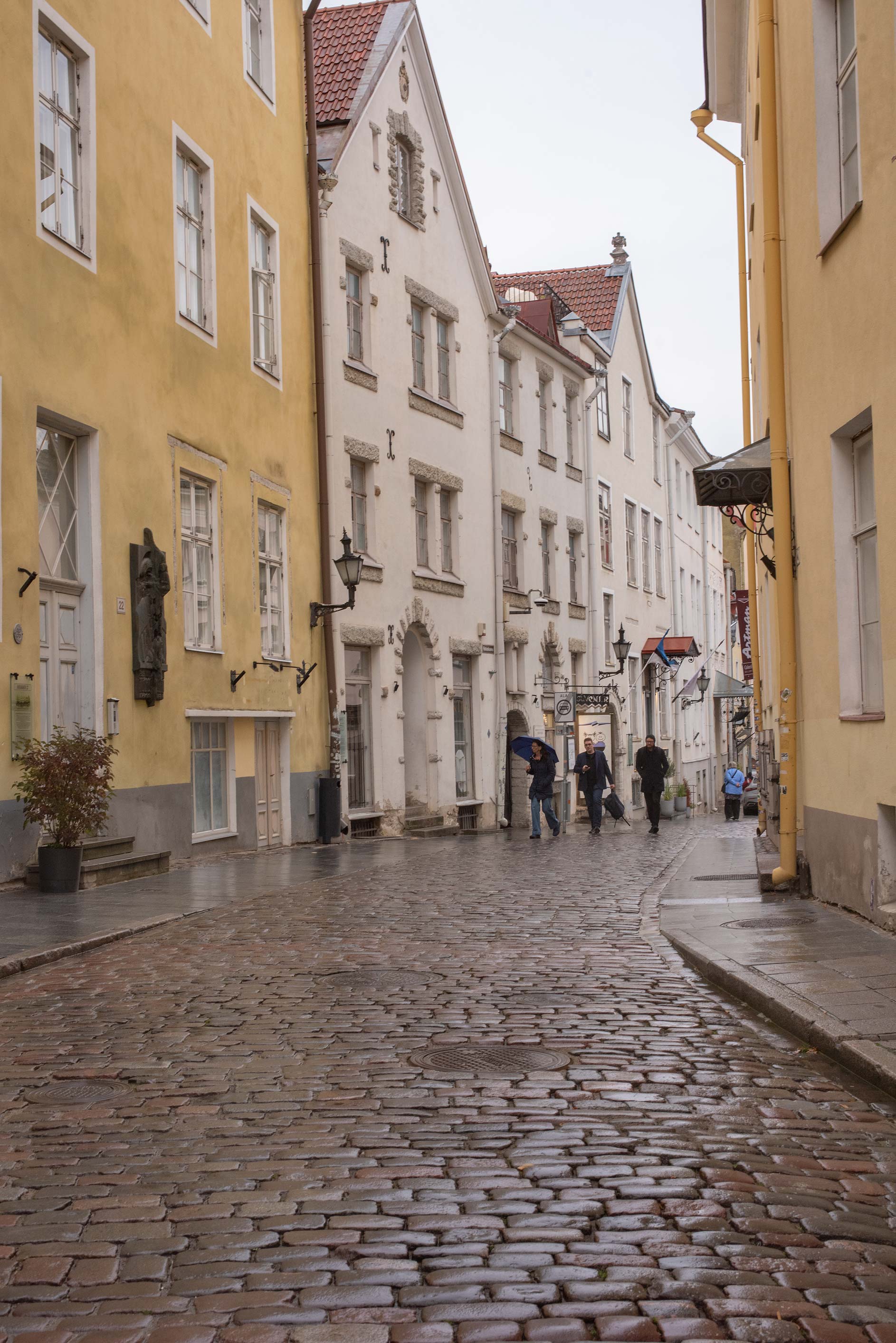
From the Ru"u"tli Street corner in Tallinn[CloseCurlyQuote]s Old Town, pedestrians pass a white gabled fac,ade with rough-cut stone trim around its windows and arched doorway. Tallinn, Estonia, September 24, 2026
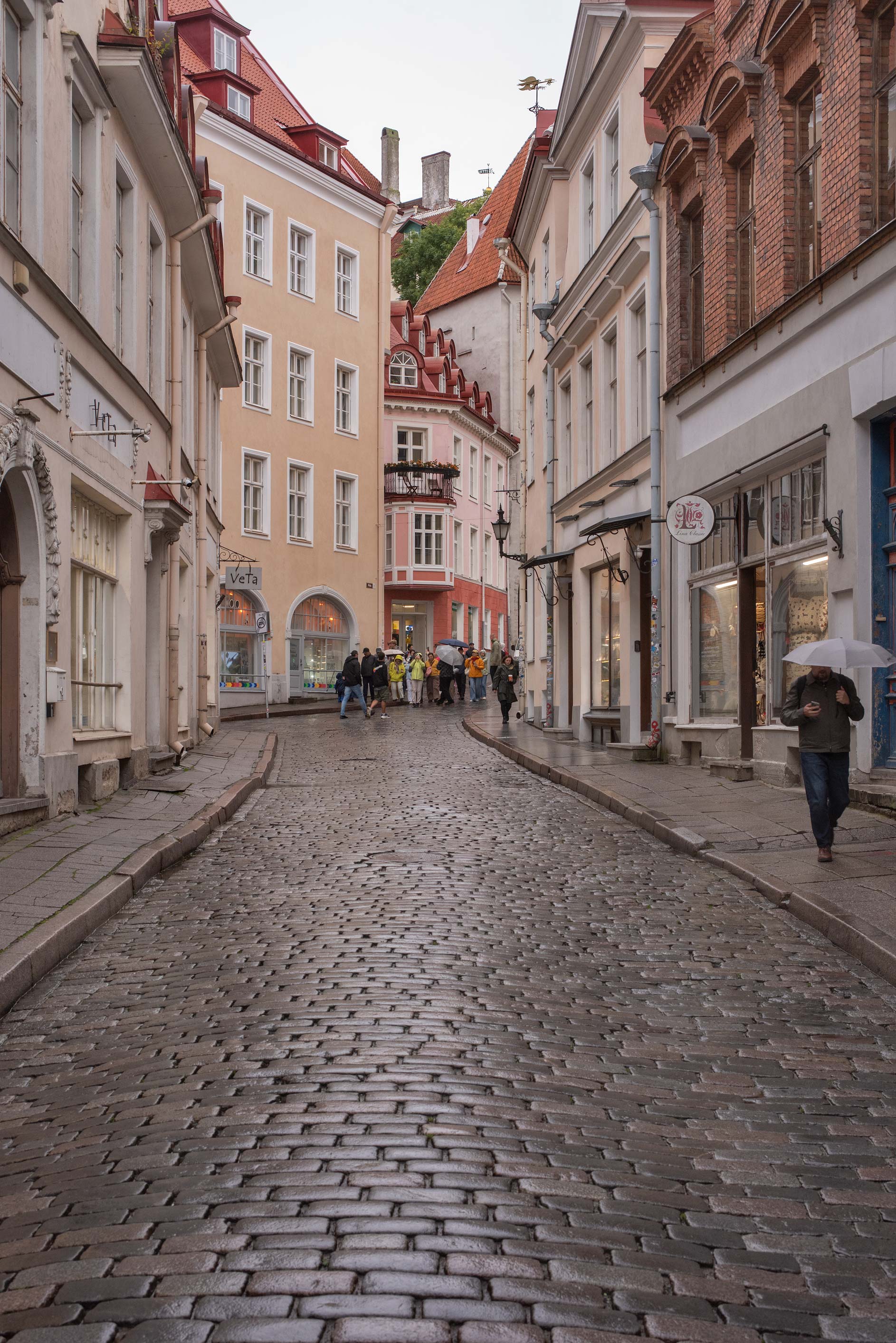
At a bend in Pikk Street in Tallinn[CloseCurlyQuote]s Old Town, pedestrians gather beneath a pink corner building with a projecting bay window and an iron balcony above it. Tallinn, Estonia, September 24, 2026
