
Powder flask (Northwest India, 18th century, wood, paint, gilt) on display in Museum of Islamic Art. Doha, Qatar, February 27, 2010

Jake Davis(?) house on Postoffice Street in East End Historic District from a corner of 18th Street. Galveston, Texas, January 1, 2011

Clarke-Jockusch house (1895) at 1728 Sealy Street, near 18th Street at evening. Galveston, Texas, January 19, 2013

Powder flask (Northwest India, 18th century, wood, paint, gilt) on display in Museum of Islamic Art. Doha, Qatar, February 19, 2011

Sealey Street near 18th Street in East End Historic District. Galveston, Texas, November 15, 2008


Clarke-Jockusch house (1895) at 1728 Sealy Street, near 18th Street in East End Historic District. Galveston, Texas, January 19, 2013

Clarke-Jockusch house (1895) at 1728 Sealy Street, near 18th Street in East End Historic District. Galveston, Texas, March 2, 2008

Maxwell Maas House (1885) at 1802 Sealy Street, a corner of 18th Street in East End Historic District. Galveston, Texas, January 1, 2011

Maxwell Maas House (1885) at 1802 Sealy, a corner of 18th Street in East End Historic District. Galveston, Texas, March 2, 2008

Maxwell Maas House (1885) at 1802 Sealy Street, a corner of 18th Street in East End Historic District. Galveston, Texas, January 19, 2013

Powder flask (Northwest India, 18th century, wood, paint, gilt) in Museum of Islamic Art. Doha, Qatar, March 6, 2013

Clarke-Jockusch house (1895) at 1728 Sealy Street, near 18th Street in East End Historic District in Galveston. Texas, December 20, 2019

Detail of a powder flask (Northwest India, 18th century, wood, paint, gilt) on display in Museum of Islamic Art. Doha, Qatar, February 5, 2011

Maxwell Maas House (1885) at 1802 Sealy, a corner of 18th Street in East End Historic District. Galveston, Texas, January 19, 2013


The Rebirth of Coyolxauhqui mural by Marina Perez-Wong on Taqueria El Buen Sabor restaurant on 18th and Valencia in Mission District of San Francisco. California, March 16, 2024

Central axis of the "Old Garden" (Regular Park), known as Hermitage Alley (Ermitazhnaya alleya) in Catherine Park. In the 18th century, this alley was the promenade for courtiers moving between the formal receptions at the Palace and the intimate, private parties at the Hermitage. Pushkin (former Tsarskoe Selo) near Saint Petersburg, Russia, October 10, 2025

Red Cascade or Turkish Cascade in Catherine Park. The Rust Red (8A611E) of the brickwork complements the surrounding Golden Orange (BB812a) foliage perfectly. The rough texture of the brick and the stepped stone cascade creates a rustic, "ruin-like" aesthetic that was highly fashionable in 18th-century landscape design. Pushkin (former Tsarskoe Selo) near Saint Petersburg, Russia, October 10, 2025

Devil s Bridge (Chertov Most), also known as the Cascade, located near the Upper Ponds in Catherine Park. Built in the 1770s, likely designed by the architect Vasily Neyelov or possibly Antonio Rinaldi, this structure is a classic example of the romantic "ruin" aesthetic popular in 18th-century landscape gardening. Pushkin (former Tsarskoe Selo) near Saint Petersburg, Russia, October 10, 2025

Chinese Gazebo (often called the Creaking Pagoda or Skripuchaya Besedka) which is one of the most eccentric and picturesque structures in Catherine Park. Built between 1778 and 1786, this pavilion was designed by Yury Felten (Georg Friedrich Veldten) at the height of the 18th-century craze for Chinoiserie (Chinese-style art). The pavilion gets its popular nickname from the metal weather vane on its roof. Shaped like a Chinese banner, it was intentionally designed to creak loudly in the wind. Originally, such pavilions served as tea houses or resting spots for the Empress and her court during their walks. Pushkin (former Tsarskoe Selo) near Saint Petersburg, Russia, October 10, 2025

Krestovy Bridge (Cross Bridge) located in Alexander Park in the town of Pushkin (formerly Tsarskoe Selo), near Saint Petersburg. It has Chinoiserie (Chinese-style) architecture, popular in the 18th century. A pavilion rests on four joined arches over the canal, creating a cross shape. It features glazed bricks (crimson, yellow, blue) and a curved "fish scale" roof. Built in 1779 by the Neyelovs for Catherine the Great, it is a key landmark of the park s "New Garden" area. Russia, October 10, 2025

Ancient oak tree trunk. Many oaks in the park are over 200 years old, some dating back to the park s initial landscaping in the 18th and 19th centuries. The gnarled, textured bark and massive girth signify its age and resilience. Northern part of Aleksandrovsky (Alexander) Park in Pushkin (former Tsarskoe Selo) near Saint Petersburg, Russia, October 10, 2025

Part of the Maze (or Labyrinth) located in the Lower Garden. The area features a classic French formal garden layout with geometrically trimmed hedges and gravel paths, characteristic of the early 18th-century design commissioned by Alexander Menshikov. Oranienbaum palace-and-park ensemble in Lomonosov (a suburb of St. Petersburg), Russia, October 13, 2025

Soykinskaya Alley (or Road) in Oranienbaum Park. This is a major thoroughfare in the Upper Park, notable for its impressive width and the straight, long perspective it creates, reminiscent of the "prospekts" designed in the 18th century. The alley is flanked by mature, stately trees--predominantly oaks and lindens--whose canopies form a "golden tunnel" overhead. The fallen leaves completely cover the ground, creating a continuous carpet of orange and yellow that mirrors the canopy above. Oranienbaum palace-and-park ensemble in Lomonosov (a suburb of St. Petersburg), Russia, October 13, 2025

Katalnaya Gorka Pavilion (Sliding Hill Pavilion), a masterpiece of 18th-century architecture located in the Upper Park of Oranienbaum. Designed by Antonio Rinaldi, this 33-meter-high pavilion is a striking blend of Baroque and early Classicism. Its festive, light-blue and white facade, tiered "wedding-cake" shape, and crowning bell-shaped dome make it resemble a lighthouse rising above the park s trees. Oranienbaum palace-and-park ensemble in Lomonosov (a suburb of St. Petersburg), Russia, October 13, 2025

The park s blend of formal structure and natural landscape during autumn. The image captures a long, straight avenue typical of the park s 18th-century layout, creating a mesmerizing "tunnel" effect. :200b Oranienbaum palace-and-park ensemble in Lomonosov (a suburb of St. Petersburg), Russia, October 13, 2025

Stone Hall Pavilion (Kammenoe Zalo) in Oranienbaum Park. It is a light pink, two-story stone pavilion designed by architect Antonio Rinaldi (built mid-18th century) for Grand Duke Peter Fedorovich. Originally used for concerts, masquerades, and dances, it later served as a Lutheran church. Oranienbaum palace-and-park ensemble in Lomonosov (a suburb of St. Petersburg), Russia, October 13, 2025

Allegorical statue of Peace, sculpted by the Venetian artist Pietro Baratta in the early 18th century in Pavlovsk Park. Pavlovsk, a suburb of Saint Petersburg, Russia, October 15, 2025

This rustic bench is a distinctive feature of landscaping style, known as the "Sentimentalist" tradition. Unlike the ornate iron benches, this bench is made of simple, whitewashed logs. This design choice is deliberate, reflecting the 18th-century fashion for "rural simplicity" (championed by Maria Feodorovna and designers like Charles Cameron). Pavlovsk, a suburb of Saint Petersburg, Russia, October 15, 2025

This is the interior of St. Nicholas Church (Niguliste kirik), now a museum of medieval art, looking towards the east end of the nave. The centerpiece is the magnificent High Altar retable (visible in the distance), a masterpiece of late medieval art created by the workshop of Lu"beck master Hermen Rode between 1478 and 1481. It is one of the largest and best-preserved altarpieces of its kind in Europe, measuring over six meters wide when fully open. The artwork depicts the lives of St. Nicholas and St. Victor, alongside more than thirty sculptures of saints. Coat-of-Arms Epitaphs: The white limestone walls of the nave are adorned with a unique collection of large, colorful coat-of-arms epitaphs (seen on the right wall). These were dedicated to wealthy local merchants and nobility from the 17th and 18th centuries, serving as memorials for those buried within the church. Estonia, October 16, 2025

This view from the St. Nicholas Church tower looks down into the heart of the lower town, specifically capturing the densely packed historic streets below. Ru"u"tli and Rataskaevu Streets: The view likely centers on the intersection or alignment of Ru"u"tli (Knight) and Rataskaevu streets, which run close to the church. These streets are characterized by their medieval layout and historic merchant houses. The prominent yellow building with the red roof in the foreground (bottom center) stands out with its orderly rows of windows and distinct dormers. This is typical of the 18th and 19th-century residential architecture found in this part of the Old Town, often housing guest apartments today. The image perfectly illustrates the "red roofscape" of Tallinn, with various shades of terracotta tiles covering the gabled roofs. You can see the complex interplay of courtyards, chimneys, and firewalls that define the city s historic urban fabric. St. Olaf s in Distance: In the upper right corner, the spire of St. Olaf s Church pierces the skyline, providing a vertical counterpoint to the horizontal spread of the lower town. The view extends to the gray waters of the bay in the background, reinforcing the city s coastal setting. Estonia, October 16, 2025

This view from the St. Nicholas Church (Niguliste) tower looks down towards the dense medieval streets of the lower town, offering a detailed perspective of the residential architecture and rooftops. The narrow, curved street cutting through the scene is Rataskaevu Street, one of the most picturesque lanes in the Old Town. Yellow Building: The prominent, multi-story yellow building in the foreground (with the large red-tiled roof and dormer windows) is likely situated on or near Rataskaevu Street. Buildings in this area often date from the 18th or 19th centuries and now frequently house guest apartments, such as the Rataskaevu Boutique Apartments or Rataskaevu Guest Apartment. Its bright facade and orderly fenestration are typical of the later updates to the medieval fabric. The image showcases the iconic "sea of red roofs" that defines Tallinn s aerial aesthetic. The jumble of gables, chimneys, and varying roof pitches reveals the organic development of the city over centuries. In the background, the spire of St. Olaf s Church (Oleviste kirik) rises above the horizon, providing a vertical anchor to the cityscape and connecting the view to the harbor beyond. Estonia, October 16, 2025
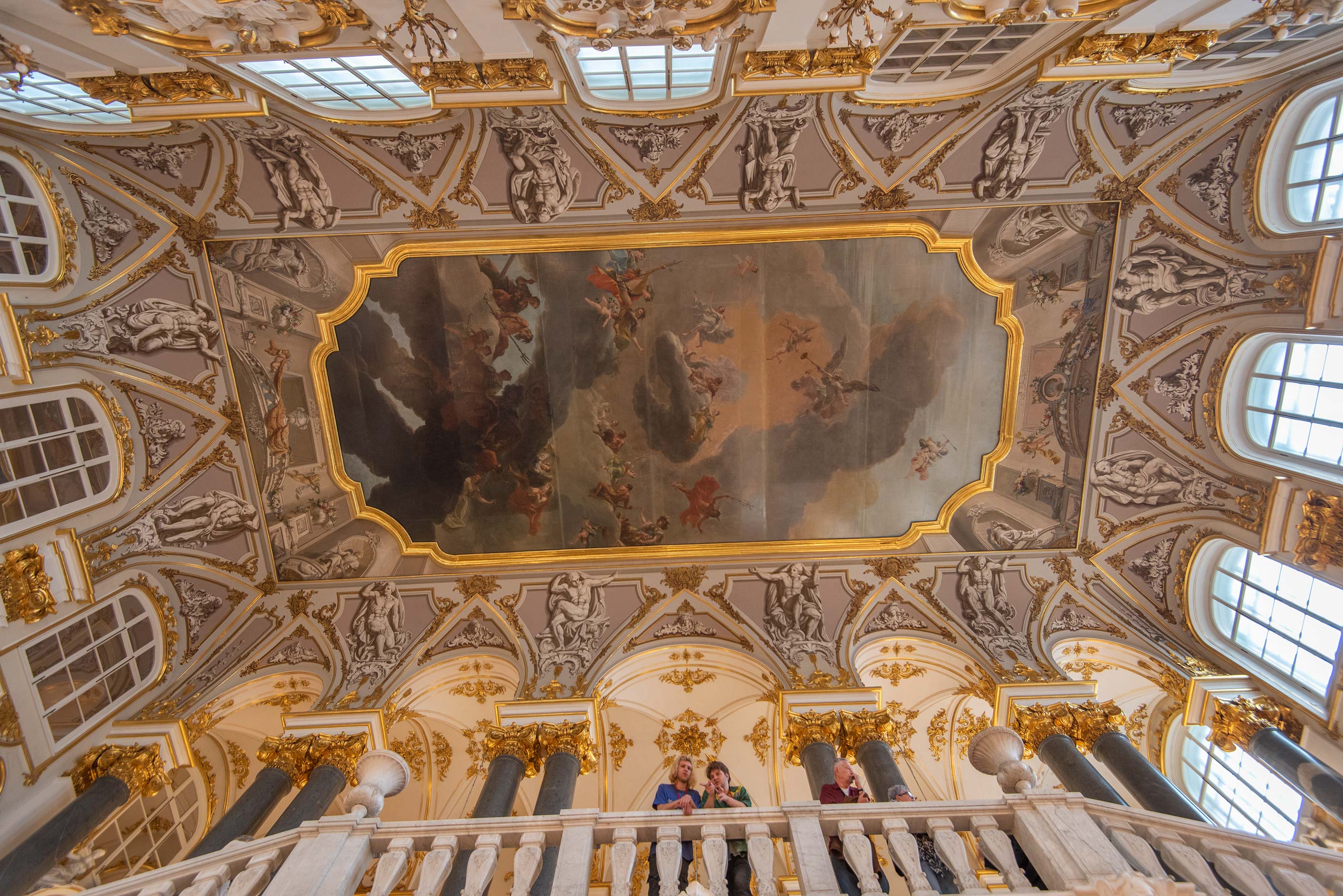
Framed by gilded rocaille molding and monochrome grisaille atlantes, the ceiling above the Jordan Staircase centers on Gasparo Diziani s 18th-century plafond depicting the gods of Mount Olympus amidst swirling clouds. Below the vaulted cove and arched clerestory windows, visitors lean over the white marble balustrade beside paired grey granite columns topped with gilded Corinthian capitals. Hermitage Museum in Saint Petersburg, Russia, September 10, 2026
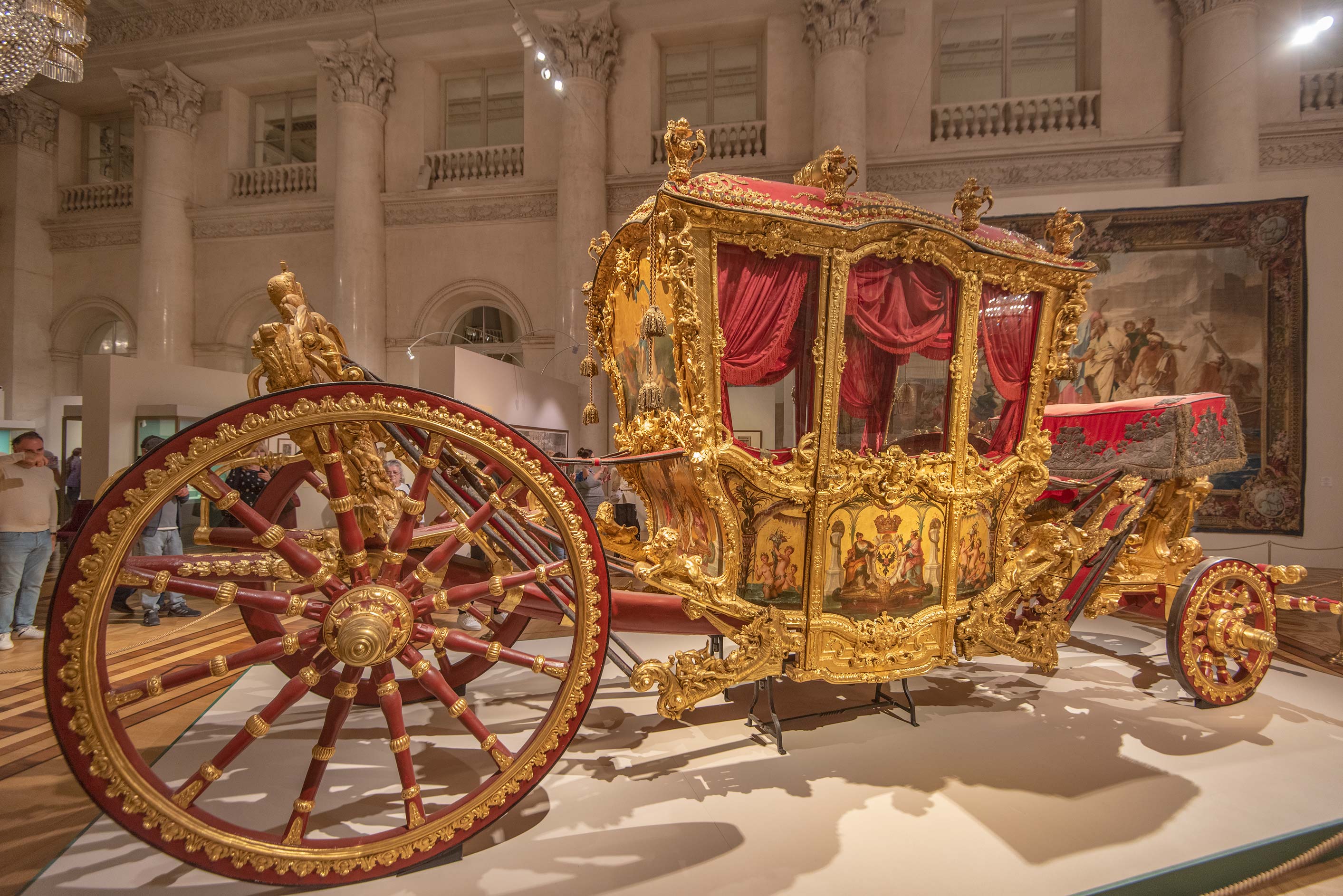
Displayed on a raised white platform in the Field Marshals Hall of the Winter Palace, the 18th-century Grand Coronation Carriage (commissioned in Paris by Peter the Great for Catherine I and later used by Catherine the Great) features gilded wood carvings, painted allegorical panels, crimson velvet curtains, and large red-spoked wheels. Behind the coach, neoclassical Corinthian columns, an upper gallery balustrade, and a large woven tapestry frame the exhibition space in the State Hermitage Museum in Saint Petersburg, Russia, September 10, 2026
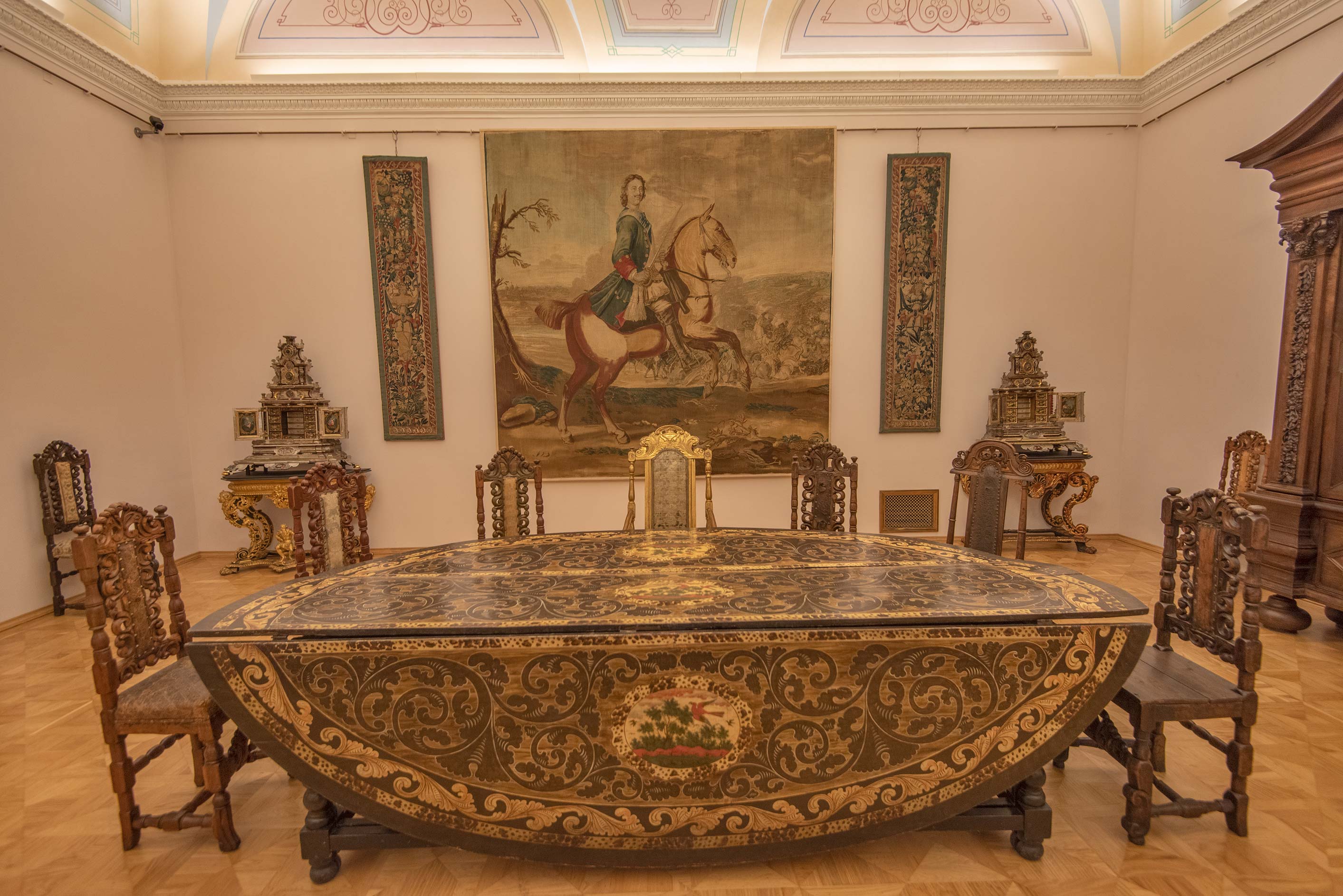
Centered in one of the halls of the Gallery of Peter the Great in the Winter Palace, a large early 18th-century oval gateleg table--intricately inlaid with floral marquetry and a central landscape medallion--stands surrounded by high-backed carved wooden chairs and a gilded armchair on a herringbone parquet floor. On the wall behind it, a monumental woven tapestry depicting Peter the Great on horseback at the Battle of Poltava is flanked by vertical floral tapestry borders, two miniature architectural cabinets on gilded console tables, and a massive carved wooden wardrobe in the State Hermitage Museum in Saint Petersburg, Russia, September 10, 2026

Detail of the central portico of the Catherine Palace under autumn fog. The mid-18th-century exterior features rhythmic white pilasters, arched windows, and ochre-toned stucco ornamentation in Ekaterininsky (Catherine) Park of Pushkin (former Tsarskoe Selo), a suburb of Saint Petersburg. Russia, September 22, 2026

Detail of the 18th-century marble statue of Perseus with the head of Medusa in the Old Garden s regular parterre. Framed by autumn fog and early-turning foliage, the sculpture stands in Ekaterininsky (Catherine) Park of Pushkin (former Tsarskoe Selo), a suburb of Saint Petersburg. Russia, September 22, 2026

Side profile of the 18th-century marble statue of Perseus along the gravel walkways of the Old Garden s regular parterre. Framed by symmetrical busts, statues, and mist-shrouded firs, the scene was photographed in Ekaterininsky (Catherine) Park of Pushkin (former Tsarskoe Selo), a suburb of Saint Petersburg. Russia, September 22, 2026

Architectural detail of the Catherine Palace exterior highlighting its gilded wrought-iron balcony balustrade and sculpted stucco window surrounds. The mid-18th-century Baroque facade combines white columns, sky-blue plaster, and ochre ornamentation in Ekaterininsky (Catherine) Park of Pushkin (former Tsarskoe Selo), a suburb of Saint Petersburg. Russia, September 22, 2026

Three bronze statues cast in the late 18th century from antique models stand along the balustrade of the Granite Terrace, including the Medici Venus (right) and a nymph at a basin (center). Framed against mist-shrouded trees and the faint silhouette of the Catherine Palace s Zubov Wing in the distance, the weathered figures overlook the Great Lawn of the Landscape Park in Ekaterininsky (Catherine) Park of Pushkin (former Tsarskoe Selo), a suburb of Saint Petersburg. Russia, September 22, 2026

Rear three-quarter view of the late 18th-century bronze copy of the Apollo Belvedere standing on a red granite pedestal along the Granite Terrace, with a companion statue of Venus (Spinario/Crouching Venus or similar classical nymph) visible on a lower plinth below. Framed by blooming pink roses and autumn foliage tinged with gold and orange in the dense fog, the sculpture overlooks the landscape grounds in Ekaterininsky (Catherine) Park of Pushkin (former Tsarskoe Selo), a suburb of Saint Petersburg. Russia, September 22, 2026
