
A wooden house near the train station in Sablino, south from Saint Petersburg. Russia, June 24, 2003

Remains of wooden houses in old fishing village (ghost town) of Al Khuwair west from Lekhwair on northern coast. Qatar, June 6, 2015

Wooden house at 11 Rubakina Street in Lomonosov (Oranienbaum). West from Saint Petersburg, Russia, August 16, 2007

A wooden house built at the end of 19th century (?) at 7/59 Morskaya Street near Sestroretskiy Kurort, 15 miles north-west from Sankt Petersburg. Russia, October 2, 2000

A wooden house at a corner of Hodge and Bayard streets. Princeton, New Jersey, March 7, 2007

A wooden house at 64 Kommunarov Street in Sestroretsk, suburb of Saint Petersburg. Russia, July 27, 2005

Wooden house with lupin flowers in Siverskaya, 50 miles south from Saint Petersburg. Russia, June 15, 2014

Wooden house at 13 Sovietskaya Street. Sortavala (Karelia), Russia, September 19, 2015


Brown wooden house on Church Street (Avenue F) in East End Historic District. Galveston, Texas, January 1, 2011

A wooden house on Summer(?) Street after snowfall. New Bedford, Massachusetts, December 27, 2004

A porch of a wooden house on East Moss Street in Bayou Saint John neighborhood at evening. New Orleans, Louisiana, August 11, 2006

Old wooden house in Siverskaya, 50 miles south from Saint Petersburg. Russia, June 15, 2014

A wooden house on East Moss Street reflected in Bayou Saint John (flipped image). New Orleans, Louisiana, August 11, 2006

Wooden house in Ozerki, view from a window of a train. Saint Petersburg, Russia, August 5, 2012

Blue wooden house at 1926 Flood Street in Lower 9th Ward. New Orleans, Louisiana, March 17, 2006

Typical wooden house in Maloe Zabrodye Village near Orzhitdy. Lomonosov Region of Leningrad District, Russia, January 4, 2016

Wooden house near Pargolovo Train Station in a suburb of Saint Petersburg. Russia, August 5, 2012


Wooden house near Sablino Train Station, 30 miles south from Saint Petersburg. Russia, July 29, 2012


Burned wooden house at Fermskoe Shosse, Litera A, view from a platform of Udelnaya train stop. Saint Petersburg, Russia, July 22, 2024

A wooden double door set within a limestone portal at approximately Pikk 67 in Tallinn s Old Town. The door is framed by a round-arched limestone portal, a common feature in Tallinn s medieval Hanseatic architecture. The rough-hewn stone blocks (voussoirs) forming the arch are clearly visible where the plaster has fallen away, revealing the underlying construction technique. The surrounding wall features peeling stucco in shades of ochre and grey, exposing the limestone masonry beneath. This texture speaks to the building s age and the ongoing challenge of maintaining historic structures in the local climate. The door itself is made of diagonal wooden planks, a traditional style for utility or courtyard entrances in the Old Town. It appears to be a secondary entrance rather than a main portal for a wealthy merchant s house. The juxtaposition of the medieval stone arch with modern urban graffiti creates a stark contrast between the city s protected history and contemporary urban challenges. Tallinn, Estonia, October 16, 2025

This broader aerial shot, taken from an aircraft heading north towards Helsinki, captures the expansive geography of Tallinn s coastline. The large landmass stretching into the sea on the left is the Kopli Peninsula. Once an industrial zone, it is now a rapidly developing area with trendy neighborhoods like Kalamaja (closer to the center) and burgeoning cultural hubs. The calm, blue waters of Tallinn Bay dominate the background, illustrating the city s intimate connection with the Baltic Sea. Further in the distance, beyond Kopli, one can see the tip of the Paljassaare Peninsula, known for its bird conservation area and beaches. The area in the foreground, characterized by a regular grid of streets and lower-rise buildings (many of them historic wooden houses), is the Kalamaja district. On the coastline to the right, the massive concrete hangars of the Seaplane Harbour museum are visible, a key maritime landmark. Near the Seaplane Harbour, the curved, defensive walls of the Patarei Sea Fortress (a former prison) stand on the water s edge, marking a grim but significant historical site. View from a window of an airplane from Tallinn to Helsinki, Estonia, October 17, 2025

An abandoned bat observation blind (or cabin) in Lick Creek Park, College Station. It was originally built to allow visitors to watch bats and other wildlife without disturbing them. A wooden box mounted high on a tree in the background (visible through the trees in the top right) is a bat house - an artificial roost designed to attract bats. Texas, December 16, 2025

The narrow passage beside Lai 19 is Aida Street, winding through the Lower Old Town near Tallinn City Theatre[CloseCurlyQuote]s complex of historic merchant houses. Unlike the broader Lai Street, Aida preserves the enclosed scale and irregular course of a medieval lane. Red and ochre plastered fac,ades give way to exposed limestone masonry around the bend, where small arched openings and narrow windows retain the appearance of older storage buildings. A low wooden door with diagonal boarding and iron ring handles, outward-opening casement windows, and wall-mounted lanterns distinguish the foreground buildings. A central strip of paving slabs provides a smoother walking surface between the rounded cobblestones. Tallinn, Estonia, August 26, 2026

At Aida 6, the lane curves between an exposed limestone wall and a plastered building with a deeply recessed, pointed-arch stone portal. The doorway[CloseCurlyQuote]s stepped mouldings, diagonal-boarded wooden door, and iron studs contrast with the plain rectangular windows above. On the opposite wall, blocked openings--including an arched recess and a brick-filled aperture--record alterations to the masonry. Rounded cobbles border a central strip of paving slabs, while shallow channels follow the edges of the buildings. The close-set walls and restricted width preserve the enclosed character of this part of Aida Street, with a yellow house closing the view around the bend. Tallinn, Estonia, August 26, 2026

The ornate corner house at Pikk 23/25, at the junction with Hobusepea Street, was completed in 1908 for merchant Reinhold Reichmann to a design by Jacques Rosenbaum. It combines Art Nouveau with German Renaissance Revival and Mannerist ornament, illustrating the early twentieth-century rebuilding of parts of Tallinn[CloseCurlyQuote]s medieval centre. The sculptural decoration was executed by the Riga-based sculptor August Volz. A rounded corner bay rises into a small turret beside a curved, elaborately decorated gable. Pale-green window surrounds, relief panels with scrolls and masks, and reddish wooden window frames contrast with the grey, rusticated ground floor. The lettering [OpenCurlyDoubleQuote]Apotheka[CloseCurlyDoubleQuote] above the corner entrance records its pharmacy use; the broad arched opening below follows the curve of the projecting bay. Tallinn, Estonia, August 26, 2026

At Vana Turg (Old Market), the narrow white-gabled house occupied by Peppersack preserves the form of a medieval merchant[CloseCurlyQuote]s dwelling and warehouse. Its pointed stone entrance portal sits below upper storage openings, a shuttered loading door, and a projecting hoisting beam. The building dates from the fifteenth century, when homes in Tallinn[CloseCurlyQuote]s trading centre commonly combined residential and storage functions. The adjoining yellow house has a more regular fac,ade with moulded window surrounds and a hipped tiled roof, contrasting with the steep gables beside it. On the right, pointed-arch ground-floor windows with decorative iron grilles reinforce the square[CloseCurlyQuote]s Gothic architectural character. A wooden stall with a canvas canopy and barrel occupies the foreground, while Viru Street opens downhill to the left. Tallinn, Estonia, August 26, 2026

So~prus Cinema, whose name means [OpenCurlyDoubleQuote]Friendship,[CloseCurlyDoubleQuote] opened in 1955 and was designed by Peeter Tarvas and August Volberg, with interiors by Maia Laul. Its monumental Stalinist-classical architecture differs from the medieval merchant houses and later townhouses surrounding it in the Old Town. Six tall, faceted columns follow the curved entrance fac,ade, supporting a broad entablature decorated with geometric panels and dentil moulding. Carved capitals and ornamental bands contrast with the plain column shafts; behind them, salmon-pink walls frame three wooden entrance doors beneath decorative pediments. The flags of Estonia, Latvia, and Lithuania hang between the columns alongside a poster advertising Baltic Film Days. Tallinn, Estonia, August 26, 2026
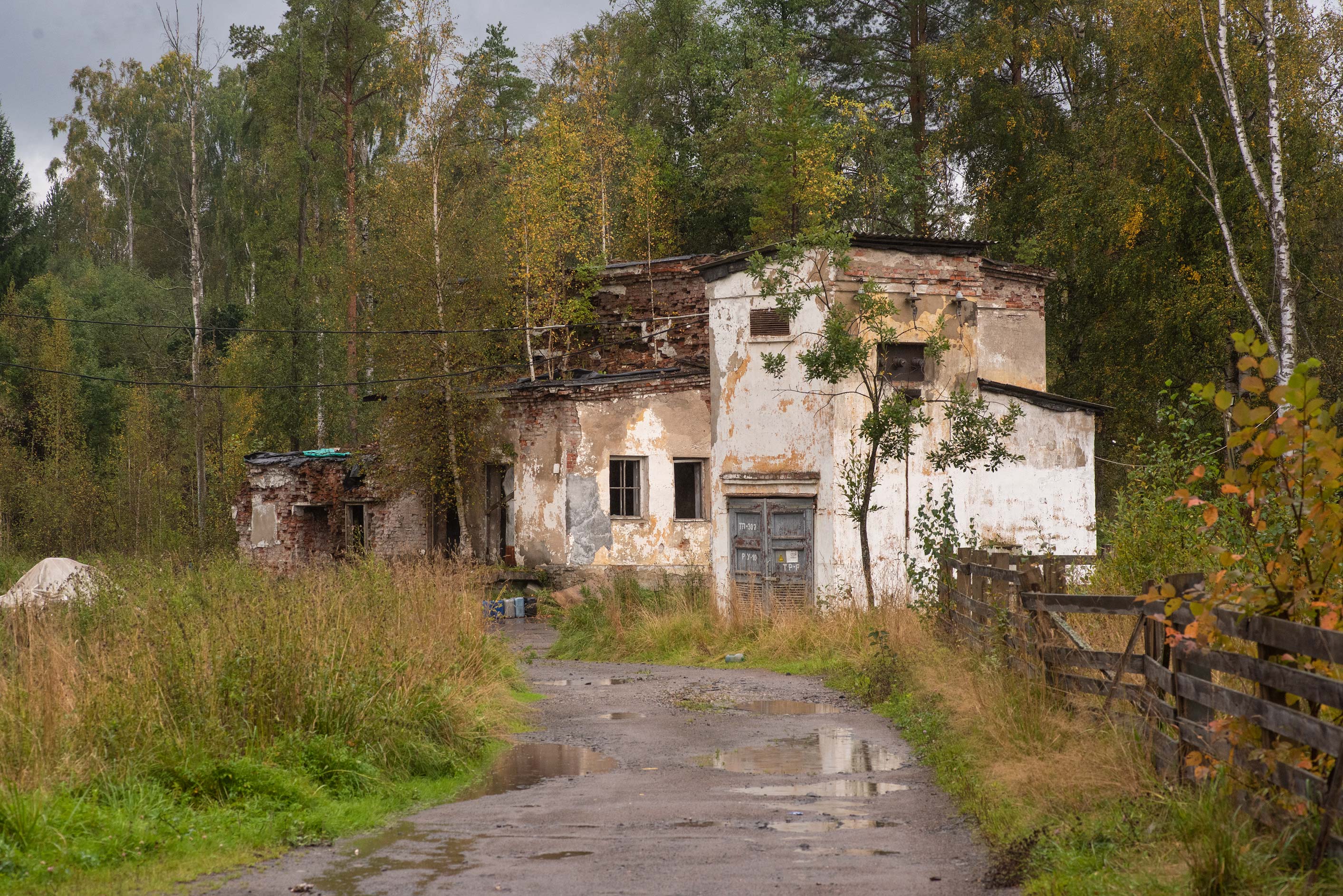
A puddled gravel road leads past an aging wooden fence toward the crumbling brick and plaster remains of an auxiliary utility building and electrical substation TP-302 on Svetlaya Street, west of Toksovo railway station in Leningrad Oblast. Originally serving a Soviet military fuel depot within former military settlement No. 2, the compound later housed community initiatives including an informal equestrian stable and the Museum of Soviet Toys before falling into dereliction amid local redevelopment disputes, leaving its fractured masonry and roofless wings to be reclaimed by birch and pine scrub. Toksovo, north from Saint Petersburg. Russia, September 10, 2026
