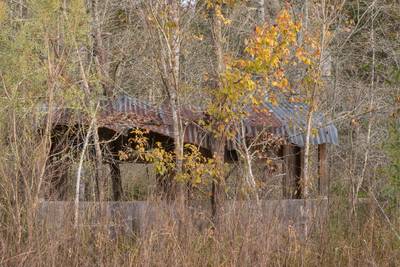
Pil Tower Bridge (Pil-bashnyy most), with the iconic Pil Tower (Pil-bashnya) visible in the background. The tower is one of the most charming "follies" in the park. Originally built in 1797 by Vincenzo Brenna, it was designed to look like a rustic water mill, complete with a thatched roof and stairs. Pavlovsk, a suburb of Saint Petersburg, Russia, October 6, 2025  Abandoned bat observation cabin near a pipeline right of way in Lick Creek Park. College Station, Texas, January 22, 2026  Rusty roof of an abandoned bat observation cabin in Lick Creek Park. College Station, Texas, January 15, 2026 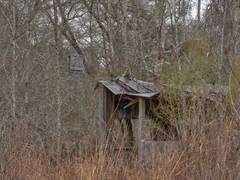 Bat observation cabin in Lick Creek Park. College Station, Texas, February 3, 2025  Bat observation cabin from sewage line right-of-way in Lick Creek Park. College Station, Texas, February 3, 2025  Bat observation cabin in Lick Creek Park. College Station, Texas, December 4, 2023  Old bat observation house in Lick Creek Park. College Station, Texas, January 8, 2025  Bat observation cabin in Lick Creek Park. College Station, Texas, March 10, 2023  Old bat observation cabin in Lick Creek Park. College Station, Texas, August 17, 2022  Old bat observation cabin in Lick Creek Park. College Station, Texas, August 7, 2022  Overgrown bat observation cabin in Lick Creek Park. College Station, Texas, August 7, 2022  Bat observation cabin near Deer Run Trail in Lick Creek Park. College Station, Texas, August 2, 2022  Bat observation cabin near Deer Run Trail in Lick Creek Park. College Station, Texas, August 7, 2022  Bat observation cabin near Deer Run Trail in Lick Creek Park. College Station, Texas, August 22, 2023  The central alley leading to the Arsenal Pavilion, a red-brick neo-Gothic structure designed by Adam Menelaws. Completed in 1834, the Arsenal resembles a medieval castle with crenellated towers and massive arched windows. It was originally built to house Nicholas I s vast collection of medieval arms and armor. The straight alley is a remnant of the formal layout from the earlier "Monbijou" pavilion that stood here, now framed by the mature trees of the surrounding landscape park. After severe damage in WWII, the building was restored and reopened in 2016 as a museum displaying imperial weaponry. Aleksandrovsky (Alexander) Park in Pushkin (former Tsarskoe Selo) near Saint Petersburg, Russia, October 10, 2025  Overgrown bat observation cabin near Deer Run Trail in Lick Creek Park. College Station, Texas, August 22, 2023  Bat observation cabin in mist at sunrise near sewage line right-of-way in Lick Creek Park. College Station, Texas, February 16, 2026  The "initial stage" of memorialization, where fresh earthen graves are densely covered in massive wreaths of artificial flowers and a forest of flags. In the foreground, the wooden cross of Aleksandr Vitalyevich Rogachev (1964-2025) identifies a 61-year-old casualty, representative of the older demographic of mobilized soldiers and volunteers. The scene highlights the diverse composition of the forces, with the flag of Uzbekistan visible in the background--indicating the recruitment of foreign nationals--while a lone mourner tends to a grave amidst the dense rows, adding a human scale to the extensive loss. "Alley of Heroes" at Cemetery of the Victims of January 9, St. Petersburg, Russia, October 4, 2025  Petrovsky Bridge in Oranienbaum Park. The bridge is a three-arched stone structure built in 1910 (designed by O. Paulson) to replace an older wooden one. It features rough-hewn stone masonry on the lower arches contrasting with lighter brick detailing and white balustrades along the top. It spans the Karasta River, which flows through a valley currently filled with vibrant orange and golden foliage from the surrounding maple and oak trees. Oranienbaum palace-and-park ensemble in Lomonosov (a suburb of St. Petersburg), Russia, October 13, 2025  Chinese Gazebo (often called the Creaking Pagoda or Skripuchaya Besedka) which is one of the most eccentric and picturesque structures in Catherine Park. Built between 1778 and 1786, this pavilion was designed by Yury Felten (Georg Friedrich Veldten) at the height of the 18th-century craze for Chinoiserie (Chinese-style art). The pavilion gets its popular nickname from the metal weather vane on its roof. Shaped like a Chinese banner, it was intentionally designed to creak loudly in the wind. Originally, such pavilions served as tea houses or resting spots for the Empress and her court during their walks. Pushkin (former Tsarskoe Selo) near Saint Petersburg, Russia, October 10, 2025  Stone Hall Pavilion (Kammenoe Zalo) in Oranienbaum Park. It is a light pink, two-story stone pavilion designed by architect Antonio Rinaldi (built mid-18th century) for Grand Duke Peter Fedorovich. Originally used for concerts, masquerades, and dances, it later served as a Lutheran church. Oranienbaum palace-and-park ensemble in Lomonosov (a suburb of St. Petersburg), Russia, October 13, 2025 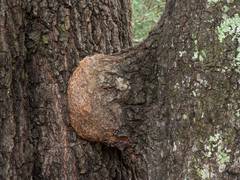 Two oaks that biologically fused together, allowing them to share resources like water and nutrients through a shared vascular system. This phenomenon is known as inosculation, or more commonly as natural grafting. Trees that have merged in this way are sometimes called "gemel trees" (from the Latin for "twin"), "marriage trees," or "husband and wife trees". Lick Creek Park. College Station, Texas, December 5, 2025  "Winterizing" for community (feral) cats in Wolf Pen Creek Park. Two common types of shelters are visible, the Green Bin (DIY) which is the classic "Rubbermaid Roughneck" shelter and the Brown House (commercial), which is a store-bought outdoor cat house (often heated or insulated). College Station, Texas, January 20, 2025  The initial "temporary" stage of burial, showing rows of fresh earthen mounds topped with simple wooden Orthodox crosses and small identification plaques. Despite the lack of permanent monuments, the graves are densely decorated with vibrant artificial flowers and a profusion of flags--including the Russian tricolor, a Soviet hammer-and-sickle banner, and the flag of Uzbekistan--highlighting the diverse origins and ideological affiliations of the recently deceased. The raw, uneven ground and the sheer number of identical crosses extending into the background visually confirm the high volume of recent casualties processed at the site. "Alley of Heroes" at Cemetery of the Victims of January 9, St. Petersburg, Russia, October 4, 2025  Another view of the Friedlander and Klawetter family plot in the Calvert Jewish Cemetery. In the background, a small, corrugated metal shed is visible among the trees. This is likely a maintenance shed for the cemetery groundskeeper, typical in older rural cemeteries. Calvert, Texas, December 13, 2025  The dense, chaotic stage of recent burial in the "Alley of Heroes," where fresh earthen graves are overwhelmed by a profusion of flags, including the Russian tricolor, the blue flag of the Aerospace Forces (VKS), and banners of various volunteer and assault units. The foreground shows a simple wooden cross with a framed photo of a young soldier, surrounded by vibrant wreaths of artificial flowers, while in the background, a woman walks amongst the rows, emphasizing the cemetery s role as an active site of public mourning. The sheer number of flags and the raw state of the ground visually confirm a continuous, high-volume flow of casualties processed at this site. Cemetery of the Victims of January 9, St. Petersburg, Russia, October 4, 2025  Bird watching cabin on Deer Run Trail in Lick Creek Park. College Station, Texas, November 14, 2025  This quiet cobblestone street is Mu"ndi ("Mint Street"), a short but historically rich passageway in Tallinn s Old Town. Despite being only about 45 meters long, Mu"ndi is one of the oldest streets in the city, with origins dating back to the 13th century when it was a pathway known as "the short one, close to the market". The narrow, curving layout framed by tall pastel-colored buildings creates a classic "canyon" effect typical of medieval urban design. The view looks towards Pikk Street, with the high gable of a merchant house visible in the background. Estonia, October 16, 2025  Pyramid Pavilion, located in a quiet, shady corner of Catherine Park in Tsarskoe Selo (Pushkin). It was originally built in 1770-1772 by the architect Vasily Neyelov and later reconstructed by Charles Cameron in 1782-1783. The pavilion was designed to resemble an ancient Egyptian mausoleum, reflecting the Romantic era s fascination with antiquity and melancholy ruins. It is constructed of brick and faced with trimmed granite. Buried behind the pyramid are three of the Empress s favorite Italian greyhounds: Tom Anderson, Zemira, and Duchesse. Saint Petersburg, Russia, October 10, 2025  Fall colors of sycamore trees near Deer Run Trail in Lick Creek Park. College Station, Texas, December 16, 2025  Bat observation blinds in Lick Creek Park. College Station, Texas, December 4, 2023  A building at 5 lit. B Engelsa Prospect which is a surviving historical service corps of the Orlovo-Novosiltsevskaya Almshouse complex. This small brick structure was originally built as one of the auxiliary buildings (likely for staff or utility purposes) for the larger almshouse institution. The main complex, located at Engelsa 1-5, was a major philanthropic center established in the 1830s. The complex was designed by the renowned architect Iosif Charlemagne (Joseph-Maria Charlemagne-Baudet) in the late Classicist style. It was constructed between 1834 and 1841. Lesnoy Park (Lesotekhnicheskiy Universitet), Saint Petersburg, Russia, October 14, 2025  Fac,ade of Pikk 18, arguably the most famous Art Nouveau building in Tallinn, known as the Dragon Gallery (Draakoni Galerii). Designed by the renowned Baltic German architect Jacques Rosenbaum and completed in 1910, this building is a prime example of late Art Nouveau (Jugendstil) architecture. The two massive, sculpted dragons flanking the ground-floor window are the building s namesake and most iconic feature. They were created by the sculptor August Volz. Above the dragons, the fac,ade features two stern female figures with Egyptian headdresses projecting from the pilasters. These, along with sphinxes and other exotic ornaments on the upper levels, reflect the eclectic and fantastical influences typical of Rosenbaum s style. The large, horseshoe-shaped window on the ground floor and the undulating gable at the top create a sense of movement and fluidity that contrasts sharply with the rigid lines of the adjacent classical and medieval buildings. Originally built as an apartment house for the merchant Reinhold Reichmann, the ground floor has housed the Draakoni Gallery since 1983, an exhibition space managed by the Estonian Artists Association. The green light visible in the window belongs to a fashion boutique or exhibition currently occupying the space. Tallinn, Estonia, October 16, 2025  Neoclassical apartment building located at 108 Bolshoy Sampsonievsky Prospect (corner of Serdobolskaya Street), viewed across Serdobolsky Pond. The dominant structure is a residential complex known locally as the House of Specialists or sometimes nicknamed the "Bastille near Lanskaya". Designed by architects Viktor F. Belov, V.A. Potapov, and M.P. Savkevich. Built between 1953 and 1956, representing the late Stalinist "Empire" style. It was commissioned by the Klimov Plant (Zavod im. Klimova), a major manufacturer of aviation engines, to house its employees. Lesnoy Park (Lesotekhnicheskiy Universitet), Saint Petersburg, Russia, October 14, 2025  Base of a water oak tree with dry leaves in Lick Creek Park. College Station, Texas, December 16, 2025  Aerial view of the Schweizerland Alps in East Greenland, likely near the Sermilik Fjord region. The jagged, snow-covered peaks visible in the foreground are part of the Schweizerland mountain range (also known as the Schweizerland Alps). This is one of the highest and most alpine regions in Greenland, located just west of the town of Tasiilaq. The image shows deep valleys filled with snow and ice, with massive glaciers flowing down from the high peaks towards the fjords. The interplay of sharp ridges (are^tes) and ice-filled basins (cirques) creates a classic, high-alpine landscape that rivals the European Alps in ruggedness but on a much wilder scale. The large body of water visible in the background (center-right) is likely Sermilik Fjord, a major fjord known for being choked with icebergs calved from the Helheim and other glaciers. The water reflects the sunlight, creating a bright contrast against the darker mountains. View from a window of an airplane from Helsinki to Dallas, Greenland, October 17, 2025  This view from the St. Nicholas Church tower looks south-east, contrasting the medieval Old Town with the modern business district in the background. The large, L-shaped building with the dark gray roof in the center-right is the Writers House (Kirjanike Maja) on Harju Street. Completed in 1963, this Soviet-era modernist building stands out among the older red-roofed structures. It was built on the ruins of buildings destroyed in the 1944 March bombing and remains a cultural hub, housing the Estonian Writers Union and a famous bookstore. In the distance, the sleek glass high-rises of Tallinn s modern city center dominate the horizon. Key skyscrapers include the Swisso^tel Tallinn and the twin towers of the Tornima"e complex, symbolizing the city s rapid economic development since regaining independence. The open area visible to the right, just beyond the dense red roofs, is Freedom Square (Vabaduse va"ljak). Although partially obscured, this major public plaza marks the southern edge of the Old Town and is home to the Victory Column of the War of Independence. Estonia, October 16, 2025  Northern end of Vene Street (Vene ta"nav) at the intersection with Olevima"gi and Bremeni ka"ik. The red brick building on the immediate left is located at Vene 28. It is a historic structure that was originally built in 1912 as a residential building and briefly housed the Estonian Provisional Government in 1918. It stands out with its industrial-style red brick facade contrasting with the medieval stone walls nearby. The large limestone wall with the archway on the far left is part of the city s defensive fortifications, specifically near the Bremen Tower (Bremeni torn). The archway leads into Bremen Passage (Bremeni ka"ik), a short, atmospheric walkway that connects Vene Street to Uus Street through the city wall. The tower itself, a 15th-century horseshoe-shaped defensive structure, is located just behind this wall. In the background, at the end of the street, you can see the yellow tower and facade of the Orthodox Church of St. Nicholas (Nikolai kirik) at Vene 24. Designed by architect Luigi Rusca and built between 1820-1827, this Neoclassical church serves a congregation under the Moscow Patriarchate and is known for its valuable iconostasis. It sits on the site of a much older church that served Novgorod merchants in the Middle Ages. Tallinn, Estonia, October 16, 2025 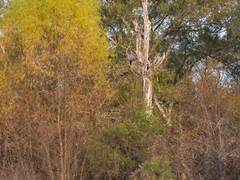 Black willow tree near Deer Run Trail in Lick Creek Park. College Station, Texas, December 16, 2025  Bird watching blind in Lick Creek Park. College Station, Texas, February 10, 2022  Katalnaya Gorka Pavilion (Sliding Hill Pavilion), a masterpiece of 18th-century architecture located in the Upper Park of Oranienbaum. Designed by Antonio Rinaldi, this 33-meter-high pavilion is a striking blend of Baroque and early Classicism. Its festive, light-blue and white facade, tiered "wedding-cake" shape, and crowning bell-shaped dome make it resemble a lighthouse rising above the park s trees. Oranienbaum palace-and-park ensemble in Lomonosov (a suburb of St. Petersburg), Russia, October 13, 2025  Splitgill mushrooms (Schizophyllum commune) on a fallen tree branch in Lick Creek Park. College Station, Texas, December 13, 2025  This perspective on Harju Street captures a striking mix of Soviet-era modernism and medieval heritage in the heart of Tallinn s Old Town. The prominent grey building on the right is the Writers House (Kirjanike Maja), located at Harju 1. Designed by architects August Volberg and Heili Volberg and completed in 1963, it is a prime example of post-war modernist architecture in Estonia. The foreground reveals traces of the area s turbulent history. The open green space on the left (Harju Street Park) occupies the site of buildings destroyed during the March 1944 Soviet bombing. For decades, these ruins were a painful scar, but the area has since been redeveloped into a recreational space that memorializes the lost urban fabric while providing a breathing room in the dense Old Town. The blue truck cabin visible in the foreground of the Harju Street photo is a GAZ-51, a legendary Soviet-era truck that was a common sight in Estonia for decades. Estonia, October 16, 2025  "Framed" perspective looking towards the trees near the Marble Bridge in Catherine Park. The arches create a "picture window" effect, a classic technique in landscape architecture designed to direct the viewer s gaze to specific idealized scenes of nature. The stone ball finials on the balustrade add a rhythmic, formal element that contrasts with the organic chaos of the forest background. Pushkin (former Tsarskoe Selo) near Saint Petersburg, Russia, October 10, 2025  This view from the tower of St. Nicholas Church offers a fascinating contrast between medieval history, post-war reconstruction, and modern urban growth, looking east towards the city center. The most prominent building in the immediate foreground is the large, grey, L-shaped structure known as the Writers House (Kirjanike Maja) on Harju Street. Built in 1963 on the ruins of buildings destroyed during the 1944 Soviet bombing of Tallinn, this modernist structure is a significant cultural landmark. It houses the Estonian Writers Union, a well-known bookstore, and the famous Cafe Pegasus, serving as a hub for the country s literary scene. The street running along the left side of the Writers House is Harju Street, historically one of the city s main commercial arteries. The open green space visible nearby (part of the Harju Street green area) was also created following the wartime destruction, serving as a memorial and recreational space before partial reconstruction debates in recent years. In the background, the view opens up to Tallinn s modern business district. The cluster of high-rise glass buildings, including the distinct wedge-shaped Swisso^tel and the SEB Bank headquarters, illustrates the city s rapid economic development and stands in stark contrast to the red-tiled roofs of the Old Town below. Estonia, October 16, 2025  Underside of splitgill mushrooms (Schizophyllum commune) on a fallen tree branch in Lick Creek Park. College Station, Texas, December 13, 2025 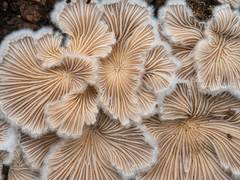 Caps of splitgill mushrooms (Schizophyllum commune) on a fallen tree branch in Lick Creek Park. College Station, Texas, December 13, 2025  Young splitgill mushrooms (Schizophyllum commune) on a fallen tree branch in Lick Creek Park. College Station, Texas, December 13, 2025  Saplings from a recently cut tree of Paloverde (Parkinsonia aculeata, ratama, horsebean)in Lick Creek Park. College Station, Texas, December 13, 2025 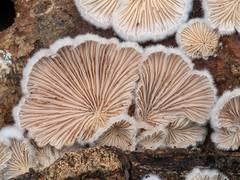 Close-up of splitgill mushrooms (Schizophyllum commune) on a fallen tree branch in Lick Creek Park. College Station, Texas, December 13, 2025  Trees in fog in Lick Creek Park. College Station, Texas, January 26, 2025  Abandoned sofa in a marshy clearing along the Lick Creek Greenway Trail, College Station, Texas, January 24, 2025 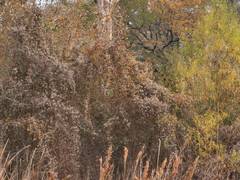 Dry climbing hempvine (Mikania scandens) and black willow tree near Deer Run Trail in Lick Creek Park. College Station, Texas, December 16, 2025  One of the Small Chinese Bridges (Small Iron Bridges) crossing the Krestovy Canal. Originally wooden (1781), they were replaced with cast iron versions forged at the Sestroretsk Arms Factory in 1786. Designed by Charles Cameron, who also planned the nearby Chinese Village. The bridge features intricate iron lattice railings and is framed by distinctive porticoes formed of paired columns with "Chinese-style" curved sheet-iron roofs. The columns are painted to mimic colored marble, and the structure was fully restored in the 21st century. Aleksandrovsky (Alexander) Park in Pushkin (former Tsarskoe Selo) near Saint Petersburg, Russia, October 10, 2025  The dense concentration of recent casualties, with fresh earthen mounds tightly packed together and adorned with the ubiquitous Russian tricolor. In the foreground, the grave of Aleksandr Vladimirovich Dementyev (1962-2025) is marked by a wooden cross and a color portrait, identifying a 63-year-old soldier whose age highlights the heavy toll on older reservists and volunteers. The background reveals the integration of the cemetery into the urban fabric, with modern commercial buildings visible just beyond the sea of flags and wreaths, grounding the war[CloseCurlyQuote]s losses in the everyday reality of St. Petersburg. "Alley of Heroes" at Cemetery of the Victims of January 9, St. Petersburg, Russia, October 4, 2025  View of Pikk Street (Pikk ta"nav), one of the most architecturally diverse streets in Tallinn s Old Town. The spectacular grey Art Nouveau building on the right (with the corner turret) is a masterpiece designed by architect Jacques Rosenbaum in 1910. It is famous for its fantastical facade featuring two large dragons and Egyptian-inspired motifs. Today, the ground floor houses the Draakoni Gallery. On the left side of the street (the red and grey facade), one can see the St. Canute s Guild Hall (Kanuti Gildi Saal). Originally built in the 13th century and remodeled in the 19th century with Tudor-style windows and statues of St. Canute and Martin Luther on the facade. It now serves as a contemporary performing arts center. The yellow building on the immediate right foreground is Pikk 22, which houses the Estonian Handicraft House (Eesti Ka"sito"o" Maja). This shop is a go-to place for authentic Estonian folk art and crafts. Tallinn, Estonia, October 16, 2025  This street scene is located on Pikk Street, just north of the Pikk Jalg gate, looking back towards the city center. The baroque spire visible in the distance belongs to St. Nicholas Church (Niguliste kirik). Originally built in the 13th century and dedicated to the patron saint of merchants and seafarers, it is one of the city s most defining landmarks. The tower now features a glass elevator and viewing platform offering 360-degree views of the Old Town. The building at the corner (implied by the location) is part of the historic Kolmjalg ("Tripod") complex, a notable architectural feature at the junction of Pikk and Voorimehe streets, known for its medieval origins. Estonia, October 16, 2025 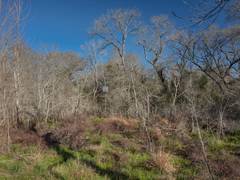 Bat house in Lick Creek Park. College Station, Texas, March 10, 2025 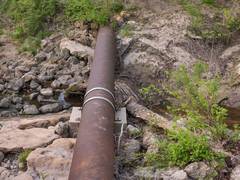 A large, heavily rusted metal pipe spanning horizontally across a ravine. The thick cylindrical pipe, completely oxidized from long-term exposure to the elements, serves as a stark piece of man-made infrastructure cutting directly through the natural landscape. Its dark, weathered surface stretches across the frame, contrasting sharply with the lighter earthy tones of the surrounding environment. In the near foreground, the engineering used to secure the pipeline is clearly visible. The heavy steel pipe rests securely on a square, poured-concrete abutment built directly into the creek bank. Two bright, unweathered metal retaining straps wrap over the top of the pipe, firmly bolted into the solid concrete base. These shiny galvanized brackets anchor the structure to the ground, designed to prevent the heavy cylinder from shifting under internal pressure or environmental stress. Lick Creek Park. College Station, Texas, March 25, 2026  Artificial waterfall on the Karasta River in Oranienbaum Park serving as a connection between the Upper and Lower Parks. It is a tiered spillway designed with granite steps that allow the water to cascade gracefully from the Lower Pond, flowing underneath a massive stone bridge (the Lower Bridge/Dam Bridge) Oranienbaum palace-and-park ensemble in Lomonosov (a suburb of St. Petersburg), Russia, October 13, 2025  Abandoned wooden building in west side of Stewart Park. Ithaca, New York, December 4, 2005  Old Passenger Terminal of Tallinn Airport. Built between 1945 and 1954 (opened in 1955), this building is a classic example of Stalinist architecture. Its symmetrical facade, rusticated ground floor, and the distinctive control tower with a viewing gallery reflect the monumental style favored in the Soviet Union during that period. An earlier Art Deco/Functionalist terminal was designed in 1938 by the architect Arthur Ju"rvetson, but construction was halted by World War II. The post-war redesign incorporated the Soviet aesthetic. This building served as the main passenger terminal until 1980, when a new, larger terminal (the current one) was built for the Moscow Olympics sailing regatta held in Tallinn. Today, this historic building has been repurposed for VIP services and administrative offices. It stands separately from the modern glass-and-steel terminal but remains an integral part of the airport s history, visible to passengers taxiing on the runway. View from a window of an airplane from Tallinn to Helsinki. Estonia, October 17, 2025  Bolshoy Lamskoy Bridge (Great Lamsky Bridge). It was built in 1820-1822 by the Scottish architect Adam Menelaws, who was instrumental in shaping the park s romantic "English" landscape style. The bridge spans the Lamsky Ponds near the Llama Pavilion, originally serving the utilitarian purpose of connecting the Lamsky stables (which housed exotic llamas from Peru) to the rest of the park. Originally a cast-iron structure, it has been carefully restored to preserve its intricate metal latticework railings, which feature a distinct geometric pattern characteristic of the Russian Empire style. Aleksandrovsky (Alexander) Park in Pushkin (former Tsarskoe Selo) near Saint Petersburg, Russia, October 10, 2025  Armored cupola of an experimental observation post, built in 1891. This was part of the "Engineer Polygon" tests to see how well concrete structures combined with armor could withstand enemy fire. Coastal Fort "Reef", Kronstadt, Russia, September 27, 2025 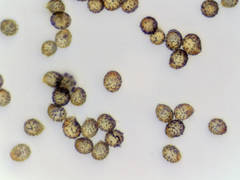 Spores of brittlegill mushrooms Russula ballouii collected 12/6/2025 in Lick Creek Park. College Station, Texas, December 23, 2025  A wooden house built at the end of 19th century (?) at 7/59 Morskaya Street near Sestroretskiy Kurort, 15 miles north-west from Sankt Petersburg. Russia, October 2, 2000  A politically charged scene on Pikk Street (specifically at Pikk 19) in front of the Russian Embassy in Tallinn. The metal barricades lining the street have become a permanent protest installation since Russia s full-scale invasion of Ukraine in February 2022. The barriers are covered in posters, slogans, and artwork condemning the war and Russian leadership. The large banner in the foreground reads "FOR THE VICTIMS OF WARS STARTED BY RUSSIA". Other signs visible on the fence typically document war crimes or satirize political figures. A police officer in a high-visibility yellow jacket is patrolling the area. A constant police presence has been standard here to maintain order given the high tensions surrounding the embassy. The Russian Embassy occupies a historic Art Nouveau building at Pikk 19. Ironically, this street is one of the most picturesque and tourist-heavy routes in the Old Town, creating a surreal juxtaposition between medieval charm and modern geopolitical conflict. Across the street (visible in the background) is the famous Maiasmokk Cafe, the oldest operating cafe in Tallinn, further highlighting the clash between leisure tourism and serious political activism in this specific location. Tallinn, Estonia, October 16, 2025  Grand Cascade (also known as the Ruined Cascade), located near the Round Pond in the Old Sylvia/White Birch district of Pavlovsk Park. Designed by Vincenzo Brenna in 1794, it was built to look like a romantic "antique ruin." Pavlovsk, a suburb of Saint Petersburg, Russia, October 6, 2025  Hunter s cabin in Lick Creek Park. College Station, Texas, May 7, 2018  Old bat abservation cabin in Lick Creek Park. College Station, Texas, January 7, 2026  Bat observation blinds in Lick Creek Park. College Station, Texas, August 17, 2022  Birwatching cabin in Lick Creek Park. College Station, Texas, April 12, 2021  Leaves of sycamore tree in Bee Creek Park. College Station, Texas, December 21, 2025  Devil s Bridge (Chertov Most), also known as the Cascade, located near the Upper Ponds in Catherine Park. Built in the 1770s, likely designed by the architect Vasily Neyelov or possibly Antonio Rinaldi, this structure is a classic example of the romantic "ruin" aesthetic popular in 18th-century landscape gardening. Pushkin (former Tsarskoe Selo) near Saint Petersburg, Russia, October 10, 2025  Marble Bridge (also known as the Palladian Bridge or Siberian Marble Gallery) in Catherine Park. Built in 1772-1774 by the architect Vasily Neelov, it is modeled after the famous Palladian Bridge at Wilton House in England (designed by Inigo Jones and Roger Morris). The bridge is constructed entirely from Ural marble (hence "Siberian"). It features a covered Ionic colonnade resting on a rusticated arch base. It spans a narrow channel connecting the Great Pond with the smaller neighboring ponds (Swan Islands). Pushkin (former Tsarskoe Selo) near Saint Petersburg, Russia, October 10, 2025  Hunter s cabin near a new cutting in Lick Creek Park. College Station, Texas, August 2, 2018  Trees in fog in Lick Creek Park. College Station, Texas, December 18, 2018  Museum of Islamic Art built on artificial island from Corniche at evening. Doha, Qatar, January 19, 2010  Abandoned house on FM 149 near Richards. Texas, March 8, 2025  Small Lamsky Bridge (Maly Lamskoy Bridge), built in the early 20th century (around 1900) to replace an earlier wooden crossing. Aleksandrovsky (Alexander) Park in Pushkin (former Tsarskoe Selo) near Saint Petersburg, Russia, October 10, 2025  Pinkgill mushrooms Entoloma hirtipes on black background in Lick Creek Park. College Station, Texas, December 24, 2018  Vibrant "Golden Autumn" (Zolotaya Osen) palette of Norway Maple (Acer platanoides) from a house on Svetlanovsky Peospekt. The dominant colors are: Golden-Orange (~32%): A rich, warm amber color (RGB: 138, 98, 28) covers the largest portion of the canopy, particularly on the sunlit tops of the trees. Deep Greenish-Bronze (~19%): Shadowed or transitioning areas (RGB: 94, 74, 13) add depth. Muted Yellow-Ochre (~15%): The mid-tone of the foliage (RGB: 186, 124, 46), creating the classic "golden" look. Green (~15-18%): Visible on the left side (likely a different tree species or a shaded branch), showing that the transition is not yet 100% complete for all vegetation. Saint Petersburg, Russia, October 8, 2025  Bat observation blinds near Deer Run Trail in Lick Creek Park. College Station, Texas, November 20, 2008 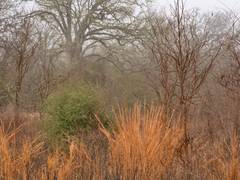 Tall dry grass and trees on Lick Creek Greenway Trail. College Station, Texas, February 25, 2025  The "initial stage" of mass burial, depicting a dense field of fresh earthen mounds marked only by temporary wooden crosses and overwhelmed by a sea of Russian tricolors, Soviet red banners, and VDV flags. The ground is raw and uneven, with a single permanent black granite curb visible in the foreground as the only sign of the eventual transition to formal memorialization. In the background, industrial infrastructure frames the scene, emphasizing the integration of this expanding military necropolis into the everyday civilian landscape of St. Petersburg "Alley of Heroes" at Cemetery of the Victims of January 9, St. Petersburg, Russia, October 4, 2025  Morning sun and trees in Lick Creek Park. College Station, Texas, December 6, 2020  Spillway Trail in Brazos Bend State Park, with a bridge across Pilant Lake spillway and observation tower in background. Needville, Texas, December 14, 2008  This view is taken from Vanaturu kael ("Old Market Neck"), a short historic street that connects the Old Market (Vana Turg) with the Town Hall Square (Raekoja Plats) in Tallinn s Old Town. The dominant structure in the center is the eastern gable of the Tallinn Town Hall (Tallinna raekoda), the oldest surviving Gothic town hall in Northern Europe and the Baltic region. The building s iconic 64-meter tower rises prominently, topped by the Old Thomas (Vana Toomas) weather vane (visible at the very tip), which has been a symbol of the city since 1530. The limestone facade features a distinct Gothic archway at street level and a small, high window on the gable. To the right, the cream-colored building with the "Hopner House" sign (partially visible) is historically significant, often associated with merchant history. Estonia, October 16, 2025  Old bird watching cabin and overgrown bat houses in Lick Creek Park. College Station, Texas, March 27, 2023  Trees and morning mist in Lick Creek Park. College Station, Texas, December 6, 2020  This picturesque courtyard is located at Ru"u"tli 28, tucked away near the medieval city wall and the fortifications of Toompea. The site features a charming, small white building with red doors and window frames, nestled directly against the limestone cliff and city wall fortifications. The lush ivy covering the stone walls turns a vibrant red in autumn, creating a "fairytale" aesthetic that contrasts with the defensive nature of the surrounding structures. The wooden walkway visible above the cliff is part of the Kiek in de Ko"k Fortifications Museum complex. This gallery connects the Maiden Tower (Neitsitorn), the Stable Tower (Marstall), and the Kiek in de Ko"k artillery tower, allowing visitors to walk along the old defensive perimeter. The courtyard below sits in the shadow of these massive fortifications, which once protected the city from invaders. Estonia, October 16, 2025  A float of krewe of Zulu at Mardi Gras parade on Jackson Avenue, with an abandoned shotgun house in background. New Orleans, Louisiana, February 28, 2006  Leaves of sycamore tree both in natural light and under 365 nm ultraviolet (UV-A) blacklight in Bee Creek Park. College Station, Texas, December 21, 2025  Italian Pergola located in the Private Garden (Sobstvenny Sadik) of Catherine Park. The pergola was built in 1865 (mid-19th century) during the reign of Alexander II. It was designed specifically to be covered in climbing plants, creating a shaded walkway or "veranda" that offered respite from the sun while allowing views of the obelisk and the surrounding landscape. Pushkin (former Tsarskoe Selo) near Saint Petersburg, Russia, October 10, 2025  Abandoned stone wall in Fisherville Brook Wildlife Refuge, near side loop of Red trail. Exeter, Rhode Island, May 21, 2004  Aerial view of Tallinn. The heart of the image is the medieval Old Town, identifiable by its dense cluster of red-tiled roofs, church spires (including the tall St. Olaf s Church), and the fortified Toompea Hill. Surrounding the Old Town are the modern high-rises of the financial district (left foreground), including the Swisso^tel and Tornima"e towers. To the right, the Port of Tallinn (Vanasadam) stretches out into the Baltic Sea, with ferries and cruise ships visible. The sweeping coastline of the Tallinn Bay dominates the background. The clear blue sky and the calm sea suggest a crisp, sunny morning. View from a window of an airplane from Tallinn to Helsinki. Estonia, October 17, 2025  View of Big Crater (Makhtesh Gadol) from Avnon observation point near Yeroham, with smoke from Zin - Arava Plant at background. The Middle East, December 23, 2000  View of Big Crater (Makhtesh Gadol) from Avnon observation point near Yeroham, with smoke from Zin - Arava Plant at background. The Middle East, December 23, 2000 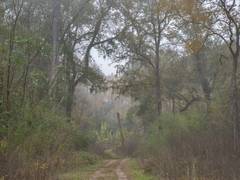 Sewage line right of way in Lick Creek Park. College Station, Texas, December 13, 2025 |