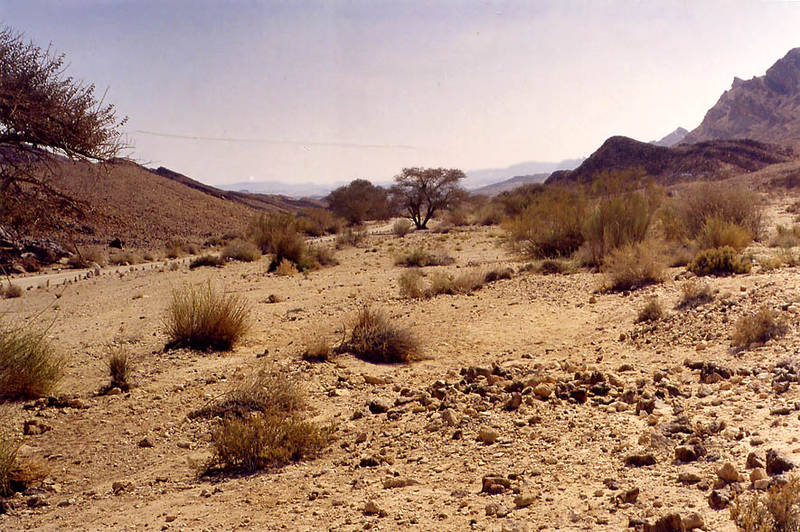

Nahal Gevanimat wadi in Sde Geves area of Ramon Crater. The Middle East


Album 270: North from Eilat - Ramon Crater, May 2 - 9, 2002
The image depicts a vast expanse of desert terrain, characterized by arid conditions and sparse vegetation. The landscape is dominated by sandy dunes and rocky outcrops, with scattered bushes and trees dotting the horizon.
In the foreground, a cluster of dry shrubs and small rocks are visible, while in the background, several larger rock formations rise up from the ground. The sky above is clear and blue, with no clouds or haze obscuring the view.
The overall atmosphere of the image suggests a hot and dry climate, with the sun beating down relentlessly on the parched earth. The lack of vegetation and the rocky terrain give the impression of a harsh environment, where survival would be challenging for any living creatures.
The presence of a wadi (a dry riverbed or valley) in the background adds to the sense of desolation and isolation, emphasizing the idea that this is a remote and unforgiving region. The image's muted color palette, dominated by shades of brown and beige, further reinforces the impression of aridity and barrenness.
Overall, the image presents a stark and uninviting landscape, one that evokes feelings of desolation and hardship. Despite its beauty, there is an underlying sense of danger and adversity lurking beneath the surface, making it clear that this is not a place to be taken lightly.
The caption provides context for the image, identifying the location as Nahal Gevanimat wadi in Sde Geves area of Ramon Crater, which helps to situate the scene within a specific geographic region. The date mentioned, May 9, 2002, adds another layer of context, suggesting that the image was taken during a period of relative calm and stability in the Middle East.
However, it is important to note that the image does not provide any direct information about the events or circumstances surrounding its creation. Without additional context or evidence, it is impossible to determine whether the image was taken for documentary purposes, as part of an environmental study, or simply for artistic expression.
Despite these limitations, the image remains a powerful and evocative representation of the natural world, one that invites viewers to reflect on their own relationship with the environment and the challenges faced by those living in such harsh conditions. – AI vision