
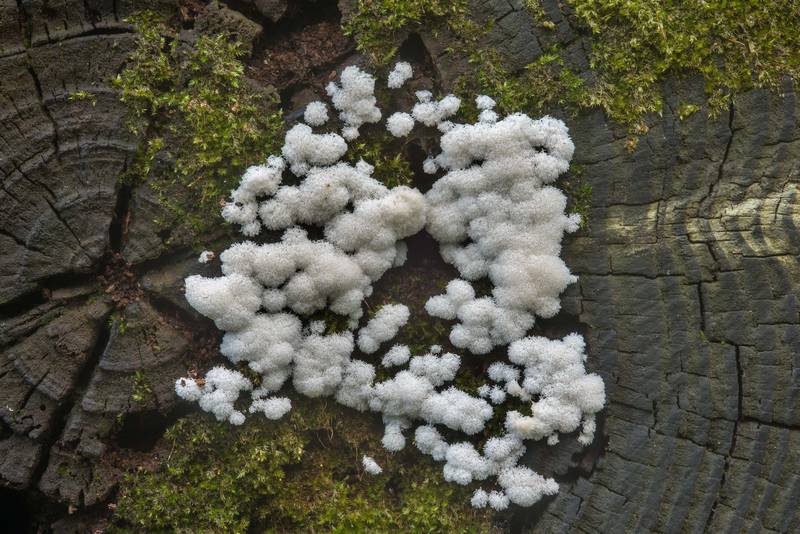

Coral slime mold (Ceratiomyxa fruticulosa) on a cut surface of an old wood log post coated with black tar in Lick Creek ParkLick Creek: Background Notes. College Station, Texas


Album 2267: Lick Creek Park in College Station, Texas, May 24, 2018
This photograph presents a close-up view of coral slime mold (Ceratiomyxa fruticulosa) growing on an old wood log post coated with black tar. The image is divided into three distinct sections: the dark gray cut surface of the log post occupies the left half, while the right half features the white coral slime mold colonies amidst small green shoots.
The cut surface of the log post appears weathered and cracked, with a rough texture that suggests it has been exposed to the elements for an extended period. The black tar coating is visible on the surface, which may be contributing to the growth of the coral slime mold. In contrast, the right half of the image showcases the white coral slime mold colonies growing in clusters around small green shoots. These shoots are likely moss or other types of vegetation that have begun to colonize the log post.
Overall, this photograph provides a detailed look at the unique relationship between the coral slime mold and its environment, highlighting how these organisms can thrive on decaying wood surfaces coated with tar. – AI vision
🇪🇸 Descripción en español / Spanish Description
El moho de la coralina (Ceratiomyxa fruticulosa) en una superficie cortada de un poste de madera viejo recubierto con alquitrán negro en el Lick Creek Park. College Station, Texas, 24 de mayo de 2018. Esta fotografía presenta una vista detallada del moho de la coralina (Ceratiomyxa fruticulosa) creciendo en un poste de madera viejo recubierto con alquitrán negro. La imagen está dividida en tres secciones distintas: la superficie cortada gris oscuro del poste ocupa la mitad izquierda, mientras que la mitad derecha muestra las colonias de coralina blanca entre brotes verdes pequeños. La superficie cortada del poste parece desgastado y agrietado, con una textura rugosa que sugiere que ha estado expuesto a los elementos durante un período prolongado. El recubrimiento de alquitrán negro es visible en la superficie, lo que puede estar contribuyendo al crecimiento del moho de la coralina. En contraste, la mitad derecha de la imagen muestra las colonias blancas del moho de la coralina que crecen en grupos alrededor de brotes verdes pequeños. Estos brotes son probablemente musgo u otros tipos de vegetación que han comenzado a colonizar el poste de madera. En general, esta fotografía proporciona una vista detallada de la relación única entre el moho de la coralina y su entorno, destacando cómo estos organismos pueden prosperar en superficies de madera en descomposición recubiertas con alquitrán. – Spanish translation


