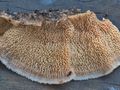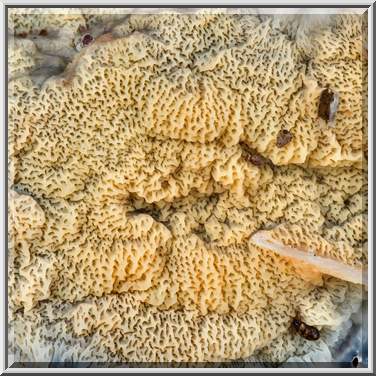
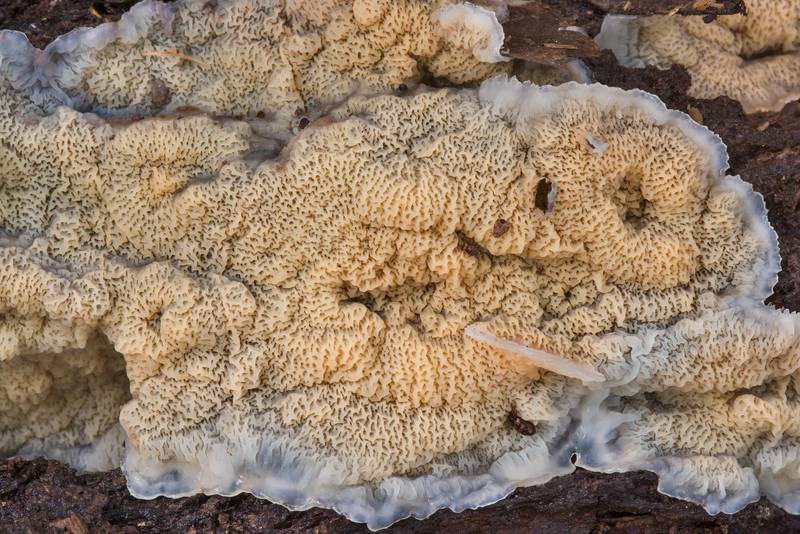
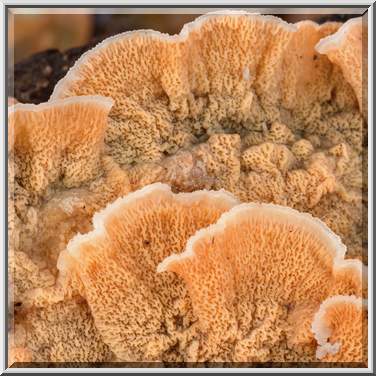
Pattern of jelly rot fungus (Phlebia tremellosa, Merulius tremellosus) on a rotten oak log in Lick Creek ParkLick Creek: Background Notes. College Station, Texas


Album 2404: College Station, Texas, November 22, 2018
The image presents a close-up view of a decaying oak log infested with jelly rot fungus (Phlebia tremellosa, Merulius tremellosus). The fungus exhibits a distinctive pattern characterized by its translucent, jelly-like appearance and intricate branching structure.
**Key Features:**
* **Fungus Appearance:** The fungus has a delicate, web-like texture that resembles coral or brain tissue. Its pale coloration allows for the underlying wood grain to be visible through it.
* **Branching Structure:** The fungus displays an intricate branching pattern, with numerous thin tendrils radiating outward from the main body of the fungus.
* **Growth Pattern:** The fungus appears to have grown in a relatively even layer across the surface of the log, with no apparent signs of clumping or bunching.
* **Wood Grain Visibility:** Despite being covered by the fungus, the underlying wood grain is still visible through the translucent tissue.
**Context:**
The image was taken on November 22, 2018, in Lick Creek Park, College Station, Texas. The presence of jelly rot fungus on a rotten oak log suggests that the log has been decomposing for some time and provides an ideal environment for this type of fungus to grow. – AI vision
🇪🇸 Descripción en español / Spanish Description
Patrón de hongo pudrición de jalea (Phlebia tremellosa, Merulius tremellosus) en un tronco podrido de roble en Lick Creek Park. College Station, Texas, noviembre 22, 2018. La imagen presenta una vista de primer plano de un tronco podrido de roble infestado con el hongo pudrición de jalea (Phlebia tremellosa, Merulius tremellosus). El hongo muestra un patrón distintivo caracterizado por su apariencia translúcida y similar a la gelatina y su estructura ramificada compleja. **Características clave:** * **Aspeto del hongo:** El hongo tiene una textura delicada, parecida a una red, que recuerda al coral o tejido cerebral. Su color pálido permite ver el grano de la madera a través de él. * **Estructura ramificada:** El hongo presenta un patrón ramificado complejo, con numerosas y delgadas yemas que se irradian hacia afuera desde el cuerpo principal del hongo. * **Patrón de crecimiento:** El hongo parece haber crecido en una capa relativamente uniforme a través de la superficie del tronco, sin signos aparentes de agrupamiento o concentración. * **Visibilidad del grano de la madera:** A pesar de estar cubierta por el hongo, la estructura del grano de la madera sigue siendo visible a través del tejido translúcido. **Contexto:** La imagen fue tomada el 22 de noviembre de 2018 en Lick Creek Park, College Station, Texas. La presencia del hongo pudrición de jalea sobre un tronco podrido de roble sugiere que el tronco ha estado descomponiéndose durante cierto tiempo y proporciona un entorno ideal para el crecimiento de este tipo de hongos. – Spanish translation