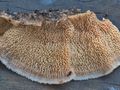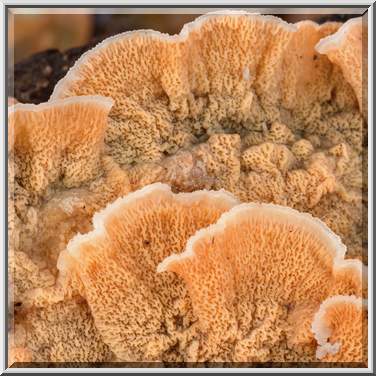
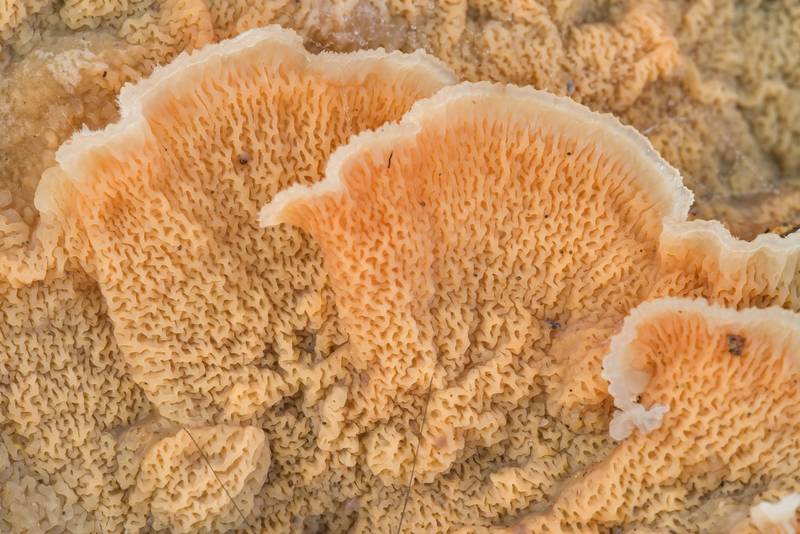
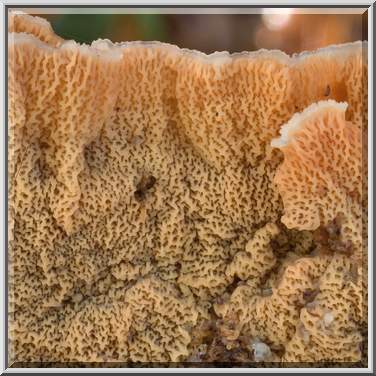
Close up of jelly rot fungus (Phlebia tremellosa, Merulius tremellosus) on a rotten oak log in Lick Creek ParkLick Creek: Background Notes. College Station, Texas


Album 2404: College Station, Texas, November 22, 2018
The image presents a close-up view of jelly rot fungus (Phlebia tremellosa, Merulius tremellosus) growing on a rotten oak log in Lick Creek Park, College Station, Texas.
Upon examination, the jelly rot fungus exhibits a distinctive appearance characterized by its soft, gelatinous texture and pale yellowish-orange color. The fungus has formed a dense mass of interwoven fibers that resemble delicate, intricate filaments. These fibers are densely packed and have a wavy pattern, giving the fungus a unique, three-dimensional structure.
The rotten oak log serves as the substrate for the jelly rot fungus, providing it with the necessary nutrients to grow and thrive. The log's surface is covered in a layer of soft, spongy material that has broken down over time due to decay and weathering. This process has created a habitat for various microorganisms such as bacteria, fungi, and insects.
In terms of size, the jelly rot fungus appears relatively small compared to other types of fungi found in this environment. It is likely several centimeters in diameter, but its exact dimensions cannot be determined from the image alone.
The location where the photo was taken, Lick Creek Park in College Station, Texas, suggests that the image was captured during the fall season (November). This time period allows for optimal viewing conditions due to favorable lighting and temperature ranges conducive to observing fungi growth.
Overall, this image offers a fascinating glimpse into the world of mycology by showcasing the intricate details of jelly rot fungus growing on a rotten oak log in Lick Creek Park. The combination of soft colors, delicate fibers, and unique texture provides an engaging visual experience while highlighting the importance of preserving natural habitats for these organisms to thrive. – AI vision
🇪🇸 Descripción en español / Spanish Description
Primer plano del hongo podredumbre de jalea (Phlebia tremellosa, Merulius tremellosus) en un tronco de roble podrido en Lick Creek Park. College Station, Texas, 22 de noviembre de 2018. La imagen presenta una vista de primer plano del hongo podredumbre de jalea (Phlebia tremellosa, Merulius tremellosus) creciendo sobre un tronco de roble podrido en Lick Creek Park, College Station, Texas. Tras el examen, el hongo podredumbre de jalea presenta una apariencia distintiva caracterizada por su textura gelatinosa suave y su color pálido amarillento-naranja. El hongo ha formado una masa densa de fibras entretejidas que recuerdan filamentos delicados e intrincados. Estas fibras están empaquetadas densamente y tienen un patrón ondulado, lo que le otorga al hongo una estructura tridimensional única. El tronco podrido sirve de sustrato para el hongo podredumbre de jalea, proporcionándole los nutrientes necesarios para crecer y desarrollarse. La superficie del tronco está cubierta por una capa de material esponjoso blando que se ha descompuesto con el tiempo debido a la putrefacción y al clima, lo que ha creado un hábitat para diversos microorganismos como bacterias, hongos e insectos. En términos de tamaño, el hongo podredumbre de jalea parece relativamente pequeño en comparación con otros tipos de hongos encontrados en este entorno. Es probable que mida varios centímetros de diámetro, pero sus dimensiones exactas no pueden determinarse a partir de la imagen sola. La ubicación donde se tomó la foto, Lick Creek Park en College Station, Texas, sugiere que la imagen fue capturada durante la temporada de otoño (noviembre). Este período de tiempo permite unas condiciones óptimas para la observación debido a la iluminación favorable y a los intervalos de temperatura propicios para observar el crecimiento de hongos. En general, esta imagen ofrece una visión fascinante del mundo micológico al mostrar los detalles intrincados del hongo podredumbre de jalea que crece en un tronco de roble podrido en Lick Creek Park. La combinación de colores suaves, fibras delicadas y textura única proporciona una experiencia visual atrayente al tiempo que destaca la importancia de preservar los hábitats naturales para que estos organismos puedan prosperar. – Spanish translation