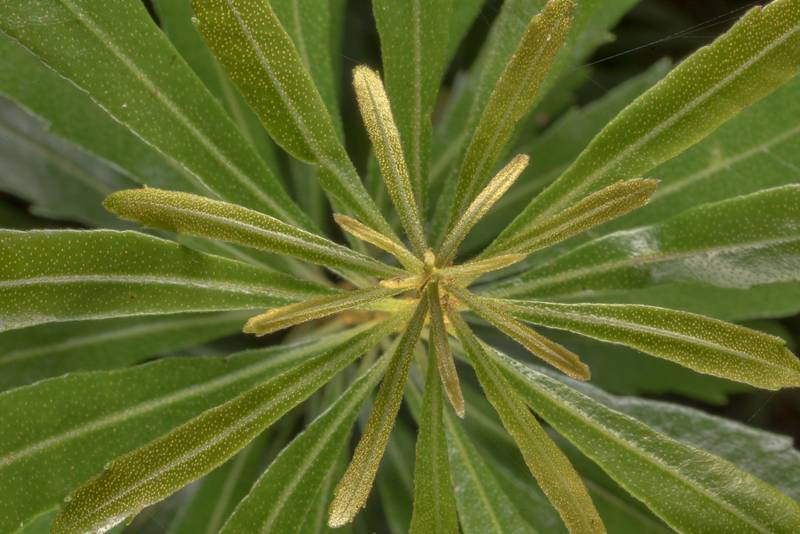
Shoot of southern wax myrtle (Bayberry, Myrica cerifera) on Little Lake Creek Loop Trail in Sam Houston National Forest. Richards, Texas


Album 2543: Sam Houston Forest, Texas, June 29, 2019
The image presents a close-up view of a shoot from a southern wax myrtle tree (Myrica cerifera), specifically focusing on its leaves and branches. The photograph is taken from directly above the plant, providing an unobstructed view of the foliage.
**Key Features:**
* **Leaves:** The leaves are long and narrow, with pointed tips and serrated edges. They have a dark green color with lighter veins running along their length.
* **Branches:** The branches are slender and flexible, with small buds visible along their lengths. They appear to be growing in an upward direction from the base of the plant.
* **Texture:** The leaves and branches exhibit a fine texture, suggesting that they are covered in tiny hairs or scales.
**Background:**
The background of the image is out of focus, but it appears to be a natural setting, such as a forest floor or woodland area. This suggests that the photograph was taken outdoors, likely using natural light.
**Overall Impression:**
The image provides a detailed and intimate view of the southern wax myrtle tree's foliage, highlighting its unique characteristics and textures. The use of close-up photography allows the viewer to appreciate the intricate details of the plant's leaves and branches, making it an effective tool for botanical study or documentation. – AI vision
🇪🇸 Descripción en español / Spanish Description
Shoot de mirto ceraudo del sur (Bayberry, Myrica cerifera) en el Little Lake Creek Loop Trail en la Sam Houston National Forest. Richards, Texas, 29 de junio de 2019. La imagen presenta una vista detallada de un brote de un árbol de mirto ceraudo del sur (Myrica cerifera), centrándose específicamente en sus hojas y ramas. La fotografía se tomó desde justo encima de la planta, proporcionando una vista despejada del follaje. **Características clave:** * **Hojas:** las hojas son largas y estrechas, con puntas agudas y márgenes serrados. Tienen un color verde oscuro con venas más claras que se extienden a lo largo de su longitud. * **Ramas:** las ramas son delgadas y flexibles, con pequeñas yemas visibles a lo largo de sus longitudes. Parecen crecer en dirección ascendente desde la base de la planta. * **Textura:** las hojas y ramas exhiben una textura fina, lo que sugiere que están cubiertas con pequeños pelos u escamas. **Antecedentes:** los antecedentes de la imagen están desenfocados, pero parecen ser un entorno natural, como el suelo de un bosque o una zona boscosa. Esto sugiere que la fotografía se tomó al aire libre, probablemente utilizando luz natural. **Impresión general:** la imagen proporciona una vista detallada y cercana del follaje del mirto ceraudo del sur, resaltando sus características únicas y texturas. El uso de fotografía de cerca permite al espectador apreciar los detalles intrincados de las hojas y ramas de la planta, convirtiéndolo en una herramienta efectiva para el estudio o documentación botánica. – Spanish translation