
Southern wax myrtle (Myrica cerifera) with fruits in Lick Creek ParkLick Creek: Background Notes. College Station, Texas


Album 2561: College Station - Sam Houston Forest, Texas, August 25 - 31, 2019
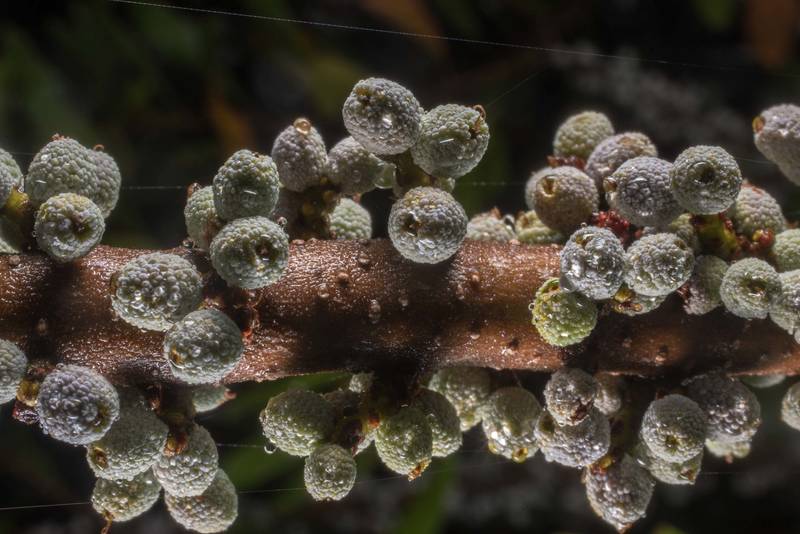
The image presents a detailed close-up view of the fruiting branches of Southern Wax Myrtle (Myrica cerifera), captured on August 25th, 2019, at Lick Creek Park in College Station, Texas. The primary focus is centered around the fruits themselves.
* **Fruits**: The small, spherical fruits are densely distributed along a single branch. They have a rough texture and appear to be covered with a thin layer of wax or resin. Each fruit is approximately 1/4 inch (6 mm) in diameter, indicating they are likely immature.
* **Color**: The fruits display a pale green color, which suggests that they may not yet be fully ripe or ready for dispersal.
* **Distribution**: The arrangement of the fruits along the branch implies a regular spacing pattern, possibly indicative of the plant's natural growth habits and fruit development cycle.
In summary, this image provides a detailed look at the fruiting structure of Southern Wax Myrtle, highlighting the small size, rough texture, and pale green color of its immature fruits. The consistent distribution of these fruits along the branch offers insight into the plant's reproductive strategy and developmental patterns. – AI vision
🇪🇸 Descripción en español / Spanish Description
El mirto cera del sur (Myrica cerifera) con frutos en el Lick Creek Park. College Station, Texas, agosto de 2019. La imagen presenta una vista detallada y de cerca de los brotes fructíferos del Mirto Cera del Sur (Myrica cerifera), capturados el 25 de agosto de 2019 en el Lick Creek Park en College Station, Texas. El principal punto de interés está centrado en torno a los propios frutos. **Frutas**: Los pequeños frutos esféricos se distribuyen densamente a lo largo de una única rama. Tienen una textura áspera y parecen estar cubiertos con una fina capa de cera o resina. Cada fruto mide aproximadamente 1/4 de pulgada (6 mm) de diámetro, lo que indica que son probablemente inmaduros. **Color**: Los frutos presentan un color verde pálido, lo que sugiere que aún no están completamente maduros ni listos para la dispersión. **Distribución**: La disposición de los frutos a lo largo de la rama implica un patrón regular de separación, posiblemente indicativo de los hábitos naturales de crecimiento y el ciclo de desarrollo de la planta. En resumen, esta imagen proporciona una visión detallada de la estructura fructífera del Mirto Cera del Sur, destacando el pequeño tamaño, la textura áspera y el color verde pálido de sus frutos inmaduros. La distribución consistente de estos frutos a lo largo de la rama ofrece información sobre la estrategia reproductiva y los patrones de desarrollo de la planta. – Spanish translation