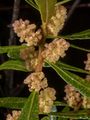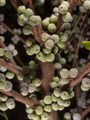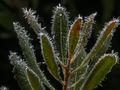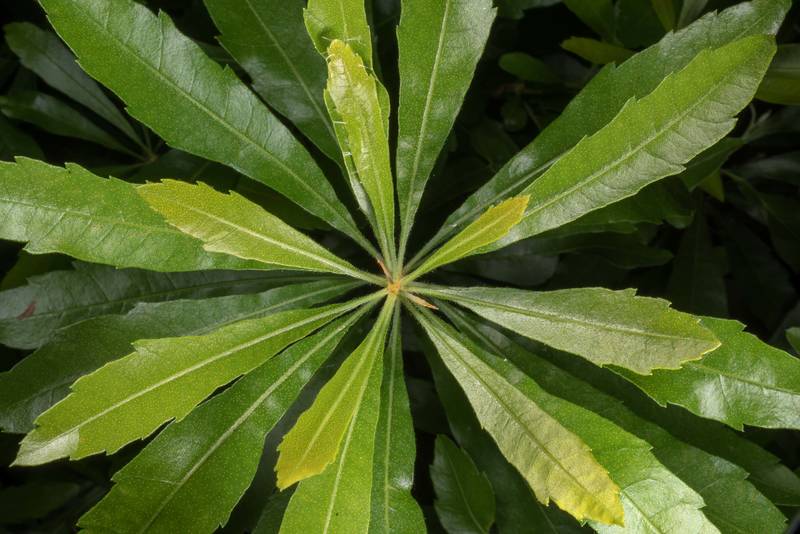

Southern wax myrtle (Myrica cerifera) on Richards Loop Trail in Sam Houston National Forest. Texas


Album 2704: Sam Houston Forest, Texas, May 10, 2020
The image presents a close-up view of a southern wax myrtle plant, showcasing its distinctive leaves and structure.
**Leaf Description**
* The leaves are long and narrow, resembling those found on an evergreen shrub.
* They have serrated edges and pointed tips, adding to their unique appearance.
* The green coloration suggests that the image was taken during spring or summer when the plant is actively growing.
**Stem and Branches**
* A central stem, likely the main trunk of the plant, runs vertically through the center of the image.
* Several branches radiate out from this stem, forming a symmetrical pattern.
* The branches are relatively thin and have a smooth texture.
**Background and Context**
* The background is dark, suggesting that the image was taken in a shaded area or under dense foliage.
* This could indicate that the plant is growing in a forested environment, such as Sam Houston National Forest.
**Overall Impression**
* The southern wax myrtle appears to be a healthy and thriving plant, with its leaves and branches well-developed and intact.
* The image provides a detailed view of the plant's structure and morphology, allowing for observation and appreciation of its unique characteristics. – AI vision
🇪🇸 Descripción en español / Spanish Description
El mirto cera del sur (Myrica cerifera) en el Richards Loop Trail en la Sam Houston National Forest. Texas, 10 de mayo de 2020. La imagen presenta una vista detallada de una planta de mirto cera del sur, mostrando sus hojas y estructura características. **Descripción de las hojas** * Las hojas son largas y estrechas, similares a las que se encuentran en un arbusto siempreverde. * Tienen bordes serrados y puntas agudas, lo que contribuye a su aspecto único. * El color verde sugiere que la imagen fue tomada durante la primavera o el verano cuando la planta está creciendo activamente. **Tallo y ramas** * Un tallo central, probablemente el tronco principal de la planta, discurre verticalmente por el centro de la imagen. * Varias ramas salen de este tallo, formando un patrón simétrico. * Las ramas son relativamente delgadas y tienen una textura lisa. **Fondo y contexto** * El fondo es oscuro, lo que sugiere que la imagen fue tomada en un área sombreada o bajo follaje denso. * Esto podría indicar que la planta está creciendo en un entorno boscoso, como el Sam Houston National Forest. **Impresión general** * El mirto cera del sur parece ser una planta sana y próspera, con hojas y ramas bien desarrolladas e intactas. * La imagen proporciona una vista detallada de la estructura y morfología de la planta, permitiendo la observación y apreciación de sus características únicas. – Spanish translation