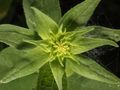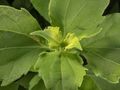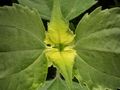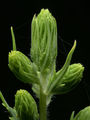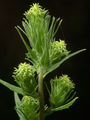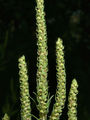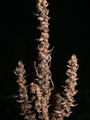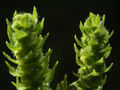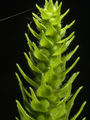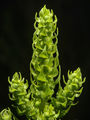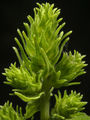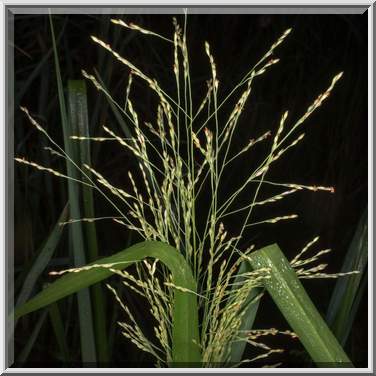
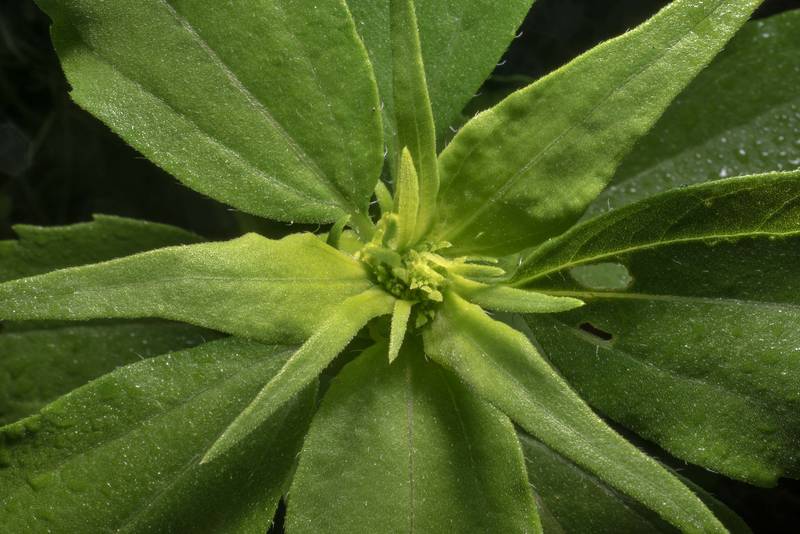
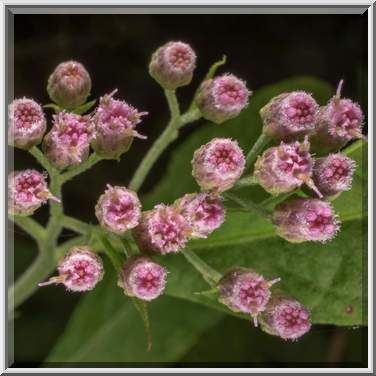
Sumpweed (Iva annua) on Raccoon Run Trail in Lick Creek ParkLick Creek: Background Notes. College Station, Texas

Album 2758: College Station, Texas, August 23, 2020
The image presents a close-up view of a plant with large leaves, likely captured during the summer or early fall season based on the lush greenery and dewy appearance of the leaves. The plant's leaves are broad, flat, and pointed at the tip, featuring serrated edges that give them a rough texture.
**Key Features:**
* **Leaf Structure:** The leaves are large, with prominent veins running along their length, suggesting they are adapted for photosynthesis.
* **Vein Pattern:** The prominent veins may indicate that the plant is an annual or perennial species.
* **Texture and Color:** The leaves have a rough texture due to the serrated edges, which could be useful in identifying the plant's family or genus. The green color suggests good health and optimal growing conditions.
**Plant Identification:**
Given these features, it is possible that the plant is Sumpweed (Iva annua), as mentioned in the caption. However, without more information or a closer examination of the plant's stem, flowers, or other characteristics, it is difficult to confirm this identification with certainty.
**Conclusion:**
In summary, the image shows a healthy-looking plant with large, flat leaves that are likely adapted for photosynthesis and may be part of the Asteraceae family. Further investigation would be necessary to determine the exact species based on additional characteristics such as flower structure, leaf arrangement, and habitat. – AI vision
🇪🇸 Descripción en español / Spanish Description
Muérdago de agua (Iva annua) en el Raccoon Run Trail del Lick Creek Park. College Station, Texas, 23 de agosto de 2020. La imagen presenta una vista detallada de una planta con grandes hojas, capturadas probablemente durante la temporada de verano o principios del otoño, basándose en el exuberante follaje verde y el aspecto rocío de las hojas. Las hojas de la planta son anchas, planas y puntiagudas en la punta, con bordes serrados que les dan una textura áspera. **Características clave:** * **Estructura de las hojas:** Las hojas son grandes, con venas prominentes a lo largo de su longitud, lo que sugiere que están adaptadas para la fotosíntesis. * **Patrón de Venas:** Las venas prominentes pueden indicar que la planta es una especie anual o perenne. * **Textura y Color:** Las hojas tienen una textura áspera debido a los bordes serrados, lo que podría ser útil para identificar la familia o género de la planta. El color verde sugiere buena salud y condiciones óptimas de crecimiento. **Identificación de Plantas:** Dadas estas características, es posible que la planta sea Muérdago de agua (Iva annua), como se menciona en la legenda. Sin embargo, sin más información o un examen más cercano del tallo, las flores u otras características, es difícil confirmar esta identificación con certeza. **Conclusión:** En resumen, la imagen muestra una planta de aspecto saludable con grandes hojas planas que probablemente estén adaptadas para la fotosíntesis y puedan formar parte de la familia Asteraceae. Sería necesaria una investigación adicional para determinar la especie exacta en función de características adicionales como la estructura de las flores, disposición de las hojas y hábitat. – Spanish translation