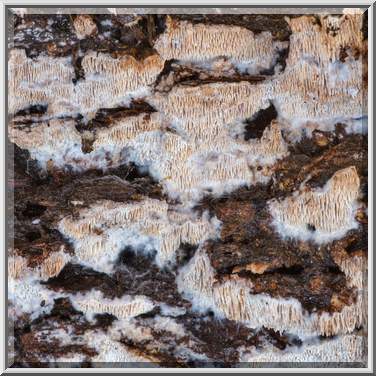
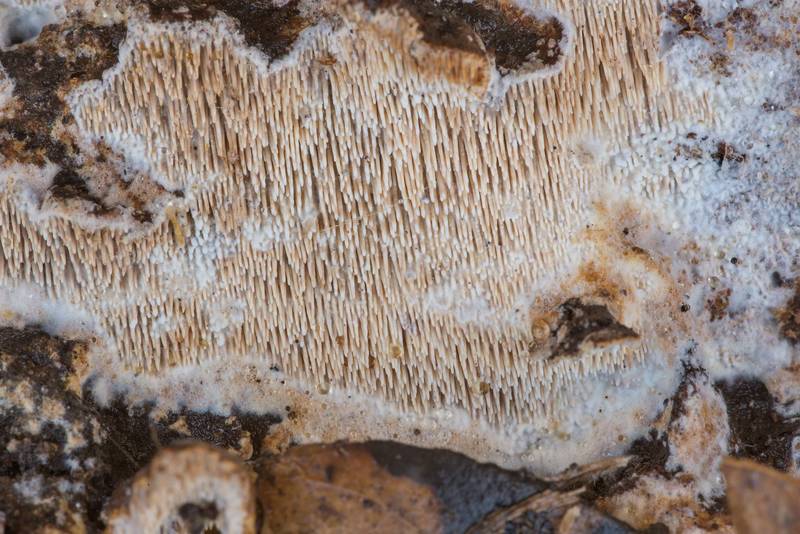
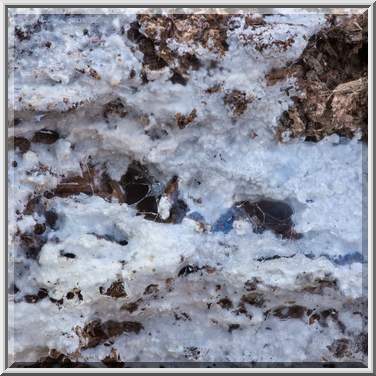
Details of resupinate hydnoid (tooth) fungus on a fallen oak in Lick Creek ParkLick Creek: Background Notes. College Station, Texas


Album 2875: College Station, Texas, March 1 - 2, 2021
The image shows a close-up view of a fungus growing on a fallen oak tree trunk. The fungus is resupinate (meaning it grows downward) and has tooth-like structures that are densely packed and uniform in shape.
Here's what we can observe about the image:
* **Fungus structure:** The fungus has a flat, irregularly shaped growth with many small, pointed teeth or spines protruding from its surface. These teeth are densely packed and cover almost the entire surface of the fungus.
* **Coloration:** The background color is light brown, which could be due to weathering effects on the tree trunk over time.
Some additional details that can be observed about this image include:
* **Texture:** The texture of the fungus appears rough and uneven, with some areas being more densely packed than others.
* **Size:** It's difficult to estimate the size of the fungus without a reference point. However, based on the scale bar in the lower-right corner, it appears to be around 1-2 cm (0.4-0.8 inches) tall.
Overall, this image provides a detailed view of a resupinate hydnoid fungus growing on a fallen oak tree trunk. The densely packed teeth or spines give the fungus a unique appearance that distinguishes it from other types of fungi. – AI vision
🇪🇸 Descripción en español / Spanish Description
Detalles del hongo hidnoide resupinado (diente) en un roble caído en Lick Creek Park. College Station, Texas, 2 de marzo de 2021. La imagen muestra una vista cercana de un hongo creciendo en el tronco de un árbol de roble caído. El hongo es resupinado (lo que significa que crece hacia abajo) y tiene estructuras dentadas similares a dientes, densamente empaquetadas y uniformes en forma. Aquí hay algunos detalles sobre la imagen:
* **Estructura del hongo:** El hongo tiene un crecimiento irregularmente plano con muchas puntas pequeñas o espinas que sobresalen de su superficie. Estas puntas están densamente empaquetadas y cubren casi toda la superficie del hongo. * **Coloración:** El color de fondo es marrón claro, lo que podría deberse a los efectos del desgaste en el tronco del árbol con el tiempo. Algunos detalles adicionales que se pueden observar sobre esta imagen incluyen:
* **Textura:** La textura del hongo parece áspera y desigual, con algunas áreas más densamente empaquetadas que otras. * **Tamaño:** Es difícil estimar el tamaño del hongo sin un punto de referencia. Sin embargo, según la regla de medida en la esquina inferior derecha, parece estar alrededor de 1-2 cm (0,4-0,8 pulgadas) de alto. En general, esta imagen proporciona una vista detallada del hongo hidnoide resupinado que crece en el tronco de un roble caído. Las puntas densamente empaquetadas le dan al hongo un aspecto único que lo distingue de otros tipos de hongos. – Spanish translation


