
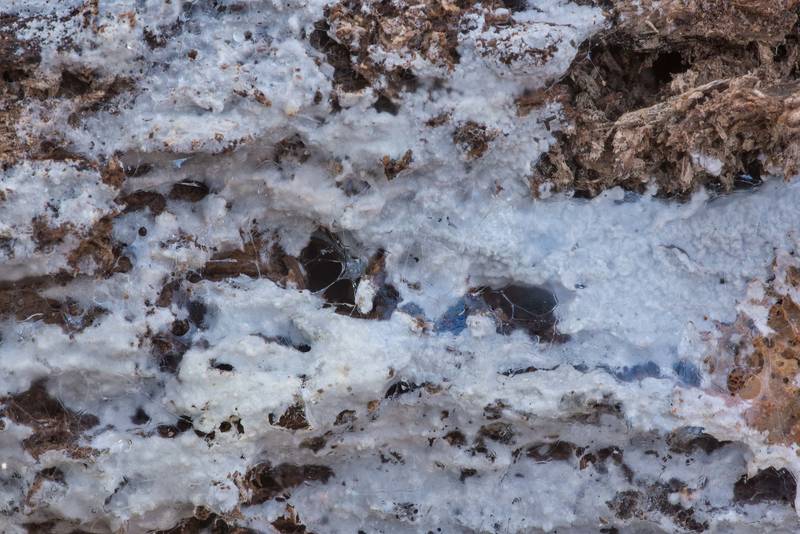

Some thin white corticioid mushroom on rotting oak wood in Lick Creek ParkLick Creek: Background Notes. College Station, Texas


Album 2875: College Station, Texas, March 1 - 2, 2021
The image presents a detailed view of a fungal growth on decaying oak wood, captured in Lick Creek Park, College Station, Texas, on March 2, 2021. The photograph focuses on a small section of a larger rotting tree trunk or branch.
**Key Features:**
* **Fungal Growth:** The primary subject is an unidentifiable thin white corticioid mushroom, characterized by its flat to irregularly lobed hymenium (the spore-bearing layer). Corticioid fungi are known for their characteristic growth patterns and often form a crusty or shelf-like appearance on decaying wood.
* **Wood Decay:** The background consists of rotting oak wood, likely the result of various factors such as insect infestation, water damage, or disease. Oak trees (Quercus spp.) are common in many parts of North America and can be susceptible to decay if not properly maintained.
* **Environmental Context:** Lick Creek Park is a natural area located in College Station, Texas. The park features several hiking trails that allow visitors to explore the local flora and fauna.
**Conclusion:**
The image provides a close-up look at an unidentifiable corticioid mushroom growing on decaying oak wood in Lick Creek Park. While the exact species of the fungus remains unknown, its flat lobed hymenium is characteristic of many corticioid fungi that form crusty growths on decaying wood surfaces. – AI vision
🇪🇸 Descripción en español / Spanish Description
Algunos finos hongos corticiodes blancos en madera de roble podrida en Lick Creek Park. College Station, Texas, 2 de marzo de 2021. La imagen presenta una vista detallada del crecimiento de hongos en madera de roble podrida, capturado en Lick Creek Park, College Station, Texas, el 2 de marzo de 2021. La fotografía se centra en una pequeña sección de un tronco o rama de un árbol en descomposición más grande. **Características clave:** * **Crecimiento fúngico:** El sujeto principal es un hongo corticiodes blanco delgado no identificable, caracterizado por su hipomenio irregularmente lobulado (la capa que contiene las esporas). Los hongos corticoides se conocen por sus patrones de crecimiento característicos y a menudo forman un aspecto similar a una repisa o costroso en la madera podrida. * **Podredumbre de la Madera:** El fondo consiste en madera de roble podrida, probablemente el resultado de varios factores como infestación por insectos, daños causados por el agua o enfermedades. Los robles (Quercus spp.) son comunes en muchas partes de Norteamérica y pueden ser susceptibles a la podredumbre si no se mantienen adecuadamente. * **Contexto Ambiental:** Lick Creek Park es un área natural ubicada en College Station, Texas. El parque cuenta con varios senderos para caminar que permiten a los visitantes explorar la flora y fauna locales. **Conclusión:** La imagen proporciona una vista detallada de un hongo corticiodes no identificable en crecimiento en madera de roble podrido en Lick Creek Park. Aunque la especie exacta del hongo sigue siendo desconocida, su hipomenio lobulado plano es característico de muchos hongos corticoides que forman crecimientos costrosos en superficies de madera podrida. – Spanish translation


