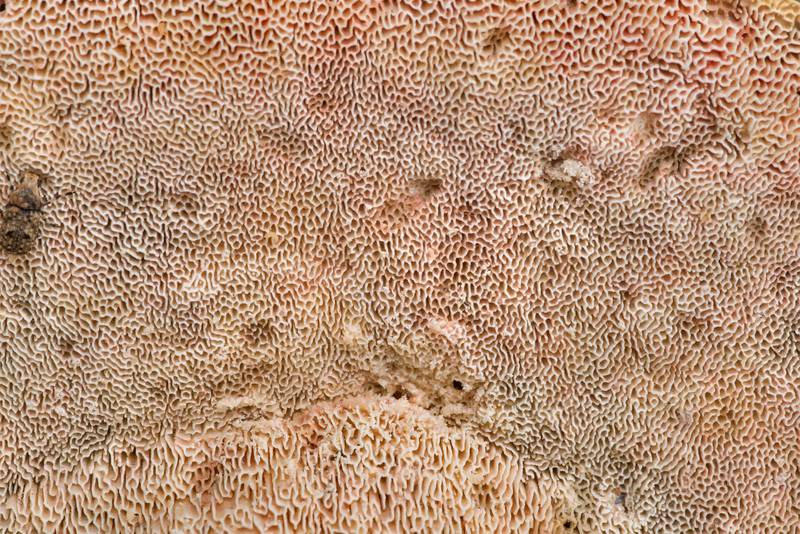

Pore surface of some bracket polypore mushroom in Lick Creek ParkLick Creek: Background Notes. College Station, Texas


Album 2961: College Station, Texas, June 9, 2021
The image depicts a detailed view of the pore surface of a bracket polypore mushroom. The pores are numerous and densely packed, arranged in concentric circles that radiate from the center of the mushroom to its periphery. They exhibit a range of colors, including white, light brown, dark brown, and red-brown, which may be due to various factors such as maturity or environmental influences.
The pores themselves appear small and irregularly shaped, with some resembling tiny holes while others seem more like shallow depressions in the surface. The overall texture is rough and uneven, suggesting that this is a mature mushroom whose pores have opened up over time.
In terms of size, it's difficult to estimate without additional context but based on visual cues alone, it appears quite large - possibly even several feet across if not larger. Given its substantial dimensions relative to other fungi found in similar habitats during peak season, it likely plays an important ecological role within these ecosystems by serving as both a food source for various animals and acting as part of the nutrient cycle by breaking down organic matter.
Overall, this image provides valuable insights into the structure and function of bracket polypore mushrooms, highlighting their unique characteristics that enable them to thrive in diverse environments. – AI vision
🇪🇸 Descripción en español / Spanish Description
La superficie de la poro de algunos hongos tipo polvo en el Lick Creek Park. College Station, Texas, 9 de junio de 2021. La imagen muestra una vista detallada de la superficie de los poros de un hongo tipo polvo. Los poros son numerosos y densamente empaquetados, dispuestos en círculos concéntricos que irradian desde el centro del hongo hacia su periferia. Presentan una variedad de colores, incluidos blanco, marrón claro, marrón oscuro y marrón rojizo, que pueden ser debidos a diversos factores como madurez o influencias ambientales. Los poros en sí mismos parecen pequeños y de forma irregular, con algunos que se asemejan a agujeros minúsculos mientras que otros parecen más depresiones superficiales poco profundas. La textura general es áspera e irregular, lo que sugiere que este hongo es maduro y sus poros se han abierto con el tiempo. En términos de tamaño, es difícil estimar sin contexto adicional, pero basándonos en señales visuales solamente, parece ser bastante grande - posiblemente incluso varios pies de diámetro si no más grande aún. Dado su sustancial dimensión relativa a otros hongos encontrados en hábitats similares durante la temporada alta, es probable que desempeñe un importante papel ecológico dentro de estos ecosistemas sirviendo tanto como fuente de alimentación para varios animales y actuando como parte del ciclo de nutrientes al romper materia orgánica. En general, esta imagen proporciona valiosos conocimientos sobre la estructura y función de los hongos tipo polvo, resaltando sus características únicas que permiten su crecimiento en diversos entornos. – Spanish translation