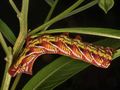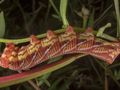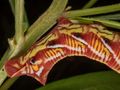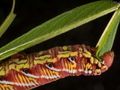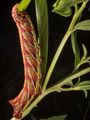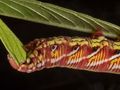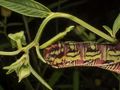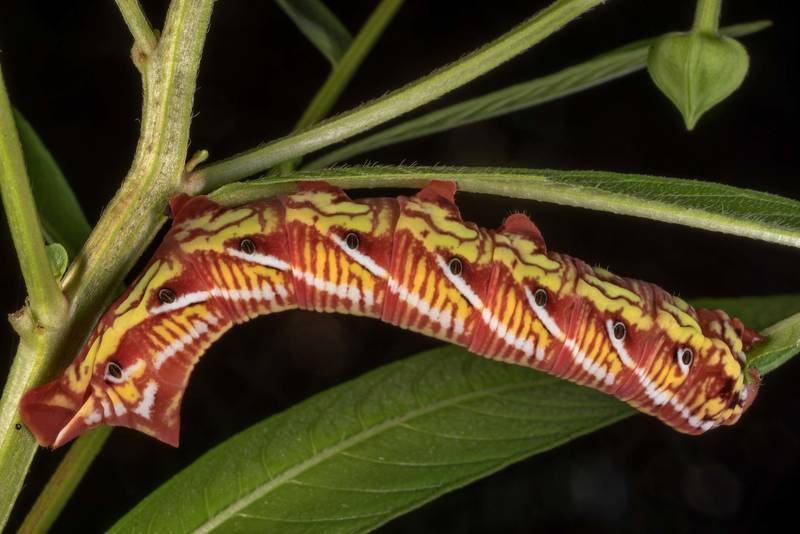

Hornworm of Banded Sphinx Moth (Eumorpha fasciatus) feeding on Ludwigia in Lick Creek ParkLick Creek: Background Notes. College Station, Texas


Album 3005: College Station, Texas, August 11 - 12, 2021
The image showcases a pair of caterpillars belonging to the species Eumorpha fasciatus, commonly known as the Banded Sphinx Moth. The caterpillars are prominently featured on two branches of Ludwigia plants, with one positioned at the top left and the other below it.
**Physical Characteristics**
* The caterpillars have a distinctive appearance, featuring red bodies adorned with yellow and white markings.
* Each caterpillar has six black eyespots on its back, which serve as a defense mechanism to deter predators.
* The caterpillars are approximately one inch in length, making them relatively small compared to other moth species.
**Habitat and Behavior**
* The image suggests that the caterpillars are feeding on Ludwigia plants, likely utilizing their leaves or stems for sustenance.
* The presence of both caterpillars on separate branches implies that they may be competing for food sources or engaging in social behavior.
**Context and Significance**
* The image was captured in Lick Creek Park, College Station, Texas, on August 12, 2021.
* This suggests that the caterpillars are native to this region and have adapted to the local environment.
* Overall, the image provides valuable insights into the life cycle and behavior of the Banded Sphinx Moth, highlighting their unique characteristics and interactions with their surroundings. – AI vision
🇪🇸 Descripción en español / Spanish Description
Oruga de la polilla listada (Eumorpha fasciatus) alimentándose en Ludwigia en Lick Creek Park. College Station, Texas, 12 de agosto de 2021. La imagen muestra un par de larvas pertenecientes a la especie Eumorpha fasciatus, comúnmente conocida como polilla listada. Las larvas se destacan en dos ramas de plantas Ludwigia, una ubicada en la esquina superior izquierda y la otra debajo de ella. **Características físicas** * Las larvas tienen un aspecto distintivo, con cuerpos rojos adornados con marcas amarillas y blancas. * Cada larva tiene seis ojitos negros en su espalda, que sirven como mecanismo de defensa para disuadir a los predadores. * Las larvas tienen aproximadamente una pulgada de largo, lo que las hace relativamente pequeñas en comparación con otras especies de polillas. **Hábitat y comportamiento** * La imagen sugiere que las larvas se alimentan en plantas Ludwigia, probablemente utilizando sus hojas o tallos para sustento. * La presencia de ambas larvas en ramitas separadas implica que pueden estar compitiendo por fuentes de alimento o participando en comportamiento social. **Contexto y Significado** * La imagen fue capturada en Lick Creek Park, College Station, Texas, el 12 de agosto de 2021. * Esto sugiere que las larvas son nativas de esta región y se han adaptado al entorno local. * En general, la imagen proporciona información valiosa sobre el ciclo vital y el comportamiento de la polilla listada, destacando sus características únicas e interacciones con su entorno. – Spanish translation