
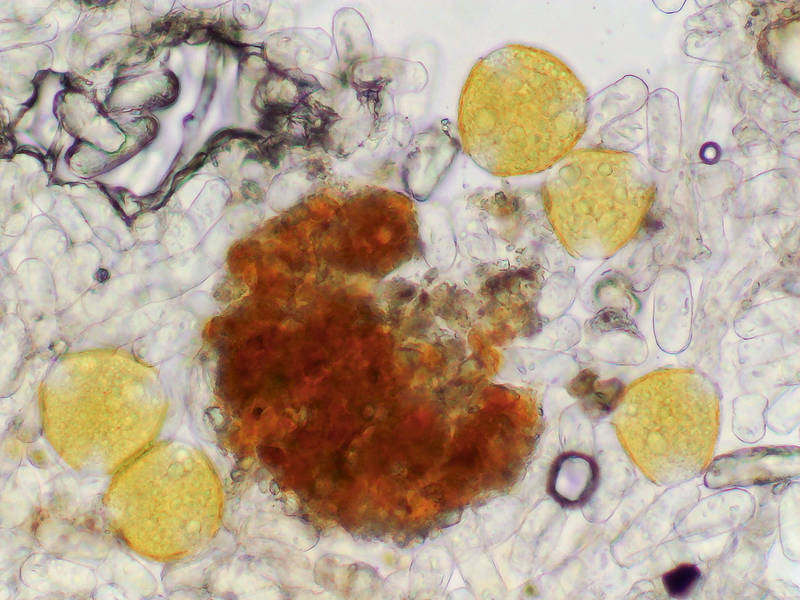

Spores of different types of white powdery mildew fungus Podosphaera euphorbiae collected in Lick Creek ParkLick Creek: Background Notes. College Station, Texas


Album 3129: College Station, Texas, April 10 - 11, 2022
The image shows a microscopic view of spores from the white powdery mildew fungus *Podosphaera euphorbiae*. The spores are irregularly shaped and appear to be clustered together. They have a rough texture and are varying shades of brown.
The background of the image is blurry, but it appears to show other fungal structures such as hyphae or conidia. There is no clear evidence of the host plant in the image.
The overall appearance of the spores suggests that they are likely to be infectious agents for plants. The rough texture and irregular shape may indicate that the fungus has adapted to infect specific hosts, possibly through a process called "co-evolution". This would allow the fungus to evade the immune system of its host by changing its structure or behavior over time.
It is important to note that without more information about the context in which this image was taken (e.g., location, date, etc.), it is difficult to determine exactly what kind of plant the spores are infecting or how they got there. However, based on their appearance alone, it seems likely that these spores could be harmful to plants if left unchecked.
*Answer*: The image shows a microscopic view of spores from the white powdery mildew fungus *Podosphaera euphorbiae*. – AI vision
🇪🇸 Descripción en español / Spanish Description
Las esporas de diferentes tipos de hongos de mildiu blanco en polvo recolectadas en el Lick Creek Park. College Station, Texas, 11 de abril de 2022. La imagen muestra una vista microscópica de esporas del hongo *Podosphaera euphorbiae* de mildiu blanco en polvo. Las esporas tienen forma irregular y parecen agrupadas juntas. Tienen una textura áspera y tonalidades variables de marrón. El fondo de la imagen está borroso, pero parece mostrar otras estructuras fúngicas como hifas o conidios. No hay evidencia clara de la planta hospedadora en la imagen. El aspecto general de las esporas sugiere que son agentes infecciosos probables para las plantas. La textura áspera y la forma irregular pueden indicar que el hongo se ha adaptado para infectar a huéspedes específicos, posiblemente a través de un proceso llamado "coevolución". Esto permitiría al hongo evadir el sistema inmunológico de su hospedador cambiando su estructura o comportamiento con el tiempo. Es importante señalar que sin más información sobre el contexto en el que se tomó esta imagen (por ejemplo, ubicación, fecha, etc.), es difícil determinar exactamente qué clase de planta está infectando las esporas o cómo llegaron allí. Sin embargo, basándose solamente en su aspecto, parece probable que estas esporas podrían ser perjudiciales para las plantas si no se controlan.
*Respuesta*: La imagen muestra una vista microscópica de esporas del hongo *Podosphaera euphorbiae* de mildiu blanco en polvo. – Spanish translation


