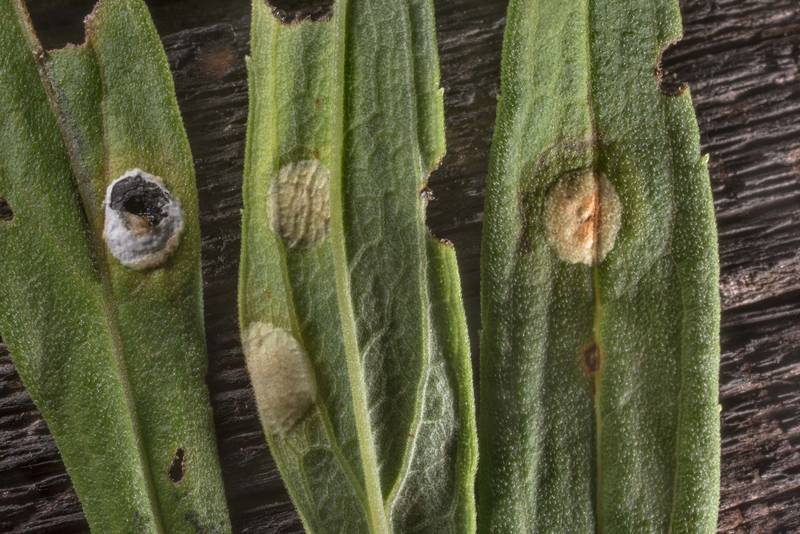

Leaves of goldenrod Solidago canadensis with raised white cushions caused by gall midges Asteromyia carbonifera and symbiotic fungus Botryosphaeria dothidea inside the galls on Richards Loop Trail in Sam Houston National Forest. Texas


Album 3189: Sam Houston Forest - College Station, Texas, July 10 - 12, 2022
The image shows three goldenrod leaves (Solidago canadensis) with raised white cushions caused by gall midges Asteromyia carbonifera and symbiotic fungus Botryosphaeria dothidea inside the galls on Richards Loop Trail in Sam Houston National Forest, Texas.
* **Leaves:**
* The leaves are long, narrow, and green.
* They have a rough texture due to the raised white cushions.
* The leaves appear to be healthy, with no visible signs of damage or disease.
* **Galls:**
* The galls are small, white, and oval-shaped.
* They are located on the surface of the leaves.
* Each gall contains a group of midges and fungus.
* **Midges:**
* The midges are tiny, wingless insects.
* They have a grayish-brown color.
* They are found inside the galls.
* **Fungus:**
* The fungus is white and fuzzy.
* It grows inside the galls with the midges.
* The fungus appears to be symbiotic, meaning it benefits both itself and the midges.
Overall, the image shows a unique interaction between the gall midges and the fungus, which has led to the formation of galls on the goldenrod leaves. This phenomenon is likely an example of mutualism, where both species benefit from each other's presence. – AI vision
🇪🇸 Descripción en español / Spanish Description
Las hojas de solidago Solidago canadensis con cojines blancos elevados causados por los gusanos Asteromyia carbonifera y el hongo simbiótico Botryosphaeria dothidea dentro de las galias en el Sendero del Bucle Richards en la Sam Houston National Forest. Texas, 10 de julio de 2022. La imagen muestra tres hojas de solidago (Solidago canadensis) con cojines blancos elevados causados por los gusanos Asteromyia carbonifera y el hongo simbiótico Botryosphaeria dothidea dentro de las galias en el Sendero del Bucle Richards en la Sam Houston National Forest, Texas. * **Hojas:** * Las hojas son largas, estrechas y verdes. * Tienen una textura áspera debido a los cojines blancos elevados. * Las hojas parecen estar sanas, sin signos visibles de daño o enfermedad. * **Galias:** * Las galias son pequeñas, de color blanco y de forma ovalada. * Se localizan en la superficie de las hojas. * Cada una contiene un grupo de mosquitos y hongos. * **Mosquitos:** * Los mosquitos son pequeños insectos alados. * Tienen un color grisáceo-parduzco. * Se encuentran dentro de las galias. * **Hongo:** * El hongo es blanco y peludo. * Crea en el interior de las galias con los mosquitos. * El hongo parece ser simbiótico, lo que significa que beneficia tanto a sí mismo como a los mosquitos. En general, la imagen muestra una interacción única entre los gusanos y el hongo, que ha llevado a la formación de galias en las hojas de solidago. Este fenómeno es probablemente un ejemplo de mutualismo, donde ambas especies se benefician de la presencia una de otra. – Spanish translation