
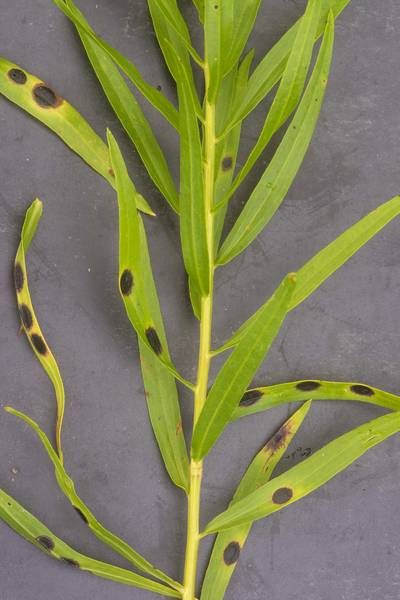

Flat-topped goldenrod (Euthamia leptocephala) with leaf tar spots caused by gall midge Asteromyia euthamiae with a symbiotic fungus Botryosphaeria dothidea in Lick Creek ParkLick Creek: Background Notes. College Station, Texas


Album 3165: College Station - Sam Houston Forest, Texas, June 1 - 2, 2022
The image shows a flat-topped goldenrod (Euthamia leptocephala) with leaf tar spots caused by gall midge Asteromyia euthamiae and its symbiotic fungus Botryosphaeria dothidea. The plant is positioned centrally in the frame, with its leaves extending outwards from the stem.
The leaves are bright green and have a waxy texture, characteristic of goldenrod plants. Several leaves exhibit dark brown or black spots on their surface, which appear to be circular or oval in shape. These spots are likely caused by the gall midge Asteromyia euthamiae, as mentioned in the caption.
In addition to the leaf tar spots, there is a small yellowish-brown structure at the base of one of the leaves. This could potentially be a gall formed by the gall midge or another type of insect.
The background of the image appears to be a gray surface, possibly a table or countertop. There are no other objects visible in the frame beyond the plant and its leaves.
Overall, this image captures an interesting phenomenon where a symbiotic relationship between two organisms (gall midge Asteromyia euthamiae and fungus Botryosphaeria dothidea) affects the appearance of a flat-topped goldenrod plant. The image provides valuable information for entomologists, botanists, or anyone interested in studying these relationships further. – AI vision
🇪🇸 Descripción en español / Spanish Description
La hierba del gorrión de pico plano (Euthamia leptocephala) con manchas de brea en las hojas causadas por la mosca gallina Asteromyia euthamiae con un hongo simbiótico Botryosphaeria dothidea en Lick Creek Park. College Station, Texas, 1 de junio de 2022. La imagen muestra una hierba del gorrión de pico plano (Euthamia leptocephala) con manchas de brea en las hojas causadas por la mosca gallina Asteromyia euthamiae y su hongo simbiótico Botryosphaeria dothidea. La planta está colocada centralmente en el cuadro, extendiéndose sus hojas hacia afuera desde el tallo. Las hojas son de un verde brillante y tienen una textura cerosa, característica de las plantas de hierba del gorrión. Varias hojas presentan manchas marrones oscuras o negras en su superficie, que parecen ser circulares u ovaladas. Estas manchas probablemente sean causadas por la mosca gallina Asteromyia euthamiae, como se menciona en el pie de foto. Además de las manchas de brea en las hojas, hay una pequeña estructura amarillenta-parduzca en la base de una de las hojas. Potencialmente podría tratarse de una galformada por la mosca gallina o otro tipo de insecto. El fondo de la imagen parece ser una superficie gris, posiblemente una mesa o un mostrador. No se ven otros objetos visibles en el marco aparte de la planta y sus hojas. En general, esta imagen captura un fenómeno interesante donde una relación simbiótica entre dos organismos (mosca gallina Asteromyia euthamiae y hongo Botryosphaeria dothidea) afecta la apariencia de la planta de hierba del gorrión de pico plano. La imagen proporciona información valiosa para entomólogos, botánicos o cualquiera interesado en estudiar estas relaciones adicionalmente. – Spanish translation


