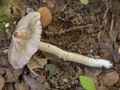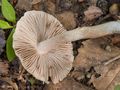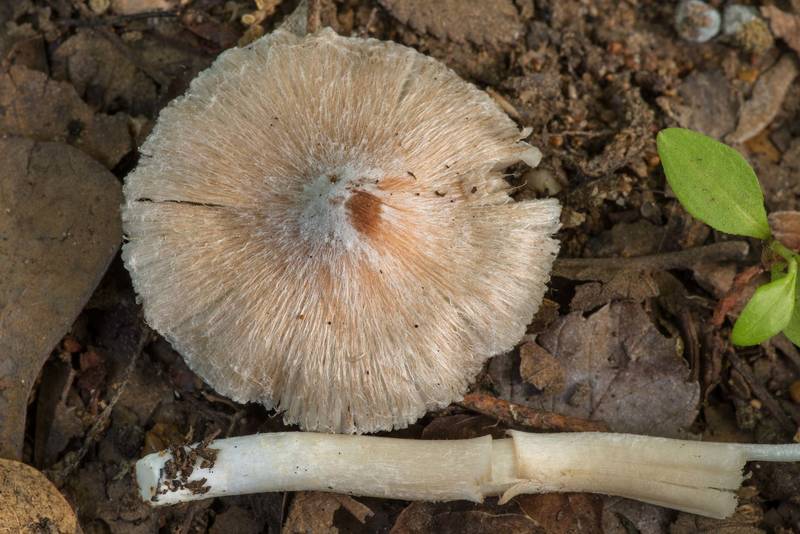

Cap of a solitary fibrecap (Inocybe) mushroom in Lick Creek ParkLick Creek: Background Notes. College Station, Texas


Album 3514: College Station, Texas, April 18 - 19, 2024
The image depicts the cap and stem of a solitary fibrecap (Inocybe) mushroom growing on the ground in Lick Creek Park, College Station, Texas. The cap is the top part of the mushroom, typically rounded or conical in shape, and ranges from 1 to 4 inches wide.
**Key Features:**
* **Cap:** Light brown coloration with white hairs covering it
* **Stem:** White coloration; no visible ring or volva on the stem
**Growth Environment:**
* The mushroom is growing on the ground in a wooded area, indicating its preference for shaded conditions and damp environments.
**Species Identification:**
The image shows a solitary fibrecap (Inocybe) mushroom, which is a type of fungi that belongs to the family Inocybaceae. These mushrooms are typically found growing alone or in small groups on rotting wood or decaying plant matter.
**Interesting Fact:**
* The name "fibrecap" comes from the hairy appearance of the cap, which resembles fibers.
* Solitary fibrecaps can be edible, but they should only be consumed by experienced mushroom hunters who are familiar with their appearance and habitat. – AI vision
🇪🇸 Descripción en español / Spanish Description
La tapa de un hongo solitario Inocybe en el parque Lick Creek. College Station, Texas, 19 de abril del 2024. La imagen muestra la tapa y el tallo de un hongo solitario Inocybe que crece sobre el suelo en el parque Lick Creek, College Station, Texas. La tapa es la parte superior del hongo, normalmente redonda o cónica en forma, y mide entre 2,5 y 10 cm de ancho. **Características clave:** * **Tapa:** Coloración marrón claro con pelos blancos que lo cubren * **Tallo:** Coloración blanca; sin anillo o volva visible en el tallo **Ambiente de crecimiento:** * El hongo está creciendo sobre el suelo en un área boscosa, lo que indica su preferencia por condiciones sombreadas y ambientes húmedos. **Identificación de la especie:** La imagen muestra un hongo solitario Inocybe, que es un tipo de hongo que pertenece a la familia Inocybaceae. Estos hongos se encuentran normalmente creciendo solos o en pequeños grupos sobre madera podrida o material vegetal en descomposición. **Hecho interesante:** * El nombre "tapa de fibra" proviene del aspecto peludo de la tapa, que recuerda a las fibras. * Los hongos solitarios de fibra pueden ser comestibles, pero solo deben consumirse por cazadores de setas experimentados que estén familiarizados con su apariencia y hábitat. – Spanish translation