
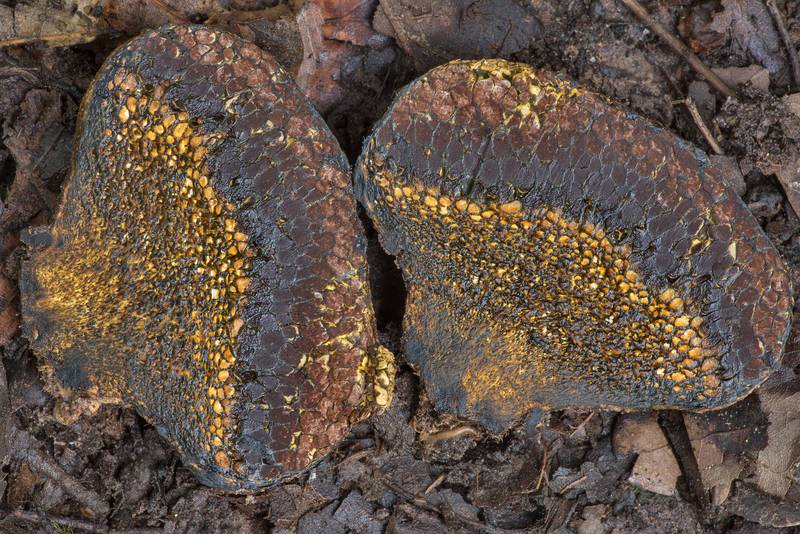

Cross section of dyeball mushroom (Pisolithus arhizus) in Lick Creek ParkLick Creek: Background Notes. College Station, Texas


Album 3530: College Station, Texas, May 8, 2024
The image presents a detailed cross-section view of a dyeball mushroom (Pisolithus arhizus), showcasing its internal structure and composition.
* **Cross Section View**
* The image displays three cross sections of the same dyeball mushroom, arranged side by side.
* Each section reveals the inner layers of the mushroom's fruiting body.
* The surface appears rough and irregular, with visible cracks and fissures.
* **Coloration**
* The outermost layer is dark brown to black in color, gradually transitioning to lighter shades towards the center.
* Yellowish-orange spots are scattered throughout the cross sections, particularly concentrated near the edges.
* **Composition**
* The mushroom's internal structure appears dense and compact, with visible fibers or strands running through it.
* The yellowish-orange spots may be indicative of spores or other reproductive structures.
* **Background**
* The background of the image is not visible due to the close-up nature of the photograph.
* However, based on the context provided by the caption, it can be inferred that the dyeball mushroom is growing in a natural environment, possibly among decaying plant matter or soil.
In summary, the image provides a detailed view of the internal structure and composition of a dyeball mushroom, highlighting its unique coloration and texture. The presence of yellowish-orange spots suggests potential reproductive structures or spores, while the dense and compact appearance indicates a mature fruiting body. – AI vision
🇪🇸 Descripción en español / Spanish Description
Presentamos una vista en sección transversal del hongo bolita de tinte (Pisolithus arhizus) en Lick Creek Park. College Station, Texas, el 8 de mayo de 2024. La imagen muestra una vista detallada en sección transversal de un hongo bolita de tinte (Pisolithus arhizus), mostrando su estructura interna y composición.
Vista en sección transversal
La imagen presenta tres vistas en sección transversal del mismo hongo bolita de tinte, dispuestas una al lado de la otra. Cada sección revela las capas internas del cuerpo fructífero del hongo. La superficie parece áspera e irregular, con grietas y fisuras visibles.
Coloración
La capa más externa es de color marrón oscuro a negro, graduándose hacia tonos más claros hacia el centro. Hay manchas amarillentas dispersas en las vistas en sección transversal, particularmente concentradas cerca de los bordes.
Composición
La estructura interna del hongo parece densa y compacta, con fibras o hebras visibles que atraviesan todo el cuerpo fructífero. Las manchas amarillentas pueden ser esporas u otras estructuras reproductivas.
Antecedentes
El fondo de la imagen no es visible debido a la naturaleza cercana de la fotografía. Sin embargo, según el contexto proporcionado por el subtítulo, se puede deducir que el hongo bolita de tinte está creciendo en un entorno natural, posiblemente entre materia en descomposición o suelo.
En resumen, la imagen proporciona una vista detallada de la estructura interna y composición del hongo bolita de tinte, destacando su coloración y textura únicas. La presencia de manchas amarillentas sugiere posibles estructuras reproductivas o esporas, mientras que el aspecto denso y compacto indica un cuerpo fructífero maduro. – Spanish translation


