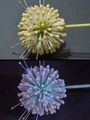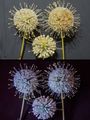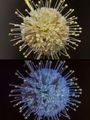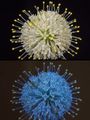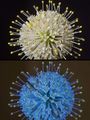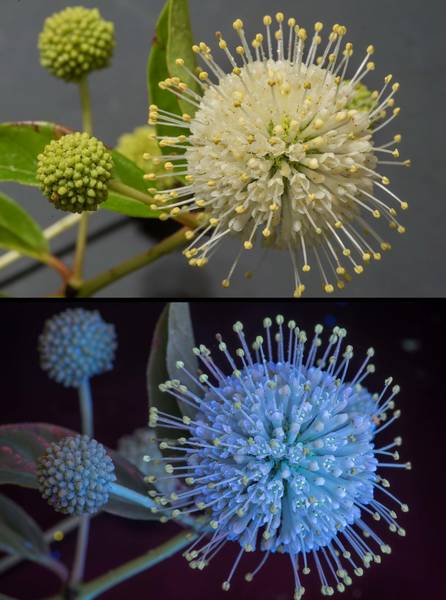

Buttonbush (Cephalanthus occidentalis) when exposed to regular daylight as well as when illuminated by a 365 nm ultraviolet (UV-A) blacklight from a trailway near Birch Creek Unit of Somerville Lake State Park. Texas


Album 3610: Lake Somerville, Texas, August 28, 2024
The image presents a comparative analysis of Buttonbush flowers under two distinct lighting conditions: regular daylight and ultraviolet (UV-A) blacklight illumination.
**Upper Image:**
In the upper photograph, the Buttonbush flower is depicted in its natural state, exposed to regular daylight. The flower exhibits a subtle white hue with yellow stamen tips, set against a backdrop of green leaves and stems. This image provides a baseline representation of the flower's appearance under normal lighting conditions.
**Lower Image:**
The lower photograph showcases the same Buttonbush flower, but this time illuminated by a 365 nm UV-A blacklight from a trailway near Birch Creek Unit of Somerville Lake State Park, Texas. Under these specific lighting conditions, the flower undergoes a transformation, displaying a striking blue coloration on its surface. This phenomenon is likely attributed to the presence of fluorescent pigments within the plant's tissues, which absorb and emit light at certain wavelengths when exposed to UV-A radiation.
**Comparison:**
A comparative analysis of the two images reveals that the UV-A blacklight illumination enhances the visibility of the flower's intricate details, including its stamen tips and petal structure. The use of UV-A light also accentuates the blue coloration on the flower's surface, creating a visually striking contrast with the surrounding foliage.
**Conclusion:**
In conclusion, the image effectively demonstrates the impact of different lighting conditions on the appearance of Buttonbush flowers. While regular daylight captures their subtle white hue, UV-A blacklight illumination reveals a more vibrant and detailed representation of these plants. This visual comparison highlights the importance of considering various environmental factors when studying or appreciating botanical specimens. – AI vision
🇪🇸 Descripción en español / Spanish Description
El botón de botón (Cephalanthus occidentalis) cuando se expone a la luz diurna regular, así como también cuando se ilumina con una luz negra ultravioleta (UV-A) de 365 nm desde un camino cerca de Birch Creek Unit of Somerville Lake State Park. Texas, 28 de agosto del 2024. La imagen presenta un análisis comparativo de las flores de botón de botón bajo dos condiciones de iluminación distintas: luz diurna regular e iluminación con luz negra ultravioleta (UV-A). **Imagen superior:** En la fotografía superior, la flor del botón de botón se representa en su estado natural, expuesta a la luz diurna regular. La flor presenta un matiz blanco sutil con puntas de estambre amarillas, frente a un fondo de hojas y tallos verdes. Esta imagen proporciona una representación básica de cómo se ve la flor en condiciones normales de iluminación. **Imagen inferior:** La fotografía inferior muestra la misma flor del botón de botón, pero esta vez iluminada con una luz negra UV-A de 365 nm desde un camino cercano a Birch Creek Unit of Somerville Lake State Park, Texas. En estas condiciones de iluminación específicas, la flor sufre una transformación, mostrando una coloración azul llamativa en su superficie. Este fenómeno se atribuye probablemente a la presencia de pigmentos fluorescentes dentro los tejidos de las plantas, que absorben y emiten luz a determinadas longitudes de onda cuando se exponen a radiación UV-A. **Comparación:** Un análisis comparativo de las dos imágenes revela que la iluminación con luz negra UV-A potencia la visibilidad de los detalles complejos de la flor, incluyendo sus puntas de estambre y estructura del pétalo. El uso de luz UV-A también acentúa la coloración azul en la superficie de la flor, creando un contraste visual llamativo con el follaje circundante. **Conclusión:** En conclusión, la imagen demuestra efectivamente el impacto de diferentes condiciones de iluminación en la apariencia de las flores del botón de botón. Mientras que la luz diurna regular captura su matiz blanco sutil, la iluminación con luz negra UV-A revela una representación más vibrante y detallada de estas plantas. Esta comparación visual resalta la importancia de considerar varios factores ambientales al estudiar o apreciar especímenes botánicos. – Spanish translation