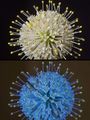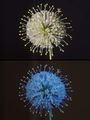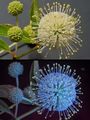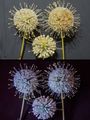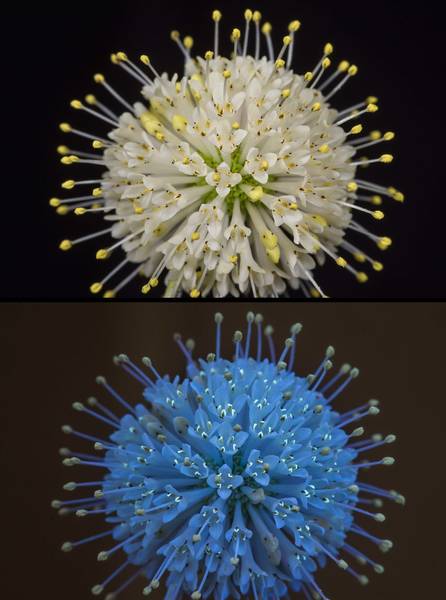

Buttonbush (Cephalanthus occidentalis) when exposed to regular daylight as well as when illuminated by a 365 nm ultraviolet (UV-A) blacklight from Lick Creek ParkLick Creek: Background Notes. College Station, Texas


Album 3617: College Station, Texas, September 8 - 10, 2024
The image presents a striking comparison of Buttonbush flowers under two distinct lighting conditions: regular daylight and UV-A blacklight illumination. The top photo showcases the flower's appearance in natural light, while the bottom photo reveals its unique response to UV-A radiation.
**Coloration Comparison**
* **Daylight**: The flower exhibits a predominantly white coloration with subtle yellow accents.
* **UV-A Blacklight**: Under UV-A radiation, the flower transforms into an intense blue hue.
**Visual Effects and Implications**
The dramatic change in coloration is likely due to the presence of anthocyanins, flavonoids that absorb light in the blue region of the visible spectrum and reflect longer wavelengths. This phenomenon results in the characteristic "blueing" effect seen in many plants exposed to UV-A radiation.
**Comparison and Analysis**
The two photos demonstrate the distinct visual effects produced by natural daylight versus UV-A blacklight illumination. The flower's response to UV-A radiation highlights the complex interplay between light absorption and reflection in plant pigmentation, showcasing the intricate mechanisms that govern plant coloration. – AI vision
🇪🇸 Descripción en español / Spanish Description
El botón de arbusto (Cephalanthus occidentalis) cuando se expone a la luz diurna habitual y cuando se ilumina con una lámpara negra ultravioleta (UV-A) de 365 nm desde el Parque Lick Creek. College Station, Texas, 8 de septiembre de 2024. La imagen presenta una comparación sorprendente de las flores del botón de arbusto en dos condiciones de iluminación distintas: luz diurna habitual e iluminación con lámpara negra UV-A. La foto superior muestra la apariencia de la flor a la luz natural, mientras que la foto inferior revela su respuesta única a la radiación UV-A. **Comparación de Colores** * **Luz diurna**: La flor exhibe una coloración predominantemente blanca con sutiles acentos amarillos. * **UV-A Blacklight**: Bajo la radiación UV-A, la flor se transforma en un tono azul intenso. **Efectos Visuales e Implicaciones** El cambio dramático de coloración es probablemente debido a la presencia de antocianinas, flavonoides que absorben luz en la región azul del espectro visible y reflejan longitudes de onda más largas. Este fenómeno produce el característico efecto "azulado" visto en muchas plantas expuestas a radiación UV-A. **Comparación y Análisis** Las dos fotos demuestran los distintos efectos visuales producidos por la luz diurna natural versus la iluminación con lámpara negra UV-A. La respuesta de la flor a la radiación UV-A destaca la compleja interacción entre absorción y reflexión en la pigmentación de las plantas, destacando los mecanismos intrincados que rigen la coloración de las plantas. – Spanish translation