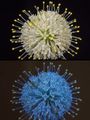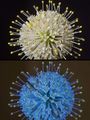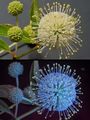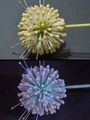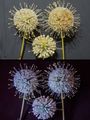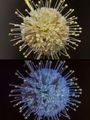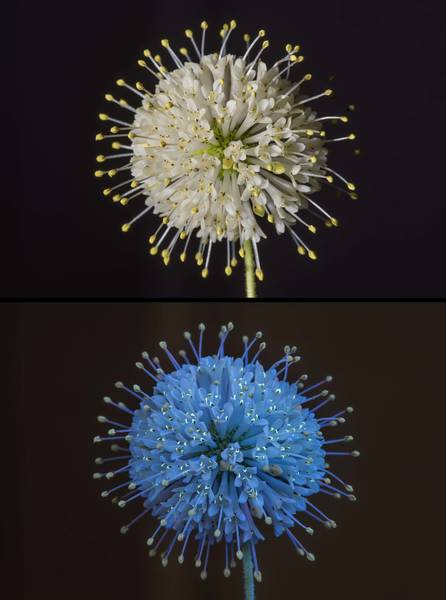

Buttonbush (Cephalanthus occidentalis) when exposed to regular daylight as well as when illuminated by a 365 nm ultraviolet (UV-A) blacklight found near Nature Center from Lick Creek ParkLick Creek: Background Notes. College Station, Texas


Album 3617: College Station, Texas, September 8 - 10, 2024
The image presents a striking comparison between the appearance of Buttonbush flowers under regular daylight and when illuminated by a 365 nm ultraviolet (UV-A) blacklight. The photograph is divided into two sections, with the top section showcasing the flower's appearance during daytime and the bottom section highlighting its response to UV-A light.
**Daytime Appearance**
* **Color**: The Buttonbush flowers appear white or pale yellow in color.
* **Shape**: They have a spherical shape, comprising numerous small florets that resemble tiny buttons.
* **Size**: Each flower measures approximately 1-2 inches (2.5-5 cm) in diameter.
**UV-A Illumination**
* **Color Change**: When exposed to UV-A light, the flowers exhibit a dramatic color change, turning blue or purple.
* **Intensification of Color**: The color becomes more vibrant and intense compared to their natural appearance.
* **Shape Retention**: Despite the color transformation, the spherical shape of the flowers remains unchanged.
**Key Observations**
* The Buttonbush flowers respond strongly to UV-A light, changing from white or pale yellow to blue or purple.
* This phenomenon highlights the unique characteristics of these plants and their ability to absorb and reflect different wavelengths of light.
* The image provides a fascinating glimpse into the world of botany and the intricate relationships between plants and their environment.
Overall, the photograph offers a captivating visual representation of how Buttonbush flowers interact with light, showcasing both their natural appearance and their response to UV-A illumination. – AI vision
🇪🇸 Descripción en español / Spanish Description
El arbusto de botón (Cephalanthus occidentalis) presenta un cambio sorprendente en su apariencia cuando se expone a la luz diurna regular, así como cuando se ilumina con una luz negra ultravioleta de 365 nm cerca del Centro Natural de Lick Creek Park. College Station, Texas, 8 de septiembre de 2024. La imagen muestra una comparación sorprendente entre la apariencia de las flores del arbusto de botón bajo luz diurna y cuando se ilumina con una luz negra ultravioleta de 365 nm. La fotografía se divide en dos secciones, con la parte superior mostrando la apariencia de las flores durante el día y la parte inferior destacando su respuesta a la luz UV-A.
**Apariencia diurna **
* **Color**: Las flores del arbusto de botón aparecen de color blanco o amarillo pálido. * **Forma**: Tienen una forma esférica, compuesta por numerosas pequeñas florecillas que se asemejan a diminutos botones. * **Tamaño**: Cada flor mide aproximadamente de 1-2 pulgadas (2,5-5 cm) de diámetro.
**Iluminación UV-A**
* **Cambio de color**: Cuando se expone a la luz UV-A, las flores presentan un cambio sorprendente de color, volviéndose azules o púrpuras. * **Intensificación del color**: El color se vuelve más vibrante e intenso en comparación con su aspecto natural. * **Retención de la forma**: A pesar del cambio de color, la forma esférica de las flores permanece sin alteraciones.
**Observaciones clave**
* Las flores del arbusto de botón responden fuertemente a la luz UV-A, pasando de blanco o amarillo pálido a azul o púrpura. * Este fenómeno destaca las características únicas de estas plantas y su capacidad para absorber y reflejar diferentes longitudes de onda de la luz. * La imagen ofrece una fascinante perspectiva del mundo de la botánica y las intrincadas relaciones entre las plantas y su entorno.
En general, la fotografía ofrece una cautivadora representación visual de cómo las flores del arbusto de botón interactúan con la luz, mostrando tanto su apariencia natural como su respuesta a la iluminación UV-A. – Spanish translation