 |
| |||||||||||||||

| ||||||||||||||||


| Similar | 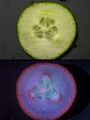  |
  |
  |
  |
  |
| |||||||||||||||||||||||||||
| |||||||||||||||||||||||||||
| 1996 1997 1998 1999 2000 2001 2002 2003 2004 2005 2006 2007 2008 2009 2010 2011 2012 2013 2014 2015 2016 2017 2018 2019 2020 2021 2022 2023 2024 2025 2026 | |||||||||||||||||||||||||||
| New version Slide Show Most Popular Full List Statistics Technical Details Home Page | |||||||||||||||||||||||||||
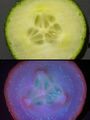
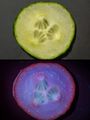
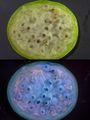
The image is composed of two parts: an upper half showing an ordinary cucumber slice and a lower half with the same cucumber slice under UV light. The top part shows a plain slice of green cucumber, which is common to see at supermarkets. The bottom part displays the same cucumber, but now illuminated by UV-A blacklight from a supermarket. This UV light causes the cucumber to fluoresce blue and red, making its interior visible as if it were transparent. The fluorescent areas are particularly noticeable around the seeds in the center of the cucumber. The image highlights that cucumbers contain chlorophyll and other pigments, which can be made visible by exposing them to ultraviolet light at a wavelength of 365 nm. This phenomenon is known as fluorescence. When illuminated by UV-A blacklight, these pigments emit light at specific wavelengths, causing the cucumber to glow in blue and red colors. Overall, this image demonstrates how UV-A blacklight can reveal hidden details in everyday objects, such as the interior structure of a cucumber slice. – AI vision |
Una rodaja de pepino inglés al exponerla a la luz diurna normal y cuando se ilumina con una luz negra ultravioleta (UV-A) de 365 nm en un supermercado. College Station, Texas, 3 de septiembre de 2024. La imagen está compuesta por dos partes: la mitad superior muestra una rodaja de pepino normal y la mitad inferior muestra la misma rodaja de pepino bajo luz UV. La parte superior muestra una rodaja común de pepino verde, que es común en los supermercados. La parte inferior muestra el mismo pepino, pero ahora iluminado con luz negra UV-A de un supermercado. Esta luz negra hace que el pepino fluoreszca en azul y rojo, haciendo que su interior sea visible como si fuera transparente. Las áreas fluorescentes son particularmente visibles alrededor de las semillas en el centro del pepino. La imagen destaca que los pepinos contienen clorofila y otros pigmentos, que pueden ser visualizados exponiéndolos a la luz ultravioleta con una longitud de onda de 365 nm. Este fenómeno se conoce como fluorescencia. Cuando se ilumina con luz negra UV-A, estos pigmentos emiten luz en longitudes de onda específicas, haciendo que el pepino brille en colores azul y rojo. En general, esta imagen demuestra cómo la luz negra UV-A puede revelar detalles ocultos en objetos cotidianos, como la estructura interior de una rodaja de pepino. – Spanish translation |
Keyword variants
high resolution online digital collection
Berlin on the Brazos
Lone Star State
United States
picture gallery
photo album
documentary photographs
daily pics
conservative town
Brazos County
TX
travelogue
snapshots
sightseeing
photowalks
photoblog
graphic
fotografias
foto
Bryan
America
Aggieland