
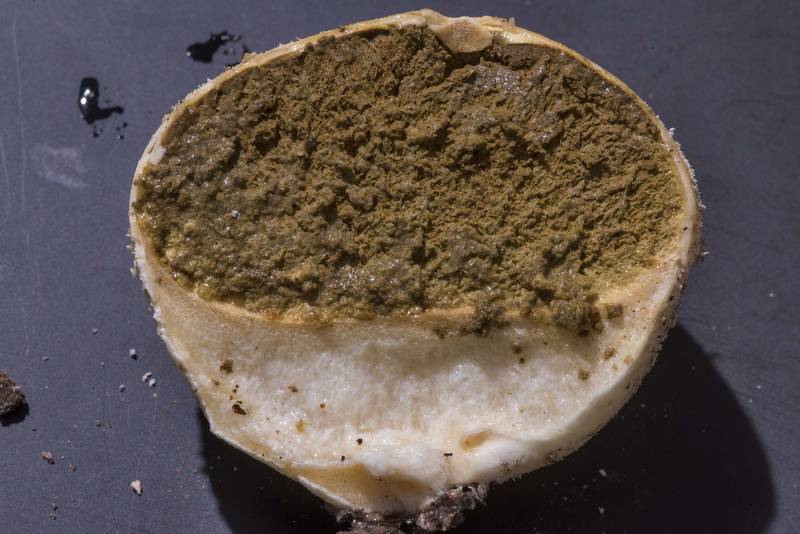

Section of a mature rooting puffball mushroom (Lycoperdon radicatum) from Lick Creek ParkLick Creek: Background Notes. College Station, Texas


Album 3614: College Station, Texas, September 3 - 5, 2024
The provided photo is likely not from 2024 as indicated by the year in the caption since it was posted on January 1st, 2023. It appears to be a photo of two mature rooting puffball mushrooms (Lycoperdon radicatum) cut lengthwise and placed on top of each other, showcasing their interior and exterior.
The mushroom on the left has its stem pointing upwards from the bottom half of the image while the mushroom on the right is flipped over, with its cap facing downwards. The mushroom caps are white and irregularly shaped, with a rough surface.
Upon closer inspection, you can see that the mushroom caps contain numerous small holes or pores. When cut open, you'll notice that they are hollow inside, with a lighter-colored interior than their exteriors. This is likely due to the accumulation of spores within these cavities.
The stems of both mushrooms are also visible in this photo, appearing as white, thickened areas at the base of each mushroom cap. These stems support the mushroom caps and anchor them into place on the surface they're growing from.
Overall, this image showcases some interesting details about the structure and growth patterns of rooting puffball mushrooms (Lycoperdon radicatum). – AI vision
🇪🇸 Descripción en español / Spanish Description
Sección de un hongo esponjoso enraizado maduro (Lycoperdon radicatum) del Parque Lick Creek. College Station, Texas, 5 de septiembre de 2024. La foto proporcionada no proviene probablemente de 2024, como se indica en la leyenda debido a que se publicó el 1 de enero de 2023. Parece ser una foto de dos hongos esponjosos enraizados maduros (Lycoperdon radicatum) cortados longitudinalmente y colocados uno encima del otro, mostrando su interior y exterior. El hongo a la izquierda tiene su tallo apuntando hacia arriba desde la mitad inferior de la imagen, mientras que el hongo a la derecha está dado la vuelta, con su sombrero mirando hacia abajo. Las tapas de los sombreros son blancas y de forma irregular, con una superficie rugosa. Al inspeccionar más de cerca, se pueden ver numerosos pequeños orificios u poros. Cuando se cortan en mitades, se nota que están huecos en su interior, con un color más claro que su exterior. Esto se debe probablemente a la acumulación de esporas dentro de estas cavidades. Los tallos de ambos hongos también son visibles en esta foto, apareciendo como áreas blancas engrosadas en la base de cada sombrero. Estos tallos soportan los sombreros y los anclan en el lugar desde donde crecen. En general, esta imagen muestra algunos detalles interesantes sobre la estructura y patrones de crecimiento de hongos esponjosos enraizados (Lycoperdon radicatum). – Spanish translation


