
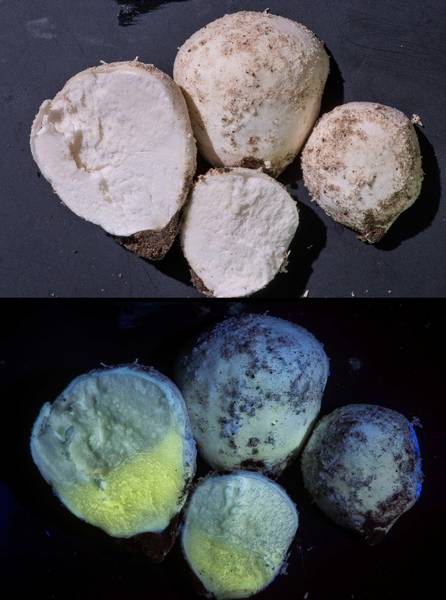

Section of rooting puffball mushrooms (Lycoperdon radicatum) when exposed to regular daylight as well as when illuminated by a 365 nm ultraviolet (UV-A) blacklight from Lick Creek ParkLick Creek: Background Notes. College Station, Texas


Album 3614: College Station, Texas, September 3 - 5, 2024
The image presents a comparative analysis of rooting puffball mushrooms (Lycoperdon radicatum) under two distinct lighting conditions: regular daylight and illumination by a 365 nm ultraviolet (UV-A) blacklight. The top portion of the image showcases the mushroom's appearance when exposed to natural light, while the bottom section reveals its response to UV-A radiation.
**Top Section: Daylight Exposure**
* **Mushroom Appearance:** The rooting puffball mushrooms exhibit a white or off-white coloration with brownish speckles on their surface. This is consistent with their natural appearance under regular daylight conditions.
* **Texture and Shape:** Upon closer inspection, the mushroom's texture appears smooth to slightly rough, while its shape suggests a rounded or oval form.
**Bottom Section: UV-A Illumination**
* **Glowing Response:** When exposed to 365 nm ultraviolet (UV-A) radiation from a blacklight, the mushrooms emit a bright greenish-yellow glow. This reaction is characteristic of many fungi and indicates bioluminescence.
* **Intensity and Distribution:** The glowing effect is not uniform across all parts of the mushroom but rather concentrated in certain areas. This suggests that the bioluminescent properties may be localized within specific tissues or structures of the fungus.
**Key Observations:**
* The rooting puffball mushrooms display a unique response to UV-A radiation, emitting a greenish-yellow glow.
* This phenomenon is likely due to the presence of bioluminescent compounds within the mushroom's tissues.
* The glowing effect is not uniform across the entire surface but rather concentrated in specific areas.
**Conclusion:**
The image effectively illustrates the distinct responses of rooting puffball mushrooms to different lighting conditions. While they appear white with brown speckles under regular daylight, they exhibit a bright greenish-yellow glow when exposed to UV-A radiation. This observation highlights the complex interactions between light and biological organisms, underscoring the importance of considering multiple environmental factors in understanding fungal behavior and ecology. – AI vision
🇪🇸 Descripción en español / Spanish Description
La sección de las setas en raíz de Lycoperdon radicatum (Puffball) cuando están expuestas a la luz natural regular, así como cuando son iluminadas por una luz negra de longitud de onda ultravioleta de 365 nm desde Lick Creek Park. College Station, Texas, 5 de septiembre de 2024. La imagen presenta un análisis comparativo de las setas en raíz de Lycoperdon radicatum bajo dos condiciones de iluminación distintas: luz natural regular e iluminación por una luz negra ultravioleta (UV-A) de 365 nm. La parte superior de la imagen muestra el aspecto de la seta cuando está expuesta a la luz natural, mientras que la sección inferior revela su respuesta a la radiación UV-A. **Sección superior: Exposición a la luz del día** * **Aspecto de las setas:** Las setas en raíz de Lycoperdon radicatum presentan una coloración blanca o blanquecina con motas parduscas en su superficie. Esto es consistente con su aspecto natural bajo luz regular del día. * **Textura y forma:** Al inspeccionarlas más de cerca, la textura de las setas parece ser suave a ligeramente rugosa, mientras que su forma sugiere una forma redondeada u ovalada. **Sección inferior: Iluminación con UV-A** * **Respuesta luminiscente:** Cuando se exponen a la radiación ultravioleta (UV-A) de 365 nm de una luz negra, las setas emiten un brillante resplandor amarillo verdoso. Este fenómeno es característico de muchos hongos e indica bioluminiscencia. * **Intensidad y distribución:** El efecto luminoso no es uniforme en todas partes de la seta, sino que está concentrado en ciertas áreas. Esto sugiere que las propiedades bioluminiscentes pueden estar localizadas dentro de tejidos o estructuras específicas del hongo. **Observaciones clave:** * Las setas en raíz muestran una respuesta única a la radiación UV-A, emitiendo un resplandor amarillo verdoso. * Este fenómeno se debe probablemente a la presencia de compuestos bioluminiscentes dentro de los tejidos del hongo. * El efecto luminoso no es uniforme en toda la superficie, sino que está concentrado en áreas específicas. **Conclusión:** La imagen ilustra efectivamente las distintas respuestas de las setas en raíz de Lycoperdon radicatum a diferentes condiciones de iluminación. Aunque aparecen blancas con motas parduscas bajo la luz del día regular, emiten un brillante resplandor amarillo verdoso cuando se exponen a la radiación UV-A. Esta observación destaca las interacciones complejas entre la luz y los organismos biológicos, subrayando la importancia de considerar múltiples factores ambientales para entender el comportamiento y ecología de los hongos. – Spanish translation


