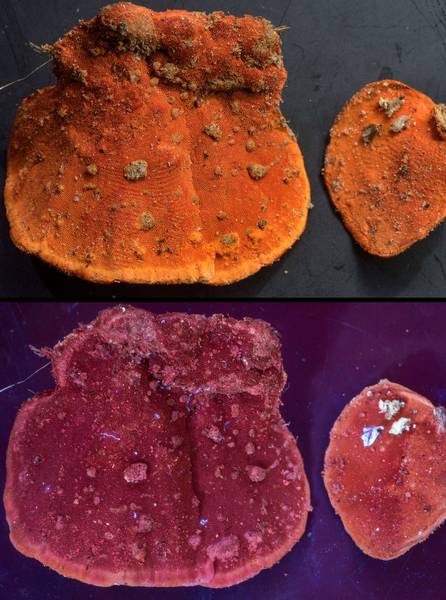

Blood red bracket mushrooms (Pycnoporus sanguineus) when exposed to regular daylight as well as when illuminated by a 365 nm ultraviolet (UV-A) blacklight from Lick Creek ParkLick Creek: Background Notes. College Station, Texas


Album 3614: College Station, Texas, September 3 - 5, 2024
**Image Description**
The image presents a comparison of Blood Red Bracket Mushrooms (Pycnoporus sanguineus) under two lighting conditions: regular daylight and ultraviolet (UV-A) blacklight illumination.
* **Daylight Image**
* The mushroom is red-orange in color, with a flat top and rounded edges.
* It has a rough texture and appears to have some small bumps or growths on its surface.
* The background of the image is dark gray, which helps to highlight the colors of the mushroom.
* **UV-A Blacklight Image**
* When illuminated by UV-A blacklight, the mushroom glows bright red with white spots scattered across its surface.
* This effect is likely due to the presence of fluorescent pigments in the mushroom's capilium layer that react with the ultraviolet light.
**Comparison and Observations**
* The main difference between the two images is the coloration of the mushroom, which changes from red-orange under regular daylight to bright red with white spots under UV-A blacklight.
* This suggests that the mushroom has fluorescent pigments in its capilium layer that are not visible under normal lighting conditions but become apparent when exposed to ultraviolet light. – AI vision
🇪🇸 Descripción en español / Spanish Description
Rojos al rojo vivo los hongos (Pycnoporus sanguineus) cuando se exponen a la luz diurna regular, así como también cuando se iluminan con una luz negra ultravioleta de 365 nm del Lick Creek Park. College Station, Texas, 5 de septiembre de 2024. **Descripción de la imagen** La imagen presenta una comparación de los hongos Rojos al rojo vivo (Pycnoporus sanguineus) en dos condiciones de iluminación: luz diurna regular e iluminación con luz negra ultravioleta (UV-A). * **Imagen de Luz Diurna** * El hongo es de color naranja rojizo, con una parte superior plana y bordes redondeados. * Tiene una textura áspera y parece tener algunos pequeños bultos o crecimientos en su superficie. * El fondo de la imagen es gris oscuro, lo que ayuda a resaltar los colores del hongo. * **Imagen de UV-A Blacklight** * Cuando se ilumina con luz negra UV-A, el hongo brilla en rojo brillante con manchas blancas dispersadas por toda su superficie. * Este efecto es probablemente debido a la presencia de pigmentos fluorescentes en la capa capilium del hongo que reaccionan con la luz ultravioleta. **Comparación y observaciones** * La principal diferencia entre las dos imágenes es la coloración del hongo, que cambia de naranja rojizo bajo la luz diurna regular a rojo brillante con manchas blancas bajo UV-A. * Esto sugiere que el hongo tiene pigmentos fluorescentes en su capa capilium que no son visibles bajo condiciones normales de iluminación, pero se vuelven evidentes cuando se exponen a la luz ultravioleta. – Spanish translation