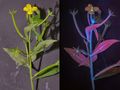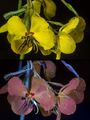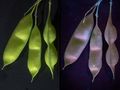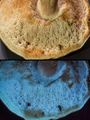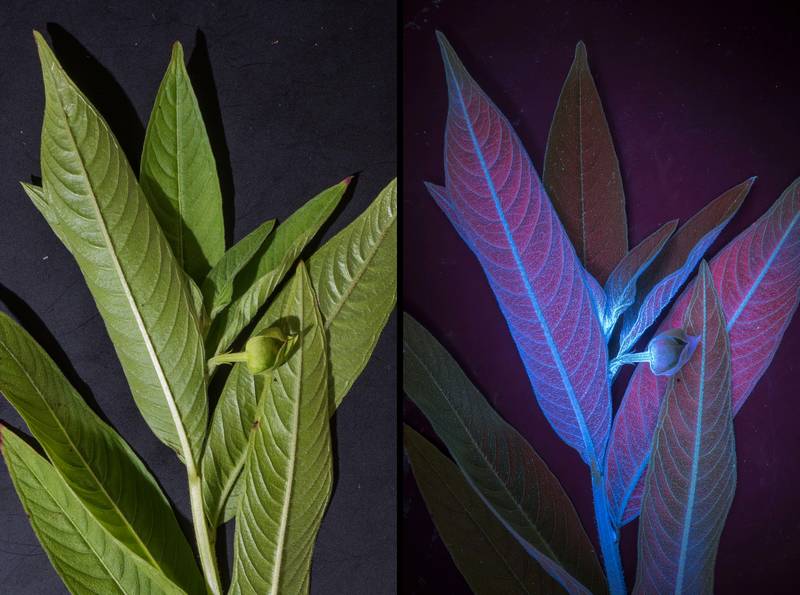

Water primrose (Ludwigia) when exposed to regular daylight as well as when illuminated by a 365 nm ultraviolet (UV-A) blacklight from Lick Creek ParkLick Creek: Background Notes. College Station, Texas


Album 3618: College Station, Texas, September 11 - XX, 2024
The image presents a striking comparison of the same plant under two distinct lighting conditions: regular daylight and illumination by a 365 nm ultraviolet (UV-A) blacklight. The left side of the image shows the plant's appearance in natural light, while the right side reveals its vibrant colors when exposed to UV-A radiation.
**Left Side: Natural Light**
* The leaves are depicted as green, with no notable fluorescence or coloration.
* The stems and veins appear pale yellowish-green.
* The flower buds at the center of the plant display a light yellow hue.
* The background is dark gray, which helps to accentuate the colors of the plant.
**Right Side: UV-A Radiation**
* Under UV-A radiation, the leaves exhibit a deep blue-purple coloration.
* The stems and veins take on a bright blue appearance.
* The flower buds are now an intense pinkish-red color.
* The background remains dark gray, but with a subtle purple tint due to the reflection of the UV light.
**Comparison and Observations**
* The most striking difference between the two images is the dramatic change in coloration when exposed to UV-A radiation.
* The plant's natural colors are muted and greenish-yellow, while under UV-A illumination, it takes on a range of blues, purples, and pinks.
* This comparison highlights the unique properties of certain plants that can fluoresce or emit light when exposed to specific wavelengths of light, such as UV-A radiation.
In summary, this image effectively demonstrates how a plant's appearance can change significantly depending on the lighting conditions. The use of UV-A radiation reveals a more vibrant and colorful display compared to natural daylight, showcasing the fascinating world of fluorescence in plants. – AI vision
🇪🇸 Descripción en español / Spanish Description
La planta del agua (Ludwigia) cuando se expone a la luz diurna regular y también cuando se ilumina con una luz negra de longitud de onda ultravioleta (UV-A) de 365 nm desde el Lick Creek Park. College Station, Texas, 11 de septiembre de 2024. La imagen presenta una sorprendente comparación de la misma planta bajo dos condiciones de iluminación diferentes: luz diurna regular e iluminación por una luz negra ultravioleta (UV-A) de 365 nm. El lado izquierdo de la imagen muestra el aspecto de la planta en luz natural, mientras que el lado derecho revela sus colores vibrantes cuando se expone a la radiación UV-A. **Lado Izquierdo: Luz Natural** * Las hojas aparecen verdes sin fluorescencia o coloración notable. * Los tallos y venas lucen amarillo pálido. * Los brotes florales en el centro de la planta muestran un matiz amarillento claro. * El fondo es gris oscuro, lo que ayuda a resaltar los colores de la planta. **Lado Derecho: Radiación UV-A** * Bajo radiación UV-A, las hojas exhiben una coloración morada azulada oscura. * Los tallos y venas adquieren un aspecto azul brillante. * Los brotes florales ahora muestran un intenso matiz rosado. * El fondo sigue siendo gris oscuro, pero con un matiz púrpura suave debido al reflejo de la luz UV. **Comparación y Observaciones** * La diferencia más sorprendente entre las dos imágenes es el cambio drástico en la coloración cuando se expone a radiación UV-A. * Los colores naturales de la planta son apagados y amarillentos, mientras que bajo iluminación con UV-A, toma una gama de azules, morados y rosas. * Esta comparación destaca las propiedades únicas de ciertas plantas que pueden fluorescer o emitir luz cuando se exponen a longitudes de onda específicas de la luz, como radiación UV-A. En resumen, esta imagen demuestra efectivamente cómo el aspecto de una planta puede cambiar significativamente dependiendo de las condiciones de iluminación. El uso de radiación UV-A revela una exhibición más vibrante y colorida en comparación con la luz diurna natural, mostrando el fascinante mundo de la fluorescencia en plantas. – Spanish translation