 |
| |||||||||||||||

| ||||||||||||||||


| Similar |   |
  |
  |
  |
  |
| |||||||||||||||||||||||||||
| |||||||||||||||||||||||||||
| 1996 1997 1998 1999 2000 2001 2002 2003 2004 2005 2006 2007 2008 2009 2010 2011 2012 2013 2014 2015 2016 2017 2018 2019 2020 2021 2022 2023 2024 2025 2026 | |||||||||||||||||||||||||||
| New version Slide Show Most Popular Full List Statistics Technical Details Home Page | |||||||||||||||||||||||||||
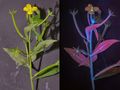
The image presents a striking comparison of the same plant under two distinct lighting conditions: regular daylight and illumination by a 365 nm ultraviolet (UV-A) blacklight. The left side of the image shows the plant's appearance in natural light, while the right side reveals its vibrant colors when exposed to UV-A radiation. **Left Side: Natural Light** * The leaves are depicted as green, with no notable fluorescence or coloration. **Right Side: UV-A Radiation** * Under UV-A radiation, the leaves exhibit a deep blue-purple coloration. **Comparison and Observations** * The most striking difference between the two images is the dramatic change in coloration when exposed to UV-A radiation. In summary, this image effectively demonstrates how a plant's appearance can change significantly depending on the lighting conditions. The use of UV-A radiation reveals a more vibrant and colorful display compared to natural daylight, showcasing the fascinating world of fluorescence in plants. – AI vision |
La planta del agua (Ludwigia) cuando se expone a la luz diurna regular y también cuando se ilumina con una luz negra de longitud de onda ultravioleta (UV-A) de 365 nm desde el Lick Creek Park. College Station, Texas, 11 de septiembre de 2024. La imagen presenta una sorprendente comparación de la misma planta bajo dos condiciones de iluminación diferentes: luz diurna regular e iluminación por una luz negra ultravioleta (UV-A) de 365 nm. El lado izquierdo de la imagen muestra el aspecto de la planta en luz natural, mientras que el lado derecho revela sus colores vibrantes cuando se expone a la radiación UV-A. **Lado Izquierdo: Luz Natural** * Las hojas aparecen verdes sin fluorescencia o coloración notable. * Los tallos y venas lucen amarillo pálido. * Los brotes florales en el centro de la planta muestran un matiz amarillento claro. * El fondo es gris oscuro, lo que ayuda a resaltar los colores de la planta. **Lado Derecho: Radiación UV-A** * Bajo radiación UV-A, las hojas exhiben una coloración morada azulada oscura. * Los tallos y venas adquieren un aspecto azul brillante. * Los brotes florales ahora muestran un intenso matiz rosado. * El fondo sigue siendo gris oscuro, pero con un matiz púrpura suave debido al reflejo de la luz UV. **Comparación y Observaciones** * La diferencia más sorprendente entre las dos imágenes es el cambio drástico en la coloración cuando se expone a radiación UV-A. * Los colores naturales de la planta son apagados y amarillentos, mientras que bajo iluminación con UV-A, toma una gama de azules, morados y rosas. * Esta comparación destaca las propiedades únicas de ciertas plantas que pueden fluorescer o emitir luz cuando se exponen a longitudes de onda específicas de la luz, como radiación UV-A. En resumen, esta imagen demuestra efectivamente cómo el aspecto de una planta puede cambiar significativamente dependiendo de las condiciones de iluminación. El uso de radiación UV-A revela una exhibición más vibrante y colorida en comparación con la luz diurna natural, mostrando el fascinante mundo de la fluorescencia en plantas. – Spanish translation |
Keyword variants
high resolution online digital collection
Lick Creek Park images
Berlin on the Brazos
Rock Prairie Rd
Lone Star State
Greens Prairie Road
United States
picture gallery
photo album
nature trails
Nature Park
documentary photographs
daily pics
conservative town
Brazos County
wildlife
TX
travelogue
snapshots
sightseeing
photowalks
photoblog
graphic
fotografias
foto
Bryan
America
Aggieland