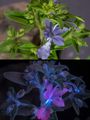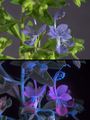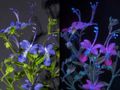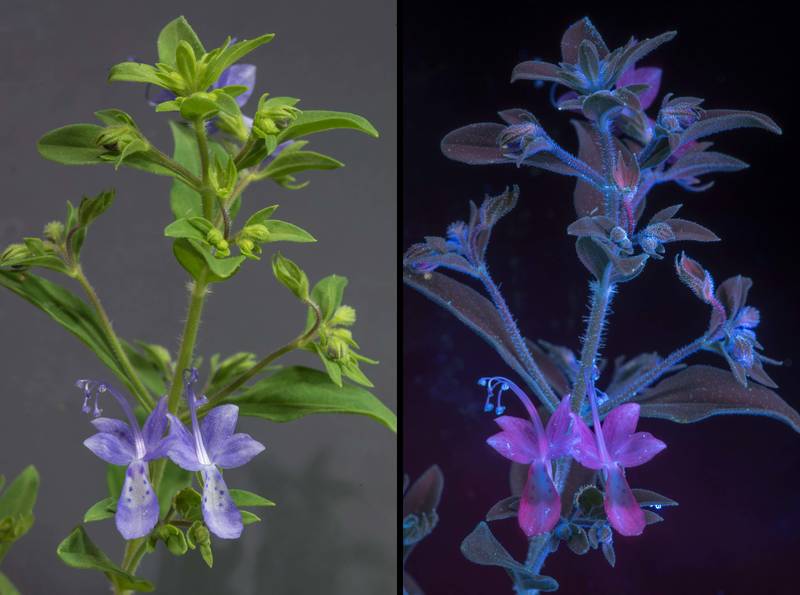

Bastard pennyroyal (Trichostema dichotomum) when exposed to regular daylight as well as when illuminated by a 365 nm ultraviolet (UV-A) blacklight from Lick Creek ParkLick Creek: Background Notes. College Station, Texas


Album 3622: College Station, Texas, September 16 - 18, 2024
The image presents a comparative view of Bastard pennyroyal (Trichostema dichotomum) under two different lighting conditions: regular daylight and illumination by a 365 nm ultraviolet (UV-A) blacklight from Lick Creek Park, College Station, Texas.
**Image Layout**
The left side of the image features Bastard pennyroyal in its natural state under regular daylight. In contrast, the right side shows the same plant when exposed to UV-A light from a 365-nm blacklight. The background of both images is dark grey, allowing for a clear visual comparison between the two lighting conditions.
**Plant Appearance**
Under daylight, the Bastard pennyroyal plant appears green with small blue flowers. In contrast, under UV-A illumination, the leaves and stems exhibit a light blue coloration, while the flowers glow bright pink. This striking transformation highlights the unique effects of UV-A light on plant pigments.
**Key Observations**
* The image demonstrates how different lighting conditions can significantly alter the appearance of plants.
* UV-A light reveals subtle details in plant structure and pigmentation that would otherwise remain hidden under regular daylight.
* The use of a 365-nm blacklight allows for a controlled comparison between the effects of natural light and artificial ultraviolet illumination on plant appearance.
Overall, this image effectively illustrates the importance of considering lighting conditions when observing or photographing plants. By exposing Bastard pennyroyal to UV-A light, researchers can gain valuable insights into its biology and ecology. – AI vision
🇪🇸 Descripción en español / Spanish Description
El verbena falsa (Trichostema dichotomum) cuando se expone a la luz diurna habitual y también cuando se ilumina con una luz negra ultravioleta de 365 nm del Lick Creek Park. College Station, Texas, 17 de septiembre de 2024. La imagen presenta una vista comparativa de la verbena falsa (Trichostema dichotomum) bajo dos condiciones de iluminación diferentes: luz diurna habitual e iluminación con luz negra ultravioleta de 365 nm del Lick Creek Park, College Station, Texas.
**Disposición de la imagen**
El lado izquierdo de la imagen presenta la verbena falsa en su estado natural bajo luz diurna habitual. Por el contrario, el lado derecho muestra la misma planta cuando se expone a luz ultravioleta A de 365 nm proveniente de una linterna negra. El fondo de ambas imágenes es gris oscuro, lo que permite una clara comparación visual entre las dos condiciones de iluminación.
**Aspecto de la planta**
Bajo la luz diurna, la planta de verbena falsa aparece verde con pequeñas flores azules. Por el contrario, bajo iluminación ultravioleta A, las hojas y tallos muestran una coloración azul claro, mientras que las flores brillan en rosa intenso. Este sorprendente cambio destaca los efectos únicos de la luz ultravioleta A en los pigmentos de las plantas.
**Observaciones clave** *
La imagen demuestra cómo diferentes condiciones de iluminación pueden alterar significativamente la apariencia de las plantas.
* La luz ultravioleta A revela detalles sutiles en la estructura y pigmentación de las plantas que permanecerían ocultos bajo la luz diurna habitual.
* El uso de una linterna negra de 365 nm permite una comparación controlada entre los efectos de la iluminación natural y artificial ultravioleta en el aspecto de las plantas.
En general, esta imagen ilustra eficazmente la importancia de considerar las condiciones de iluminación al observar o fotografiar plantas. Al exponer a la verbena falsa a luz ultravioleta A, los investigadores pueden obtener información valiosa sobre su biología y ecología. – Spanish translation