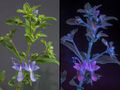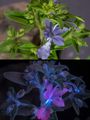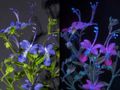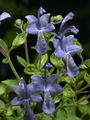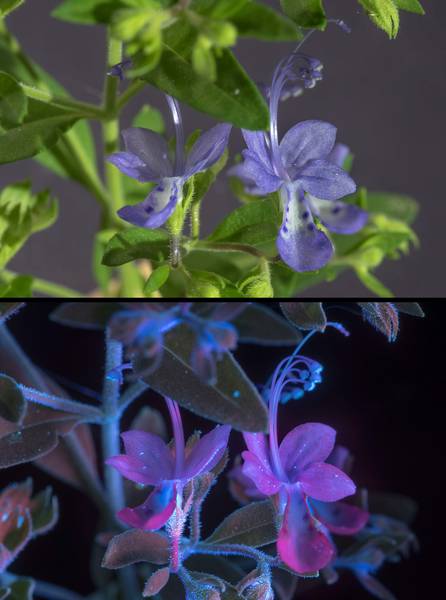

Blooming bastard pennyroyal (Trichostema dichotomum) when exposed to regular daylight as well as when illuminated by a 365 nm ultraviolet (UV-A) blacklight from Lick Creek ParkLick Creek: Background Notes. College Station, Texas


Album 3622: College Station, Texas, September 16 - 18, 2024
This image presents a comparative view of blooming bastard pennyroyal (Trichostema dichotomum) plants under two different lighting conditions: regular daylight and UV-A blacklight illumination.
**Daylight Image**
The top half of the image shows the plant in its natural state, illuminated by regular daylight. The flowers appear as a soft purple color with five petals each, and are surrounded by green leaves. The background is a solid gray color, providing a neutral contrast to the plant's colors.
**UV-A Blacklight Image**
In contrast, the bottom half of the image displays the same plant when exposed to UV-A blacklight from Lick Creek Park in College Station, Texas. Under this specialized lighting, the flowers exhibit a vibrant pinkish-purple hue with five petals each, while the leaves remain green. The background remains gray.
**Overall Observation**
Notably, the use of UV-A blacklight highlights the presence of fluorescent pigments in the plant's flowers, which are not visible under regular daylight conditions. This phenomenon is often referred to as "fluorescence" or "UV-induced fluorescence." The image effectively demonstrates how different lighting conditions can reveal new details about a subject's appearance and properties.
**Conclusion**
In summary, this image showcases the unique effects of UV-A blacklight illumination on the blooming bastard pennyroyal plant, highlighting its fluorescent pigments and providing a fascinating visual comparison between natural daylight and specialized lighting conditions. – AI vision
🇪🇸 Descripción en español / Spanish Description
La planta de pennyroyal en flor ("Trichostema dichotomum") cuando está expuesta a la luz diurna normal y también cuando se ilumina con una luz negra ultravioleta (UV-A) de 365 nm del Lick Creek Park. College Station, Texas, 17 de septiembre de 2024. Esta imagen presenta una vista comparativa de las plantas de pennyroyal en flor ("Trichostema dichotomum") bajo dos condiciones de iluminación diferentes: luz diurna normal e iluminación con luz negra UV-A.
**Imagen de la luz del día** La mitad superior de la imagen muestra la planta en su estado natural, iluminada por la luz diurna regular. Las flores aparecen como un color púrpura suave con cinco pétalos cada una y están rodeadas de hojas verdes. El fondo es un color gris sólido, proporcionando un contraste neutro a los colores de las plantas.
**Imagen de luz UV-A** En contraste, la mitad inferior de la imagen muestra la misma planta cuando se expone a la luz negra UV-A desde el Lick Creek Park en College Station, Texas. Bajo esta iluminación especializada, las flores exhiben un tono púrpura rosado vibrante con cinco pétalos cada una, mientras que las hojas permanecen verdes. El fondo sigue siendo gris.
**Observación general** Cabe destacar que el uso de luz negra UV-A resalta la presencia de pigmentos fluorescentes en las flores de la planta, que no son visibles bajo condiciones de luz diurna normal. Este fenómeno se conoce comúnmente como "fluorescencia" o "fluorescencia inducida por UV". La imagen demuestra efectivamente cómo diferentes condiciones de iluminación pueden revelar nuevos detalles sobre el aspecto y las propiedades de un sujeto.
**Conclusión** En resumen, esta imagen muestra los efectos únicos de la iluminación con luz negra UV-A en la planta de pennyroyal en flor ("Trichostema dichotomum"), destacando sus pigmentos fluorescentes y proporcionando una fascinante comparación visual entre la luz diurna natural y las condiciones de iluminación especializadas. – Spanish translation