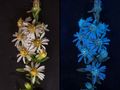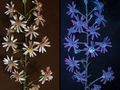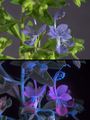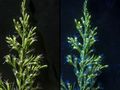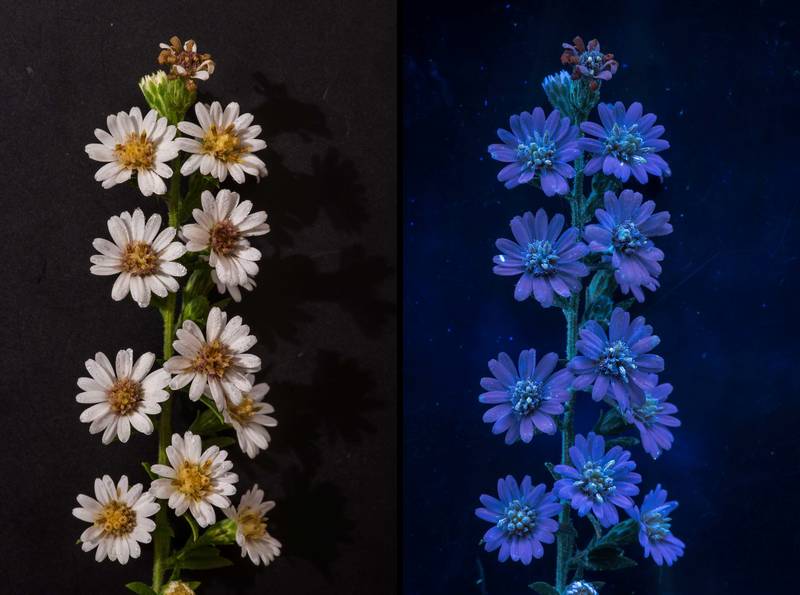

Blooming aster (Symphyotrichum) when exposed to regular daylight as well as when illuminated by a 365 nm ultraviolet (UV-A) blacklight from Lick Creek ParkLick Creek: Background Notes. College Station, Texas


Album 3634: College Station, Texas, October 21 - 23, 2024
The image presents a striking visual comparison between two photographs of blooming aster flowers, captured under different lighting conditions.
**Photograph 1: Daylight**
* The photograph on the left showcases the blooming aster flower in its natural state.
* The white petals and yellow centers are illuminated by regular daylight.
* The background is a solid gray color, providing a neutral contrast to the vibrant colors of the flowers.
**Photograph 2: UV-A Blacklight**
* In stark contrast, the photograph on the right features the same blooming aster flower, but this time it has been exposed to a 365 nm ultraviolet (UV-A) blacklight from Lick Creek Park.
* The effect is remarkable, as the white petals now glow with an intense blue light, while the yellow centers remain unchanged.
* The background of this photograph is also gray, allowing the viewer's attention to focus on the dramatic change in the flower's appearance.
**Overall Impression**
The image effectively highlights the unique properties of UV-A radiation and its ability to alter the appearance of certain materials. The contrast between the two photographs creates a sense of surprise and wonder, inviting the viewer to appreciate the fascinating world of light and color. – AI vision
🇪🇸 Descripción en español / Spanish Description
El Aster en flor (Symphyotrichum) cuando se expone a la luz natural diurna y cuando se ilumina con una luz negra de longitud de onda ultravioleta (UV-A) de 365 nm del Lick Creek Park. College Station, Texas, 22 de octubre de 2024. La imagen presenta una sorprendente comparación visual entre dos fotografías de flores de aster en flor, capturadas bajo diferentes condiciones de iluminación. **Fotografía 1: Luz Diurna** *La fotografía a la izquierda muestra la flor de aster en flor en su estado natural. *Los pétalos blancos y los centros amarillos están iluminados por la luz diurna regular. *El fondo es un color gris uniforme, proporcionando un contraste neutro a los colores vibrantes de las flores.**Fotografía 2: Luz Negra** *En un fuerte contraste, la fotografía a la derecha presenta la misma flor de aster en flor, pero esta vez ha sido expuesta a una luz negra ultravioleta (UV-A) de 365 nm del Lick Creek Park. *El efecto es notable, ya que los pétalos blancos ahora brillan con un intenso color azul, mientras que los centros amarillos permanecen sin cambios. *El fondo de esta fotografía también es gris, lo que permite que la atención del espectador se centre en el dramático cambio de aspecto de la flor. **Impresión General** La imagen destaca efectivamente las propiedades únicas de la radiación UV-A y su capacidad para alterar la apariencia de ciertos materiales. El contraste entre las dos fotografías crea una sensación de sorpresa y asombro, invitando al espectador a apreciar el fascinante mundo de la luz y el color. – Spanish translation