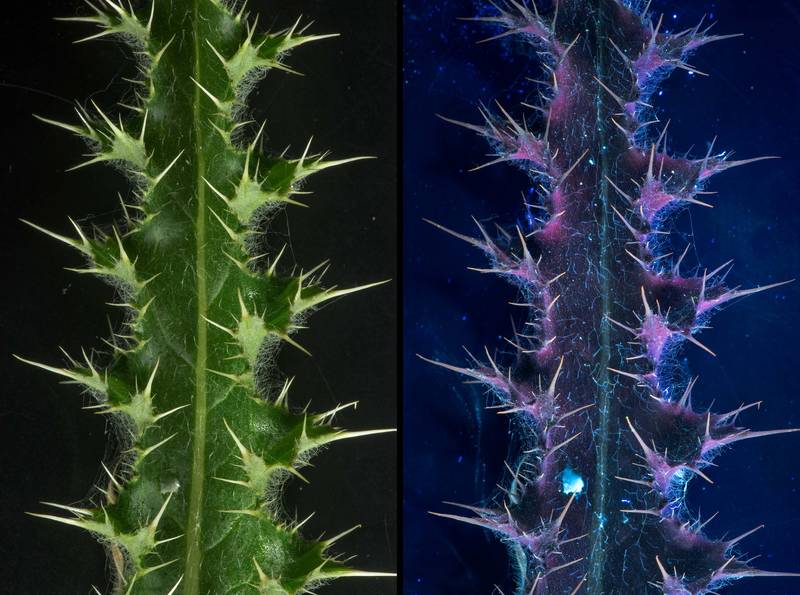

Leaf of a thistle (Cirsium) both in natural light and under 365 nm ultraviolet (UV-A) blacklight from Lick Creek ParkLick Creek: Background Notes. College Station, Texas


Album 3634: College Station, Texas, October 21 - 23, 2024
The image presents a comparative analysis of a thistle leaf under two distinct lighting conditions: natural light and 365 nm ultraviolet (UV-A) blacklight. The left side of the image features the leaf illuminated by natural light, while the right side is exposed to UV-A blacklight.
**Observations Under Natural Light**
* The leaf exhibits its characteristic green color in natural light.
* Numerous small hairs are visible on the leaf's surface, providing a sense of texture and detail.
* The overall appearance is typical of a thistle leaf, with a central vein and branching patterns.
**Observations Under UV-A Blacklight**
* Upon exposure to UV-A blacklight, the leaf undergoes significant changes in appearance.
* The green coloration fades, revealing a more subtle, muted tone.
* Small hairs on the leaf's surface become more pronounced, taking on a pinkish hue under the UV light.
* A network of fine lines and patterns becomes visible, particularly around the edges of the leaf.
**Comparison and Observations**
* The transition from natural light to UV-A blacklight highlights the unique properties of thistle leaves.
* The use of UV-A blacklight reveals details that are not apparent under natural lighting conditions.
* The image suggests that thistle leaves have a complex structure, with both visible and invisible features.
* The comparison between the two images underscores the importance of considering multiple perspectives when studying or observing plant anatomy.
In conclusion, the image effectively demonstrates how different lighting conditions can significantly impact our perception of plant morphology. By comparing the appearance of a thistle leaf under natural light and UV-A blacklight, we gain insight into its intricate structure and the presence of subtle features that might otherwise remain hidden. – AI vision
🇪🇸 Descripción en español / Spanish Description
Una hoja de cardo (Cirsium) tanto en luz natural como bajo luz negra ultravioleta (UV-A) de 365 nm desde Lick Creek Park. College Station, Texas, octubre de 2024. La imagen presenta un análisis comparativo de una hoja de cardo bajo dos condiciones distintas de iluminación: luz natural y luz negra ultravioleta (UV-A) de 365 nm. El lado izquierdo de la imagen muestra la hoja iluminada por luz natural, mientras que el lado derecho está expuesto a luz negra UV-A. **Observaciones bajo luz natural** * La hoja exhibe su color verde característico en luz natural. * Son visibles numerosos pelillos pequeños en la superficie de la hoja, proporcionando un tacto y detalles. * El aspecto general es típico del cardo, con una vena central y patrones ramificados. **Observaciones bajo luz UV-A** * Tras la exposición a luz negra UV-A, la hoja sufre cambios significativos en su apariencia. * El matiz verde se desvanece, revelando un tono más sutil y atenuado. * Los pelillos pequeños en la superficie de la hoja se vuelven más pronunciados, adquiriendo un tono rosado bajo la luz UV-A. * Se hace visible una red de finas líneas y patrones, en particular alrededor de los bordes de la hoja. **Comparación y observaciones** * La transición de luz natural a luz negra UV-A destaca las propiedades únicas de las hojas del cardo. * El uso de luz negra UV-A revela detalles que no son evidentes bajo condiciones de iluminación natural. * La imagen sugiere que las hojas del cardo tienen una estructura compleja, con características tanto visibles como invisibles. * La comparación entre las dos imágenes subraya la importancia de considerar múltiples perspectivas al estudiar u observar la anatomía de las plantas. En conclusión, la imagen demuestra efectivamente cómo diferentes condiciones de iluminación pueden afectar significativamente nuestra percepción de la morfología de las plantas. Comparando el aspecto de una hoja de cardo bajo luz natural y UV-A negra, obtenemos información sobre su estructura intrincada y la presencia de características sutiles que podrían pasar desapercibidas de otra forma. – Spanish translation