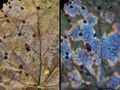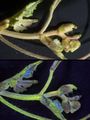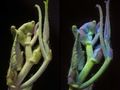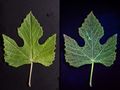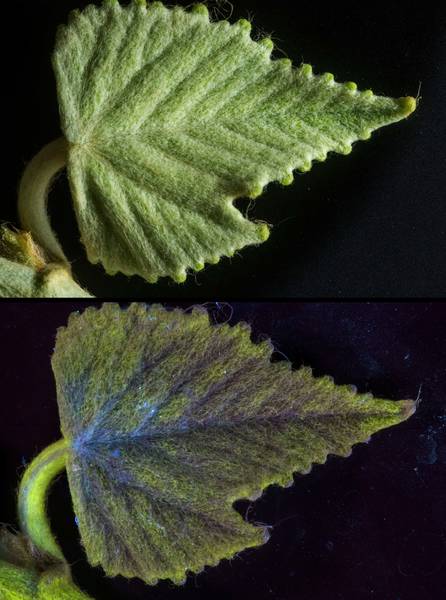

Young leaf of mustang grape (Vitis mustangensis) both in natural light and under 365 nm ultraviolet (UV-A) blacklight from Lick Creek ParkLick Creek: Background Notes. College Station, Texas


Album 3618: College Station, Texas, September 11 - XX, 2024
The image presents a comparative analysis of a young leaf from a mustang grape plant under two distinct lighting conditions: natural light and 365 nm ultraviolet (UV-A) blacklight.
**Leaf Description**
* The leaf is positioned at an angle, with its tip pointing towards the top right corner.
* It has a light green color with wavy edges and prominent veins.
* The upper surface of the leaf appears slightly hairy or fuzzy.
**Natural Light Image**
The natural light image captures the leaf's morphology in ambient lighting conditions. The leaf is illuminated from above, revealing its texture and structure.
**UV-A Blacklight Image**
In contrast, the UV-A blacklight image exposes the leaf to a specific wavelength of ultraviolet radiation (365 nm). This causes certain compounds within the leaf to fluoresce or emit light, creating a glowing effect. The fluorescence is most pronounced along the midrib and secondary veins, producing a bright blue-green hue.
**Comparison**
A closer examination reveals that the UV-A blacklight image highlights areas where the leaf's natural pigments are present in higher concentrations, such as the midrib and secondary veins. These regions appear more vibrant under UV-A light due to the fluorescence of chlorophylls and other pigments.
**Conclusion**
The comparison between the two images demonstrates the effectiveness of using UV-A blacklight to visualize specific features of plant leaves that may not be visible in natural light. This technique can aid in botanical research, plant identification, and the study of leaf morphology. – AI vision
🇪🇸 Descripción en español / Spanish Description
La hoja joven de la uva mustang (Vitis mustangensis) tanto a la luz natural como bajo la luz negra ultravioleta de 365 nm desde Lick Creek Park. College Station, Texas, 11 de septiembre de 2024. La imagen presenta un análisis comparativo de una hoja joven de una planta de uva mustang bajo dos condiciones de iluminación distintas: luz natural e iluminación negra ultravioleta (UV-A) de 365 nm. **Descripción de la hoja** * La hoja está posicionada en ángulo, con su punta apuntando hacia la esquina superior derecha. * Tiene un color verde claro con bordes ondulados y venas prominentes. * La superficie superior de la hoja parece ligeramente peluda o fofa. **Imagen de luz natural** La imagen de luz natural captura la morfología de la hoja en condiciones de iluminación ambiental. La hoja es iluminada desde arriba, revelando su textura y estructura. **Imagen de luz negra ultravioleta (UV-A)** Por el contrario, la imagen de luz negra ultravioleta expone la hoja a una longitud de onda específica de radiación ultravioleta (365 nm). Esto hace que ciertos compuestos dentro de la hoja fluoreszcan o emitan luz, creando un efecto resplandor. La fluorescencia es más pronunciada a lo largo de la nervadura central y las venas secundarias, produciendo un tono azul-verdoso brillante. **Comparación** Un examen más detallado revela que la imagen de luz negra ultravioleta pone en evidencia áreas donde los pigmentos naturales de la hoja están presentes en mayores concentraciones, como la nervadura central y las venas secundarias. Estas regiones parecen más vibrantes bajo la luz UV-A debido a la fluorescencia de clorofilas y otros pigmentos. **Conclusión** La comparación entre las dos imágenes demuestra la efectividad del uso de la luz negra ultravioleta para visualizar rasgos específicos de hojas de plantas que pueden no ser visibles a la luz natural. Esta técnica puede ayudar en investigación botánica, identificación de plantas y el estudio de la morfología de las hojas. – Spanish translation