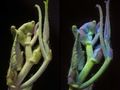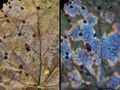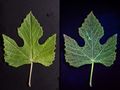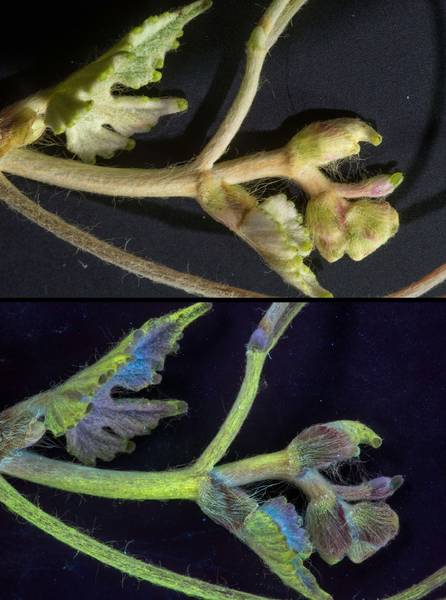

Young growth of mustang grape (Vitis mustangensis) when exposed to regular daylight as well as when illuminated by a 365 nm ultraviolet (UV-A) blacklight from Lick Creek ParkLick Creek: Background Notes. College Station, Texas


Album 3618: College Station, Texas, September 11 - XX, 2024
The image depicts two photographs of young growths of mustang grape vines (Vitis mustangensis). The top photograph shows the vine's growth under regular daylight conditions, while the bottom one illustrates how it appears when illuminated by a 365 nm ultraviolet (UV-A) blacklight.
**Regular Daylight Conditions**
In the top photograph, the plant exhibits a normal appearance. It features two branches with leaves at their tips, and the stem has some hair-like growths. The coloration is predominantly green, which indicates that it is healthy and thriving under regular daylight conditions.
**Ultraviolet (UV-A) Blacklight Illumination**
In contrast, the bottom photograph shows the same plant when illuminated by a 365 nm UV-A blacklight. This type of light has a shorter wavelength than visible light and can cause certain materials to fluoresce or glow in the dark. When exposed to this type of radiation, the hair-like growths on the stem become more pronounced and take on a blue-green hue. The leaves also appear more vibrant and colorful, with shades of yellow, orange, and red.
**Comparison**
The most striking difference between the two photographs is the appearance of the hair-like growths on the stem. Under regular daylight conditions, these growths are barely visible and blend in with the rest of the plant. However, when illuminated by the UV-A blacklight, they become much more prominent and take on a distinct blue-green color. This suggests that these growths may be sensitive to ultraviolet radiation and respond to it by fluorescing or glowing.
**Conclusion**
In conclusion, the image highlights the unique effects of ultraviolet radiation on plant growth. The mustang grape vines appear normal under regular daylight conditions but exhibit striking changes when illuminated by a 365 nm UV-A blacklight. This phenomenon is likely due to the sensitivity of certain cellular components in the plant to ultraviolet radiation, which causes them to fluoresce or glow. Further research could explore the potential applications of this property for agricultural purposes or other fields related to plant biology.
*Answer*: The image shows how young growths of mustang grape vines (Vitis mustangensis) appear under regular daylight conditions and when illuminated by a 365 nm ultraviolet (UV-A) blacklight. – AI vision
🇪🇸 Descripción en español / Spanish Description
El crecimiento joven de la vid silvestre (Vitis mustangensis) cuando se expone a la luz del día regular, así como cuando se ilumina con una lámpara negra de rayos ultravioleta (UV-A) de 365 nm desde el Lick Creek Park. College Station, Texas, 11 de septiembre de 2024. La imagen representa dos fotografías del crecimiento joven de las vides de vid silvestre (Vitis mustangensis). La parte superior muestra el crecimiento de la vid en condiciones normales de luz diurna, mientras que la parte inferior ilustra su aspecto cuando se ilumina con una lámpara negra de rayos ultravioleta (UV-A) de 365 nm.
**Condiciones de luz del día regular** En la parte superior de la fotografía, la planta exhibe un aspecto normal. Tiene dos ramas con hojas en sus extremos y el tallo tiene crecimientos similares a pelos. La coloración es predominantemente verde, lo que indica que es saludable y prospera bajo condiciones de luz diurna regular.
**Iluminación ultravioleta (UV-A)** En contraste, la parte inferior muestra la misma planta cuando se ilumina con una lámpara negra UV-A de 365 nm. Este tipo de luz tiene una longitud de onda más corta que la luz visible y puede hacer que ciertos materiales fluoresezcan o brillen en la oscuridad. Cuando se expone a este tipo de radiación, los crecimientos similares a pelos del tallo se vuelven más prominentes y adquieren un tono azul-verde. Las hojas también parecen más vibrantes y coloridas, con matices de amarillo, naranja y rojo.
**Comparación** La diferencia más notable entre las dos fotografías es la apariencia de los crecimientos similares a pelos en el tallo. En condiciones de luz diurna regular, estos crecimientos son apenas visibles y se mezclan con el resto de la planta. Sin embargo, cuando se ilumina con la lámpara negra UV-A, se vuelven mucho más prominentes y adquieren un tono azul-verde distintivo. Esto sugiere que estos crecimientos pueden ser sensibles a la radiación ultravioleta y responder fluoresciendo o brillando.
**Conclusión:** En conclusión, la imagen destaca los efectos únicos de la radiación ultravioleta en el crecimiento vegetal. Las vides silvestres parecen normales bajo condiciones de luz diurna regular pero exhiben cambios sorprendentes cuando se iluminan con una lámpara negra UV-A de 365 nm. Este fenómeno es probablemente debido a la sensibilidad de ciertos componentes celulares en la planta a la radiación ultravioleta, lo que hace que estas partes del tallo fluoreszcan o brillen. Investigaciones adicionales podrían explorar las posibles aplicaciones de esta propiedad para fines agrícolas u otros campos relacionados con la biología vegetal. *Respuesta*: La imagen muestra cómo el crecimiento joven de las vides silvestres (Vitis mustangensis) aparece en condiciones de luz diurna regular y cuando se ilumina con una lámpara negra ultravioleta (UV-A) de 365 nm. – Spanish translation