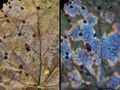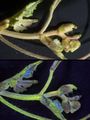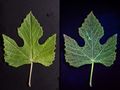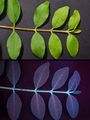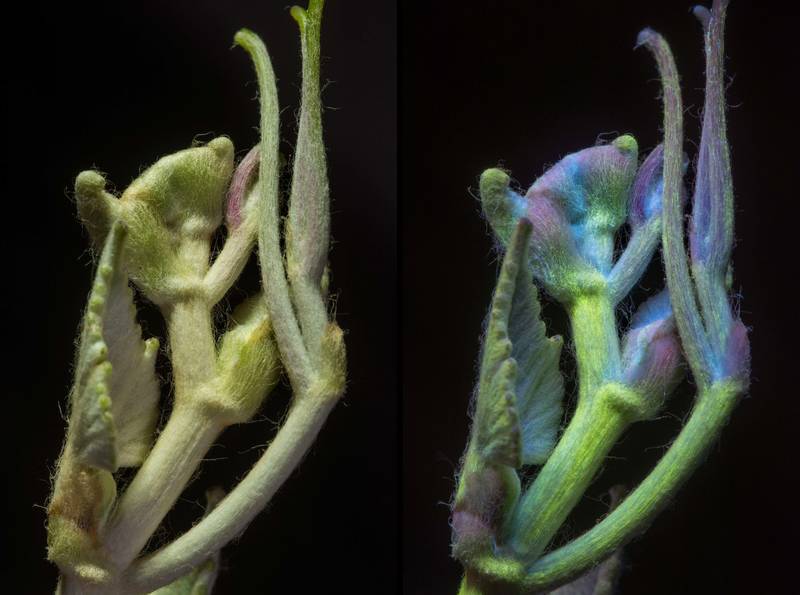

Shoot of mustang grape (Vitis mustangensis) when exposed to regular daylight as well as when illuminated by a 365 nm ultraviolet (UV-A) blacklight from Lick Creek ParkLick Creek: Background Notes. College Station, Texas


Album 3618: College Station, Texas, September 11 - XX, 2024
The image presents a comparison of the same shoot of mustang grape (Vitis mustangensis) under two distinct lighting conditions: regular daylight and UV-A blacklight illumination. The left side of the image displays the plant's appearance in natural light, while the right side showcases its response to the 365 nm ultraviolet (UV-A) blacklight from Lick Creek Park.
**Left Side: Daylight**
* **Plant Appearance:** The shoot appears pale green with a subtle sheen.
* **Petals and Stems:** The petals are not visible due to their white or light-colored hue, blending with the surrounding foliage.
* **Stem Coloration:** The stems exhibit a soft green color.
**Right Side: UV-A Blacklight Illumination**
* **Plant Appearance:** Under UV-A blacklight illumination, the plant's appearance changes dramatically.
* **Petals and Stems:** The petals become visible as they absorb the UV light, turning bright blue or purple. This phenomenon is known as "fluorescence," where certain materials emit light when exposed to ultraviolet radiation.
* **Stem Coloration:** The stems also exhibit a noticeable change in color, transitioning from green to yellow.
In summary, the image effectively illustrates the distinct responses of mustang grape shoots to different lighting conditions. While they appear relatively inconspicuous under regular daylight, their true colors and structures are revealed when exposed to UV-A blacklight illumination, showcasing a striking contrast between the two environments. – AI vision
🇪🇸 Descripción en español / Spanish Description
El brote de uva mustang (Vitis mustangensis) cuando está expuesto a la luz diurna normal y cuando se ilumina con una luz negra ultravioleta (UV-A) de 365 nm del Lick Creek Park. College Station, Texas, 11 de septiembre de 2024. La imagen presenta una comparación del mismo brote de uva mustang (Vitis mustangensis) en dos condiciones distintas de iluminación: luz diurna normal e iluminación con luz negra ultravioleta (UV-A). El lado izquierdo de la imagen muestra el aspecto de la planta a la luz natural, mientras que el lado derecho muestra su respuesta a la luz negra ultravioleta (UV-A) de 365 nm del Lick Creek Park. **Lado izquierdo: Luz diurna** * **Aspecto de la planta:** El brote parece verde pálido con un brillo sutil. * **Pétalos y tallos:** Los pétalos no son visibles debido a su color blanco o claro, que se mezcla con el follaje circundante. * **Coloración del tallo:** El tallo muestra un color verde suave. **Lado derecho: Iluminación con luz negra ultravioleta (UV-A)** * **Aspecto de la planta:** Bajo iluminación con luz negra ultravioleta (UV-A), el aspecto de la planta cambia drásticamente. * **Pétalos y tallos:** Los pétalos se vuelven visibles a medida que absorben la luz UV, volviéndose azul o morado brillante. Este fenómeno se conoce como "fluorescencia", donde ciertos materiales emiten luz cuando se exponen a radiación ultravioleta. * **Coloración del tallo:** El tallo también exhibe un cambio notable en el color, pasando de verde a amarillo. En resumen, la imagen ilustra eficazmente las distintas respuestas de los brotes de uva mustang a diferentes condiciones de iluminación. Aunque aparecen relativamente inconspicuos bajo luz diurna normal, sus verdaderos colores y estructuras se revelan al exponerlos a la iluminación ultravioleta negra (UV-A), lo que muestra un contraste sorprendente entre los dos entornos. – Spanish translation