 |
| |||||||||||||||

| ||||||||||||||||


| Similar | 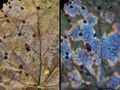  |
  |
  |
  |
  |
| |||||||||||||||||||||||||||
| |||||||||||||||||||||||||||
| 1996 1997 1998 1999 2000 2001 2002 2003 2004 2005 2006 2007 2008 2009 2010 2011 2012 2013 2014 2015 2016 2017 2018 2019 2020 2021 2022 2023 2024 2025 2026 | |||||||||||||||||||||||||||
| New version Slide Show Most Popular Full List Statistics Technical Details Home Page | |||||||||||||||||||||||||||
The image presents a comparative analysis of a young leaf from a mustang grape plant under two distinct lighting conditions: natural light and 365 nm ultraviolet (UV-A) blacklight. **Leaf Description** **Natural Light Image** **UV-A Blacklight Image** **Comparison** **Conclusion** |
La hoja joven de la uva mustang (Vitis mustangensis) tanto a la luz natural como bajo la luz negra ultravioleta de 365 nm desde Lick Creek Park. College Station, Texas, 11 de septiembre de 2024. La imagen presenta un análisis comparativo de una hoja joven de una planta de uva mustang bajo dos condiciones de iluminación distintas: luz natural e iluminación negra ultravioleta (UV-A) de 365 nm. **Descripción de la hoja** * La hoja está posicionada en ángulo, con su punta apuntando hacia la esquina superior derecha. * Tiene un color verde claro con bordes ondulados y venas prominentes. * La superficie superior de la hoja parece ligeramente peluda o fofa. **Imagen de luz natural** La imagen de luz natural captura la morfología de la hoja en condiciones de iluminación ambiental. La hoja es iluminada desde arriba, revelando su textura y estructura. **Imagen de luz negra ultravioleta (UV-A)** Por el contrario, la imagen de luz negra ultravioleta expone la hoja a una longitud de onda específica de radiación ultravioleta (365 nm). Esto hace que ciertos compuestos dentro de la hoja fluoreszcan o emitan luz, creando un efecto resplandor. La fluorescencia es más pronunciada a lo largo de la nervadura central y las venas secundarias, produciendo un tono azul-verdoso brillante. **Comparación** Un examen más detallado revela que la imagen de luz negra ultravioleta pone en evidencia áreas donde los pigmentos naturales de la hoja están presentes en mayores concentraciones, como la nervadura central y las venas secundarias. Estas regiones parecen más vibrantes bajo la luz UV-A debido a la fluorescencia de clorofilas y otros pigmentos. **Conclusión** La comparación entre las dos imágenes demuestra la efectividad del uso de la luz negra ultravioleta para visualizar rasgos específicos de hojas de plantas que pueden no ser visibles a la luz natural. Esta técnica puede ayudar en investigación botánica, identificación de plantas y el estudio de la morfología de las hojas. – Spanish translation |
Keyword variants
Lick Creek Park picture gallery
high resolution online digital collection
Berlin on the Brazos
Rock Prairie Rd
Lone Star State
Greens Prairie Road
United States
photo album
nature trails
Nature Park
documentary photographs
daily pics
conservative town
Brazos County
wildlife
TX
travelogue
snapshots
sightseeing
photowalks
photoblog
graphic
fotografias
foto
Bryan
America
Aggieland